

“Use AI for Private Equity Deal Sourcing to build hyper-targeted M&A lists and automate outreach, delivering a steady flow of pre-qualified, off-market acquisition targets directly to your deal team.”
The Deal Sourcing Engine Is Broken. It’s Time for an Upgrade.
In the world of private equity, you thrive or falter based on your deal flow. It’s the lifeblood of the firm. For decades, the model for PE deal origination has been straightforward, if not brutally inefficient. You hire bright, hungry junior analysts. You arm them with a subscription to PitchBook and a phone. And you tell them to start dialing.
This “dialing for dollars” approach, supplemented by the same over-fished “proprietary” networks and investment banking auctions, has a problem. It’s slow. It’s expensive. And it’s incredibly competitive.
Every other PE firm is looking at the same deals from the same IBs. They’re calling the same lists of companies from the same databases. The result? Sky-high valuations for “in-play” companies and a massive, untapped ocean of off-market deals that no one has the time or workforce to find.
Think about the math. A junior analyst might make 100 calls a day. They might get 10 conversations. From those 10, they might find one owner remotely interested in a “hypothetical” conversation. That’s a 1% hit rate. To see 20 qualified leads, they need to make 2,000 calls. This is a monumental waste of human capital. Your sharpest minds are spending 99% of their time hearing “no,” “not interested,” or “call me next year.”
Meanwhile, partners and VPs—the people who close deals—are stuck in the prospecting mud, managing this inefficient process instead of building relationships with interested sellers.
But what if you could change the math?
What if you could build a target list of not 1,000 companies, but 100,000? And what if you could call all 100,000 of them—not with an army of analysts, but with a single, intelligent system? What if you could automate outreach to business owners at a scale previously unimaginable, and have that system bubble up only the 200, 300, or 500 owners who said, “Yes, I’m open to talking”?
This isn’t science fiction. This is the new reality of AI for private equity deal sourcing. Firms that adopt this PE firm technology will not only survive but also dominate the next decade of mergers and acquisitions (M&A). This guide explores the new playbook for using AI to build hyper-targeted lists and, crucially, to automate the initial conversations that qualify potential acquisitions.
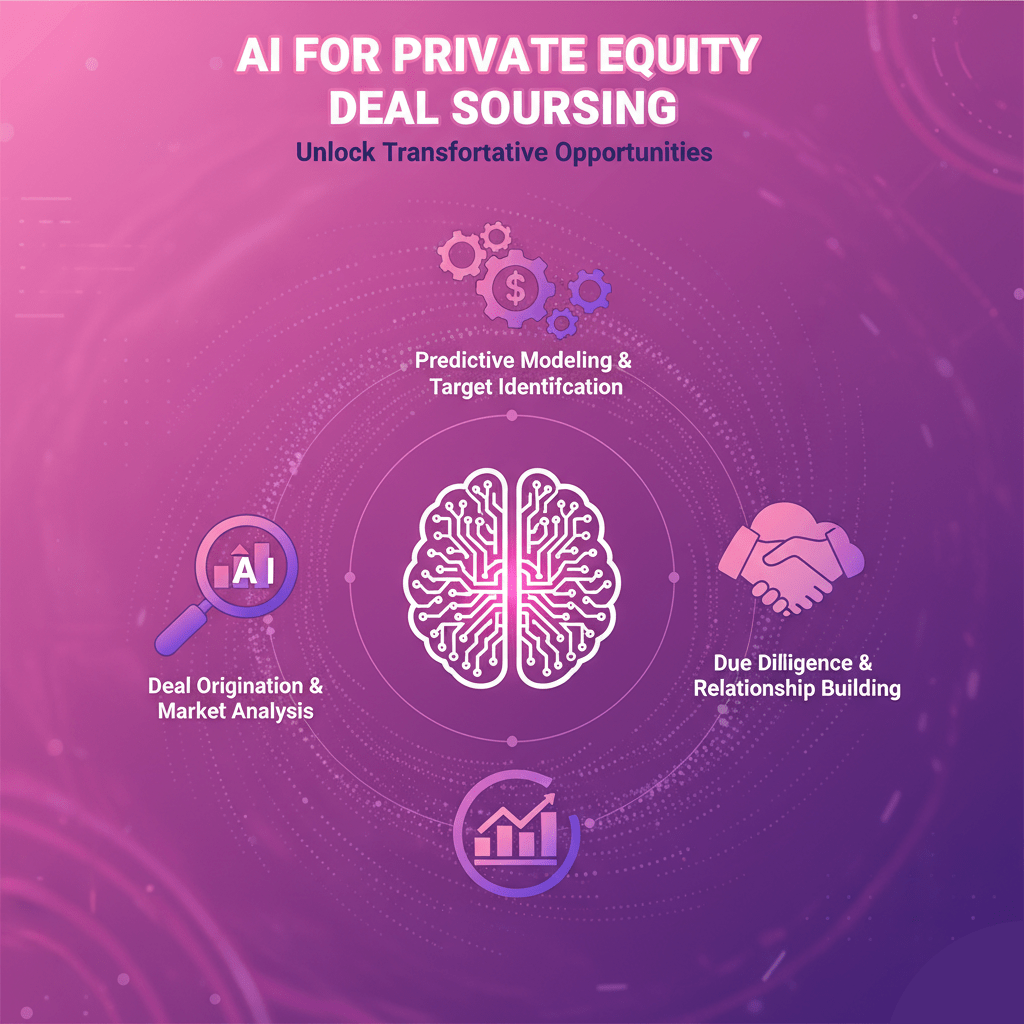
Chapter 1: The Old Playbook vs. The AI-Powered Pipeline
To appreciate the shift, we must first acknowledge the limitations of the traditional deal-sourcing model. It’s built on relationships and brute force. Both are valuable, but neither scales.
The Traditional PE Deal Origination Model
The old way relies on three main pillars:
- Banker-Led Auctions: This is the most common source of information. Investment banks run a structured process. The problem? You’re invited to the party with 50 other firms. There is no information advantage. You are competing purely on price and terms. This is a recipe for overpaying and eroding returns.
- Broker Networks: These are the smaller, regional business brokers. They offer better access to smaller deals, but the network is still limited. Good brokers are inundated, and you’re still competing with the handful of other PE firms they have on speed dial.
- Proprietary / Manual Sourcing: This is the “brute force” method. Junior associates and VPs scour databases like Capital IQ, PitchBook, and Grata. They build lists based on basic firmographics: industry (SIC/NAICS codes), revenue, EBITDA, and location. Then, the cold calling and emailing begin.
This manual process is the only way to find genuine off-market deals, but it’s fundamentally flawed by simple economics.
- It’s Slow: An analyst can only research and call so many companies in a day.
- It’s Expensive: The fully loaded cost of a deal origination team (including salaries, bonuses, data subscriptions, and overhead) is substantial.
- It’s Inconsistent: Humans have bad days. They get tired. They get “call reluctance” after hearing “no” 50 times before lunch. Their delivery of the script varies.
- It’s Inefficient: The vast majority of time is spent on non-core tasks, such as finding the correct phone number, navigating gatekeepers, leaving voicemails, and meticulous CRM data entry.
This entire model is a bottleneck. The valuable, high-level skill of a PE professional—building rapport, understanding a business model, structuring a deal—is locked behind a massive, time-consuming wall of low-level prospecting.
The New Model: The AI-Powered Origination Engine
The new model doesn’t seek to replace human relationships. It aims to unleash them. It utilizes PE firm technology to excel at tasks that humans struggle with (high-volume, repetitive tasks), allowing humans to focus on what they are good at (complex negotiation and strategic relationships).
The AI model is a two-part engine:
- AI for M&A Target Screening: Using AI to build a target list that is 100x larger and 100x more accurate than any human-built list.
- AI for Automated Outreach: Using conversational AI to execute the initial, high-volume outreach (the “first call”) to qualify potential acquisitions at scale.
When you combine these two, you streamline the deal pipeline. Instead of a trickle of leads, you get a managed, predictable flow. Your deal team’s calendar is no longer empty; it’s filled with pre-qualified, interested owners who are expecting their call. This is how you improve deal flow from a trickle to a torrent.
Chapter 2: Step 1 – Using AI for Hyper-Targeted M&A Target Screening
You cannot automate outreach effectively if your target list is garbage. “Garbage in, garbage out” is the cardinal sin of all automation. The first job of AI is to act as the ultimate research analyst, building a “perfect” target list.
Traditional M&A target screening is lazy. You filter by industry code (e.g., “NAICS 332710: Machine Shops”) and revenue (“$10M – $50M”). This gives you a list of 5,000 companies. The problem? This list tells you nothing about why they might be a good target.
AI screening goes dramatically deeper. It moves beyond static firmographics and into dynamic signals. It builds a “deal thesis” and then scrapes the entire public and private web to find companies that match it.
Beyond Revenue: What AI Looks For
Let’s say your thesis is: “We want to acquire family-owned industrial businesses in the Midwest where the owner is nearing retirement and the company is under-invested in technology.”
A human analyst can’t find this. An AI can. Here’s how:
- Proprietary Data Modeling: AI systems can scan millions of data points to create predictive models. It can look at the owner’s LinkedIn profile for their tenure (“CEO at Smith Manufacturing for 35 years”).
- Website & Text Analysis (NLP): The AI can use Natural Language Processing (NLP) to read the “About Us” page of every company. It looks for keywords like “family-owned,” “founded in 1975,” or “second-generation leadership.” It can also scan the “Careers” page. A lack of job postings for “IT Manager” or “Software Engineer” might signal a lack of tech investment.
- News and Sentiment Analysis: The AI can scan local news articles for relevant information. Is the company mentioned in a positive light (e.g., “Smith Manufacturing lands new contract”) or a negative one (e.g., “local plant faces new environmental reviews”)? Negative sentiment can signal an owner who is tired and ready to sell.
- Growth Signals: The AI can track hiring velocity. A company that suddenly starts hiring 20 new salespeople is in growth mode (maybe a good “platform” buy). A company that hasn’t posted a job in two years might be stagnating (a good “tuck-in” opportunity).
- “Founder Fatigue” Signals: AI can find companies with outdated websites, declining web traffic, or a lack of recent press releases. These are all subtle indicators of an owner who may have lost the energy to keep growing—the perfect candidate for a discussion.
Building the “Perfect List”
Using these techniques, the AI doesn’t just give you a list of 5,000 machine shops. It gives you a ranked list of the 500 machine shops that most closely match your perfect acquisition thesis.
It can score them based on:
- Fit Score (9/10): Matches 90% of your criteria (family-owned, 30+ years in business, Midwest, etc.).
- Sentiment Score (Positive): Recent local news mentions are good.
- Succession Risk (High): The CEO is 65 years old, and no other family members are listed on the leadership page.
Now, instead of a blunt-force cold call (“Are you for sale?”), Your outreach can be particular. But who will make these 500 calls? Even this is too many for a small deal team.
This is where the second part of the engine kicks in.
Chapter 3: Step 2 – The “AI Origination Analyst” (Starring SalesCloser.ai)
You have your perfect, AI-generated list of 500 high-probability targets. The next step is the bottleneck: the first contact.
Email automation is the first thing most firms try. They use tools like Mailchimp or Outreach to send mass emails. The result? A 1% reply rate, if they’re lucky. Why? Because business owners, especially successful ones, are inundated. Their inboxes are graveyards for “checking in” and “quick question” emails. They are experts at hitting “delete.”
A phone call is different. A phone call is direct, personal, and much harder to ignore.
But as we established, manual calling doesn’t scale. This is the problem that solutions like SalesCloser.ai were built to solve.
Meet Your New “AI Origination Analyst”
Think of SalesCloser.ai not as a “robocaller” but as an AI Origination Analyst. It is an autonomous AI agent that operates like a top-performing, excellently scripted, and tireless junior associate.
Its job is simple: to take your hyper-targeted list and execute the initial outreach to automate initial conversations. Its only goal is to determine one thing: “Is this owner open to a conversation?”
Here is the step-by-step process of how this PE firm’s technology works to qualify potential acquisitions.
1. The Call Campaign Is Loaded
You upload your list of 500 targets, complete with names, companies, and phone numbers. You then work with the system to design the “conversation script.” This isn’t a rigid, linear script. It’s a dynamic conversation map.
Example Script Goal:
- Identity: “I’m calling from [PE Firm Name].”
- Context: “We are a private equity firm that invests in companies in the [Industry] space, and your name came up in our research as a leader in the field.”
- The Question: “I know this is out of the blue, but our partners were wondering if you might be, even hypothetically, open to a discussion about what a strategic acquisition might look like for [Company Name]?”
2. The AI Starts Dialing (At Scale)
The AI Origination Analyst begins calling. This is where the magic happens. A human analyst can be on one call at a time. The AI can manage hundreds of calls concurrently. It can dial, wait for an answer, and instantly classify the result.
- Voicemail? It leaves a perfect, custom-recorded message.
- Wrong number? It logs it and removes it from the list.
- Busy signal? It schedules a call-back in 30 minutes.
- A human answers? The conversational AI activates instantly.
3. Navigating the Gatekeeper
This is the skill that separates a great analyst from a bad one. And it’s a skill the AI has perfected.
Receptionist: “ABC Manufacturing, how can I help you?” AI Analyst: “Hi there, I’m trying to reach Mr. John Smith, please.” Receptionist: “May I ask who is calling?” AI Analyst: “My name is [AI’s Name], calling from [PE Firm Name].” Receptionist: “And what is this regarding?” AI Analyst: “It’s a strategic business inquiry for Mr. Smith. Is he available?”
The AI is persistent, unfailingly polite, and never gets flustered. It can handle common objections (“He’s in a meeting,” “Is this a sales call?”) with pre-programmed, natural-sounding responses to navigate its way to the decision-maker.
4. The Conversation and Qualification
The AI finally reaches the owner, Mr. Smith. The “real” conversation begins.
AI Analyst: “Mr. Smith, thanks for taking my call. I’m [AI’s Name] from [PE Firm Name]. I know this is out of the blue. Still, our partners were wondering if you might be, even hypothetically, open to a discussion about what a strategic acquisition might look like for your company?”
Now, the AI’s advanced NLP capabilities kick in. It’s not just listening for “yes” or “no.” It’s listening for intent and sentiment.
- The “Hard No”:
- Owner: “Absolutely not. We are not for sale. Don’t call here again.”
- AI Response: “I understand completely, Mr. Smith. Thank you for your time. We’ll update our records. Have a great day.”
- Result: The AI logs this as “Not Interested – DNC” in the CRM. The human team never wastes a second on this lead.
- The “Soft No / Timing”:
- Owner: “You know, we’re just not thinking about that right now. We’re head-down on a big project. Maybe next year.”
- AI Response: “That makes perfect sense. Would it be alright if we checked back in with you in, say, six months?”
- Result: The AI logs this as “Nurture – Follow up in 6 Months.” The system automatically schedules the next contact.
- The “Curious / Yes”:
- Owner: “Huh. [PE Firm Name], you said? I’ve heard of you. What… what exactly did you have in mind?”
- AI Response: “That’s great to hear. My role is to handle the initial outreach and determine if there’s any interest at all. Our Managing Partner, [Partner’s Name], would be the best person to discuss the details. Are you free for a brief 15-minute introductory call with her sometime next week?”
- Result: This is the “win.” The AI has successfully identified an interested owner. It can even go as far as to check the partner’s calendar via an API and schedule the meeting immediately.
5. The “Golden” Handoff
This is the most critical part. The AI’s job is not to close the deal. Its job is to find the open door.
The moment that call ends, the AI-powered system does three things instantly:
- Updates the CRM: Logs the call, records the “Interested” disposition, and provides a complete, word-for-word transcript.
- Alerts the Deal Team: It sends an email or Slack message to the Partner: “NEW QUALIFIED LEAD: John Smith at ABC Manufacturing is open to a call. He is booked for Tuesday at 10 AM.”
- Provides Intel: The Partner can read the 2-minute call transcript and know precisely what was said. They are familiar with the owner’s tone, their initial questions, and their sentiment.
The Partner now enters the conversation warm. They don’t have to prospect. They don’t have to qualify. They just have to do what they do best: build rapport and close the deal.
This is how you streamline the deal pipeline. You are leveraging an AI Origination Analyst to make thousands of calls, filter out 99% of the “no’s,” and deliver a steady, predictable stream of interested, qualified owners.
Chapter 4: Weaving AI Into Your Firm’s DNA (Integration & Workflow)
This kind of PE firm technology is not a “set it and forget it” tool. To truly improve deal flow, it must be woven into your firm’s core processes.
From Data Silo to “Single Source of Truth”
The biggest mistake firms make is having their deal sourcing tech live on an “island.” Your AI Origination Analyst must talk to your CRM (whether it’s DealCloud, Affinity, Salesforce, or another platform).
This integration is non-negotiable.
- Automated Data Entry: When the SalesCloser.ai agent finishes a call, that activity must be logged in the CRM instantly and autonomously. No one should copy and paste transcripts. This saves your human team countless hours of “admin” work.
- Pipeline Visibility: A Partner should be able to look at a dashboard in their CRM and see, in real-time:
- “AI Analyst 1 is working the ‘Midwest Machine Shops’ list.”
- “Calls Made Today: 1,500”
- “Conversations Had: 210”
- “Qualified Leads Generated: 8”
- Preventing “Cross-Talk”: The integrated CRM ensures that your AI agent doesn’t call a company that one of your VPs had lunch with last week. The AI checks the CRM first: “Is there recent activity on this account? Yes? OK, skip.”
The New Role of the Human Analyst
A common fear is: “Will this AI replace my junior analysts?”
The answer is no. It repurposes them.
Instead of being a low-level “dialer,” the junior analyst becomes a “campaign manager” or a “deal quarterback.” Their new job is far more strategic and valuable:
- Thesis Development: They work with Partners to craft the “perfect target list” criteria (Chapter 2). They are the “brains” behind the AI’s search.
- Campaign Management: They “manage” the AI Origination Analyst. They monitor its call lists, review its conversation scripts, and tweak the messaging. They’re the “handler” for the AI “bloodhound.”
- Lead Triage: When the AI flags a lead as “Curious / Yes,” the analyst is the first human to review it. They read the transcript, do 15 minutes of deep-dive research, and prepare a “briefing doc” for the Partner before the call.
- Handling “Warm” Follow-ups: The analyst can take over the “Nurture” leads. “Hi, Mr. Smith, our automated system noted you might be open to a call next quarter. I’m [Analyst’s Name], a partner’s associate. I’m just calling to confirm personally…”
This shift is critical. You stop burning out your junior talent on 99% rejection. You transform them into high-value, strategic thinkers who are 100% focused on active, interested deals.
The Data Feedback Loop: Getting Smarter Over Time
This is the hidden advantage of AI for private equity deal sourcing. Every “no” is now a data point.
In the old model, an analyst gets a “no” and just moves on. The “why” is lost.
With an AI system, every “no” is categorized. The AI logs why the owner wasn’t interested. After 10,000 calls, your AI can provide stunning market intelligence:
- “Owners in the $10M-$2 revenue bracket are 3x more likely to say ‘call me next year’ than owners in the $20M-$50 bracket.”
- “Our ‘family legacy’ messaging is performing poorly, but our ‘growth partnership’ messaging has a 20% higher rate of ‘yes.'”
- “Targets in Ohio are 80% ‘hard no,’ but targets in Texas are 30% ‘curious.’ We should re-allocate our efforts to Texas.”
This feedback loop makes your entire firm smarter. Your M&A target screening (Chapter 2) gets more accurate. Your outreach scripts (Chapter 3) get more effective. Your sourcing becomes a fine-tuned, learning, and self-improving engine, not just a blunt instrument.
Chapter 5: The “Buts” – Addressing Common Objections
The idea of an AI calling a CEO is futuristic. And it naturally raises questions. Let’s address the most common ones head-on.
1. “But PE is a ‘relationship business.’ Won’t this feel robotic and impersonal?”
This is the most important objection. Yes, PE is a relationship business. That’s why this model works.
The AI’s job is not to build the relationship. The AI’s job is to identify individuals who are open to forming a relationship.
Think of it this way: Your Partners’ time is your most valuable asset. Do you want them spending that precious “relationship capital” on 100 people who will hang up on them? Or do you want them spending it on 100 people who have already been qualified and have agreed to a conversation?
The AI handles the rejection, allowing your human experts to focus on the relationship. And modern conversational AI, like the technology powering SalesCloser.ai, is astonishingly human-like. It has natural intonation, can handle interruptions, and doesn’t sound “like a robot.” Its job is to be polite, professional, and efficient.
2. “But isn’t this just high-tech spam? Won’t it hurt our brand?”
Spam is defined by its irrelevance. Sending an email about a “hot crypto stock” to a 65-year-old manufacturing CEO is spam.
This is the opposite. This is precision outreach.
Because of the AI-powered list building (Chapter 2), your call is hyper-relevant. The message is: “We are [PE Firm], we specialize in exactly your kind of business, and we are interested in a strategic conversation.”
For many owners, this isn’t an annoying “spam” call. It’s the most critical call they might receive all year. It’s a relevant and professional B2B inquiry. By being professional and respecting a “no,” the AI-powered approach actually protects your brand far more than a pushy, commission-driven junior analyst might.
3. “But what if the AI messes up? What if it says the wrong thing to a key target?”
This is a fear rooted in the “old” AI. Modern systems are not “dumb” chatbots. You meticulously design the conversational map.
The AI cannot go “off-script.” It doesn’t get emotional. It doesn’t get argumentative. It doesn’t make promises you can’t keep (“Oh yeah, we’ll pay 15x EBITDA, no problem!”).
The AI is, in fact, the most compliant and consistent “analyst” you have. It will deliver your carefully crafted message perfectly, thousands of times in a row, without deviation. It’s far less risky than a new analyst who might misstate your firm’s thesis or stumble over an objection.
Conclusion: The Future of Deal Flow Is Already Here
The private equity landscape is not getting any less competitive. Valuations for good, “in-play” companies will continue to climb. The only way to generate outsized returns is to find deals that no one else is looking at.
To do that, you need to find and talk to owners of off-market businesses. The only way to do that at scale is with technology.
Relying on manual “dialing for dollars” in an age of AI is like bringing a knife to a gunfight. It’s inefficient, it burns out your best people, and it leaves mountains of opportunity on the table.
The new model is clear:
- Utilize AI for M&A Target Screening to create extensive, hyper-targeted lists based on dynamic signals, rather than relying solely on static data.
- Utilize an AI Origination Analyst (such as SalesCloser.ai) to automate outreach to business owners, manage the thousands of “no’s,” and streamline initial conversations.
- Focus your human deal team 100% on what they do best: building relationships and closing deals with the steady stream of qualified, interested sellers that your AI engine provides.
This isn’t just about improving deal flow; it’s also about enhancing the overall experience. It’s about creating a permanent, scalable, and intelligent competitive advantage for your firm. The firms that make this shift first will be the ones to buy the best companies at the best prices over the next decade.
The only question is: will your firm be one of them?
Frequently Asked Questions (FAQs)
Q: What exactly is “AI for private equity deal sourcing”?
A: AI for private equity deal sourcing refers to using artificial intelligence and machine learning technologies to streamline and improve the M&A pipeline. This breaks down into two main parts:
- Screening/Targeting: Using AI to analyze vast amounts of data (websites, news, databases, job postings) to identify potential acquisitions that fit a particular investment thesis—often finding signals that human analysts would miss.
- Outreach/Qualification: Using conversational AI agents (like SalesCloser.ai) to automate the initial outreach (phone calls, emails) to thousands of targets to qualify their interest in an acquisition, so the human deal team only speaks to interested owners.
Q: How can AI help me find “off-market” deals?
A: AI is the best tool for finding off-market deals. Traditional “in-play” deals come from investment banks. Off-market deals are found through direct, proprietary outreach. AI allows you to conduct this outreach at a massive scale. An AI can scan 100,000 company websites, identify 5,000 that fit your “nearing retirement” thesis, and then call all 5,000 of them in a week. It’s a numbers game, and AI lets you play it at a level humans never could, surfacing the “needle in a haystack” owners who are ready to talk but haven’t hired a banker yet.
Q: Can an AI really automate conversations with business owners? Won’t it sound fake?
A: Yes. Modern conversational AI is light-years beyond the “robocalls” of the past. Platforms like SalesCloser.ai use agents with incredibly human-like voices, tones, and inflections. They can understand context, handle interruptions, and navigate complex conversations. The goal isn’t to “trick” the owner; it’s to be a polite, professional, and efficient first point of contact. The AI’s job is to execute a simple, pre-defined script to gauge interest, not to negotiate an LOI.
Q: Will this AI technology replace my junior analysts?
A: No, it will make them more powerful. It replaces the worst part of their job: manual cold calling and data entry. Instead of spending 99% of their time prospecting, your analysts are promoted to “campaign managers.” They design the investment thesis for the AI, manage outreach campaigns, and triage the warm, qualified leads generated by the AI. They stop being dialers and start being deal-makers.
Q: How does a tool like SalesCloser.ai work to qualify potential acquisitions?
A: SalesCloser.ai acts as an “AI Origination Analyst.” You give it a target list and a conversation script. It then dials the numbers, navigates phone trees and gatekeepers, and speaks directly to the owner or CEO. It delivers your scripted message (e.g., “We are a PE firm interested in your space… are you open to a discussion?”). Based on the owner’s response, the AI will either (1) politely end the call if it’s a “no,” (2) schedule a follow-up if the timing is wrong, or (3) book a meeting with your human deal team if it’s a “yes.” It then logs the entire transcript and outcome in your CRM.
Q: What’s the real difference between this and just sending an email blast?
A: The difference is engagement and data. Email blasts have abysmal reply rates (often <1%). They are passive and easily ignored. A phone call is direct and demands an immediate response. An AI-powered call prompts a “yes,” “no,” or “maybe,” providing a clear, actionable outcome for every company on your list. You get 100% data coverage on your target list, not just 1% reply-rate data.
Q: Is it difficult to set up this kind of AI with our current PE firm technology (like DealCloud or Affinity)?
A: No, modern PE firm technology is built for integration. Platforms like SalesCloser.ai are designed to connect directly with major CRMs (DealCloud, Affinity, Salesforce, etc.). This integration is key. It enables the AI to log calls, transcripts, and lead statuses automatically, resulting in a seamless workflow. Your human team never has to leave their CRM—the qualified leads and data simply appear there, ready for action.