
AI callback scheduling means the AI agent books a follow-up call when a lead says “call me back later.” On SalesCloser, an agent on a phone call confirms the time the lead asks for, books a new call to that lead and dials at that time, even outside campaign calling hours. It is built in, with no setting.
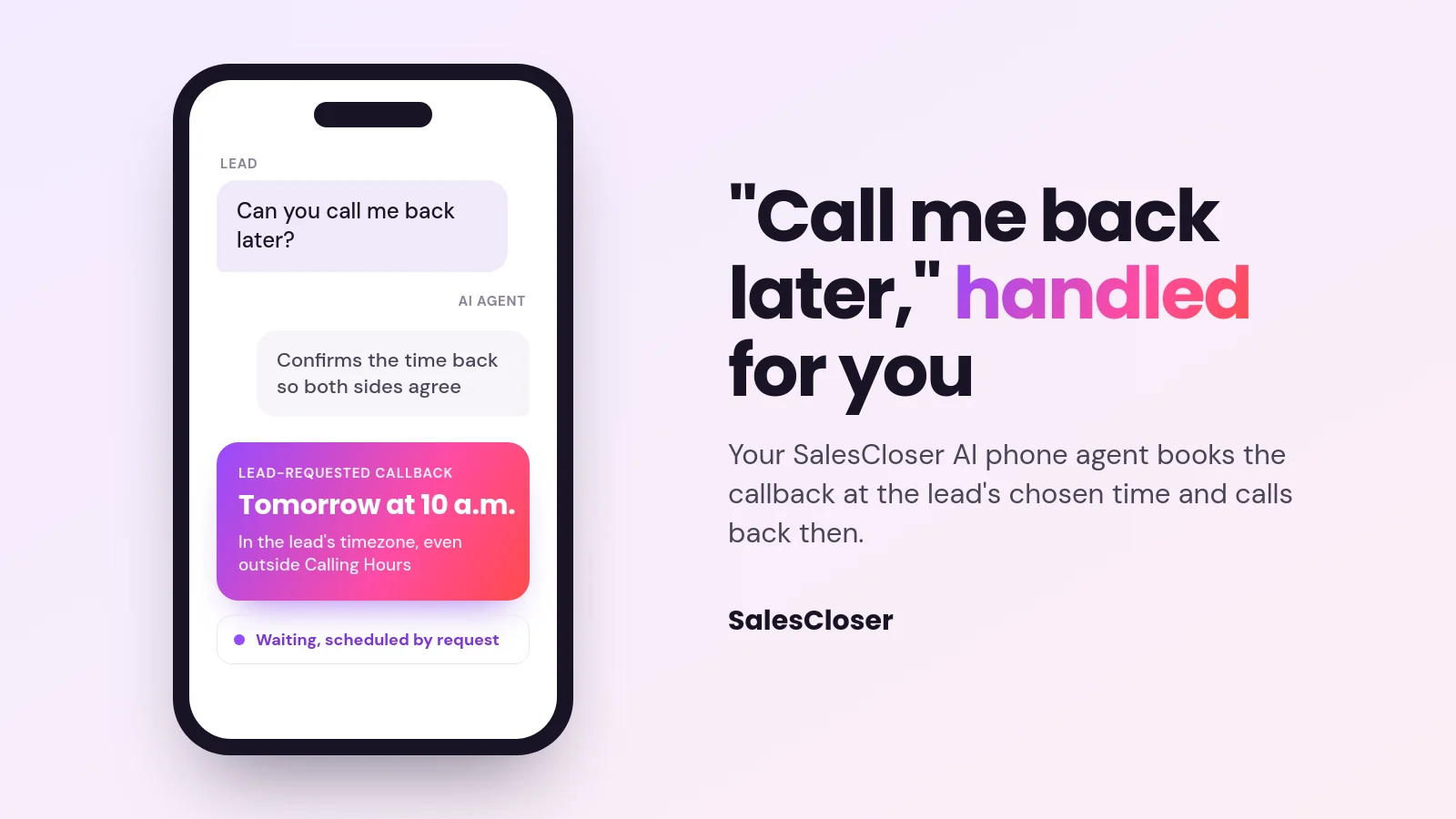
A lead picks up, hears who is calling and says they are driving. “Can you call me back later?” It is one of the most common answers on a sales call, and one of the easiest to lose. Someone has to note the time, remember it and dial at the right moment in the right timezone.
SalesCloser handles that request for you on phone calls. When a lead asks for a callback, the AI agent confirms the time, books it and calls the lead back then. This guide covers how it works, what the lead hears, calling hours and limits.
What is AI callback scheduling?
AI callback scheduling means the AI agent itself books a follow-up call when a lead asks for one, then places that call at the agreed time. There is no form to fill in and no task waiting for a rep. The request and the booking both happen inside the conversation.
On SalesCloser, this works on phone calls, both inbound and outbound. If a lead calls in and asks to talk later, or the agent calls out and the lead says now is a bad time, the agent handles the callback request the same way.
Why does “call me back later” cost you leads?
A lead who asks for a callback is still interested. They are telling you when, not whether. Manual follow-up depends on someone noting the time, reading it in the lead’s timezone and being available to dial when that time comes around.
Miss a step and the lead hears from you at the wrong time or not at all. Across many calls, that adds up to warm leads left waiting.
An automated callback removes the handoff. The same agent that heard the request books it and makes the call. For a wider look at where AI phone agents fit in outbound work, see our guide to AI agents for outbound sales.
How does the AI agent schedule a callback?
When a lead asks to be called back, the agent works through a short sequence during the call:

- Hears the request and the time. The lead says when they want the call, such as tomorrow at 10 a.m. or Thursday at 3 p.m.
- Checks the time makes sense. The agent accepts times from a few minutes out up to six months ahead.
- Confirms it with the lead. The agent repeats the time back so both sides agree before it is booked.
- Books the callback. A new scheduled outbound call to the same lead is created. If the original call was part of a campaign, the callback stays in that campaign.
- Calls back at the agreed time. When the time arrives, the agent dials the lead.
The time is read in the lead’s timezone when it is known. If it is not known, the agent’s timezone is used. That way “call me at 9” means 9 for the lead wherever possible, not 9 for your office.
Each callback is flagged as lead-requested. A callback booked on a campaign call shows on that campaign’s calls table as “Waiting, scheduled by request” until it dials. A callback booked on an inbound call has no campaign, so it is not listed ahead of time. It appears with the lead’s conversations after it runs.
What does the lead experience?
For the lead, it sounds like a normal conversation. They say they cannot talk now and name a time. The agent confirms that time back to them, and the call wraps up. Then their phone rings at the time they picked.
If the lead changes their mind while talking to the agent, for example “actually, I have a few minutes now” or “no need to call back”, the agent can cancel the callback. The lead is not chased for a call they no longer want.
The callback is a fresh conversation. The agent does not recall what was said on the first call. Only the lead’s fields carry over.
If the same callback gets booked twice, such as when a lead repeats the time, callbacks for the same lead within five minutes of each other are merged into one. The lead gets one call, not two.
For more on how the agent sounds on the phone, see our guide to natural AI voice agents.
Does a callback follow campaign calling hours?
No, and this is deliberate. A callback goes out at the time the lead chose, even if that time falls outside your campaign’s calling hours. The lead asked for that time, so the agent keeps the appointment.

Regular campaign calls work differently. In the campaign wizard, under Call Setup, you set Calling Hours, and calls that fall outside them wait for the next allowed time. Lead-requested callbacks are the one exception to that rule.
So if your Calling Hours end at 6 p.m. and a lead asks for a call at 7:30 p.m., the callback dials at 7:30 p.m. Calling rules and consent stay your responsibility, so check what applies to the leads you call.
| Regular campaign call | Lead-requested callback | |
|---|---|---|
| Who picks the time | Your campaign settings | The lead, during the call |
| Calling Hours | Followed: calls outside them wait for the next allowed time | Ignored on purpose: dials at the lead’s chosen time |
| Timezone | Agent’s timezone, or each lead’s local time if you turn on Use each lead’s local time | Lead’s timezone if known, otherwise the agent’s |
| Channel | Phone | Phone only, booked on inbound or outbound calls |
| Setting needed | Campaign setup | None, built in for every phone agent |
| How it shows | As a campaign call | From a campaign: “Waiting, scheduled by request” on the campaign’s calls table until it dials. From an inbound call: with the lead’s conversations after it runs |
| If nobody answers | The campaign’s retry settings | From a campaign: the campaign’s retry settings. From an inbound call: not retried |
How do you set up automated callbacks?
There is nothing to switch on. Callback scheduling is built in for every SalesCloser agent that takes phone calls. What you can do is check the settings around it and test it once yourself:

- Use an agent that takes phone calls, inbound or outbound. Agents on web chat do not book callbacks.
- Check that the agent’s timezone is correct. It is the fallback when a lead’s timezone is not known.
- For outbound campaigns, open the campaign wizard, go to Call Setup and set Calling Hours, using Add Time Window + for each window. Remember that callbacks do not wait for these hours.
- Review the campaign’s retry settings. An unanswered campaign callback follows them.
- Call your agent from your own phone, say you are busy and ask it to call you back in a few minutes. Let it confirm the time.
- Answer the callback. An inbound-call callback is not listed beforehand, so check that it appears with your test lead’s conversations after it runs.
- To test a campaign callback, ask for a callback on a campaign call to your own number. Open the campaign’s calls table and look for “Waiting, scheduled by request” until it dials.
What are the limits of callback requests?
Callbacks are simple on purpose. Plan around these boundaries:
- Phone only. Callbacks are booked on phone calls, inbound or outbound. They are not booked from web chat, the website widget or text messages.
- Lead-requested. A callback is booked when the lead asks for one during a call. Returning a missed call that nobody answered is a different job, and it is not what this feature covers.
- A few minutes to six months out. Times outside that window are not accepted.
- Unanswered callbacks. A callback booked on a campaign call follows that campaign’s retry settings. A callback booked on an inbound call has no campaign, so if the lead does not answer, it is not retried.
What are the best practices for callback scheduling?
A few habits make callbacks work better for your team and your leads:
- Get the agent’s timezone right. It decides what “call me at 9” means whenever the lead’s timezone is unknown.
- Review lead-requested callbacks. Look at what leads ask for and when, on the campaign’s calls table and in each lead’s conversations.
- Keep lead fields complete. Lead fields are all that carries over to the callback, so save the details that matter on the lead.
- Read the pattern. If many leads ask for evening callbacks, your Calling Hours may not match when your leads can talk.
- Give leads another route. Some leads would rather speak to a person now than wait. See our guide to AI to human handoff for that path.
How does SalesCloser fit?
SalesCloser AI sales agents talk to leads by phone, answer questions and move the conversation toward a next step. Callback scheduling is one practical piece: when a lead says “not now”, the agent books their time and calls back then.
You control how the agent introduces itself, including whether it says it is an AI up front, and you can tell it to always answer truthfully when asked. Conversations are recorded and transcribed so your team can review them. To see how agents work alongside reps, read our guide to building an AI sales team.
See it on a demo. Book a SalesCloser demo, ask the agent to call you back later and hear the callback for yourself.
Frequently asked questions
How does AI callback scheduling work?
When a lead on a phone call asks to be called back at a certain time, the SalesCloser agent checks the time is between a few minutes and six months away, confirms it with the lead and books it. That creates a new scheduled outbound call to the same lead, and the agent dials at the agreed time.
Will the AI call back outside campaign calling hours?
Yes. A lead-requested callback goes out at the time the lead chose, even if it falls outside your campaign’s Calling Hours. This is deliberate, because the lead picked the time. Regular campaign calls still wait for the next allowed time. Calling rules and consent stay your responsibility.
Do I need to turn on callbacks?
No. Callback scheduling is built in for every SalesCloser agent that takes phone calls, inbound or outbound. There is no setting or toggle. To see it work, call your agent, ask it to call you back in a few minutes and check that the callback appears with your conversations after it runs.
Can a lead request a callback from web chat?
No. Callbacks are phone only. They are booked during inbound or outbound phone calls, not from web chat, the website widget or text messages.
What if the lead changes their mind or asks twice?
If the lead changes their mind while talking to the agent, the agent can cancel the callback. If the same lead ends up with two callbacks within five minutes of each other, they are merged into one, so the lead gets a single call.