
AI sales tools automate or support steps of selling that used to be manual. They fall into six categories: prospecting and data, outreach and sequencing, conversation intelligence, AI sales agents that hold live conversations, forecasting and CRM AI, and scheduling. Choose the category that fixes the step where leads stall or reps lose the most time.
Search for AI sales tools and you get long ranked lists that mix data vendors, email tools, call recorders and forecasting software as if they all did the same job. They don’t.
A tool that finds contact data will not help a rep who has too many calls to review, and a forecasting add-on will not answer a lead who fills in your form at night.
This guide sorts AI sales tools by the job they do. For each category you get what the tools actually do, when they are worth it, and a few well-known example vendors. Then you get a simple way to pick a category based on the bottleneck in your own funnel.
There are no rankings here, because the right tool depends on where your team is losing time and buyers.
What counts as an AI sales tool
An AI sales tool is software that uses machine learning or large language models to do part of a selling task that used to be manual. That can mean finding and enriching prospects, drafting messages, recording and summarizing calls, scoring deals, booking meetings, or holding a live conversation with a buyer.
Most sales stacks already contain some AI, often switched on inside a CRM or an email tool. The useful question is not whether to use AI, but which step of your process it should take over or support. That is why a category view is more helpful than a top ten list.
The six categories of AI sales tools
For a stage-by-stage view of where AI helps in the sales process before you pick a tool, see our guide to AI for sales.

1. Prospecting and data
These tools build and clean your lead lists. They pull company and contact data, flag buying signals such as job changes or hiring, and enrich records in your CRM so reps start from accurate information.
Worth it when: reps spend hours researching accounts, bounce rates are high, or your CRM is full of stale or incomplete records.
Examples: ZoomInfo, Apollo, Cognism and Clay all describe themselves on their own sites as sources of B2B data, prospecting or data workflows.
2. Outreach and sequencing
Sales engagement tools run your outbound cadences across email, phone tasks and social touches. Their AI features typically draft or rewrite messages, suggest the next step for a rep, and help decide which prospects to work first.
Worth it when: you have a defined outbound motion and the limit is how many personalized touches each rep can send and track.
Examples: Outreach, Salesloft and Apollo offer sequencing and engagement features, and Lavender positions itself as an AI email coach for sellers.
3. Conversation intelligence and call analysis
These tools join or record your sales calls, transcribe them, write summaries and surface patterns: which questions come up, which objections stall deals, how much the rep talks versus listens. Managers use them for coaching and for spotting risky deals without sitting in on every call.
Worth it when: your team runs a lot of calls and managers cannot review them, or you want evidence of what your best reps do differently.
Examples: Gong, Avoma, Fathom and Fireflies record, transcribe and summarize meetings, with varying depth of coaching and deal features.
4. AI sales agents that hold live conversations
This is the newest category. Instead of helping a rep, the AI agent talks with the buyer itself, by chat, phone or video. It answers questions, asks qualifying questions, can walk through a demo, and books the right prospects onto a rep’s calendar. Some agents also call leads outbound.
Worth it when: inbound leads wait too long for a first reply, reps spend their week on discovery calls with poor-fit prospects, or nobody covers evenings, weekends and other time zones.
Examples: SalesCloser, Conversica, Qualified (with its Piper agent) and 1mind each describe AI agents that converse with leads, with different channels and focus areas.
5. Forecasting and CRM AI
Forecasting tools read pipeline and activity data to flag deals at risk, predict which opportunities are likely to land this period, and give leaders a clearer forecast. CRM vendors also build AI into their platforms for summaries, drafting and recommendations.
Worth it when: your forecast calls rely on gut feel, deals slip without warning, or reps skip CRM updates.
Examples: Salesforce and HubSpot build AI into their CRMs, while Gong Forecast and Clari Forecast (now offered within Salesloft) focus on forecasting and pipeline risk.
6. Scheduling and routing
These tools get a qualified buyer onto the right person’s calendar with the least friction. AI features include routing by territory or account owner, qualifying on the form, and handling reschedules.
Worth it when: booked meetings fall through between the form and the calendar, or leads land with the wrong rep.
Examples: Calendly and Chili Piper focus on scheduling and routing, and Avoma includes scheduling alongside its meeting tools.
AI sales tools compared by category
Use this table to match a category to the problem you are trying to solve. Vendors are examples, not a ranking, and many of them cover more than one category.

| Category | What it does | Best fit for this bottleneck | Example tools |
|---|---|---|---|
| Prospecting and data | Finds, enriches and updates contact and company data | Not enough accurate leads to work | ZoomInfo, Apollo, Cognism, Clay |
| Outreach and sequencing | Runs multi-touch cadences and drafts messages | Reps cannot send enough relevant outreach | Outreach, Salesloft, Apollo, Lavender |
| Conversation intelligence | Records, transcribes and analyzes sales calls | Managers cannot coach or review calls at scale | Gong, Avoma, Fathom, Fireflies |
| AI sales agents (live conversations) | Talks with buyers by chat, phone or video, qualifies and books meetings | Slow lead response and reps stuck on early calls | SalesCloser, Conversica, Qualified, 1mind |
| Forecasting and CRM AI | Scores deals, flags risk and predicts the quarter | Unreliable forecast and surprise slipped deals | Salesforce, HubSpot, Gong Forecast, Clari Forecast |
| Scheduling and routing | Routes leads and books them on the right calendar | Meetings lost between form and calendar | Calendly, Chili Piper, Avoma |
If you want a deeper look at platforms in several of these categories, see our roundup of sales AI software platforms.
How to choose the right AI sales tool for your bottleneck
The fastest way to waste budget is to buy the tool with the best demo instead of the one that fixes your slowest step. Work through these steps before you book any vendor calls.

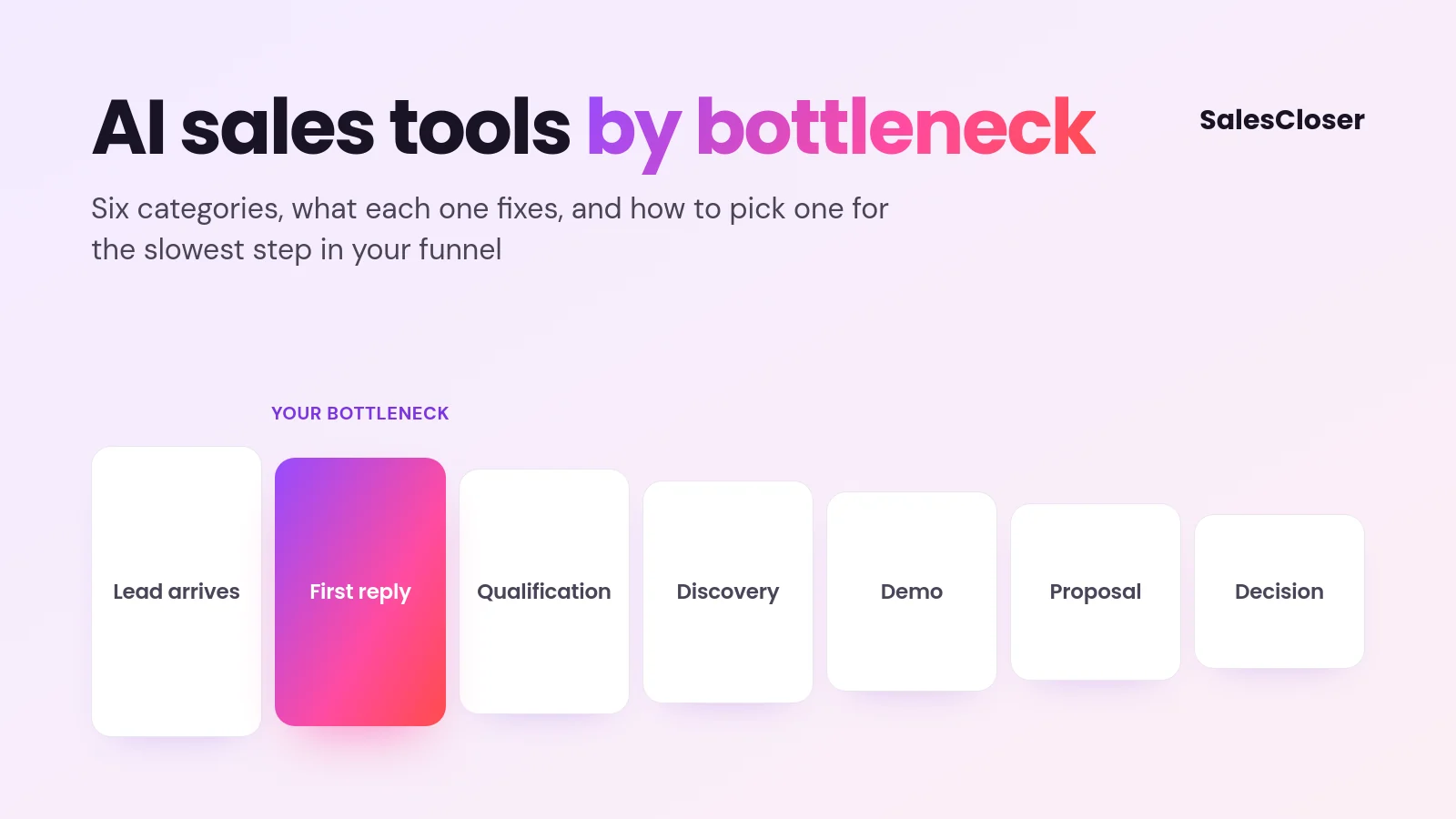
- Map your funnel in plain terms. Write down each step from first touch to signed contract: lead arrives, first reply, qualification, discovery, demo, proposal, decision.
- Find where leads stall or reps lose hours. Ask reps where their week goes and look at where deals sit the longest. That step is your bottleneck.
- Pick one category, not five. Match the bottleneck to a category using the table above. If leads wait hours for a reply, a data tool will not help. If reps have plenty of leads but weak calls, look at conversation intelligence.
- Check fit with your stack. Confirm the tool connects to your CRM and calendar, and ask exactly which data it writes back and where.
- Run a narrow pilot. Test on one segment, one lead source or one team, with a clear before and after measure that you choose in advance.
- Review real output. Read the emails it wrote, listen to the calls it handled, and check the records it changed. The output tells you more than any feature list.
A quick rule of thumb: early stage teams with few leads usually start with prospecting and outreach. Teams with healthy inbound but slow follow up get more from AI agents and scheduling. Larger teams with many reps and calls tend to need conversation intelligence and forecasting first.
Which AI tools help sales teams win deals faster
Speed in sales usually breaks down in three places. The first is the gap between a lead raising a hand and someone replying. The second is the time reps spend on early calls with prospects who were never a fit. The third is deals that go quiet late in the cycle because nobody noticed the warning signs.

- Slow first reply: AI sales agents and smart scheduling tools respond and book while interest is high. Our guide to speed to lead explains why that window matters.
- Too many poor-fit calls: AI agents that run qualification and discovery send reps only the prospects who meet your criteria. See how teams handle unqualified demo calls.
- Late-stage surprises: conversation intelligence and forecasting tools flag deals where the buyer has gone quiet, a competitor came up, or key people are missing.
Which software finds the questions and signals that matter on calls
If you want to know which discovery questions move deals forward, conversation intelligence is the category to look at. These tools transcribe every recorded call and let you search across them, so you can compare calls that turned into opportunities with calls that went nowhere.
Start with a short list of questions you suspect matter, such as budget, timeline and who else is involved, and check how often your strongest reps ask them compared with the rest of the team. Turn what you find into your qualification framework, then make sure your reps and any AI agent you use ask those same questions.
Can AI predict which deals will close?
Forecasting and CRM AI tools estimate which deals are likely to land by looking at activity, stage history, engagement and past outcomes. They are good at flagging risk: a deal with no recent contact, a single contact on a large opportunity, or a close date that keeps moving.
Treat those predictions as a prompt for a conversation with the rep, not as a verdict. Their quality depends on clean CRM data, which is why many teams pair forecasting with tools that capture call notes and activity automatically.
Where AI sales tools fall short
- Bad data in, bad output out. Scoring, forecasting and personalization all depend on accurate CRM and contact data.
- Too many overlapping tools. Several vendors now cover multiple categories. Check what you already own before adding another login.
- Generic messaging. AI-written outreach still needs a clear point of view and human review, or it reads like everyone else’s.
- Unclear handoffs. Decide in advance when AI hands a buyer to a person and what context the person receives.
- Your own obligations. Recording calls, contacting leads and storing data all come with legal and consent requirements that vary by region and industry. Check what applies to you before rollout.
How SalesCloser fits
SalesCloser sits in the AI sales agents category. Its agents hold real conversations by voice, video or chat: on the phone, on Zoom or in the browser.
They answer inbound leads, ask qualifying questions, run discovery, give product demos by live screen share or by presenting the product video, and book qualified prospects onto your team’s calendar through Calendly or Cal.com.
You can set up demo, discovery, onboarding and support agents without code by giving the agent your website, documents, FAQs and rules. Agents can also call leads outbound, within calling hours and limits you set. They work around the clock and in many languages.
SalesCloser connects to HubSpot, Pipedrive, Zoho, GoHighLevel, Zendesk and Intercom, saving the lead, a call summary and the qualification answers. Creating or moving deals is done through Zapier. Conversations are recorded and transcribed so your team can review them.
You control how the agent introduces itself, including whether it says it’s an AI up front, and you can tell it to always answer truthfully when asked. See the full list of integrations or read more about lead qualification.
Conclusion
The best AI sales tool is the one that fixes your slowest step. Map your funnel, find where leads wait or reps lose time, and choose the category that targets that problem. Pilot narrowly, read the real output, and only then expand.
If your bottleneck is answering and qualifying leads quickly, an AI sales agent is the category to test first. You can book a demo to see how a SalesCloser agent handles a live conversation.