
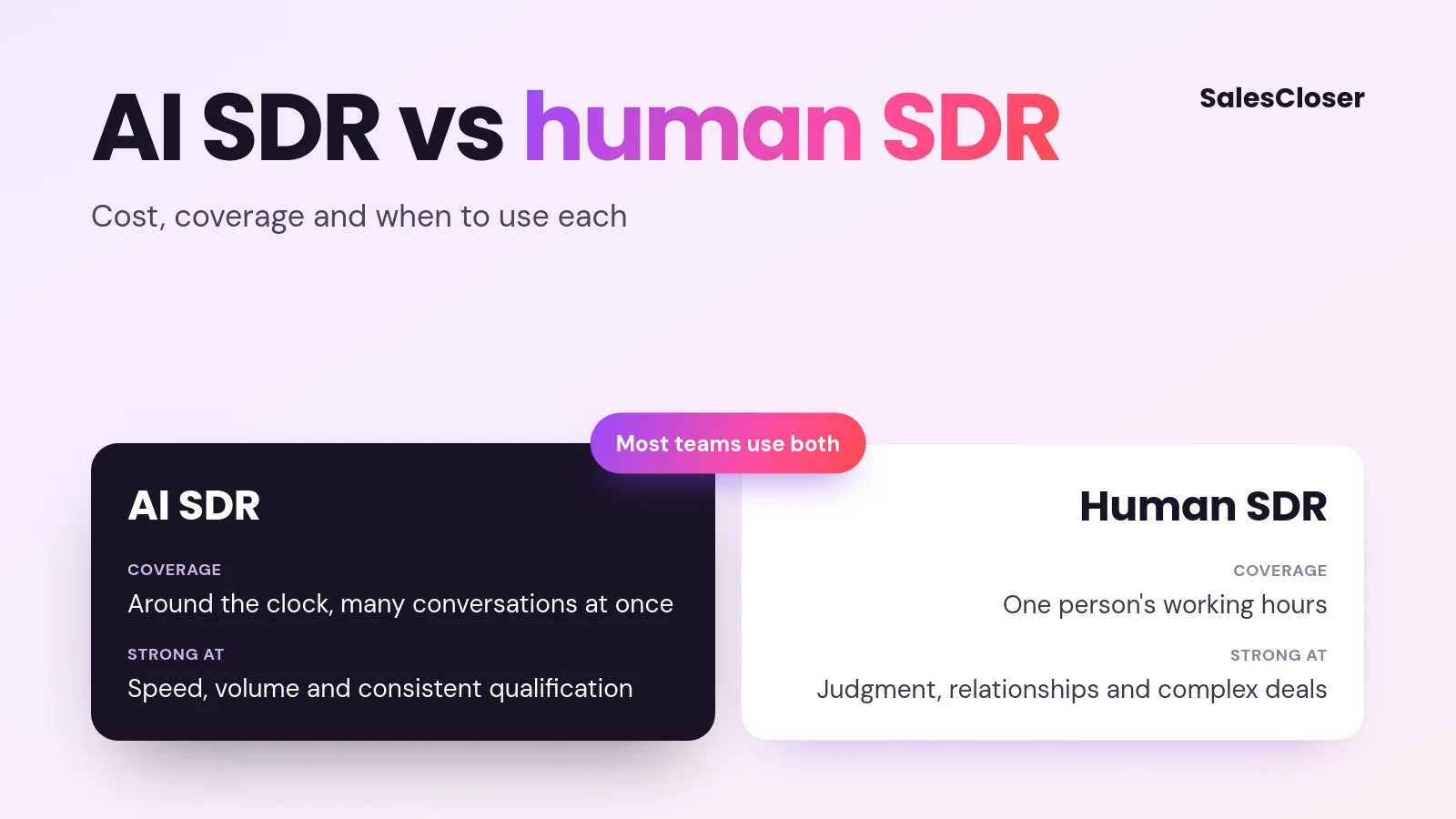
A human SDR costs salary, variable pay, benefits, recruiting, ramp and management time, and covers one person’s working hours. An AI SDR costs a platform fee plus setup and review, and can answer every inbound lead instantly at any hour. AI wins on speed and volume; humans win on judgment and complex deals. Most teams use both.
Most sales leaders asking about AI SDRs are not trying to get rid of their team. They want to know two things: what an AI SDR really costs compared with a person, and which parts of the SDR job it can handle well.
This guide gives you a fair comparison. It lays out the full cost structure of each option as a set of transparent assumptions you can fill in with your own numbers, shows where each one wins on coverage and conversion, and explains the hybrid model most teams end up with.
What an AI SDR does compared with a human SDR
A sales development rep (SDR) sits at the top of the funnel. The job is to respond to new leads, find out whether they fit, and book qualified meetings for account executives. Many SDRs also do outbound prospecting.
An AI SDR is software that does part of that job through live conversation. Depending on the product, it can answer an inbound lead by chat, phone or video, ask your qualifying questions, answer product questions from your knowledge base and put a meeting on a rep’s calendar.
Some AI SDR tools focus on writing and sending outbound email instead, so check which kind you are evaluating.
The key difference is not intelligence. It is the shape of the work each one is suited to:
- AI SDRs are strong at repeatable conversations at volume: the same qualifying questions, the same product answers and the same booking step, at any hour, with no queue.
- Human SDRs are strong at judgment: reading a hesitant buyer, working an account with several stakeholders, and deciding when to bend the script.
AI SDR vs human SDR cost: the full cost structure
Comparing a salary with a software subscription is the most common mistake in this decision. Both options carry costs that do not show up on the headline number. The table below lists the cost lines for each. It is built on assumptions, not market data, because salaries, commission plans and software pricing vary widely by region, industry and vendor.
| Cost line | Human SDR | AI SDR |
|---|---|---|
| Core cost | Base salary plus variable pay or commission | Platform subscription or usage fee |
| Employment overhead | Payroll taxes, benefits, equipment, office or remote stipend | None |
| Hiring | Recruiter fees or internal recruiting time, interviews | Vendor evaluation and a pilot |
| Ramp | Weeks or months of reduced output while learning product and process | Setup time: loading the knowledge base, writing rules, testing |
| Management | Share of a manager’s time for coaching, one to ones, reviews | Someone who reviews conversations and updates content |
| Tools | CRM seat, dialer, email tools, data tools | Integrations with your CRM and calendar |
| Turnover | Backfill cost and lost ramp time when a rep leaves | Switching cost if you change vendors |
| Coverage | One person’s working hours, minus time off | Around the clock, many conversations at once |
Assumptions behind this table:
- The human SDR is a full-time employee, not a contractor or an outsourced agency rep.
- The AI SDR handles inbound conversations and qualification. Outbound prospecting is out of scope.
- Both are measured over the same period, and both send meetings to the same account executives.
- Management and review time is counted on both sides. An AI SDR is not zero maintenance.
The point of the table is not to declare a winner. It is to make sure you compare full loaded cost against full loaded cost, rather than salary against a price page.
How to calculate cost per qualified meeting
Total cost on its own tells you little. What matters is what each option costs per useful outcome. For most SDR teams that outcome is a qualified meeting that the account executive accepts. Use this simple worksheet:

- Add up the monthly loaded cost. For a human SDR, include salary, variable pay, overhead, tools and a share of management time. Spread recruiting and ramp costs over the expected tenure. For an AI SDR, include the platform fee plus the hours your team spends on setup and ongoing review.
- Count qualified meetings, not booked meetings. Use the meetings your account executives accept after the first call. Booked meetings that no one should have taken inflate the result.
- Divide cost by qualified meetings. That gives cost per qualified meeting for each option.
- Add the cost of leads that went unanswered. If leads arrive at night, on weekends or during spikes, estimate how many get a slow response or none at all. Those missed conversations are a real cost of limited coverage.
- Compare over at least one full quarter. A single month hides ramp time, seasonality and turnover.
If you want a deeper method for building the business case, our guide on how to prove ROI for an AI sales agent walks through the inputs in more detail.
Coverage: hours, volume and response time
Cost is only half of the comparison. The other half is coverage: how many leads get a fast, good conversation.
A human SDR works set hours, takes breaks, goes on holiday and handles one conversation at a time. When ten demo requests arrive after a webinar, most of them wait. When a buyer fills in a form on Saturday night, they wait until Monday. None of that is a failing of the rep. It is simply how human capacity works.
An AI SDR does not have those limits. It can respond the moment a lead arrives, hold many conversations at once and work in several languages. That makes the biggest difference for teams with:
- Inbound volume that comes in waves, such as after campaigns, events or product launches.
- Buyers in other time zones.
- Leads that arrive outside office hours.
- A backlog of form fills that SDRs cannot reach quickly.
Faster response matters because interest fades. A buyer who just asked for a demo is paying attention now. An hour later they may be in a meeting or talking to a competitor. We cover this in more depth in our guide to inbound lead response SLAs.
Conversion: where an AI SDR wins and where a human SDR wins
People often search for AI SDR vs human SDR conversion rates. Honest answer: there is no single number that applies to your business. Conversion depends on lead source, product complexity, deal size and how well each option is set up.
Be wary of any benchmark that claims otherwise. Instead, look at the kinds of conversations where each one tends to do better.

Where an AI SDR tends to win
- Speed. It answers every lead immediately, so fewer go cold.
- Consistency. It asks every qualifying question, every time, and does not skip steps late on a Friday.
- Volume. Spikes do not create a queue.
- Simple and mid-complexity products. Where the questions are predictable and the answers live in your documentation.
- Records. Every conversation can be recorded and reviewed, which makes coaching and quality checks easier.
Where a human SDR tends to win
- Complex, high-value deals with several decision makers and long buying cycles.
- Relationship-led sales where trust built over many touches matters.
- Unusual situations that your knowledge base does not cover.
- Strategic outbound into named accounts, where research and creativity matter more than speed.
- Reading emotion and politics on the buyer’s side and adjusting in the moment.
The hybrid model: AI answers and qualifies, humans run complex deals
For most teams the right answer is not AI or human. It is a split of work based on what each does best. A common hybrid setup looks like this:

- The AI SDR takes first response. Every inbound lead gets an immediate conversation by chat, phone or video, at any hour.
- The AI SDR qualifies. It asks your qualifying questions, answers product questions and, for good fits, books a meeting on the right calendar.
- Humans take the handoff. SDRs or account executives pick up qualified prospects with a summary and the qualification answers already captured.
- Humans own the complex work. Enterprise accounts, multi-stakeholder deals, negotiation and strategic outbound stay with people.
- Humans review the AI. Someone reads a sample of conversations each week and updates the knowledge base and rules.
In this model, SDRs spend less time chasing form fills and more time on the accounts that need a person. It also changes hiring: you can grow inbound coverage without adding headcount at the same rate as lead volume. Our article on building an AI sales team covers how roles shift when AI joins the team.
Hidden costs and risks on both sides
A fair comparison includes what can go wrong.
Human SDR risks: turnover in SDR roles tends to be high, so you keep paying for recruiting and ramp. Quality varies between reps and between days. Leads outside working hours wait.
AI SDR risks: answers are only as good as the knowledge base you give it. Poor rules can book meetings that should not happen. Some buyers prefer to talk to a person, so the handoff path needs to be easy.
You also need to be clear about disclosure: choose a tool that is truthful when a prospect asks whether they are talking to an AI, and check your own legal obligations around call recording and consent in the regions you sell into.
Neither set of risks is a reason to avoid the option. They are things to plan for in your pilot.
How SalesCloser fits
SalesCloser provides AI sales agents that hold real conversations by voice, video or chat: on the phone or in the browser. In an SDR role, the agent answers inbound leads, asks your qualifying questions, runs discovery, can give a product demo by live screen share or by presenting your product video, and books qualified prospects onto your team’s calendar through Calendly or Cal.com.
Setup is no-code. You give the agent your knowledge base (website, documents, FAQs) and your rules. It connects to HubSpot, Pipedrive, Zoho, GoHighLevel and Zendesk, saving the lead, a call summary and the qualification answers. Creating or moving deals is done through Zapier.
Conversations are recorded and transcribed so your team can review them. You control how the agent introduces itself, including whether it says it is an AI up front, and you can tell it to always answer truthfully when asked.
It works around the clock and in many languages, which is why teams typically use it for first response and qualification while their people focus on complex deals.
How to decide: a short checklist
- Do many leads arrive outside working hours or in spikes? An AI SDR covers that gap.
- Are your qualifying questions consistent and your product answers documented? That is a good fit for AI.
- Are your deals large, slow and multi-stakeholder? Keep humans in front, and use AI for first response only.
- Is SDR turnover eating your budget? Compare full loaded cost per qualified meeting, not salary against subscription.
- Can someone own weekly conversation review? If not, plan for that before you launch.
Start with a pilot on one lead source, measure cost per qualified meeting and response time on both sides for a full quarter, and expand what works. If you want to see how an AI SDR handles your own qualifying questions, you can book a demo.
Conclusion
AI SDR vs human SDR is less a contest than a division of labor. Human SDRs bring judgment and relationships but cost more than their salary and cover limited hours. AI SDRs bring instant response and consistent qualification at volume but need good content and regular review.
Build your comparison on full loaded cost per qualified meeting, plan the handoff carefully, and let each do the work it is best at.