
AI sales coaching uses AI to help sales reps improve their conversations. Tools record, transcribe and score calls against the skills you define, let reps practice with AI roleplay, and can prompt reps during live calls. Managers still set the standards and run the coaching; the AI gives them real call material for every rep.
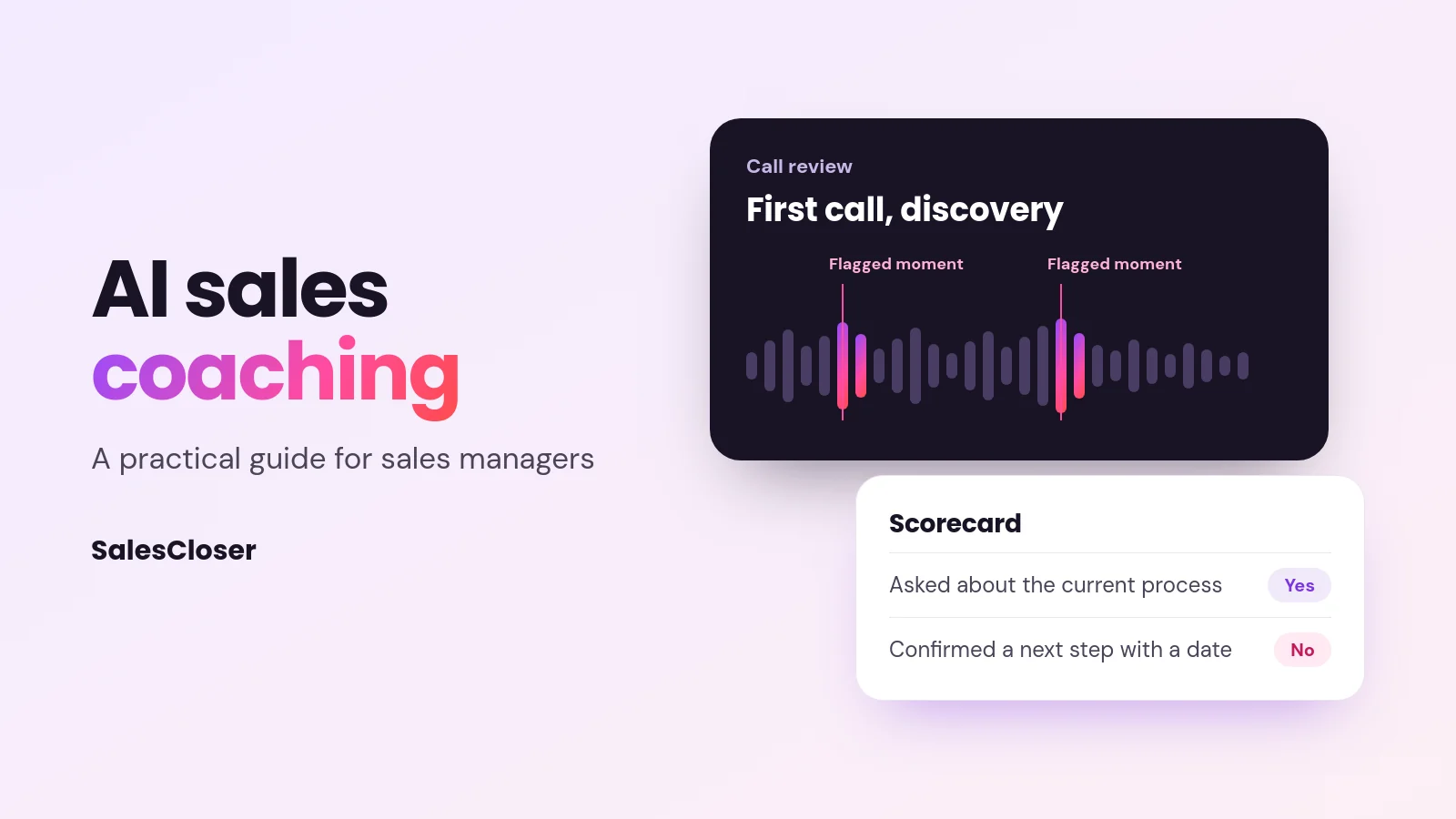
Most sales managers know coaching matters. The problem is time. Reviewing calls by hand is slow, so feedback is based on the few calls a manager happens to hear, and it often arrives days after the conversation. New reps wait for help, and experienced reps rarely get any.
AI sales coaching tools change where the time goes. Software handles the listening, scoring and practice, and the manager focuses on feedback that needs a person. This guide covers the main types of AI sales coaching, what each is good for, what managers still own, how to roll out a program, what to measure and how to choose a tool.
What is AI sales coaching?
AI sales coaching is the use of AI to help sales reps improve their conversations. The software records and transcribes calls, checks them against the skills and talk tracks you define, flags moments worth discussing and gives reps a place to practice. An AI sales coach is the tool that does this work.
The goal is not to automate coaching itself. It is to give every rep regular, specific feedback based on real conversations instead of a manager’s memory of one call. The manager still decides what good looks like and has the coaching conversation. The AI makes sure there is material for that conversation every week.
Traditional coaching depends on a manager listening to a small sample of calls. That sample tends to reflect the last call they heard or their own selling style. AI coaching can review every recorded call, so feedback follows a rep’s patterns over time rather than one good or bad day.
What are the main types of AI sales coaching tools?
Search for AI sales coaching software and you will find tools that do quite different jobs. Most fall into four groups.
- Call recording and analysis (conversation intelligence). The tool records sales calls, transcribes them and analyzes what happened: talk time, questions, objections, competitor mentions and next steps. Many tools score each call against your scorecard, so managers see which calls need attention without hearing them all. See our guide to AI sales call analysis for how this works.
- AI roleplay and practice partners. The rep talks to an AI that plays a buyer, such as a skeptical prospect, a busy executive or someone pushing back on price. The tool gives feedback after each session. Reps can rehearse a new pitch or a hard objection as often as they like before trying it on a real prospect.
- Real-time in-call guidance. The tool listens during a live call and shows prompts on the rep’s screen: a reminder to ask a discovery question, a suggested answer to an objection, or a note when the rep has been talking for too long. This is sometimes called AI call coaching.
- AI sales agents that handle conversations. These are not coaching tools in the strict sense. An AI agent holds the conversation itself, for example answering an inbound lead or giving a first demo. Managers get recordings, transcripts and summaries to review, which shows what prospects actually ask and how the answers land.
Some platforms combine more than one of these. When you compare tools, look at which job each one does well rather than how many features it lists.
Which type of AI sales coaching fits your team?
Each approach solves a different problem, and none of them runs without a manager. Use this table to match the approach to the gap you want to close.

| Coaching approach | What it does | Best for | What the manager still does |
|---|---|---|---|
| Call recording and analysis | Records, transcribes and scores calls against your scorecard; flags key moments | Coaching from real calls across the whole team; spotting patterns by rep | Builds the scorecard, picks the calls to discuss and runs the coaching session |
| AI roleplay and practice | Plays a buyer so reps can rehearse pitches and objections, with feedback after each session | New hire ramp, new products, new talk tracks and hard objections | Writes realistic scenarios, sets practice goals and checks progress |
| Real-time in-call guidance | Shows prompts and suggested answers to the rep during a live call | Reps who know the basics but miss steps under pressure | Decides which prompts appear, keeps them accurate and checks they help rather than distract |
| AI sales agents with recordings and summaries | Holds early conversations with leads; saves transcripts, summaries and qualification answers for review | Teams that want to learn from many first conversations and give reps more time with qualified prospects | Reviews conversations, updates the agent’s knowledge and rules, and turns what it learns into coaching for reps |
Many teams start with call analysis because it builds on calls they already have. Roleplay is a natural next step for onboarding. Real-time guidance works best once your talk tracks are settled, because prompts are only as good as the content behind them.
What do sales managers still do with AI coaching?
AI can listen to more calls than any manager. It cannot decide what your team should get better at, or build the trust that makes a rep act on feedback. Keep these jobs with people:

- Defining what good looks like. Which discovery questions matter, how to handle pricing questions and what a strong next step sounds like are your decisions. The AI scores against them.
- Choosing focus. A rep cannot fix ten things at once. The manager picks one or two skills per rep for the next few weeks.
- Running the coaching conversation. Feedback lands better when a person explains why it matters and listens to the rep’s view of the call.
- Judging context. A low score on a call with an unusual buyer may be the right call. Managers know the deal and the account.
- Deal strategy. Multi-stakeholder deals, negotiation and pricing exceptions need judgment that call scores do not capture.
- Keeping the content current. Scorecards, roleplay scenarios and prompts go stale when products, pricing or competitors change.
A useful way to frame it: the AI finds the moments, and the manager decides what to do about them.
How do you roll out an AI sales coaching program step by step?
A coaching tool on its own changes little. The program around it does the work. These steps keep the rollout focused.

- Pick one or two skills to start. For example, discovery questions on first calls, or handling a common pricing objection. Narrow goals are easier to score and easier to coach.
- Write the scorecard. Turn each skill into a few yes or no checks a reviewer could agree on, such as “asked about the current process” or “confirmed a next step with a date”.
- Check recording rules. Recording and transcribing calls is regulated in many places, and some require consent from everyone on the call. Confirm your obligations and tell prospects when calls are recorded.
- Explain the purpose to reps. Experienced sellers can see call scoring as surveillance. Position it as support: less time on post-call notes, faster feedback and a clear view of their own progress. Share how scores will and will not be used.
- Start with a pilot group. Run the program with one team for a few weeks. Compare AI scores with a manager’s review of the same calls and adjust the scorecard where they disagree.
- Set a weekly rhythm. Each rep gets a short session built around two or three flagged moments from their own calls. Add roleplay practice on the skill they are working on.
- Feed in good material. Load current product information, objection guidance and examples of strong calls. Coaching suggestions are only as good as what you give the tool.
- Expand and review. Add skills and teams once the first cycle runs smoothly. Review the scorecard every quarter.
For more on handling the objections that come up most, see our guide to AI sales objection handling. It is a good source of roleplay scenarios.
What should you measure in an AI sales coaching program?
Set a baseline before the pilot so you can compare like with like. You do not need industry benchmarks. Your own numbers before and after are more useful.
- Call review coverage. The share of calls that get reviewed by the AI, a manager or both. Before AI, this is often a small sample.
- Coaching sessions held. How many reps get a coaching conversation each week, and whether it is based on their own calls.
- Skill scores you define. Track each rep’s score on the specific skills in your scorecard over time. Look for steady movement on the skills you chose to coach.
- Ramp time. How long new reps take to reach the level you expect, measured the same way for each hiring group.
- Practice volume. How often reps use roleplay, and whether practice on a skill is followed by better scores on live calls.
- Funnel outcomes. Meetings that move to the next stage, pipeline created and win rate. These move more slowly and depend on many factors, so read them alongside skill scores.
If skill scores rise but outcomes do not, check whether the scorecard measures the behaviors that matter for your buyers. If coverage is high but sessions are rare, the bottleneck is manager time, not data.
How do you choose AI sales coaching software?
Start from the problem you wrote down in the rollout plan, then test tools against it. Use this checklist when you compare AI sales coaching software:
- Fit to your gap. Does the tool focus on call analysis, roleplay, live guidance or a mix, and does that match your goal?
- Where your calls happen. Check that it works with your phone system, video meeting tools and the languages your team sells in.
- Custom scorecards. You should be able to define your own skills and checks, not only use a generic template.
- Transcript quality. Test it on your own calls, including accents, product terms and poor connections.
- Evidence for each score. A manager should be able to click from a score to the exact moment in the call.
- Rep experience. Reps should see their own calls, scores and progress. Tools reps avoid do not get used.
- CRM connection. Check what the tool writes to your CRM and what stays in the tool.
- Recording and data controls. Ask how consent notices, retention, access permissions and deletion requests are handled, and check them against your own obligations.
- Setup and ownership. Ask how long setup takes and who on your side maintains scorecards and content.
Run a short trial on real calls with two or three managers before you sign. Their view of whether the tool saves time is the best test. Our overview of AI for sales shows where coaching sits among other AI tools in the funnel.
Where does SalesCloser fit in AI sales coaching?
SalesCloser is an AI sales agent, not a coaching platform. It does not score your reps’ calls or run roleplay sessions. Its agents hold real conversations with leads by voice, video or chat: answering inbound leads, asking qualifying questions, running discovery, giving product demos and booking qualified prospects onto your team’s calendar.
Its value for coaching comes from what those conversations leave behind. Conversations are recorded and transcribed so your team can review them. SalesCloser also saves the lead, a call summary and the qualification answers to HubSpot, Pipedrive, Zoho, GoHighLevel, Zendesk or Intercom.
Managers can use that record in two ways. Reviewing the agent’s conversations shows which questions and objections come up most, which is good material for coaching reps and writing roleplay scenarios. It also shows where the agent’s answers need work, so you can update its knowledge base and rules.
Read more about AI for sales calls and how an AI sales team works alongside reps, or book a demo.
How should you get started with AI sales coaching?
Pick the gap first. If managers cannot hear enough calls, start with call recording and analysis. If new reps are slow to ramp, add roleplay. If reps slip under pressure, test real-time guidance. If early conversations eat rep time, an AI sales agent can take those and give you transcripts to learn from.
Whatever you choose, keep the program simple: a few skills, a clear scorecard, a weekly coaching rhythm and your own baseline to measure against. The AI handles the listening. Your managers turn it into better selling.