
AI sales calls are live sales conversations run by an AI agent instead of a rep. The agent answers the call or chat, asks your qualifying questions, answers product questions from your knowledge base, can present a demo and books qualified buyers onto a rep’s calendar. People take over for complex deals, negotiation and anyone who asks for a person.
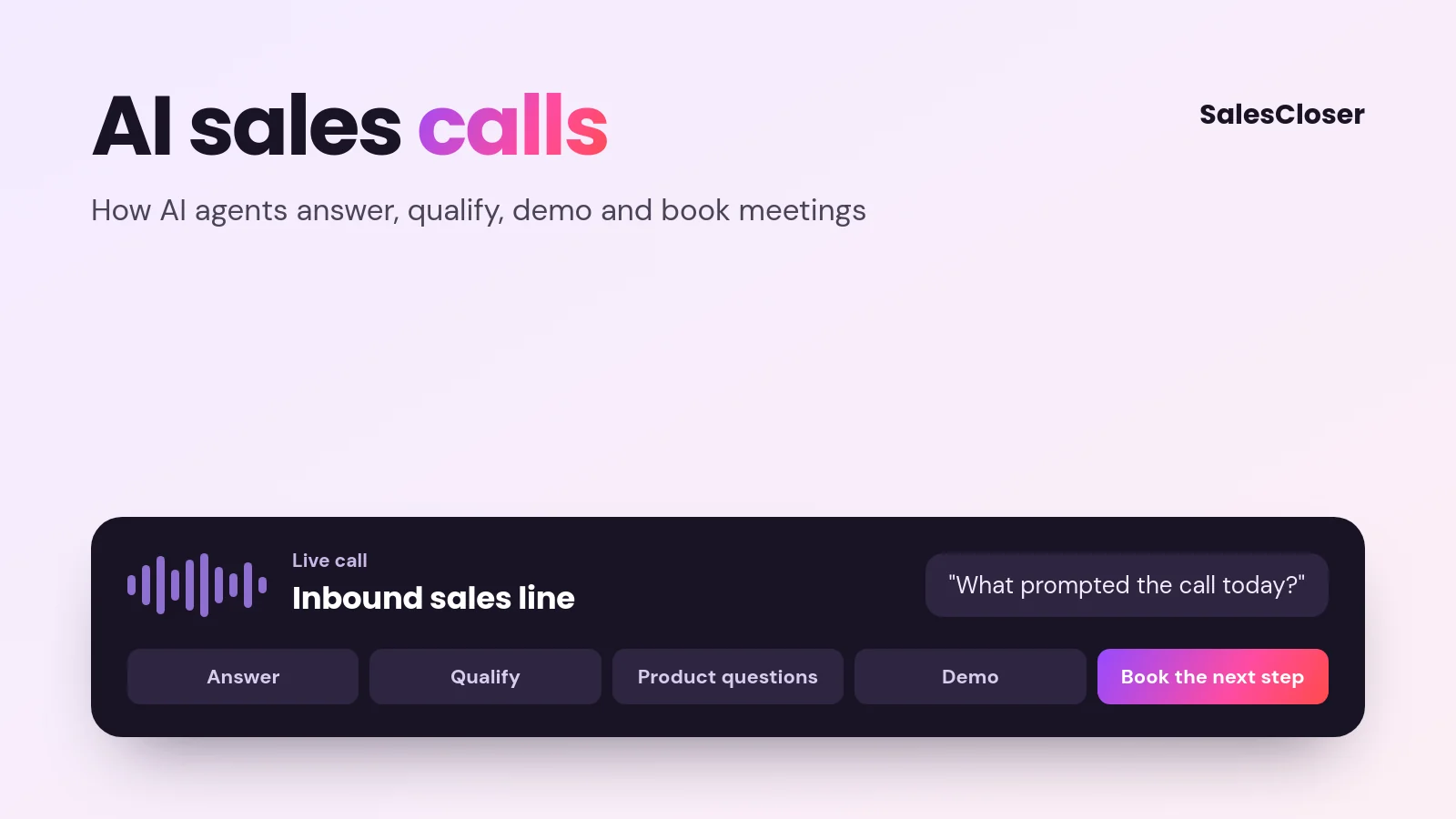
Most sales teams already use AI around their calls: transcription, call summaries, coaching notes. AI sales calls go one step further. An AI agent holds the conversation itself, by phone, on a video call or in a browser chat, and hands the buyer to a person when that is the better next step.
This guide covers how AI agents run each part of a sales call, what a good call sounds like, where humans should take over, how to measure the results and how to start without putting your pipeline at risk.
What are AI sales calls?
An AI sales call is a live sales conversation in which an AI agent speaks with the buyer in real time. The agent listens, works out what the buyer is asking, finds the answer in the material you have given it and replies in a natural voice.
It follows your rules for what to ask, what to say and when to hand off.
People use the phrase for three different things, so it helps to separate them:
- AI that runs the call. The agent is the one talking to the buyer. This is the focus of this guide.
- AI that assists a rep during the call. Real-time prompts, battlecards or notes while a person does the talking.
- AI that analyzes calls afterward. Transcripts, summaries, scoring and coaching once a human call ends.
All three are useful. Only the first one adds capacity, because it lets sales conversations happen when no rep is available.
How AI agents run sales calls, step by step
A well-run AI sales call follows the same arc as a good human call. Here is what the agent does at each stage.

1. Answering the inbound call or chat
The agent picks up when a buyer calls your sales line, starts a chat on your site or joins a scheduled video meeting. It greets them, confirms why they reached out and sets expectations for the conversation. Because it has no working hours, the same thing happens at night, at weekends and during a spike when every rep is busy.
That matters because interest fades quickly, which is the whole argument behind speed to lead.
2. Qualification and discovery
Next the agent asks your qualifying questions: role, company, the problem the buyer wants to solve, timing, and anything specific to your business. A good agent does not read them out like a form.
It asks one question at a time, follows up on vague answers and skips questions the buyer has already answered. For a deeper look at this stage, see our guide to AI discovery calls.
3. Answering product questions
Buyers ask questions in the middle of qualification. The agent answers from your knowledge base: your website, product documents and FAQs. When a question falls outside that material, the right behavior is to say so and offer a follow-up with a specialist, not to guess.
4. Giving a demo by screen share or video
On a video call or in the browser, a demo agent can present the product, either by sharing a live screen and walking through it or by presenting your product video, and answer questions as it goes.
This suits first demos that cover the same core workflow every time, and buyers who want to see the product before they talk to sales.
5. Booking the next step
When the buyer is a fit, the agent books a meeting with the right rep directly on their calendar, confirms the time and explains what happens next. When the buyer is not a fit, it says so politely and points them to a better resource.
Either way, the lead, a call summary and the qualification answers should reach your CRM so the rep does not start from zero.
Types of AI sales calls
Not every call is a good fit for an agent. This table shows the common call types, what the agent handles and where a person usually steps in.
| Call type | What the AI agent does | Where a person usually takes over |
|---|---|---|
| Inbound sales line | Answers, qualifies, answers common questions, books a meeting | Large or complex opportunities, existing customers with account issues |
| Website chat or voice | Starts a conversation while the buyer is on the page, qualifies, books | Buyers who ask for a person or need a custom quote |
| Discovery call | Runs structured discovery and records the answers | Multi-stakeholder deals and technical deep dives |
| First demo | Presents the product by screen share or video and answers common questions | Custom demos, integration questions, security reviews, negotiation |
| Onboarding or support call | Walks new customers through setup and answers common questions | Escalations, billing disputes, account changes |
What a good AI sales call sounds like
A good AI sales call sounds like a well-trained rep on a good day: clear, brief and focused on the buyer. Here is a short illustrative example of an inbound call for a scheduling product:

- Agent: “Thanks for calling. I’m an AI assistant on the sales team. I can answer questions or set up time with a specialist. What prompted the call today?”
- Buyer: “We’re looking at a new scheduling tool. Ours doesn’t handle multiple locations well.”
- Agent: “That comes up a lot. How many locations are you running, and who manages the schedules today?”
- Buyer: “Six. Each office manager does their own.”
- Agent: “Got it. Would it help to see how multi-location scheduling works first? I can show you now, or book you with a specialist who works with multi-site teams.”
What makes that call work:
- It is honest about what it is. Whether the agent introduces itself as an AI up front is your choice, but it should always answer truthfully when asked.
- Short turns. The agent asks one thing at a time and lets the buyer talk.
- It uses what it hears. The follow-up builds on the buyer’s answer instead of jumping to the next item on a list.
- A clear next step, with a choice. The buyer decides between seeing the product now and talking to a person.
- It knows its limits. It says when something needs a specialist instead of improvising.
A weak call is the opposite: long monologues, repeated questions, made-up answers, talking over the buyer and no clear way to reach a person.
Where humans take over
AI sales calls work best with a clear line between what the agent owns and what your team owns. Write these handoff rules before launch:

- The buyer asks for a person. Always honor it, quickly.
- High-value or strategic accounts. Route by company size, a named account list or deal potential.
- Complex requirements. Custom integrations, security and legal reviews, unusual use cases.
- Negotiation and contracts. The agent can share what you publish; discounts and terms stay with people.
- Sensitive moments. Complaints, cancellations and frustrated buyers.
- Anything outside the knowledge base. The agent notes the question and books a follow-up.
The handoff itself matters as much as the rule. The rep should see the call summary and qualification answers before the meeting, so the buyer never has to repeat themselves.
Inbound vs outbound AI sales calls
Inbound calls are the natural starting point. The buyer chose to reach out, intent is high and the agent’s job is to respond well and fast. Outbound AI calling, where an agent calls prospects, carries more risk: lower intent, more objections and stricter rules.
If you are considering outbound, check the rules where you sell before you start. In the US, for example, automated and artificial voice calls fall under the Telephone Consumer Protection Act, and many regions have rules on call recording and consent. Get advice on your own obligations rather than relying on a vendor’s summary.
How to measure AI sales calls
Track a small set of metrics by channel and time of day, and compare them with a baseline from before launch:
- Answer rate and time to answer. How many inbound calls and chats get a real conversation, and how fast.
- Completed conversations. Calls that reach a clear outcome (booked, not a fit or handed off) rather than dropping off.
- Qualification accuracy. Whether reps agree with the agent’s fit decision. Sample calls every week.
- Meetings booked and held. Booked meetings that actually take place.
- Meetings accepted by sales. Meetings your account executives agree were worth taking.
- Answer accuracy. Wrong or unsupported answers found in transcript reviews.
- Handoff speed. How long buyers who need a person wait for one.
If answer times improve but accepted meetings do not, look at your qualification rules and the handoff before you blame the agent’s voice or script.
How to start with AI sales calls
- Pick one call type. After-hours inbound calls, overflow when reps are busy, or first demos for one product are common starting points.
- Write the playbook. Qualifying questions, fit criteria, disqualifiers, handoff rules and topics the agent should never discuss.
- Build the knowledge base. Website, product documents, FAQs and your best answers to common objections. Fill the gaps you find in testing.
- Decide on disclosure and recording. How the agent introduces itself and how callers are told the call is recorded.
- Connect your calendar and CRM. Make sure booked meetings land with the right rep and the summary is attached to the lead.
- Test with your own team. Have reps play difficult buyers: vague answers, interruptions, off-topic questions, requests for a person.
- Launch on part of your traffic. Review every call for the first weeks, fix answers and rules, then expand.
A structured trial makes the decision easier. Our guide on how to run a pilot program for an AI sales agent covers goals, scope and review.
How SalesCloser fits
SalesCloser provides AI sales agents that hold real sales conversations by voice, video or chat: on the phone or in the browser. The agent answers inbound leads around the clock, asks your qualifying questions, runs discovery, can give a product demo by live screen share or by presenting your product video, and books qualified prospects onto your team’s calendar through Calendly or Cal.com.
Setup is no-code: you give it your knowledge base (website, documents, FAQs) and your rules. It connects to HubSpot, Pipedrive, Zoho, GoHighLevel and Zendesk, saving the lead, a call summary and the qualification answers. Conversations are recorded and transcribed so your team can review them.
You control how the agent introduces itself, including whether it says it is an AI up front, and you can tell it to always answer truthfully when asked. To hear how it handles your own questions, you can book a demo.
Conclusion
AI sales calls are no longer only about recording and analyzing what reps say. An AI agent can now run the first conversation itself: answer, qualify, show the product and book the meeting.
The teams that get value from it start with one call type, write clear handoff rules, review calls every week and judge results by the meetings their reps accept.
Frequently asked questions
Can AI make sales calls?
Yes. AI agents can hold live sales conversations by phone, video or chat. They answer, ask qualifying questions, respond to product questions from your materials and book meetings. Most teams start with inbound calls, where the buyer reached out first. Outbound AI calling carries stricter legal rules, so check your obligations before you try it.
Do buyers know they are talking to an AI on a sales call?
They should always be able to find out by asking. Choose a tool that answers truthfully when a buyer asks whether it is an AI, and decide whether it should say so at the start of the call. Many teams disclose up front. Also check local rules on disclosure and call recording where you sell.
Will AI sales calls take over the work of sales reps?
Only part of it. AI agents handle the repeatable part of the conversation: first response, qualification, common questions, first demos and booking. Reps keep complex deals, negotiation, multi-stakeholder buying and relationships. The aim is for reps to spend more of their time with buyers who are ready for a real sales conversation.
What is the difference between AI sales call agents and conversation intelligence?
Conversation intelligence tools record and analyze calls that people make, then provide summaries, scores and coaching. AI sales call agents take part in the call and talk to the buyer themselves. Many teams use both: an agent for first conversations and conversation intelligence for the calls reps run later in the deal.
How long does it take to set up an AI sales call agent?
It depends mostly on your content and rules, not the technology. With a no-code tool, the agent is configured from your website, documents and FAQs. Most of the work is writing qualifying questions, handoff rules and answers to common objections, then testing with your own team before real buyers reach it.