
AI agents for sales are software agents that carry out sales tasks on their own instead of only assisting a rep: answering and qualifying leads, running discovery and first demos, booking meetings and keeping records current. Most teams start with inbound response and qualification, keep people on complex deals and judge vendors on conversation quality and handoff.
Sales teams have used automation for years: sequences, lead routing, dialers, chatbots with fixed scripts. AI agents for sales are different. Instead of following a rigid flow or suggesting what a rep should do, an agent carries out a sales task on its own, adapts to what the buyer says and hands off to a person when it should.
This guide explains the main jobs AI agents do across the funnel, with examples by team type, what to automate first, the mistakes to avoid and a neutral checklist for evaluating vendors.
What are AI agents for sales?
An AI agent for sales is software that pursues a sales goal, such as qualifying a lead or booking a meeting, by holding a conversation or completing a series of steps without a person directing each one.
It works from your knowledge base and rules, and it connects to the tools your team already uses, such as your CRM and calendar.
It helps to compare agents with the tools they are often confused with:
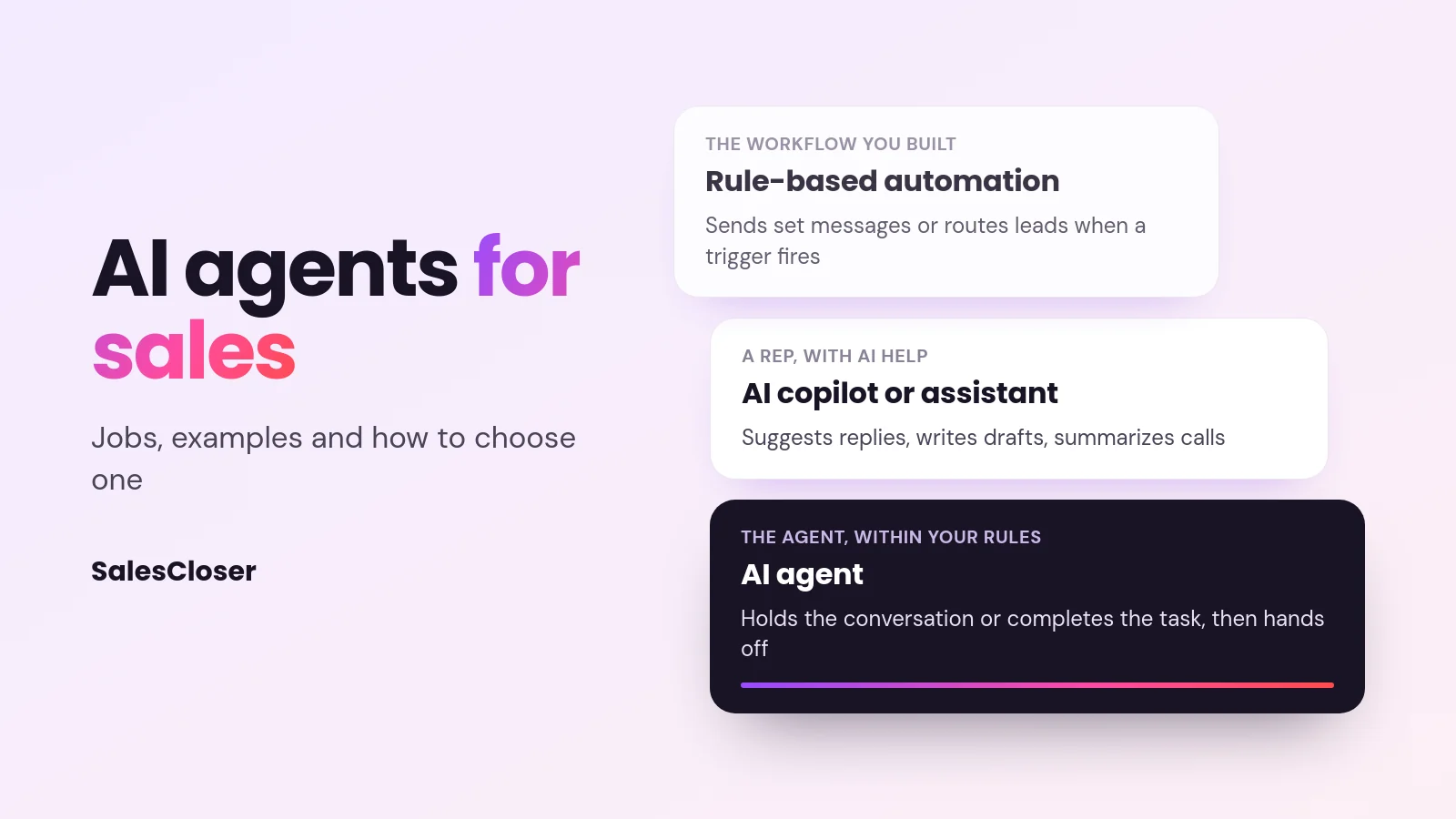
| Tool | What it does | Who does the work |
|---|---|---|
| Rule-based automation | Sends set messages or routes leads when a trigger fires | The workflow you built; no judgment |
| AI copilot or assistant | Suggests replies, writes drafts, summarizes calls | A rep, with AI help |
| AI agent | Holds the conversation or completes the task, then hands off | The agent, within your rules |
The practical difference is capacity. A copilot makes a rep faster. An agent can handle a conversation when no rep is available at all.
What AI agents do across the sales funnel
Most of the value sits in a handful of jobs. Here they are in funnel order.

- First response to inbound leads. Answering calls, chats and form fills right away instead of leaving buyers in a queue.
- Lead qualification. Asking your qualifying questions, following up on vague answers and sorting fit from not-fit. Our guide on how to qualify leads with AI goes deeper.
- Discovery. Running structured discovery and recording the answers so the rep starts with context.
- First demos. Presenting the product by live screen share or a product video, and answering common questions along the way.
- Meeting booking. Putting qualified buyers directly on the right rep’s calendar.
- Follow-up and reminders. Checking in after a missed meeting or a stalled conversation.
- Research and prospecting. Gathering account information and drafting outreach for reps to review.
- CRM updates. Logging the lead, a summary and key answers so records stay current.
- Onboarding and support. Walking new customers through setup and answering common questions after the sale.
Not every agent does all of these. Some products focus on written outreach, others on live conversations by voice, video or chat. Know which jobs you need before you compare tools.
Examples of AI agents for sales by team type

B2B SaaS with inbound demand
Demo requests arrive all day and across time zones. An agent answers each request immediately, runs a short discovery, gives a first demo by screen share to buyers who want to see the product now, and books qualified accounts with an account executive. Account executives start their meetings with a summary instead of a cold open.
Founder-led and small sales teams
There is no SDR, and the founder misses calls while in meetings. An agent covers the sales line and website chat, answers common questions, filters out poor fits and books the good ones into the founder’s calendar.
High-volume consumer and home services sales
Teams selling solar, insurance, home improvement or education often get large volumes of inbound calls and form fills, many outside office hours. An agent answers every one, collects the details a specialist needs and books appointments, so specialists spend their time with qualified households.
Agencies and professional services
Inquiries vary widely in fit and budget. An agent asks about scope, timing and budget range, books discovery calls for good fits and politely redirects the rest.
Teams with an existing SDR function
Here the agent usually takes first response, after-hours coverage and overflow, while SDRs focus on outbound and on accounts that need a personal touch. Our comparison of AI SDRs and human SDRs covers how to split the work.
What to automate first
The best first job for an AI agent has four traits: high volume, repeatable questions, clear success criteria and low risk if the agent gets one conversation wrong. For most teams that points to one of these:

- After-hours and overflow inbound. Leads that would otherwise wait or get no answer. The downside is small and the gain is easy to see.
- Qualification of inbound leads. The questions are already written, and reps can judge the results.
- Meeting booking. A clear outcome you can count.
- First demos for a standard product. Once qualification works, add demos for buyers who want to see the product before a sales meeting.
Leave negotiation, complex multi-stakeholder deals and strategic accounts with people. Revisit the split after you have reviewed real conversations. For a closer look at how live conversations work, see our guide to AI sales calls.
Common pitfalls with AI sales agents
- Automating a broken process. If your qualification criteria are vague, an agent applies vague criteria faster. Fix the playbook first.
- A thin knowledge base. Agents answer from what you give them. Missing pricing rules, product limits or objection answers lead to weak or evasive replies.
- No handoff plan. Buyers who need a person must reach one quickly, and reps need the summary before the meeting.
- Unclear disclosure. Decide how the agent introduces itself, and make sure it answers truthfully whenever a buyer asks if it is an AI.
- Measuring activity instead of outcomes. Conversation counts look good on a dashboard. Meetings your reps accept, and pipeline from them, are what matter.
- Set and forget. Products, pricing and messaging change. Someone needs to own weekly conversation review and content updates.
- Ignoring the rules. Automated calling, recording and consent are regulated in many places. Check your own obligations for each region and channel.
How to measure AI agents for sales
Judge the agent on the same outcomes you would use for a new team member, and compare them with a baseline from before launch:
- Response time and coverage. How fast leads get a real conversation, including nights and weekends.
- Qualification accuracy. Whether reps agree with the agent’s fit decisions on a weekly sample.
- Meetings booked, held and accepted. Meetings that take place and that account executives agree were worth their time.
- Answer accuracy. Wrong or unsupported answers found in conversation reviews.
- Pipeline from agent-sourced meetings. Tracked over a full sales cycle, not just the first month.
If conversations go up but accepted meetings do not, the problem is usually the qualification rules or the handoff, not the agent itself.
How to evaluate AI sales agent vendors
Use the same questions for every vendor, and test with your own leads and questions rather than a scripted demo.
| Area | Question to ask | What a good answer looks like |
|---|---|---|
| Channels | Which channels does the agent work on: phone, video, chat, email, SMS? | Covers the channels your buyers actually use |
| Conversation quality | Can we test it with our own hardest questions and interruptions? | Short, accurate replies; admits when it does not know |
| Knowledge and control | How do we add content and set rules on what it can and cannot say? | Your team can update it without engineering help |
| Handoff | How does it route a buyer to a person, and what does the rep receive? | Configurable rules plus a summary and qualification answers |
| Booking | Which calendars does it book into, and how does it pick the rep? | Works with your calendar tools and routing logic |
| CRM | What exactly is written to the CRM, and what is not? | A precise list, not a general promise |
| Disclosure | What does it say when asked if it is an AI? Can we disclose up front? | You set disclosure up front and truthful answers when asked |
| Review | Are conversations recorded and transcribed? Who can review them? | Every conversation available for review |
| Security and compliance | Which certifications and policies can you document? | Documents you can verify, matched to your own obligations |
| Pilot | Can we run a defined pilot on one lead source? | Clear scope, success criteria and review cadence |
Ask each vendor to show the agent handling a buyer who is clearly not a fit, one who asks for a person and one who asks something outside the knowledge base. How it handles those three tells you more than a smooth happy-path demo.
How SalesCloser fits
SalesCloser provides AI sales agents for the conversation jobs in this guide: they answer inbound leads around the clock, ask your qualifying questions, run discovery, give product demos by live screen share or by presenting your product video, and book qualified prospects onto your team’s calendar through Calendly or Cal.com.
Conversations happen by voice, video or chat: on the phone or in the browser. Agent types cover demo, discovery, onboarding and support.
Setup is no-code: you give the agent your knowledge base (website, documents, FAQs) and your rules. It connects to HubSpot, Pipedrive, Zoho, GoHighLevel and Zendesk, saving the lead, a call summary and the qualification answers; creating or moving deals is done through Zapier. Conversations are recorded and transcribed so your team can review them.
You control how the agent introduces itself, including whether it says it is an AI up front, and you can tell it to always answer truthfully when asked. If you want to test it on your own leads, book a demo.
Conclusion
AI agents for sales are most useful when they own a clear job: first response, qualification, first demos or booking. Start with high-volume, repeatable conversations, write your handoff rules before launch, review conversations every week and judge vendors by how they handle hard cases, not polished demos. Keep your people on the work that needs judgment and relationships.