“Discover how SalesCloser AI works to automate your pipeline. Explore our neural sales engine, CRM syncing, and real-time voice tech.”
Sales teams often face a significant gap between lead generation and actual conversations. Manual tasks and research consume valuable hours that representatives could spend closing deals. SalesCloser AI fills this gap by deploying autonomous agents to conduct discovery, qualification, and live demos. These agents act as a tireless extension of your workforce, engaging prospects the moment they show interest.
But how does it actually work? It is one thing to hear an AI talk to a prospect. It is another to understand the machinery that powers that interaction. This guide provides a deep look at the SalesCloser.ai architecture and the technology that makes our agents sound human. We explore our neural sales engine, our approach to data security, and the proprietary models that drive every conversation. If you have wondered how SalesCloser AI works to turn a “no” into a “yes,” this post explains the logic behind the voice.
What is SalesCloser AI?
Before we get into the code and the cloud, we should define what the platform is.
Featured Snippet Optimization: Definition
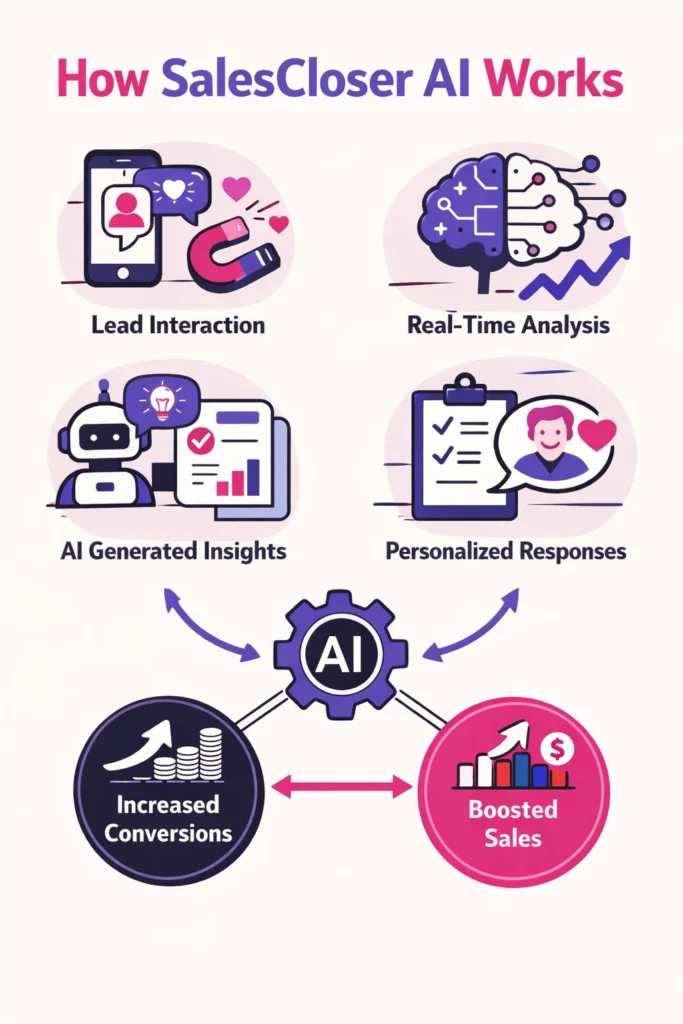
How SalesCloser AI works: SalesCloser AI is an autonomous sales platform that uses a neural sales engine to conduct full-cycle sales conversations. It combines proprietary sales LLMs with real-time voice processing and CRM integration. This allows the AI to qualify leads, handle objections, and book meetings without human intervention.
The Core Neural Sales Engine Architecture
At the heart of the platform lies the neural sales engine. This is not a single piece of software. It is a sophisticated orchestration of three distinct layers: processing, reasoning, and execution. Most AI tools simply wrap a generic chat model around a basic interface. SalesCloser AI builds its own logic layers to ensure the AI remains focused on the sale.
The Input Layer: Real-Time Listening
When a prospect speaks, the AI must hear them perfectly. We use advanced Automatic Speech Recognition (ASR) tuned specifically for business terminology. Generic ASR often struggles with industry-specific jargon or heavy accents. Our engine filters background noise and processes audio in less than 200 milliseconds. This low latency is vital; if the AI takes two seconds to “think” before responding, the human flow of the conversation breaks.
The Reasoning Layer: The Proprietary Sales LLM
Once the engine “hears” the words, it must understand the intent. This is where proprietary sales LLMs (Large Language Models) come into play. While many competitors use “off-the-shelf” models, SalesCloser uses models fine-tuned on millions of successful sales transcripts. Our AI does not just understand English; it understands sales psychology. It knows the difference between a “hard no” and a “not right now.”
The Output Layer: Natural Voice Synthesis
The final step is turning a text-based response back into audio. Our Text-to-Speech (TTS) engine focuses on “prosody.” This refers to the rhythm, stress, and intonation of speech. If a prospect sounds excited, the AI can mirror that energy. If the prospect is in a hurry, the AI shortens its responses to respect their time.
AI Personality Mapping: Why Every Agent Sounds Unique
One of the biggest concerns for sales leaders is brand consistency. You do not want a “robotic” agent representing your high-end enterprise solution. AI personality mapping ensures that every SalesCloser agent matches your company’s specific culture and tone.
Setting the Tone
During setup, users define the personality traits of their AI agent. These include:
- Formality: Should the agent use “Mr. Smith” or “John”?
- Assertiveness: How hard should the agent push when someone says they are busy?
- Directness: Does the agent give long, detailed explanations or short, punchy answers?
Industry-Specific Context
A sales agent selling medical devices needs a different vocabulary than one selling TikTok marketing services. Our neural sales engine adjusts its “personality” based on the industry knowledge base you provide. By mapping these traits, we ensure the agent feels like a natural extension of your team rather than a third-party bot.
Emotional Intelligence (EQ) in Sales
The AI uses sentiment analysis to track the prospect’s mood throughout the call. If the system detects frustration, it pivots the strategy. It might offer to send an email instead of continuing the pitch. This level of nuance is what separates SalesCloser from simple automated dialers.
| Personality Trait | Enterprise Rep Style | Startup SDR Style |
| Greeting | “Good morning, [Name]. Thank you for taking the call.” | “Hey [Name], catching you at a good time?” |
| Objection Response | “I understand your concern regarding the ROI.” | “Totally get that. Most folks we work with felt the same.” |
| Closing Move | “Shall we schedule a formal review for Tuesday?” | “Want to jump in and try it out this week?” |
Real-Time Objection Handling Tech
The moment a prospect says, “It’s too expensive,” most AI chatbots fail. They either loop the same script or hallucinate. Real-time objection handling tech is what makes SalesCloser AI a “closer.”
The Logic Tree vs. The Neural Path
Traditional sales bots use rigid “if-then” logic. If the user says X, the bot says Y. This fails because humans rarely stick to a script. How SalesCloser AI works is by using a neural path. It looks at the context of the entire conversation.
If a prospect mentions a budget concern early on, the AI notes it. If they mention it again later, the AI knows it isn’t just a reflex; it is a real hurdle. It then accesses the knowledge base to pull specific case studies or ROI data that address that specific concern.
The “Listen-Validate-Transform” Framework
Our AI is programmed with a standard sales framework:
- Listen: It processes the objection without interrupting.
- Validate: It acknowledges the concern (e.g., “I hear you, many of our clients were worried about implementation time too.”)
- Transform: It provides a counterpoint backed by data.
According to Gartner research, 61% of B2B buyers prefer a rep-free experience if given the choice. However, they still need their questions answered. Our real-time tech gives them the answers they need without the pressure of a human salesperson.
Knowledge Base Integration and Data Flow
The AI is only as smart as the information you give it. SalesCloser AI does not guess. It pulls from a structured knowledge base that you control. This prevents the “hallucination” problem common in other AI systems.
Direct CRM Syncing
SalesCloser integrates directly with Salesforce, HubSpot, and Pipedrive. When an AI agent makes a call, it pulls the prospect’s history. It knows whether they visited your pricing page or spoke with a human rep six months ago.
- Pre-call: The AI reviews the CRM record to personalize the opening.
- During the call, the AI updates a live log of the conversation.
- Post-call: The AI writes a summary, tags the lead’s interest level, and moves them to the next stage in your pipeline.
How the AI Accesses Information
When a prospect asks a technical question—like “Does your API support OAuth 2.0?”—the AI queries your uploaded documents. It uses a process called Retrieval-Augmented Generation (RAG). Instead of relying on its general training, it looks for the specific answer in your technical docs and paraphrases it for the conversation. This ensures 100% accuracy in technical demos.
AI Sales Security: Protecting Your Pipeline
For technical buyers, security is often the primary dealbreaker. AI sales security is a core pillar of the SalesCloser.ai architecture. We recognize that these agents handle sensitive prospect data and company secrets.
Data Encryption and Privacy
All audio and text data are encrypted both in transit and at rest. We use AES-256 encryption, the industry standard for financial institutions. Furthermore, we do not use your proprietary customer data to train our “global” models. Your data stays within your SalesCloser instance.
Compliance and Monitoring
SalesCloser is designed to be SOC 2 compliant. We also provide built-in tools for “human-in-the-loop” monitoring. Sales managers can listen to any call recording or read any transcript. If a manager sees the AI struggling with a specific question, they can update the knowledge base in real time to resolve the issue for all future calls.
PII Redaction
Our system automatically identifies and masks Personally Identifiable Information (PII). If a prospect accidentally says their credit card number or private home address, the AI can be configured to redact that information from the stored transcript. This protects both you and your leads.
How SalesCloser AI Learns and Improves
The “AI” in SalesCloser is not static. It gets better with every minute of conversation. However, it does not learn “on its own” in a way that could lead to unpredictable behavior. It learns through a structured feedback loop.
Learning from the “No”
Every time a call ends without a meeting booked, the system performs a “Post-Mortem” analysis.
- Did the prospect lose interest?
- Did the AI fail to answer a question?
- Was the tone too aggressive?
The system aggregates these insights into a dashboard for the sales manager. It suggests improvements like, “The AI is losing leads when discussing the integration timeline. Consider adding more detail to the knowledge base regarding the 2-week setup process.”
A/B Testing Your Agents
Because SalesCloser agents are digital, you can run experiments that would be impossible with humans. You can deploy two different versions of an agent to see which one has a higher conversion rate.
- Agent A: Uses a “consultative” approach focusing on pain points.
- Agent B: Uses a “challenger” approach focusing on missed opportunities.
After 100 calls, you will have statistically significant data on which script works best. You can then “promote” the winning logic to your entire AI workforce with one click.
Call Analytics Behind the Scenes
What happens after the AI hangs up? The work is just beginning. Within seconds, the neural sales engine generates a massive amount of data that a human rep would take an hour to document.
Sentiment and Intent Scoring
The AI assigns a “Buy Signal” score to every lead. It looks for verbal cues like “How much does that cost?” or “Can you show me that feature?” These are positive indicators. Conversely, it tracks “Friction points” like “I need to talk to my boss” or “We already use a competitor.”
Automated Follow-ups
If a call goes well, the AI does not just wait for the human rep to act. It can automatically send a follow-up email summarizing the call and including a link to the calendar. This keeps the momentum going.
Manager Dashboards
The platform provides a high-level view of your entire “Digital SDR” team. You can see:
- Total minutes talked.
- Objection handling success rates.
- Average time to qualification.
- Revenue pipeline generated by AI.
Scaling Your Sales Team with AI
The true power of SalesCloser AI lies in its scalability. A human sales rep can handle 50 calls a day if they are incredibly productive. A SalesCloser agent can handle 5,000 calls simultaneously.
Unlimited Concurrency
Imagine launching a new product. Instead of spending weeks training your team, you upload the product specs to SalesCloser. Within minutes, your AI agents can call your entire database. They handle every conversation with the same level of enthusiasm and accuracy, whether it is the first call of the day or the thousandth.
Global Reach
Because the proprietary sales LLMs are multilingual, your company can expand into new markets instantly. You do not need to hire a French-speaking sales team to test the market in Paris. You simply toggle the language setting on your SalesCloser agent. The AI understands the region’s cultural nuances and local business etiquette, enabling seamless international expansion.
Conclusion
Understanding how SalesCloser AI works reveals a system built for precision, speed, and security. By combining a neural sales engine with AI personality mapping and proprietary sales LLMs, we have created more than just a chatbot. We have built an autonomous workforce. This technology handles the repetitive, grueling parts of the sales cycle, allowing your human experts to focus on closing high-value deals.
The SalesCloser.ai architecture ensures that every interaction is data-driven, secure, and brand-aligned. As the platform continues to learn from every “no,” it moves your company closer to a consistent, predictable “yes.”
Ready to see the neural sales engine in action?
Book a demo with a SalesCloser AI agent today and experience the future of autonomous selling.
FAQ
How does SalesCloser AI handle accents?
Our ASR (Automatic Speech Recognition) is trained on diverse datasets to ensure high accuracy across various regional accents and dialects.
Can I integrate SalesCloser with my existing phone system?
Yes, SalesCloser offers seamless API integration and can work alongside most enterprise VoIP and CRM systems.
Is my data used to train other companies’ AI?
No. Your data is siloed and encrypted. SalesCloser follows strict privacy protocols to ensure your competitive intelligence remains yours.
Does the AI ever “hallucinate” or make up prices?
By using Retrieval-Augmented Generation (RAG), the AI only pulls pricing and technical data from the official knowledge base you provide, virtually eliminating hallucinations.