“Leverage AI for Sales Prospecting to automate lead identification, 24/7 qualification, and cold outreach, filling your pipeline with pre-vetted, high-intent buyers.”
Let’s be honest. For most sales teams, prospecting is a grind.
It’s the least glamorous part of the job. It’s the endless cold calls that go unanswered, often ending up in voicemail. It’s the carefully crafted emails that get zero replies. It’s the hours spent digging through LinkedIn, trying to find the right person at the right company, only to find your data is six months out of date.
We’ve all been there. Your sales reps, your SDRs—they’re spending 80% of their time on tasks that don’t involve talking to qualified buyers. They’re stuck at the top of the funnel, chipping away with a pickaxe, when they should be at the bottom, closing deals with a handshake.
This massive time sink is the single biggest bottleneck to scaling revenue. You hire more reps, but they just get stuck in the same prospecting mud.
But what if you could change that?
What if you could hand your team a high-powered drill instead of a pickaxe? What if you could automate the grind?
This is precisely what AI for sales prospecting is all about. It’s not a futuristic concept from a sci-fi movie. It’s here, it’s practical, and it’s fundamentally changing how B2B companies build their pipelines.
AI isn’t about replacing your salespeople. It’s about making them superhuman. It’s about filtering the entire ocean of potential leads to hand-deliver to your team the only fish that are ready to bite.
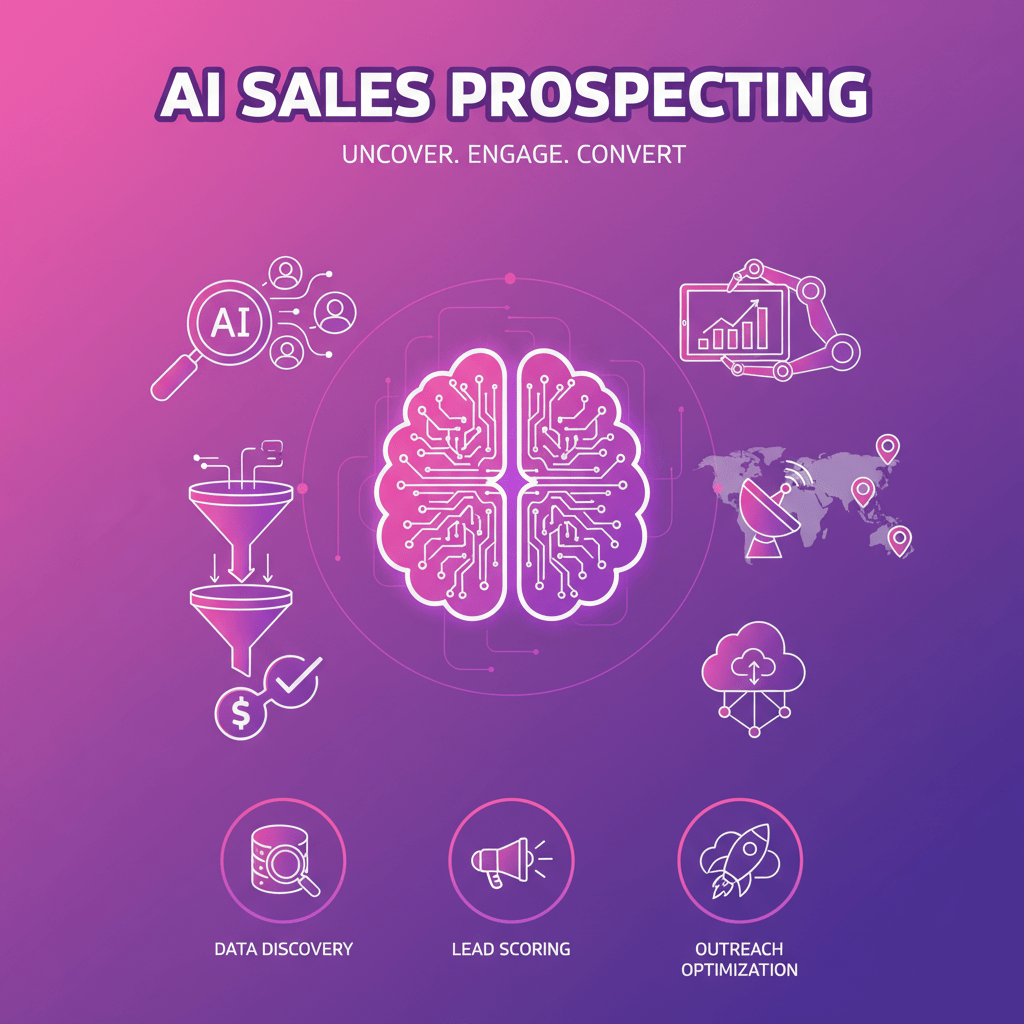
This comprehensive guide will walk you through the entire process. We’ll break down how AI transforms the three core stages of prospecting:
- Identification: Using AI to find the proper accounts and people.
- Qualification: Using AI to vet those leads and see if they’re actually a good fit.
- Engagement: Using AI to start the conversation in an innovative, personalized way.
Get ready to see how AI-led generation moves from a buzzword to your team’s most potent strategic weapon.
Stage 1: Identification (The “Who”) — Using AI to Find Your Perfect Customers
The most significant waste of time in sales is talking to the wrong people.
Traditional prospecting is a “spray and pray” numbers game. You buy a static list of 10,000 contacts in the “software industry,” load them into a dialer, and hope for the best. The result? Abysmal connect rates, frustrated reps, and a damaged brand reputation.
AI completely upends this entire model. Instead of “spray and pray,” it enables “find and focus.” It utilizes data to construct a microscopic-level understanding of your Ideal Customer Profile (ICP) and then scans the entire internet to identify companies that match it perfectly.
Here’s how AI handles identification.
1. Dynamic Ideal Customer Profile (ICP) Analysis
You think you know your ICP. You probably have it written down somewhere: “Companies with 500-5,000 employees in the finance industry.”
That’s a good start, but AI sees it differently.
AI performs an ideal customer profile analysis by examining your actual customer data in your CRM. It analyzes your top 100 best customers—the ones who signed quickly, have the highest LTV (Lifetime Value), and never churn.
Then, it identifies the thousands of hidden attributes that they all share in common. These aren’t just firmographics (like size and industry). AI spots patterns in:
- Technographics: What technology do they use? (e.g., “They all use Salesforce, Marketo, and AWS.”)
- Hiring Trends: What jobs are they hiring for? (e.g., “They all hired a ‘VP of RevOps’ 3-6 months before buying.”)
- Funding: Have they recently raised capital?
- Company Structure: What is the ratio of their sales team to their engineering team?
- Online Footprint: What keywords do they use on their website? What topics do their executives post about on LinkedIn?
AI builds a rich, multi-dimensional model of your perfect customer. This ICP isn’t a static document; it’s a living, breathing algorithm that gets smarter with every new deal you close.
2. Predictive Lead Scoring
Once you have your AI-powered ICP, the next step is predictive lead scoring.
Forget traditional lead scoring. You know, the old rules-based system: “Downloaded an ebook = +10 points. Visited the pricing page = +25 points.” This was helpful, but it can be easily gamed and is often incorrect. A college student writing a research paper could look like your hottest lead.
Predictive lead scoring is different. It’s an algorithm that compares new leads against your AI-built ICP.
When a new lead enters your system, the AI model instantly assigns a score to it. It doesn’t just look at what the lead did on your website. It enriches that lead with hundreds of external data points—the same technographics, hiring trends, and company data from your ICP analysis.
The result is a simple score (e.g., A, B, C, D) or a percentage (e.g., 95% fit) that tells your reps exactly how likely this lead is to become one of your best customers.
This allows your team to stop wasting time on “C” and “D” leads. They can focus 100% of their energy on the “A” leads—the ones the AI has already flagged as a perfect match.
3. Buying Signal Detection
This is where AI becomes truly intelligent.
The best time to sell to someone is right when they have the problem you solve. But how do you know when that is?
You use AI for buying signal detection.
AI tools continuously monitor the public web, encompassing news articles, press releases, social media platforms, LinkedIn, review sites, and job boards. They are looking for “trigger events” that signal a company has just entered a buying window.
Think about these real-world examples:
- Signal: A company posts a new job for a “Head of Cybersecurity.”
- Opportunity: They are clearly building out their security stack and are likely evaluating new vendors.
- Signal: A company just raised a $50 million Series C round.
- Opportunity: They have fresh capital and a mandate to grow, making them prime candidates for new software and services.
- Signal: An executive at a target account complains on LinkedIn about the limitations of their current CRM.
- Opportunity: This is a gold-plated invitation to show them a better alternative.
- Signal: A target account’s main competitor is mentioned in the news for a massive data breach.
- Opportunity: That company is now thinking about its own vulnerabilities, even if it won’t admit it.
Sales intelligence platforms powered by AI surface these buying signals in real-time. Your reps no longer lead with “Just checking in.” They lead with, “I saw your company just opened a new office in London, and I specialize in helping teams scale internationally.”
That’s a conversation worth having.
4. Automated Contact Data Enrichment
Ultimately, AI addresses one of the oldest challenges in sales: inaccurate data.
A rep finds the perfect account (thanks to predictive scoring) and the perfect trigger event (thanks to buying signals). They look up the VP of Marketing in the CRM… and the email bounces. The phone number is a dead line. That person left the company eight months ago.
Prospecting grinds to a halt.
AI-powered contact data enrichment tools automatically address this issue. They integrate with your CRM and:
- Verify existing emails and phone numbers.
- Find correct direct dials and mobile numbers.
- Identify new stakeholders at the account who align with your buyer persona.
- Alert you when a key contact changes jobs, so you can follow them to their new company (and sell to them again).
With AI enrichment, your reps have the correct contact information for the right person at the exact right time. This dramatically increases connect rates and sales velocity.
Tools for the Identification Stage:
Many sales intelligence platforms, such as ZoomInfo, Cognism, and Apollo.io, utilize AI to power these identification features, enabling you to build lists based on advanced data points.
Stage 2: Qualification (The “If”) — Using AI to Vet Your Leads
Okay, so Stage 1 gave you a list of “A” leads. Your pipeline is full of high-potential accounts that perfectly match your ICP.
Now what?
This is where the real bottleneck begins. In a traditional model, this is when your Sales Development Reps (SDRs) pick up the phone and start qualifying. They spend their entire day asking the same basic questions over and over:
- “Are you the right person to talk to about this?”
- “What are your current challenges?”
- “What’s your budget for a solution like this?”
- “What’s your timeline for making a decision?”
This BANT (Budget, Authority, Need, Timeline) qualification is critically essential. But it’s also repetitive, time-consuming, and inefficient. For every 100 calls, an SDR might only book one or two good meetings. The rest are “not interested,” “wrong person,” “call me next quarter,” or straight to voicemail.
This is a terrible use of a skilled human’s time.
This is where AI doesn’t just assist the process; it becomes the process.
1. The Problem with Inbound MQLs
Let’s first look at inbound leads. Someone downloads an ebook or requests a demo. This is a Marketing Qualified Lead (MQL). Great!
The problem is, “demo request” doesn’t mean “qualified buyer.” It could be a competitor, a student, or a “tire kicker” with no budget.
The phenomenon of “speed to lead” is a real occurrence. Studies show you are 7x more likely to have a meaningful conversation with a lead if you respond within the first hour. Most teams can’t do this. By the time an SDR responds to the demo request 24 hours later, the lead has likely gone cold.
2. From Chatbots to AI-Powered Conversations
Basic chatbots were the first attempt to address this issue. They pop up on your site: “Can I help you?” They can answer simple questions (“Where’s your pricing?”) and book meetings. They’re good, but they’re not great. They often feel robotic and struggle to engage in complex, human conversations.
This is where the revolution is happening.
The next generation of automated prospecting tools isn’t just a text box. It’s an AI Sales Agent that can have a real, human-like conversation to qualify leads instantly.
This is the core of what we’re building at SalesCloser.ai.
Think about this workflow:
- Instant Response: A lead fills out your “Request a Demo” form at 10:00 PM on a Tuesday.
- AI Takes Action: Instead of sending a “Thanks, we’ll be in touch” email, SalesCloser.ai immediately calls that lead.
- Human-like Conversation: The AI introduces itself (e.g., “Hi John, this is ‘Alex,’ an assistant from X Company. I saw you just requested a demo, just wanted to connect for a moment to understand what you’re looking for.”)
- Deep Qualification: The AI then engages in a natural, two-way conversation. It doesn’t follow a rigid script. It listens, understands intent, and asks the tough qualifying questions:
- “What specific challenges are you hoping to solve?”
- “How many people are on your team?”
- “What other tools are you evaluating?”
- “What’s the decision-making process look like at your company?”
- Handles Objections: The lead says, “I’m actually in a meeting, just send me an email.” The AI responds, “Totally understand. Just so I send the right information, could you tell me…?” It can navigate fundamental objections to get the core qualifying information.
- The “Close”: If the lead is qualified, the AI’s goal is simple: book a meeting. It integrates directly with your human reps’ calendars. “It sounds like you’d be a great fit for our platform. My colleague, Sarah, is our product expert. Does Thursday at 2:00 PM work for a 30-minute call with her?”
- The Handoff: The meeting is booked. Sarah, your human Account Executive, gets a calendar invite, a complete call transcript, and a summarized list of the lead’s needs, challenges, and “hot buttons.”
Your sales rep hasn’t lifted a finger. They just show up to a meeting with a perfectly qualified prospect who is expecting their call.
This single application of AI solves for speed-to-lead, eliminates manual qualification, and ensures your expensive AEs spend time only on high-intent, pre-vetted conversations. It allows you to qualify leads 24/7/365, at a scale no human team could ever match.
Stage 3: Engagement (The “How”) — Using AI to Start the Conversation
Now we get to the sharp end of the spear: outbound prospecting.
This is where you take your perfectly identified list (from Stage 1) and actively reach out to them. This is the domain of AI cold outreach.
The problem with traditional cold outreach is that it’s… well, cold.
Reps either send a generic, one-size-fits-all template to 500 people (which everyone ignores) or they spend 30 minutes per lead researching and writing a “hyper-personalized” email that still might not get a reply.
Neither approach scales.
AI provides a third, much better option. It delivers personalization at scale.
1. AI for Personalized Outreach Generation
This is the most common use of AI cold outreach tools today.
These tools plug into your lead list and:
- Scrape Data: They scan the lead’s LinkedIn profile, their company’s “About Us” page, recent news articles, and even their personal Twitter or blog.
- Find “Hooks”: They look for interesting, relevant “hooks” to use as an icebreaker.
- Generate Openers: Using generative AI, they write the first one or two lines of your email.
Instead of:
“Dear John,
I’m writing to you from the SaaaS Company. We provide a platform that…”
AI generates:
“Hi John,
I saw your recent LinkedIn post about the challenges of scaling your SDR team in Q4. It really resonated with me.”
Or:
“Hi John,
Congrats on your company’s new product launch. I saw it mentioned in TechCrunch. It looks like a huge step forward for the logistics space.”
This single capability saves your reps hours per day. It gives them the power of hyper-personalization without the manual research time. The rep can then build the rest of the email around this AI-generated, relevant hook. This makes B2B lead generation AI feel much more human.
2. AI-Optimized Sales Cadences
Starting the conversation is one thing. Following up is another.
Most deals aren’t closed on the first email. They require a multi-step, multi-channel cadence (e.g., Email 1, LinkedIn Connect, Call 1, Email 2…).
AI is now being used to optimize this entire outbound prospecting automation flow.
- Sentiment Analysis: AI tools can analyze the replies you get. They can automatically sort “Interested,” “Wrong Person,” “Not Now, Try Q3,” and “Unsubscribe.” This “reply triage” routes positive responses directly to a rep and puts the “Not Now” leads into an automated nurture sequence.
- Timing Optimization: AI can analyze data from millions of interactions to determine the exact best time and day to send your follow-up email to a specific persona (e.g., VPs of Finance respond at 7:30 AM on Tuesdays, while IT Managers respond at 4:00 PM on Thursdays).
- A/B Testing on Autopilot: AI can automatically test different subject lines, calls-to-action (CTAs), and value propositions across your sequences, learning what works and automatically deploying the “winning” version.
3. The Ultimate AI Engagement: The Outbound Cold Call
Email and LinkedIn are crowded. The phone is still the most direct way to start a real conversation.
But it’s also the most brutal.
A human SDR might make 80 to 100 dials a day. They might have 5 to 10 conversations. And they’ll book 1-2 meetings. It’s a grueling, low-yield activity that burns out even the best reps.
Now, let’s reintroduce the AI Sales Agent from Stage 2. However, instead of receiving inbound leads, we will direct them to our outbound list.
This is the absolute cutting edge of outbound prospecting automation.
This is the other side of SalesCloser.ai.
Here is the workflow:
- Load the List: You feed the AI your list of 1,000 “A” leads from Stage 1 (the ones with the right ICP match and buying signals).
- The AI Dials: The AI agent starts calling. Not 80 dials a day. It can make thousands.
- The Perfect Pitch, Every Time: The AI doesn’t get tired. It doesn’t get discouraged. It doesn’t stumble over its words. It delivers your carefully crafted value proposition perfectly, every single time.
- Navigates Gatekeepers: It can intelligently interact with receptionists and executive assistants.
- Handles Objections: It’s trained on your specific product and common objections.
- “I’m not interested.”
- AI: “I understand. Many of our best customers initially said the same thing. They found that by spending just 15 minutes, they uncovered…”
- “Just send me an email.”
- AI: “Happy to. To make sure it’s relevant, what’s your biggest priority right now regarding…?”
- “We use your competitor.”
- AI: “That’s great, they’re a good company. We actually specialize in [Specific Differentiator], which is why many clients choose to work with us. Are you open to a quick comparison?”
- “I’m not interested.”
- The Goal: The AI’s job is not to sell the product. Its job is to find a spark of interest and book the meeting.
- The Handoff: Just like with the inbound flow, as soon as a lead is qualified and agrees to a meeting, the AI books it on your human AE’s calendar.
Think about the implications.
You’ve taken the single most difficult, time-consuming, and soul-crushing part of sales—manual outbound cold calling—and completely automated it.
Your SDRs are no longer “dialers.” They become “strategists.” They manage the AI, analyze the results, and refine the scripts.
Your Account Executives (AEs) do zero prospecting. Their calendars are simply filled with a steady stream of meetings with qualified, interested buyers who agreed to talk.
This is how you supercharge a pipeline. You stop using humans for robotic work. You use AI for sales prospecting to handle identification, qualification, and initial engagement at scale.
You free your humans to do the one thing AI can’t do: build relationships, understand complex nuance, and close a deal.
Your New Sales Model: Man + Machine
The future of sales isn’t AI or humans. It’s AI and humans, working together.
Let’s look at the “Before” and “After.”
Before (Traditional Sales):
- SDR: Spends all day manually researching, dialing, and emailing. Faces a 98% rejection. Burns out in 12 months.
- AE: Spends half their day prospecting for their own leads because MQLs are low quality. They spend the other half on “demo calls” with unqualified tire kickers.
- Result: Slow pipeline growth, high rep turnover, and a high cost of customer acquisition (CAC).
After (AI-Powered Sales):
- AI Agent (e.g., SalesCloser.ai):
- Scans the market for perfect-fit accounts (Stage 1).
- Instantly calls and qualifies every inbound lead 24/7 (Stage 2).
- Makes thousands of outbound cold calls to find interested prospects (Stage 3).
- Fills your AE’s calendar with meetings.
- AE: Spends 100% of their day in high-value conversations with pre-qualified, interested buyers. They focus on strategy, solutions, and closing.
- Result: Explosive pipeline growth, happy and effective reps, and a dramatically lower CAC.
This isn’t a fantasy. This is what automated prospecting tools are currently enabling. You just have to decide to stop wasting your most valuable resource—your sales team’s time—on tasks a machine can do better.
Stop digging with a pickaxe. It’s time to pick up the drill.
Are you ready to stop prospecting and start closing?
If you’re tired of seeing your reps burn out on low-value tasks and want to see what a pipeline filled with pre-qualified, high-intent meetings looks like, it’s time to see AI in action.
Learn how SalesCloser.ai can become your team’s prospecting engine. Book a Demo Today
Frequently Asked Questions (FAQs)
1. What is AI for sales prospecting, in simple terms?
It’s the use of artificial intelligence to automate and improve the top-of-funnel sales process. This includes using AI to (1) identify the best companies to target, (2) qualify their interest and fit, and (3) engage them with personalized outreach and even automated cold calls.
2. Will AI replace my SDRs and salespeople?
No. This is the biggest misconception. AI will transform the SDR role, not eliminate it. AI handles repetitive, high-volume, low-yield tasks (such as hundreds of dials, basic qualification, and data entry). This frees your human SDRs to become “AI operators” and “account strategists,” focusing on refining the AI’s scripts, analyzing data, and managing high-value accounts. It allows your AEs to stop prospecting and just focus on closing.
3. How is this different from simple “sales automation” tools?
Simple automation is “if-then.” For example: “IF a lead fills a form, THEN send this email.” It’s a rigid, pre-set sequence.
AI is cognitive and conversational. It can understand human language, make decisions, and adapt in real-time. An AI agent like SalesCloser.ai can have a 10-minute voice conversation, understand objections, and ask unscripted follow-up questions—something simple automation could never do.
4. What’s the best way to start using AI in my sales process?
The easiest place to start with the highest ROI is Stage 2: Qualification.
Look at your inbound lead flow. How many “demo requests” or “contact us” leads are going cold because your team can’t respond fast enough? Implementing an AI agent to call and qualify every single lead instantly, 24/7, will provide an immediate and significant lift in your meeting booked rate.
5. How does an AI like SalesCloser.ai handle different languages or accents in a call?
Modern conversational AI models are trained on vast, global datasets. They are highly proficient at understanding a wide variety of accents, dialects, and languages. They can not only understand what is being said but also the intent behind it. You can deploy AI agents that are fluent in multiple languages to handle your prospecting across different regions.
6. This sounds great, but is it “spammy”?
It’s the opposite of spammy. Spam is sending an irrelevant, generic message to 10,000 people. AI-powered prospecting is about using data (Stage 1) to identify the few companies that actually have the problem you solve, and then (Stages 2 & 3) engaging them in a relevant, respectful, and intelligent conversation about their needs. It’s a move from mass-market noise to highly targeted, one-to-one communication.