“Drive sales efficiency with Agentic Integrations that move beyond simple data syncing to autonomous reasoning, lead qualification, and proactive CRM management.”
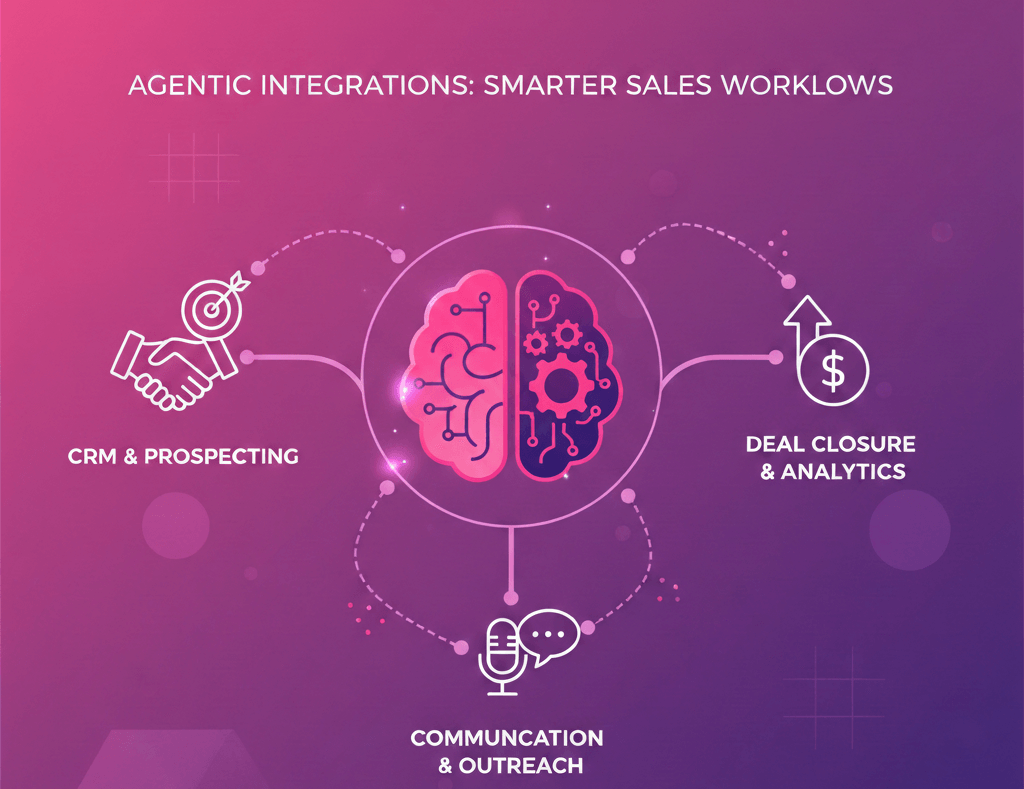
In the rapidly evolving landscape of 2026, the transition from traditional automation to agentic workflows represents a fundamental shift in sales operations. While standard “if-this-then-that” logic has served RevOps teams for years, it often fails when faced with the nuance of human conversation and the complexity of multi-stage deal cycles. Agentic integrations bridge this gap. They move beyond simple data syncing to autonomous decision-making, where software agents observe CRM signals, reason through next steps, and execute tasks across your stack.
This guide provides a technical and operational breakdown of the best agentic integrations for sales workflows. We will examine how these systems connect, the architectural trade-offs involved, and how platforms like SalesCloser.ai are redefining performance through native agentic capabilities.
1. The Architecture of Agentic Sales Workflows
Before selecting a tool, it is vital to understand the underlying architecture. Traditional integrations are linear. Agentic integrations are iterative.
The Control Loop Model
An agentic integration operates on a “Reason-Act-Observe” loop. In a sales context, this might look like:
- Observe: The agent detects a “Closed Lost” deal in Salesforce due to “Budget.”
- Reason: It checks the prospect’s LinkedIn for a new funding round or a job change.
- Act: It triggers a personalized re-engagement sequence or schedules a discovery call.
API-First vs. Event-Driven
Most enterprise-grade agentic tools now leverage the Model Context Protocol (MCP) or similar standards. This allows agents to pull context from disparate sources—like a Slack thread, a Gong recording, and a HubSpot record—without requiring a heavy, custom-coded bridge for every interaction.
| Feature | Traditional Automation (RPA/Zapier) | Agentic Integration |
| Logic | Hard-coded rules | Dynamic reasoning |
| Data Handling | Structured data only | Structured & Unstructured |
| Error Handling | Fails on edge cases | Self-corrects or asks for help |
| Integration Depth | Surface-level API calls | Deep contextual access |
2. SalesCloser.ai: Leading the Native Agentic Shift
While many tools try to “bolt on” AI to existing frameworks, SalesCloser.ai builds from the ground up with a focus on autonomous performance. It is designed for teams that require more than just a chatbot; it provides full-cycle agents that manage discovery, demos, and scheduling.
Technical Deep Dive: The SalesCloser Agent
The core of SalesCloser.ai is its ability to conduct high-fidelity, multilingual discovery calls and screen-share presentations. This is achieved through a proprietary orchestration layer that minimizes latency—a critical factor in voice-based agentic sales.
- Knowledge Base Integration: Unlike generic LLMs, SalesCloser agents are grounded in your specific company data. You upload your playbooks, pricing sheets, and technical docs, and the agent uses this as its “source of truth.”
- Multilingual Fluidity: The platform supports over 32 languages with native-level fluency. This isn’t just translation; the agent understands regional business etiquette and nuances, which is a massive operational advantage for global teams.
- CRM Bi-Directionality: When a SalesCloser agent finishes a call, it doesn’t just send a transcript; it also sends a copy of the call recording. It updates specific CRM fields, scores the lead based on custom criteria, and triggers the next step in the sequence.
Why It Wins on Performance
SalesCloser.ai improves sales performance by removing the “top-of-funnel” bottleneck. By deploying agents capable of handling thousands of discovery calls simultaneously, human reps can focus exclusively on high-value negotiations and relationship building.
3. CRM Automation and Deal Intelligence
The CRM is the nervous system of any sales organization. Agentic integrations here focus on “Auto-Refining” the pipeline.
Microsoft Autogen & Dynamics 365
For Azure-native environments, Microsoft Autogen offers a framework for multi-agent collaboration. You can build a “Research Agent” that scours the web for prospect news and a “Writer Agent” that drafts the email.
- Operational Trade-off: High technical overhead. You need developers to maintain the agentic logic and ensure the agents don’t “hallucinate” deal updates.
Relevance AI
Relevance AI is a strong contender for teams that want to build custom agents with a low-code interface. It excels at “Lead Research” workflows.
- Integration Depth: It connects deeply with tools like Clay and Apollo. It can take a list of leads, find their latest 10-K filings, summarize the “Risk Factors,” and insert that summary into a Salesforce “Deal Intelligence” field.
4. AI-Augmented Outreach and Sequencing
Outreach is where most teams see the fastest ROI from agentic workflows. The goal is to move away from “Spray and Pray” toward “Hyper-Personalization at Scale.”
CrewAI for Complex Prospecting
CrewAI treats AI agents as a cohesive team. In a sales workflow, you might have:
- The Scout: Identifies companies matching your ICP.
- The Analyst: Finds specific pain points from public forums or social media.
- The SDR Agent: Crafts a sequence based on the Analyst’s findings.
Operational Reality
Integrating CrewAI requires an orchestration platform (like a Python environment or a managed service). It is powerful for “Long-Tail” sales, where research requirements are high but volume is manageable.
5. Governance, Controls, and Ethics
As agents gain more autonomy, governance becomes the primary concern for RevOps and IT leaders. You cannot have an agent offering a 90% discount just to close a deal.
The “Human-in-the-Loop” (HITL) Requirement
Every agentic integration should have defined confidence thresholds.
- High Confidence: The agent updates the CRM and sends the follow-up.
- Low Confidence: The agent flags the task for human review.
Security and Compliance
When deploying tools like SalesCloser.ai, look for SOC 2 Type II compliance and GDPR alignment. Since agents interact with PII (Personally Identifiable Information) during calls and emails, data encryption and “Right to be Forgotten” protocols must be built into the integration architecture.
6. Implementation Strategies: How to Start
Transitioning to agentic workflows is an iterative process. Avoid a “Big Bang” migration.
Step 1: Identify the Bottleneck
Is your team failing to follow up on inbound leads fast enough? Or is your CRM data constantly out of date? Choose one specific friction point.
Step 2: Define Agentic Roles
Don’t think in terms of “Tasks.” Think in terms of “Roles.”
- Role: The Lead Qualifier.
- Goal: Move a lead from “MQL” to “SQL” within 5 minutes of signup.
- Tools: SalesCloser.ai for the call, HubSpot for the record.
Step 3: Set Success Metrics
Measure the Agent vs. Human delta.
- Response Time: Agents typically reduce this from hours to seconds.
- Conversion Rate: Track if the AI-qualified leads move through the funnel at the same rate as human-qualified ones.
7. Operational Comparison of Top Tools
| Tool | Best For | Technical Complexity | Governance Controls |
| SalesCloser.ai | Full-cycle autonomous sales (Calls/Demos) | Low (No-code setup) | High (Configurable playbooks) |
| Microsoft Autogen | Custom Azure-based agent networks | High (Requires Python) | High (Role-based access) |
| Relevance AI | Data-heavy research & enrichment | Medium (Low-code) | Medium (Audit logs) |
| Tray.ai | Multi-SaaS workflow orchestration | Medium (Visual builder) | High (Enterprise-grade) |
| CrewAI | Collaborative multi-agent squads | High (Open-source) | Low (Depends on deployment) |
8. The Future: Agent-to-Agent Commerce
By the end of 2026, we expect to see the rise of “Agent-to-Agent” (A2A) interactions. Your Sales Agent (e.g., from SalesCloser.ai) will likely negotiate directly with a prospect’s “Procurement Agent.” This will require even deeper integrations into contract management systems (such as Ironclad) and finance tools (such as NetSuite).
Frequently Asked Questions (FAQs)
What is an “Agentic” integration?
An agentic integration is a system where an AI agent has the autonomy to complete a multi-step workflow. Unlike a standard integration that just moves data from Point A to Point B, an agentic integration involves the AI making decisions based on the data it encounters.
How does SalesCloser.ai differ from a standard chatbot?
Standard chatbots are reactive and text-based. SalesCloser.ai agents are proactive and multi-modal. They can initiate phone calls, conduct Zoom demos with screen-sharing, and follow up autonomously across different channels. They use a reasoning engine to handle objections rather than following a fixed script.
Can AI agents replace my entire sales team?
No. The goal is “Augmentation.” AI agents handle high-volume, repetitive tasks—such as initial qualification, data entry, and scheduling. This allows your human reps to focus on the “Closing” phase, complex negotiations, and building deep enterprise relationships.
Are these integrations secure for enterprise data?
Yes, provided you choose the right platforms. Enterprise-ready tools like SalesCloser.ai follow SOC 2 standards and provide granular controls over which data agents can access. Always ensure your AI agents have “Least Privilege” access to your CRM.
How do I prevent an AI agent from “hallucinating” or making mistakes?
The best way to prevent errors is through Grounded Knowledge. By connecting the agent to your actual company documentation (PDFs, URLs, and playbooks), the agent relies on facts rather than its general training data. Additionally, setting up “Human-in-the-Loop” triggers for sensitive deal stages adds a layer of safety.
What is the ROI of agentic sales workflows?
ROI typically comes from three areas:
- Increased Lead Velocity: Responding to leads in seconds increases conversion.
- Reduced Overhead: You can scale your outreach without hiring more SDRs.
- Data Integrity: Agents ensure every interaction is logged accurately in the CRM, enabling better forecasting.