
Sales. It’s a game of skill, persistence, and often, quick thinking. Every sales professional knows the sting of a deal stalling because of a familiar objection. “It’s too expensive.” “Now isn’t a good time.” “We’re happy with our current provider.” These aren’t just words; they’re roadblocks, stopping your pipeline dead. But what if you could transform these hurdles into stepping stones? What if you could turn objection handling from an inconsistent art into a data-driven science? That’s where an AI Agent to overcome common sales objections steps in, changing the game entirely.
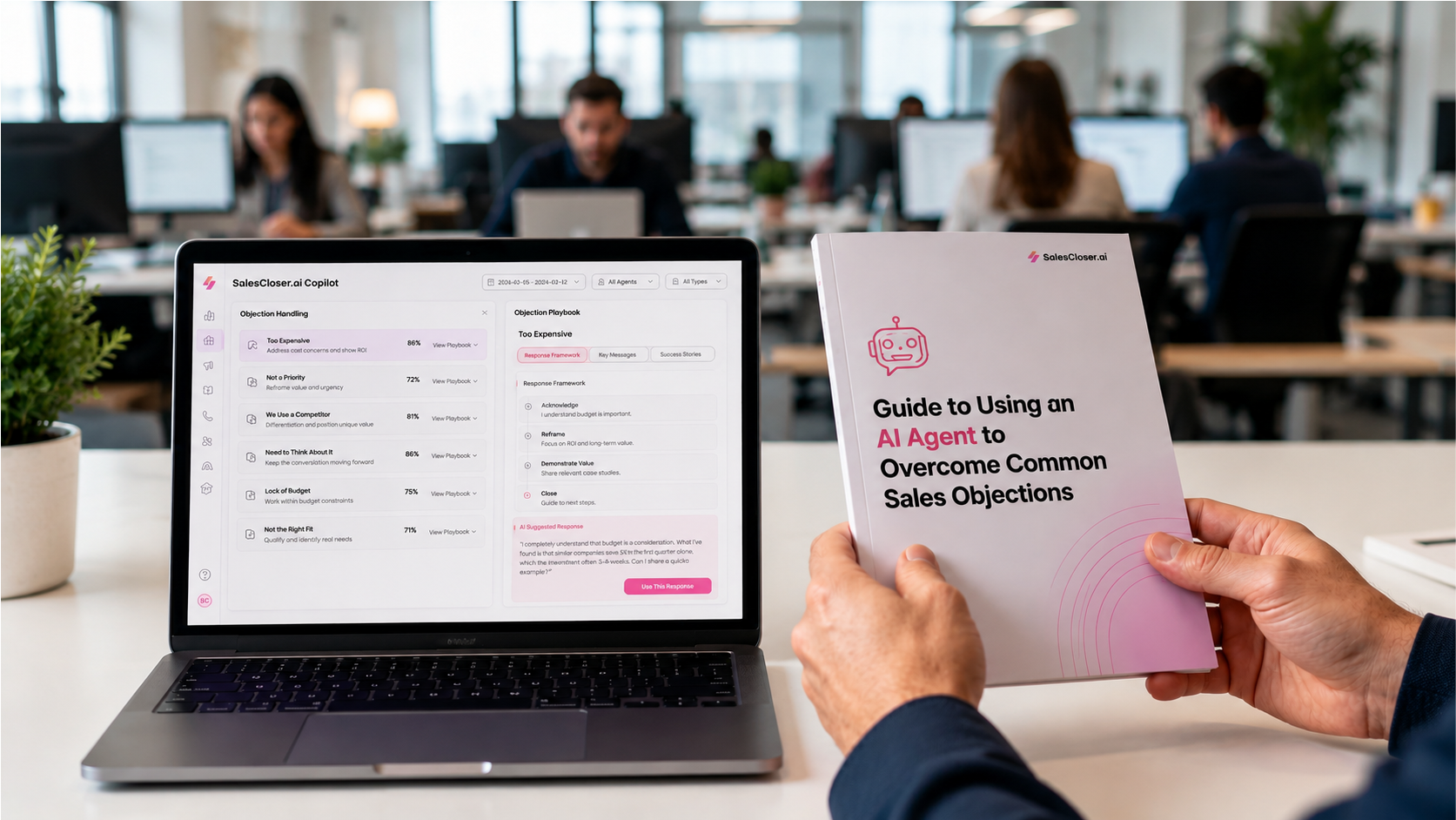
This isn’t about replacing your sales team, far from it. This is about equipping them with a potent tool. Imagine having an assistant who never gets tired, forgets a key talking point, and can analyze vast amounts of data in real time to deliver the perfect response. That’s the promise of AI in sales. It’s about achieving unmatched consistency, empathy, and persistence in every customer interaction.
Let’s explore how AI Agents can systematically dismantle the most common sales objections. We’ll explore practical strategies for programming and deploying these agents. The goal is not just to answer questions but skillfully pivot conversations, qualify leads, and convert more prospects into appointments.
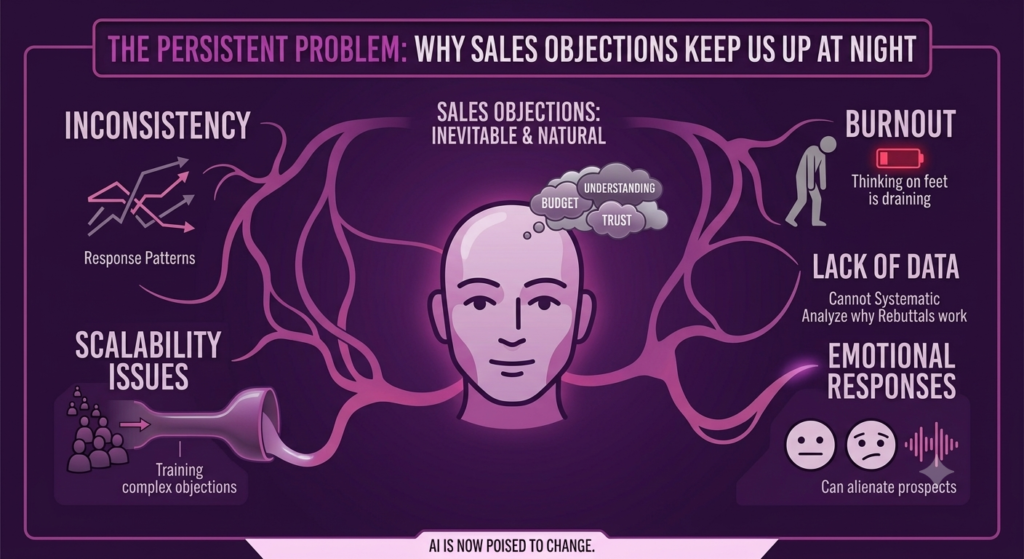
The Persistent Problem: Why Sales Objections Keep Us Up at Night
Before we talk solutions, let’s acknowledge the problem. Sales objections are inevitable. They are a natural part of the buying process. Prospects have genuine concerns, budget limitations, or a lack of understanding about your offering.
For a long time, handling objections relied heavily on individual sales talent. A seasoned salesperson develops an intuition, a sixth sense for what to say and when. They learn from experience, from successes and failures. However, this approach has its limitations:
- Inconsistency: Not every salesperson has the same level of experience or skill. Responses can vary wildly, leading to unpredictable outcomes.
- Burnout: Constantly facing rejection and thinking on your feet can be draining.
- Lack of Data: It’s hard to systematically analyze why specific rebuttals work better than others across a team.
- Scalability Issues: Training new sales reps to handle complex objections effectively takes time and significant resources.
- Emotional Responses: Human sales reps can get frustrated, impacting delivery and potentially alienating prospects.
These challenges mean valuable leads can slip through the cracks even with a great product. It’s a frustrating reality, but it’s a reality that AI is now poised to change.
AI for Sales: Transforming Objection Handling into a Science
Enter the AI Agent. Think of it as your most knowledgeable, patient, and data-driven sales expert. This isn’t a futuristic fantasy; it’s a present-day reality for many forward-thinking sales organizations. An AI Agent to overcome common sales objections isn’t just a chatbot. It’s a sophisticated system designed to understand context, analyze sentiment, and deliver highly relevant, persuasive responses.
How does it do this?
1. Data-Driven Insights
AI thrives on data. It can analyze thousands of past sales calls, email exchanges, and chat transcripts. This allows it to identify patterns:
- Common Objections: What are the most frequent roadblocks?
- Effective Rebuttals: Which responses actually led to a positive outcome?
- Timing: When in the sales cycle do specific objections typically arise?
- Customer Segments: Do different types of customers raise objections or respond better to particular approaches?
This deep analysis provides an objective, evidence-based foundation for your objection-handling strategy. You’re no longer guessing; you’re operating on facts.
2. Consistent and Empathetic Responses
One of the most significant advantages of an AI Agent is its unwavering consistency. Once programmed with the best responses, it delivers them perfectly, every single time. There’s no deviation, no bad days, no forgetting key benefits.
Furthermore, advanced conversational AI sales tools are designed to be empathetic. They can detect the tone and sentiment of a prospect’s voice or text. If a prospect sounds frustrated, the AI can be programmed to acknowledge that frustration before presenting a solution. This builds rapport, even in an automated interaction.
3. Real-Time Adaptation
Imagine a salesperson who can instantly access every product information, every case study, and every competitor analysis mid-conversation. That’s what an AI Agent can do. In a live interaction, whether by phone or chat, the AI can process the objection, cross-reference it with its vast knowledge base, and formulate a relevant, data-backed response in milliseconds. This real-time adaptation is crucial for navigating complex or unexpected objections.
4. Automated Lead Qualification
Beyond just handling objections, an AI Agent can significantly improve automated lead qualification. As it interacts with prospects, it gathers information. It can ask targeted questions based on the conversation flow. For example, if a prospect brings up budget concerns, the AI can follow up with questions about their current spending or the ROI they expect. This allows it to determine if a lead truly fits your ideal customer profile and is genuinely interested, before passing them to a human sales rep. This saves your team valuable time, allowing them to focus on truly qualified opportunities.
Strategies for Programming and Deploying Your AI Agent
Implementing an AI Agent to overcome common sales objections isn’t a “set it and forget it” process. It requires careful planning and ongoing refinement. Here’s a step-by-step approach to programming and deploying these powerful tools:
1. Identify Your Most Common Objections
Start by collecting data from your existing sales interactions. Review call recordings, CRM notes, and email threads. What are the recurring themes? Group these objections into categories. Common examples include:
- Price Objections: “It’s too expensive,” “We don’t have the budget,” “Your competitor is cheaper.”
- Timing Objections: “Now isn’t a good time,” “Call me back next quarter,” “We’re busy.”
- Competitor Objections: “We’re already using [Competitor Name],” “We’re happy with what we have.”
- Need Objections: “We don’t need that,” “I don’t see the value,” “Our current process works fine.”
- Authority Objections: “I need to talk to my boss,” “I’m not the decision-maker.”
List these out. This forms the foundation of your AI agent’s knowledge base.
2. Develop Winning Sales Rebuttal Techniques
For each identified objection, craft several effective rebuttal techniques. This is where you leverage your best human sales talent. What are your top performers saying? What truly resonates with prospects?
Consider these principles for your rebuttals:
- Acknowledge and Validate: Start by acknowledging the prospect’s concern. “I understand budget is a key consideration.”
- Reframe the Value: Shift the focus from cost to value, ROI, or the cost of inaction. “While our solution might seem like an investment, consider the long-term savings and increased efficiency it provides.”
- Provide Social Proof: Use testimonials, case studies, or statistics. “Many of our clients initially felt the same way, but after implementing our system, they saw an average of 30% reduction in operational costs.”
- Ask Probing Questions: Dig deeper to understand the root cause of the objection. “What specific concerns do you have about the price?” or “What challenges are you currently facing with your existing solution?”
- Offer Solutions/Alternatives: Can you offer different pricing tiers, payment plans, or a phased implementation?
Document these rebuttals thoroughly. This becomes the script for your AI.
3. Build a Comprehensive Knowledge Base
Your AI Agent needs a vast amount of information from which to draw. This includes:
- Product Information: Detailed features, benefits, specifications.
- Pricing Structures: Clear explanations of different packages and what they include.
- Competitor Analysis: How do you stack up against the competition? What are your unique selling propositions?
- Case Studies and Testimonials: Real-world examples of success.
- FAQs: Answers to common questions beyond just objections.
- Industry Data: Relevant statistics or trends that support your value proposition.
Organize this information in an easily searchable format. This powers the AI’s ability to provide contextually relevant answers.
4. Design Conversation Flows
An AI Agent doesn’t just blurt out answers. It follows a carefully designed conversation flow. For each objection, map out the potential paths:
- Initial Objection: “It’s too expensive.”
- AI’s First Response: Acknowledge and reframe the value.
- Prospect’s Reply: (e.g., “But we really don’t have the budget right now.”)
- AI’s Second Response: Probing question, offer payment options.
- Prospect’s Reply: (e.g., “What kind of ROI can we expect?”)
- AI’s Third Response: Provide specific ROI data and a relevant case study.
These flows need to be robust enough to handle various responses from the prospect while guiding them towards a positive outcome – ideally, an appointment or a deeper qualification.
5. Integrate with CRM and Sales Automation Software
Your AI Agent needs to be integrated with your existing sales tech stack for maximum effectiveness. This includes:
- CRM (Customer Relationship Management): The AI should log all interactions, update lead status, and add notes to prospect profiles. This ensures a seamless handover to a human sales rep.
- Sales Automation Software: The AI can trigger follow-up emails, schedule appointments directly, or send relevant marketing materials based on the conversation. This extends the AI’s influence beyond the immediate interaction.
This integration ensures that the AI’s efforts are not isolated but contribute directly to your sales process and data.
6. Train, Test, and Refine Your AI
AI models learn and improve over time. Start by training your AI with your carefully prepared data. Then, rigorously test it. Run simulations, role-play scenarios, and even conduct pilot programs with actual (but non-critical) prospects.
- Monitor Performance: Track key metrics, such as objection handling success rates, lead qualification rates, and appointment setting rates.
- Analyze Failures: When the AI struggles, identify why. Was the information unclear? Was the conversation flow insufficient?
- Iterate and Improve: Continuously feed new data back into the system. Update scripts, add new knowledge, and refine conversation flows based on real-world interactions. This iterative process is key to maximizing the AI’s effectiveness.
Overcoming Specific Objections with Your AI Agent
Let’s look at how an AI Agent can overcome common sales objections and tackle some of the most prevalent deal-breakers:
A. Handling Price Objections (“It’s too expensive”)
Price is almost always a factor. An AI Agent can approach this with logic and data:
- Acknowledge and Reframe: “I understand cost is a significant factor in any investment. Many of our clients initially felt the same way.” The AI can then pivot, “However, they quickly realized our solution isn’t just an expense; it’s a strategic investment that delivers substantial ROI.”
- Value Proposition Deep Dive: The AI can instantly pull up specific features that justify the price, explaining how each feature translates into benefits like increased efficiency, reduced errors, or higher revenue.
- ROI Calculators: Some advanced AI agents can even perform simple ROI calculations on the fly, asking for a few data points from the prospect and showing potential savings or gains. “Based on your current operational costs, our solution could save you X dollars annually by automating Y processes.”
- Tiered Options: If programmed, the AI can present different pricing tiers or payment plans, helping to find a solution that fits the prospect’s budget while still delivering core value.
- Cost of Inaction: AI can subtly highlight the costs associated with maintaining the status quo, such as lost opportunities, continued inefficiencies, or competitive disadvantages.
B. Countering Timing Issues (“Now isn’t a good time”)
This objection often hides a deeper issue or a lack of perceived urgency. An AI Agent can address it with persistence and value:
- Automated Follow-ups: This is where the AI truly shines. If a prospect says, “Call me back next quarter,” the AI can schedule that follow-up automatically. In the interim, it can send targeted, valuable content, a case study demonstrating immediate results, an industry report highlighting urgency, or a quick video explaining a specific pain point your solution addresses. This keeps your brand top-of-mind without being pushy.
- Probe for the Real Reason: “I understand you’re busy and appreciate your honesty. To help me best prepare for our next conversation, could you share what specific priorities are occupying your time right now?” This question helps the AI understand if it’s genuinely a bad time or if there’s a deeper objection masked as timing.
- Highlight Quick Wins: The AI can quickly articulate how your solution can deliver immediate benefits or solve an urgent problem the prospect might not realize they have. “Even a quick 15-minute demo could show you how to streamline [specific task] by X% this week.”
- Offer Flexible Engagement: Suggest different ways to engage. “Perhaps a quick, five-minute overview of our most impactful feature would be more suitable now?”
C. Navigating Competitor Objections (“We’re happy with a competitor”)
This means the prospect is already solving their problem, but perhaps not optimally. Your AI Agent needs to articulate superior value:
- Acknowledge and Differentiate: “It’s great to hear you have a solution. Many of our clients also used [Competitor Name] before switching.” The AI can then pivot, “What they often found was that while [Competitor Name] handles X, our platform truly excels in Y, offering [specific unique benefit].”
- Highlight Gaps: Based on its knowledge base, the AI can ask targeted questions to uncover potential weaknesses in the competitor’s offering that your solution addresses. “Are you finding any challenges with [common competitor weakness]?” or “How effectively does your current system handle [specific problem your solution solves particularly well]?”
- Feature-Benefit Comparison: The AI can instantly provide a concise, data-backed comparison, focusing on your distinct advantages and their benefits. “While [Competitor Name] offers A and B, we provide A, B, and a proprietary C feature which leads to [tangible outcome].”
- Pilot Programs or Free Trials: The AI can offer a low-commitment way to experience your solution firsthand. “We often find that seeing our solution in action reveals its true power. Would you be open to a personalized demo focusing on areas where you might be looking for more robust capabilities?”
D. Addressing Need Objections (“We don’t need that,” “I don’t see the value”)
This often indicates that the prospect doesn’t fully understand their problem or your solution’s relevance. Your AI needs to educate and create urgency:
- Problem-Solution Framing: The AI can start by asking about current challenges. “Many businesses in your industry face issues with [specific pain point]. How are you currently handling that?”
- Educate on Industry Trends: Provide data or insights on how the market changes and how your solution helps them stay ahead. “With the increasing complexity of [industry challenge], companies that leverage [your solution’s capability] are seeing X% better results.”
- Personalized Value Proposition: Based on any information gathered, the AI can articulate how your solution directly addresses their unique business context. “Given your focus on [prospect’s stated goal], our platform could help you achieve [specific benefit] by [method].”
- Show, Don’t Just Tell: The AI can suggest a personalized demo or a relevant case study that vividly illustrates the value.

Beyond Basic Objections: Advanced Capabilities of AI Sales Agents
The power of an AI Agent to overcome common sales objections extends far beyond simply scripting answers. Advanced platforms offer capabilities that truly transform the sales process:
1. Live Phone and Video Call Navigation
Imagine an AI agent participating in actual sales calls. This isn’t science fiction. Platforms like SalesCloser.ai allow AI agents to use live phone and video calls.
- Real-time Rebuttals: The AI listens, understands the spoken objection, and provides the perfect, scripted response in real time. The AI can deliver this directly or whisper suggestions to a human sales rep.
- Sentiment Analysis: During a live call, the AI can analyze the prospect’s tone of voice and sentiment. If the prospect sounds hesitant, frustrated, or excited, the AI can adapt its response accordingly, ensuring an empathetic and effective interaction.
- Dynamic Information Retrieval: If a prospect asks an obscure question about a product feature, the AI can instantly pull the exact answer from its knowledge base, providing accurate information without delay.
- Automated Note-Taking: While conversing, the AI can simultaneously take detailed notes, updating the CRM with key points, objections raised, and next steps. This frees up the human rep to focus entirely on the conversation.
2. Personalized Demos to Preempt Objections
Proactively addressing value-based concerns before they even become objections is a powerful strategy. AI can facilitate this through personalized demo experiences:
- Pre-Demo Qualification: An AI Agent can conduct a brief pre-demo qualification call or chat, gathering information about the prospect’s specific needs, pain points, and goals.
- Tailored Demo Content: Based on this information, the AI can help generate or suggest a highly personalized demo script or a recorded demo video highlighting the most relevant features and benefits for that specific prospect. For example, the AI-curated demo will heavily feature integration capabilities if the prospect is concerned about integration.
- Interactive Demo Experiences: Some platforms allow AI to guide prospects through interactive demos. The AI can answer questions and provide real-time context as the prospect explores the product, making the demo more engaging and effective.
3. Continuous Learning and Optimization
The best AI Agents are always learning. Every interaction provides new data.
- Feedback Loops: Human sales managers can provide feedback on AI interactions, marking responses as effective or ineffective. This data further trains the AI.
- A/B Testing of Rebuttals: AI can automatically test different versions of rebuttals to see which ones perform best, then automatically adopt the most successful approaches. This continuous optimization leads to ever-improving sales scripts and outcomes.
- Identifying Emerging Objections: As markets evolve, new objections may arise. AI can spot these trends faster than human analysis, allowing you to develop new rebuttal strategies proactively.
SalesCloser.ai: Your Premier Platform for AI-Powered Objection Handling
You need a platform built for this specific challenge to deploy an AI Agent to overcome common sales objections effectively. This is where SalesCloser.ai shines. It’s engineered to transform your sales pipeline by providing cutting-edge AI capabilities designed to navigate objections in real-time, ensure persistent follow-up, and deliver deeply personalized experiences.
SalesCloser.ai empowers your sales team by:
- Excelling in Live Phone and Video Calls: SalesCloser.ai agents are not static chatbots. They actively participate in live conversations, understanding context, detecting sentiment, and delivering perfectly timed, empathetic responses to objections. This means your leads get the correct information, every time, even when your human reps are busy.
- Using Automated Follow-ups to Counter Timing Issues: The platform addresses “now isn’t a good time” with intelligent, automated follow-up sequences. SalesCloser.ai ensures that valuable leads are nurtured with relevant content and timely reminders, keeping them engaged until they are ready to proceed. It turns a temporary delay into a future opportunity.
- Delivering Personalized Demos to Preempt Value-Based Concerns: SalesCloser.ai helps you create and deploy personalized demo experiences. By understanding prospect needs through pre-qualification, the AI tailors demo content to highlight the most relevant features and benefits, effectively addressing potential value objections before they even surface. This builds more substantial perceived value from the outset.
- Skillfully Pivoting Conversations and Qualifying Leads: SalesCloser.ai agents are programmed to answer questions and guide the conversation. They ask insightful follow-up questions, gather critical information, and consistently qualify leads. This ensures that when a lead reaches a human sales rep, they are genuinely interested and well-informed, drastically increasing appointment-setting rates.
- Improving Sales Script and Rebuttal Techniques: Through continuous learning and data analysis, SalesCloser.ai helps refine your sales scripts and objection-handling rebuttals. It identifies which approaches are most effective, allowing you to optimize your strategies and achieve higher conversion rates across the board.
SalesCloser.ai transforms potential deal-breakers into qualified appointments. It’s not just a tool; it’s a strategic partner that helps you build a more robust, predictable, and successful sales pipeline.
The Future is Here: Increase Appointment Setting Rates and Sales Efficiency
The sales landscape is constantly evolving. Customers are more informed, and competition is fierce. Relying solely on traditional methods for objection handling is no longer sustainable for consistent growth.
You gain a significant competitive edge by integrating an AI Agent to overcome common sales objections in your strategy. You achieve:
- Higher Appointment Setting Rates: By skillfully addressing initial objections and consistently qualifying leads, AI agents ensure that more prospects move through your funnel to the appointment stage.
- Improved Sales Efficiency: Your human sales team can focus on closing deals and building relationships with highly qualified leads, rather than spending valuable time on initial qualification and objection handling.
- Enhanced Customer Experience: Prospects receive consistent, accurate, and empathetic responses, building trust and a positive perception of your brand.
- Data-Driven Optimization: Every interaction becomes a learning opportunity, allowing you to refine your sales processes and continuously improve outcomes.
- Scalability: You can handle more leads without proportionally increasing your human sales force, making your growth more sustainable.
The question isn’t whether to use AI in sales but how quickly you can effectively implement it. Using an AI Agent to overcome common sales objections is no longer a luxury; it’s a necessity for any sales organization serious about maximizing its potential. It’s time to stop letting common objections stall your pipeline and start using AI to turn every “no” into a potential “yes.”