“Streamline your workflow with AI decision engines for sales. Automate lead routing, prioritization, and next-best actions to close more deals.”
Sales teams face a massive challenge in today’s fast-paced market. They possess too much raw data and too little actual time. Leads pour in constantly from webinars, website forms, outbound campaigns, and social media channels. Sales representatives spend countless hours deciding whom to call first. They dig endlessly through bloated lead management systems. They guess what message might work best for a specific prospect. This manual repetitive work drains their energy. Consequently, it costs companies valuable deals. You need a drastically better way to manage this complex flow. Enter the AI decision engine for sales.
This article will break down how modern organizations build and use these probust systems. We will explore how an AI decision engine moves your team beyond simple automation. We will look at actual intelligent, rule-based orchestration. Furthermore, we will show you how to map your sales processes effectively. You will learn to create automated rules for lead routing, prioritization, and determining the exact next-best action. Finally, we will show how a platform like SalesCloser.ai serves as the conversational core of this setup, driving significant performance improvements.
The Evolution of Sales Process Automation
For years, sales organizations relied on basic CRM automation rules. These early systems operated on simple, rigid logic. If a prospect downloaded a whitepaper, the system sent an automated “thank you” email. If a company listed over 500 employees on a form, the system assigned that prospect to the enterprise team. We referred to this baseline capability as sales process automation. It provided value for a long time.
However, these traditional setups fall apart as companies grow. A basic rule-based sales engine lacks context. It cannot understand a buyer’s actual intent or urgency. When you generate thousands of leads a month, simple “if-then” rules create massive traffic jams in your pipeline. Modern sales operations automation requires something much more sophisticated. It requires intelligent orchestration that adapts in real-time.
Why Simple CRM Rules Fail at Scale
Simple CRM automation rules treat every action equally. A CEO downloading a pricing guide triggers the same workflow as a college student downloading a research paper guide. The old systems lack the intelligence to tell the difference. Therefore, your sales reps waste hours calling unqualified prospects. Meanwhile, the actual high-value buyers wait in the queue and eventually turn to your competitors.
Furthermore, basic rules require constant manual updating. As your product lines expand, your routing rules become a tangled mess. Sales operations managers spend their entire days fixing broken workflows instead of building strategic campaigns. You cannot run a high-performing revenue team on outdated technology. You must transition to a system that thinks, adapts, and decides.
What is an AI Decision Engine for Sales?
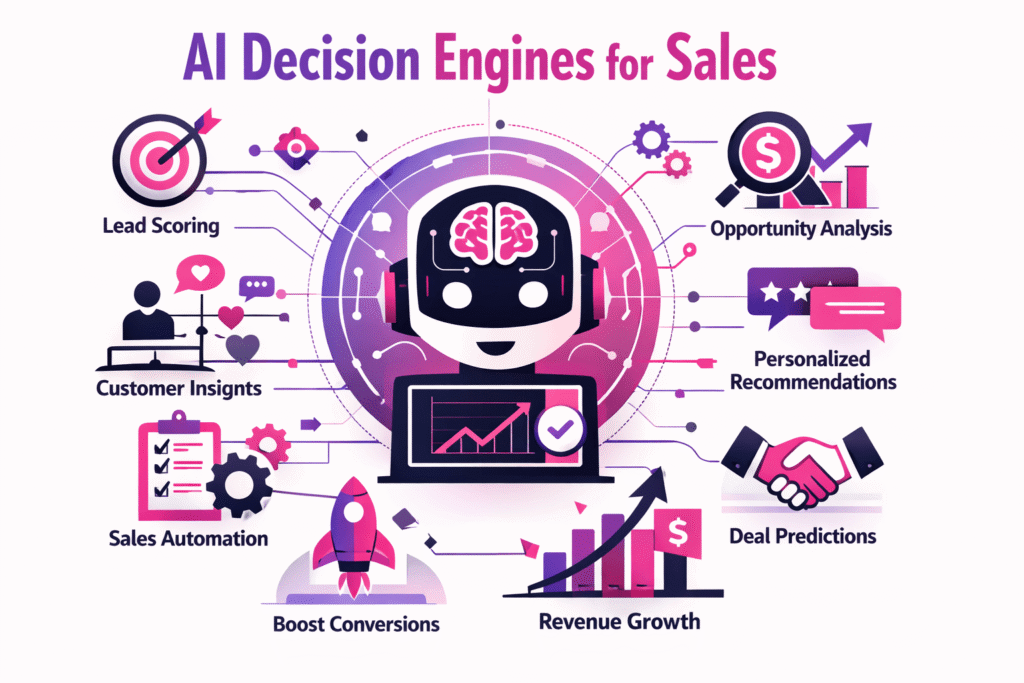
An AI decision engine for sales acts as the central brain of your revenue operation. It connects all your disparate data points. It analyzes every customer interaction instantly. Then it decides the exact right move for your team. This technology powers actual AI sales orchestration. It does not just move data from one field to another. It analyzes the data context to drive revenue.
The Core Components of the Engine
To understand how this system works, you must look at its four primary components.
1. Data Ingestion Layer First, the engine needs data. It connects to your CRM, website analytics, email platform, and call recording software. It pulls all this information into one central hub. The system constantly monitors for new inputs and updates.
2. Intent Analysis Module Next, the engine analyzes the data for intent. It looks beyond simple demographics. It tracks behavioral signals. Did the prospect visit the pricing page three times today? Did they watch a full demo video? The intent module scores these actions to gauge how close the prospect is to making a purchase.
3. The Rules and Logic Center. This component serves as the traffic cop. You configure the parameters, but the AI manages the execution. It takes the data and the intent score, and it runs them against your business logic. This center decides who gets the lead, when they get it, and what they should do with it.
4. The Execution and Action Layer Finally, the engine takes action. It updates the lead management system. It pings the sales rep on Slack. It sends an automated follow-up email on behalf of the rep. It handles the manual execution so your human team can focus on actually selling.
Automated Lead Routing: Getting the Right Lead to the Right Rep
Speed wins in modern sales. If a high-intent buyer requests a software demo, waiting four hours to respond kills the deal. Automated lead routing guarantees that the best lead reaches the most qualified representative instantly.
The Problem with Round-Robin Distribution
Old systems rely heavily on round-robin distribution. A round-robin system simply takes the next sales rep in line and assigns them the newest lead. It ignores the rep’s specific skill set. It ignores the prospect’s industry. It ignores the potential deal size.
Consequently, your newest junior rep might receive a massive enterprise lead that they do not know how to close. Meanwhile, your veteran enterprise rep might get assigned a tiny account that barely meets the minimum threshold. This method frustrates your team and hurts your conversion rates.
Transitioning to Skill and Intent-Based Routing
An AI decision engine completely transforms this dynamic. It utilizes intelligent automated lead routing. When a lead enters the system, the engine reviews the firmographic data. It checks the company size, the industry, and geographic location. Simultaneously, it reviews the intent score.
Then, it routes the lead to the representative with the highest historical win rate for that specific buyer profile. If a healthcare company from Germany requests a demo, the engine bypasses the general queue. It assigns the lead directly to your top-performing European healthcare specialist. This targeted approach significantly increases your chances of closing the deal.
Handling Unavailability and Routing Exceptions
Even the best automated lead-routing rules fail when a rep is out sick or on vacation. An intelligent engine monitors calendar availability in real time. If the designated specialist is out of the office, the system prevents the lead from sitting untouched. It automatically triggers a fallback rule. It routes the prospect to the following best available representative. It ensures that every hot lead receives an immediate human response.
Prioritization: Sorting the Signal from the Noise
Once leads successfully land in a representative’s queue, the next major hurdle appears. Who do they call first? Proper prioritization separates top-performing sales teams from average ones.
Moving Beyond Static Lead Scoring
A standard sales enablement platform usually provides a static lead score. It might give a prospect a score of 75. But what does 75 actually mean to a busy sales rep? Static scores decay quickly. A prospect might hit a score of 75 on Monday, but by Thursday, they have already signed with a competitor.
An AI decision engine looks much deeper. It utilizes dynamic prioritization. It continuously tracks engagement across all channels. It monitors subtle buying signals. As a result, it pushes the hottest, most active leads to the top of the list in real time.
Factors Driving AI Prioritization
The engine considers multiple complex factors to effectively prioritize a list.
First, it looks at recency. A prospect who opened an email five minutes ago holds much more value than a prospect who attended a webinar three weeks ago. The AI spots the immediate activity and flags the rep to strike while the iron is hot.
Second, it analyzes executive engagement. If a junior analyst visits your website, the engine registers the activity. However, if the Chief Financial Officer from the same company visits the website, the engine immediately spikes the priority score. It understands that executive involvement signals a real buying initiative.
Third, it factors in historical success patterns. The engine constantly learns from closed-won deals. Prospects who read a specific case study are 40% more likely to close. Therefore, when a new prospect reads that same case study, the engine automatically prioritizes them over others.
Next-Best-Action Sales: Guiding Reps to the Close
After the engine routes the lead and prioritizes the list, the actual selling begins. This brings us to the critical concept of next-best-action sales. Sales representatives frequently struggle to decide exactly what to do next with a prospect. Should they make a phone call? Should they send a personalized LinkedIn message? Should they email a technical whitepaper?
Removing the Guesswork from Sales
The AI decision engine removes this guesswork entirely. It tells the representative exactly what action will yield the absolute best result at that specific moment. It analyzes millions of data points from past successful deals to identify winning patterns.
For example, a prospect might stall after receiving a pricing proposal. A human rep might just send a generic “just checking in” email. These emails rarely work. The AI decision engine, however, recognizes the stall pattern. It suggests a next-best-action sales approach. It prompts the rep to send a concrete ROI calculator instead. It knows that this particular asset breaks through pricing objections based on historical data.
Integrating with Your Sales Enablement Platform
To execute these actions smoothly, the engine connects directly with your sales enablement platform. When the AI recommends sending a case study, it does not make the rep search for it. It surfaces the exact document right inside the CRM.
Furthermore, the engine drafts the suggested email context. It pulls in data from previous conversations. It personalizes the messaging automatically. The sales representative simply reviews the suggestion, makes minor tweaks, and hits send. This drastically reduces administrative time. It allows reps to spend more hours actually talking to buyers.
Mapping Your Sales Process for Automation
You cannot automate a fundamentally broken process. Before you plug in an AI decision engine, you must map your sales workflow thoroughly. Sales workflow automation requires clear, logical, and documented steps. If you skip this phase, you will simply scale your current inefficiencies.
Step 1: Document the Current State
Start by understanding exactly how things work right now. Shadow your best-performing sales representatives. Find out what they do differently from the rest of the team. Identify exactly where leads get stuck in the pipeline. Look for tedious manual tasks that waste valuable selling time.
Write down every single step a lead takes from the first touchpoint to the final closed-won signature. Do not leave out the small details. You must understand the baseline before you can improve it.
Step 2: Identify the Bottlenecks
Once you map the current state, look for the blockages. Where do leads sit untouched for days? Where do deals fall apart most frequently?
Perhaps your business development reps spend four hours a day manually researching company sizes before routing leads. That represents a massive bottleneck. Your account executives may fail to follow up on proposals after three days. That means a critical leakage point. You must identify these issues to know what rules to build into your AI decision engine.
Step 3: Define the New Automated Rules
Now, you build the logic for your engine. You create the “if-then” scenarios that the AI will manage dynamically.
Start with routing. Define your territories clearly. Define your skill sets. Create a rule that says: “If company revenue > $50M AND intent score > 80, route immediately to Senior Enterprise Team.”
Next, define your prioritization rules. “If a prospect opens an email three times in one hour, boost their lead score by 20 points and send an immediate Slack alert to the account owner.”
Finally, define the next-best-action triggers. “If a prospect goes completely silent for 14 days after a demo, automatically enroll them in the ‘re-engagement’ email drip campaign.”
Step 4: Test and Refine
Do not turn the engine on for the entire sales floor all at once. Start small. Roll out the sales process automation to a pilot group of trusted representatives. Monitor the automated lead routing closely. Ensure the system assigns leads accurately.
Gather feedback from the pilot team. Are the next-best-action recommendations actually helpful? Is the dynamic prioritization accurate? Use this feedback to refine your rules. Adjust the scoring models. Tweak the routing logic. Only after you prove success in the pilot phase should you deploy the engine across the entire organization.
SalesCloser.ai: The Conversational Core of Your Engine
We have discussed how the AI decision engine processes data and executes rules. However, we must address a critical question: how do you gather the rich, high-quality data needed to fuel this engine in the first place? Web forms and email clicks only tell half the story. To truly orchestrate your sales process, you need deep conversational intelligence.
This is where you implement a powerful tool like SalesCloser.ai. You can view SalesCloser.ai as the conversational core of your entire AI decision engine.
AI Agents on the Front Lines
SalesCloser.ai provides advanced AI agents that handle actual, real-time conversations with your prospects. We are not talking about simple, rule-based chatbots that frustrate website visitors. These sophisticated AI agents engage dynamically. They ask intelligent, qualifying questions. Most importantly, they listen carefully to the prospect’s answers and gauge their true intent.
These agents can manage discovery calls. They can handle initial inbound inquiries. They speak naturally and adapt to the flow of the conversation. As they talk with the prospect, they continuously extract structured data. They capture budget constraints, timelines, pain points, and technical requirements.
Triggering the Engine with Conversational Data
The data and intent gathered during the AI’s call become the primary, most powerful trigger for your automated engine. Let us look at how this works in practice.
Imagine a new prospect visits your website and initiates a conversation with a SalesCloser.ai agent. The AI agent asks about their current challenges. During the natural flow of the chat or voice call, the prospect mentions they have a $150,000 budget. They also state they need to implement a solution within the next 30 days to meet a compliance deadline.
The AI agent instantly processes these spoken data points. It recognizes the high budget and the tight timeline. It flags this prospect as a high-value, highly urgent enterprise lead.
Automating the High-Value Handoff
Because SalesCloser.ai integrates tightly with your AI decision engine, the workflow triggers instantly. The engine completely skips the standard, slow follow-up queue. It does not send the prospect to a junior development rep.
Instead, the decision engine automatically routes this high-value lead directly to your senior Account Executive. It checks the executive’s calendar availability in real-time. It automatically books a priority meeting for the next morning. It sends a calendar invite to both parties. Finally, it sends a summary of the AI conversation directly to the executive, highlighting the budget and timeline. The engine automated a massive strategic decision securely and instantly.
Handling Low-Priority Leads at Scale
Conversely, the engine manages unqualified leads just as efficiently, saving your team countless hours.
Suppose another prospect talks to the SalesCloser.ai agent on the same day. The AI agent asks about their timeline. The prospect states they are simply researching options for a university project. They have no budget and no buying authority.
The AI agent accurately logs this conversational data. The AI decision engine processes this input immediately. Instead of clogging up a human representative’s pipeline and wasting their valuable time, the system acts. It automatically categorizes the lead as low-priority. It bypasses the sales team entirely. It then adds this prospect to a specific, automated nurture sequence in your marketing platform. The prospect receives helpful educational content automatically over the next six months.
Through SalesCloser.ai, you successfully automate key strategic decisions at scale. You ensure your expensive human talent only speaks to buyers who are ready to purchase.
Building Your Sales Operations Automation Strategy
Purchasing the technology represents only the first step. To succeed, you must build a comprehensive strategy around your new engine. You must manage the data, the technology, and, most importantly, the people.
Integrating the Tech Stack
An AI decision engine requires seamless connectivity. It must integrate with your CRM, marketing automation platform, email servers, and conversational AI tools, such as SalesCloser.ai.
Ensure you have clean APIs. Work closely with your revenue operations team to map the data flow. If your CRM data is a mess, your AI engine will make terrible decisions. The adage “garbage in, garbage out” applies heavily here. Spend the time cleaning your historical data before you turn the engine on. Standardize your industry fields. Clean up duplicate accounts. Ensure your lead management system operates smoothly.
Navigating Change Management
Sales representatives often resist new technology. They develop habits and routines. When you introduce a system that tells them who to call and what to say, they might push back. They might feel the system threatens their autonomy.
You must manage this change carefully. Do not position the AI decision engine as a tool to replace them. Position it as a tool to remove the parts of the job they hate. Show them how automated lead routing eliminates manual research. Show them how dynamic prioritization helps them hit their quota faster.
Involve your best representatives in the rule-building process. When they see their own successful strategies built into the engine’s next-best-action recommendations, they will adopt the tool much faster.
Measuring the ROI of Sales Orchestration
You must track specific metrics to prove the value of your AI decision engine. Do not just look at top-line revenue immediately. Look at operational efficiency metrics first.
- Lead Response Time: Measure how quickly a prospect receives a relevant response after an inquiry. Automated routing should drop this from hours to minutes.
- Rep Activity Ratios: Track how much time your reps spend selling versus doing administrative work. The engine should significantly increase the actual selling time.
- Conversion Rates by Stage: Monitor the conversion rate from the initial meeting to the proposal. Next-best-action recommendations should steadily improve this metric.
- Pipeline Velocity: Measure how fast deals move through your pipeline. Intelligent orchestration removes bottlenecks, causing deals to close faster.
By tracking these numbers, you can easily justify the investment in advanced sales operations automation. You can show leadership exactly how the technology impacts the bottom line.
The Future of the Rule-Based Sales Engine
We are just beginning to see the true potential of AI in sales operations. The current generation of AI decision engines relies on rules and supervised machine learning. However, the future holds even more predictive power.
Predictive Pipeline Management
Soon, these engines will not just react to lead behavior; they will predict it with high accuracy. The system will analyze market trends, economic indicators, and historical buyer data to forecast your pipeline months in advance. It will tell your sales managers exactly which reps need coaching and which specific skills they need coaching on.
Hyper-Personalization at Scale
The next-best-action capabilities will become hyper-personalized. The engine will not just suggest sending a specific case study. It will use generative AI to rewrite the case study on the fly, tailoring the particular ROI numbers and industry jargon perfectly to the prospect reading it.
Autonomous Deal Negotiation
While human relationships will always remain central to enterprise sales, AI agents will handle more of the transactional negotiation. Tools like SalesCloser.ai will negotiate standard contracts, handle security questionnaires autonomously, and manage the procurement process. This will free your senior executives to focus entirely on building strategic partnerships and managing complex, multi-stakeholder relationships.
The companies that adopt AI sales orchestration today will hold an insurmountable advantage tomorrow. They will operate faster, smarter, and much more efficiently than their competitors. They will secure the best leads, close deals quickly, and retain their top sales talent by providing the industry’s best tools.
Summary of Core Principles
To ensure you grasp the full scope of this methodology, let us review the fundamental principles of building an AI decision engine for your team.
- Move beyond basic automation: Simple “if-then” CRM rules fail at scale. You need an engine that understands context, intent, and historical data.
- Automate lead routing intelligently: Stop using round-robin. Route leads based on rep skill, territory expertise, and real-time availability.
- Prioritize dynamically: Static lead scores decay over time. Use real-time behavioral data and engagement metrics to push the hottest leads to the top of the queue.
- Prescribe the next-best action: Do not let reps guess their next move. Use AI to recommend the specific email, call script, or content asset with the highest mathematical probability of advancing the deal.
- Map your process before automating: Document every step of your workflow. Identify bottlenecks. Build your AI rules based on a thoroughly optimized process.
- Leverage conversational AI: Use advanced platforms like SalesCloser.ai to gather deep intent data during live conversations. Use this rich data to trigger your routing and prioritization rules instantly.
- Manage the human element: properly train your team. Frame the AI as an assistant, not a replacement—secure buy-in by showing them how the tool helps them earn more commission.
By sticking to these core principles, you can transform a chaotic, disorganized sales floor into a highly efficient, predictable revenue machine. You remove the friction from the buying process. You give your prospects immediate, relevant attention. You give your sales representatives the exact information they need to win.
FAQs
1. What is the difference between simple CRM automation and an AI decision engine?
Simple CRM automation relies on rigid, static rules (e.g., if a form is submitted, send an email). An AI decision engine uses real-time data, intent signals, and historical patterns to make dynamic decisions. It orchestrates complex workflows, dynamically scores leads, and recommends specific actions based on changing context rather than just executing fundamental triggers.
2. How does an AI decision engine improve lead routing?
It replaces blind round-robin distribution with intelligent, skill-based routing. The engine analyzes a new lead’s firmographics and intent, checks rep availability, and assigns the lead to the representative with the best historical win rate for that specific type. This ensures the most qualified person handles high-value prospects instantly.
3. What is “next-best-action” in sales?
Next-best-action sales is a methodology in which an AI system analyzes past successful deals to recommend the exact next step a rep should take. Instead of guessing, the rep receives a data-backed prompt to send a specific case study, make a phone call at a particular time, or address a specific pain point.
4. How does SalesCloser.ai integrate with an AI decision engine?
SalesCloser.ai acts as the conversational front line. Its AI agents handle actual calls and chats, extracting deep intent and qualification data (like budget and timeline). This conversational data acts as a powerful trigger for the decision engine. For example, the engine can use the AI agent’s findings to automatically book a priority meeting for a senior rep or route an unqualified lead to a nurture sequence.
5. Will an AI decision engine replace my sales team?
No. The engine is designed to handle administrative tasks, manual research, and complex routing logic. It removes the tedious work so your human representatives can spend more time building relationships, negotiating complex terms, and actually closing deals. It acts as an advanced assistant, not a replacement.
6. How do we prepare our current data for this transition?
You must clean your historical data before implementation. Audit your CRM to remove duplicate records, standardize industry fields, and ensure contact information is accurate. If you feed the AI engine messy, outdated data, it will make poor routing and prioritization decisions.
7. How long does it take to implement this technology?
Implementation timelines vary based on the complexity of your current setup. However, mapping your processes, defining rules, cleaning data, and running a pilot program typically takes between 60 and 90 days. We strongly recommend rolling it out to a small pilot team first before a full organizational deployment.