“Revolutionize your GTM strategy with AI-First Sales Enablement Tools that automate prospecting and execution to maximize your 2026 revenue.”
The sales landscape is shifting under our feet. If you look back at 2023 or 2024, sales enablement was a library. It was a collection of PDFs, pitch decks, and “how-to” videos buried in a central hub. Managers spent months building these playbooks. Then they spent even more time begging their reps actually to read them.
By 2026, that model is dead.
We are entering the era of AI-first sales enablement tools. This isn’t just about making content easier to find. It is about changing what “enablement” actually means. In the past, enablement meant teaching a human how to do a task. In 2026, enablement means giving that task to an AI agent so the human never has to touch it.
This shift will redefine Go-To-Market (GTM) strategies. Teams that cling to manual workflows will move too slowly to compete. Meanwhile, those adopting autonomous sales development will scale at speeds we once thought were impossible.
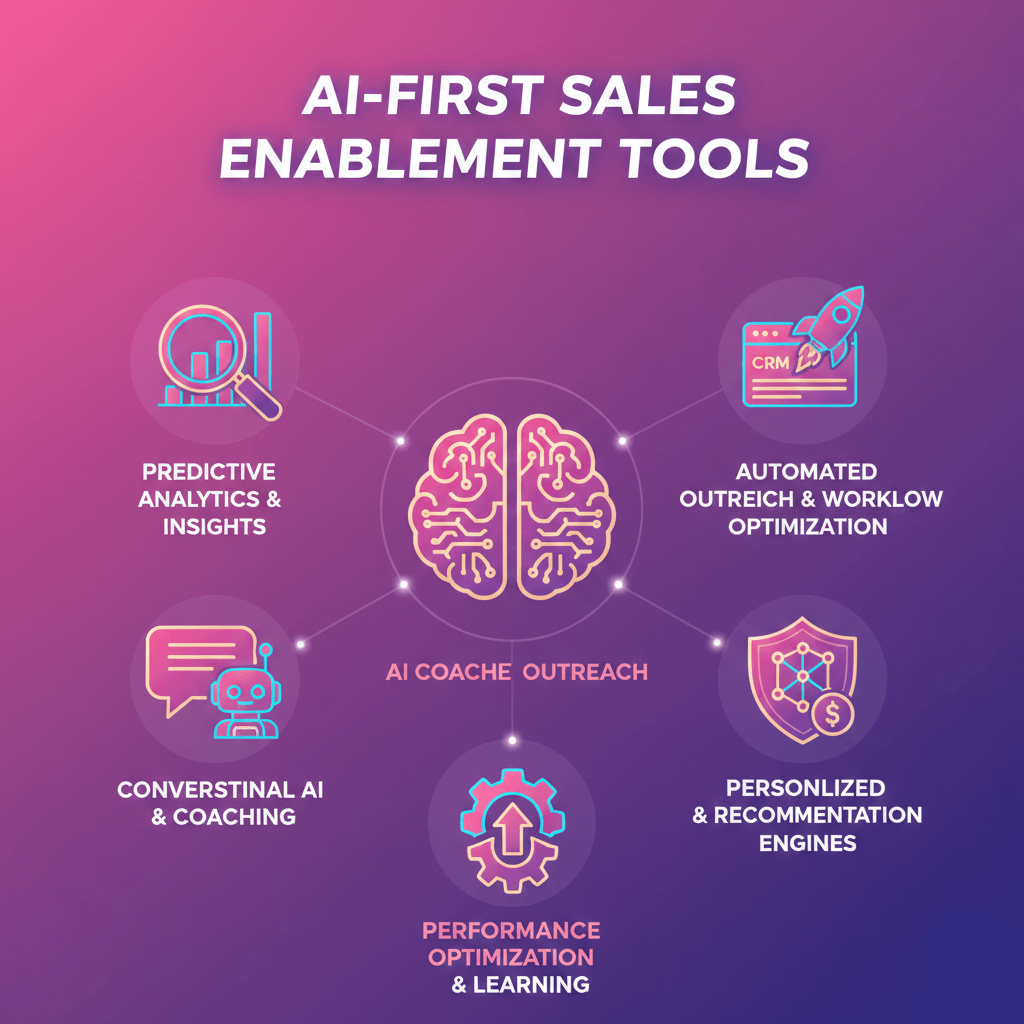
The Death of Static Enablement
Traditional sales enablement has a massive flaw: it relies on human memory and manual effort.
Think about the standard onboarding process for a New Business Representative. They spend two weeks in “boot camp.” They learn the product, the personas, and the scripts. Then they’re thrown into the wild to find leads, send emails, and book meetings.
What happens? They forget 70% of the training within a week. They spend 4 hours a day on “admin” tasks—researching prospects, cleaning CRM data, and formatting outreach. Only a tiny fraction of their day is spent on actual selling.
AI-First Sales Enablement Tools flip this script. Instead of teaching a rep how to research a lead, the AI does the research. Instead of teaching a rep how to write a cold email, the AI writes and sends it.
Why the Shift is Happening Now
Several factors are converging to make 2026 the year of AI dominance in GTM stacks:
- Data Saturation: There is too much information for a human to process. An AI can scan a prospect’s LinkedIn, their company’s annual report, and their recent podcast appearances in seconds.
- Buyer Expectations: Buyers want immediate, personalized responses. They don’t want to wait three days for a rep to find a “relevant” case study.
- Cost of Labor: Hiring and training a massive SDR team is expensive and risky. AI offers a fixed price with infinite scalability.
What Defines an “AI-First” Tool?
Not every tool labeled “AI” is actually AI-first. Many legacy platforms just added a GPT wrapper to help you summarize notes. That is a feature, not a foundation.
An AI-first tool is built from the ground up to operate autonomously. It doesn’t just assist the human; it acts as a digital teammate. Here is how these tools differ from the old guard:
1. From Content to Execution
Traditional tools focus on content management. They help you store decks. AI-first tools concentrate on execution. They don’t just store the playbook; they run it. If your playbook says “Follow up with every lead within 5 minutes,” an AI-first tool executes that action without a human having to click a button.
2. Autonomous Sales Development
We are moving toward a world of sales development. This is the peak of sales productivity. Imagine an agent that identifies a target account, finds the right decision-makers, crafts a hyper-personalized message based on real-time news, and manages the back-and-forth until a meeting is booked.
3. Intelligent Sales Tools and Real-Time Feedback
Legacy enablement tools provide analytics on past events. AI-first tools offer guidance in the moment. They analyze live calls or emails and adjust the strategy in real time. This creates a self-optimizing GTM loop.
The GTM Technology Stack of 2026
By 2026, the GTM stack will look leaner but much more powerful. You won’t need 15 different point solutions. You will need a core CRM and a layer of AI agents that handle the heavy lifting.
The New Funnel Structure:
- Top of Funnel (TOFU): Managed almost entirely by AI-First Sales Enablement Tools. This includes prospecting, initial outreach, and lead qualification.
- Middle of Funnel (MOFU): A hybrid of AI and humans. AI handles scheduling and basic Q&A, while humans handle complex demos.
- Bottom of Funnel (BOFU): Purely human-centric. This is where high-skill activities such as negotiation, multi-stakeholder management, and closing take place.
How AI-Powered Playbooks Change the Game
Manual playbooks are static. They are “if/then” statements written in a Google Doc.
AI-powered playbooks are dynamic. They learn from every interaction. If a specific objection about “pricing” keeps coming up in a particular industry, the AI updates its own response strategy across the entire organization instantly.
This level of sales team efficiency is unprecedented. You no longer have to wait for a quarterly sales kick-off to “roll out” a new strategy. You simply update the AI’s parameters, and the new strategy is live.
Automating Sales Plays
Think about the most common sales plays:
- The “Lost Opportunity” re-engagement.
- The “New Executive” outreach.
- The “Content Download” follow-up.
In a traditional setup, these plays often fall through the cracks. Reps get busy or bored. An AI-first tool never gets bored. It runs these plays with 100% consistency, ensuring every lead is nurtured to its fullest potential.
SalesCloser.ai: The Future of Sales Enablement
When we talk about the quintessential AI-First tool, we have to look at SalesCloser.ai. It offers AI agents that improve sales performance by moving beyond the role of a simple “assistant.”
Most companies see “enablement” as a way to help their SDRs work better. SalesCloser.ai changes the perspective: The tool is the SDR.
It doesn’t just give your team a playbook. It is the agent that runs the play. It handles the entire top-of-funnel process autonomously.
Why SalesCloser.ai is Different
- It’s Not a “Helper”: Most tools are “co-pilots.” SalesCloser.ai is the pilot for the prospecting phase. It discovers leads and carries out the conversation. It can even join Zoom calls, share its screen, and conduct product demonstrations.
- Perfect Qualification: Because it follows your ideal customer profile (ICP) logic perfectly, it only hands off meetings that are truly qualified. Your senior reps stop wasting time on “discovery” calls that lead nowhere.
- Infinite Capacity: A human can only send so many emails or make so many calls. SalesCloser.ai can handle thousands of conversations simultaneously in over 20 languages without losing quality.
- Real-Time Performance Boost: These agents don’t just work in a vacuum. They analyze conversations to provide real-time coaching or even take over the interaction entirely if the situation warrants it.
By using SalesCloser.ai, you aren’t just “enabling” your sales team—you are multiplying them. You are freeing your human closers to do what they do best: build relationships and sign contracts.
Transitioning to an AI-First GTM Strategy
Moving to an AI-first model requires a change in mindset. Leaders must stop measuring “activity” (number of calls made) and start measuring “outcomes” (number of qualified meetings booked).
Step 1: Audit Your Current Stack
Look at your current tools. How many of them require a human to enter data or trigger an action manually? Those are the tools that will become obsolete.
Step 2: Define Your AI-Ready Plays
Which of your sales plays are repetitive? Start there. Whether it’s cold outbound or inbound lead response, identify the areas where an AI agent can take the lead.
Step 3: Shift Human Focus
As you implement AI-first tools, retrain your staff. They don’t need to be better at “hustling” for leads. They need to improve their high-level strategy, empathy, and complex problem-solving.
The Road Ahead: 2026 and Beyond
The goal of Go-To-Market has always been to match a solution with a problem. For decades, we’ve used humans to do the matching. It was slow, expensive, and prone to error.
By 2026, the most successful companies will use AI to handle the “matching” and humans to handle the “connection.” AI-First Sales Enablement Tools are the bridge to that future. They provide the efficiency of a machine with the intelligence of a seasoned strategist.
If you want to stay ahead of the curve, stop looking for better ways to train your reps to do manual work. Start looking for the AI agents that will do that work for them. The future belongs to the autonomous GTM team.
Frequently Asked Questions (FAQs)
What are AI-First Sales Enablement Tools?
These are platforms built with artificial intelligence as the core engine. Unlike traditional tools that store content or provide basic automation, AI-first tools execute sales tasks autonomously, such as prospecting, lead nurturing, and meeting scheduling.
Will AI replace sales reps by 2026?
AI will not replace the “Salesperson,” but it will replace the “Task-doer.” The role of the SDR is evolving. Humans will move away from repetitive top-of-funnel work and toward high-value closing and relationship management.
How does autonomous sales development work?
It uses AI agents to identify prospects, research their needs, and engage them in personalized conversations. The AI manages the entire initial relationship until the prospect is ready for a live meeting with a human closer.
What is the difference between sales automation and AI-first enablement?
Sales automation follows rigid rules (e.g., “Send Email A on Day 3”). AI-first enablement uses machine learning to adapt to the buyer’s response, changing its tone, timing, and content based on the conversation’s context.