

“Boost sales efficiency with AI for Real-Time Lead Prioritization. Turn live intent signals into instant revenue by reaching the right prospects first.”
The sales floor is quiet. It’s 2026. You don’t hear the frantic clicking of SDRs trying to filter through thousands of rows in a spreadsheet. You don’t hear the groan of a representative who just dialed a number only to find out the prospect bought a competitor’s solution two days ago. The “dialing for dollars” approach that dominated the early 2020s is dead.
Instead, you see focus. You see sales representatives engaging in deep, closing conversations. They aren’t hunting for leads; the leads are finding them. But this isn’t the inbound marketing we knew a few years ago. This is something sharper. This is AI for real-time lead prioritization.
For decades, sales efficiency relied on static lists. We built Ideal Customer Profiles (ICPs), we assigned points for downloading a whitepaper, and we handed a list of 500 names to a human being. We told them, “Start at the top and work your way down.”
Here is the problem with that model: It assumes the market stands still.
It doesn’t. By the time a rep gets to lead number 45 on that list, the data is stale. Lead number 302 might be on your pricing page right now, credit card in hand, but your rep won’t call them for another three days. That is the inefficiency gap. That is where revenue dies.
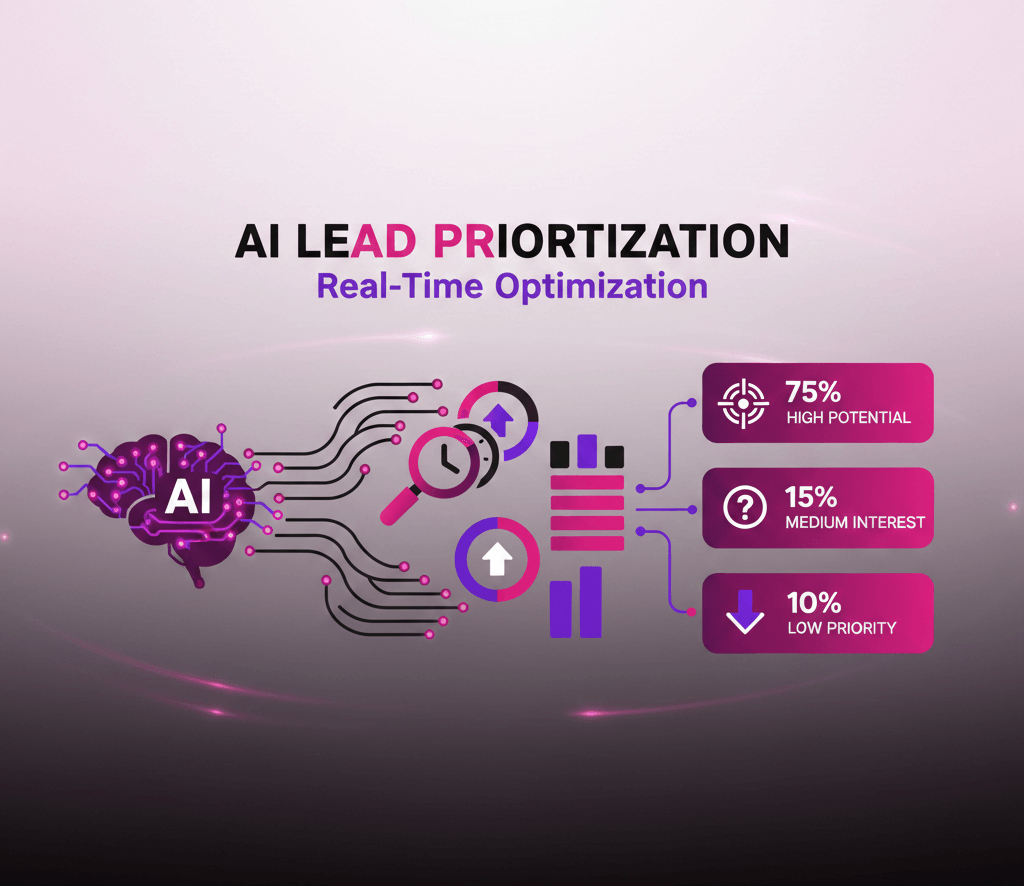
In 2026, we are fixing this. We are moving from static lists to dynamic streams. We are using AI sales-readiness engines to analyze real-time sales signals and re-rank prospects every second.
And when that perfect moment strikes—when intent is highest—we aren’t just flashing a notification. We are acting. This is where tools like SalesCloser.ai come into play, closing the loop between knowing who to call and actually making the call.
The Death of the Static Score
To understand where we are going, we have to look at why our current tools are failing us. Traditional lead scoring is a math equation based on history.
- Download a PDF? +5 points.
- Job title is CEO? +20 points.
- Company size > 500? +10 points.
If a lead hits 50 points, it becomes a Marketing Qualified Lead (MQL). This system served us well for a long time, but it has a fatal flaw: It ignores context and timing.
A CEO who downloaded your whitepaper six months ago and hasn’t returned to your site has a high score but low intent. A Manager who visited your pricing page three times in the last hour has a lower “demographic” score but massive sales intent data.
Static scoring creates false positives and false negatives. It forces sales teams to waste hours chasing high-scoring ghosts while low-scoring buyers slip through the cracks. It relies on the past. Sales happen in the present.
The static list is a snapshot. Dynamic lead scoring is a movie.
What is Real-Time Lead Prioritization?
In 2026, the concept of a “lead list” will feel archaic. Instead, imagine a stock ticker.
On a stock exchange, prices change millisecond by millisecond in response to buying and selling pressure. Your sales dashboard should work the same way. This is AI-based real-time lead prioritization.
It is a continuous loop. An AI engine sits on top of your data ecosystem. It doesn’t just check your CRM once a day. It watches everything, all the time. It ingests thousands of data points to answer one specific question:
Who is the single most valuable person to contact right now?
This is not about who has the best job title. It is about who has the highest AI sales readiness.
When a prospect opens an email, their rank moves up. When a prospect’s company announces a Series B funding round on TechCrunch, its rank moves up. When a prospect spends more than two minutes reading your “Terms of Service” page (a huge buying signal), their rank rockets to the number one spot.
Conversely, if a prospect stops engaging or hires a competitor, their rank drops instantly. The list is alive. It breathes.
The Engine: Fueling the Prioritization Matrix
This level of fluidity requires data. In the past, data was siloed. Marketing had website data; sales had call data; success had usage data. The revolution of 2026 is the unification of these signals into a central brain.
Here are the inputs that drive increased sales efficiency:
1. Behavioral Velocity
We used to look at what people did. Now, we look at the speed and intensity of what they do.
- Dwell Time: Did they just click the pricing page, or did they stay there for four minutes?
- Scroll Depth: Did they read the headline, or did they scroll to the technical specifications?
- Frequency: Did three different people from the same company visit the site in the last hour? That is a swarm signal.
2. External Intent Data
Your website is only a tiny fraction of the internet. Sales intent data aggregates behavior from the rest of the web.
- Search Queries: Is the prospect searching for “alternatives to [Your Competitor]”?
- Content Consumption: Are they reading articles about the specific problem your software solves on third-party industry blogs?
- Technographic Install: Did they just uninstall a tool that conflicts with yours?
3. CRM and Firmographic Shifts
Companies change. The AI monitors these changes in real-time.
- Personnel Changes: A new VP of Sales just joined. They will want to buy new tools within their first 90 days.
- Financial Triggers: End of fiscal year announcements, budget expansions, or mergers.
4. Conversational Sentiment
This is the newest frontier. AI analyzes previous emails and call recordings.
- Did the prospect sound hesitant or enthusiastic in the last call?
- Did they use words like “budget approved” or “just looking”?
- The AI uses Natural Language Processing (NLP) to assign a sentiment score that feeds the prioritization engine.
The Psychology of “Next-Best-Action”
The output of this analysis is not just a ranking. It is a prescription. This is often called next-best-action sales.
If the AI determines that Lead A is the top priority, it also determines the best channel to reach them.
- Scenario A: Lead is on the website right now. Action: Trigger live chat or instant call.
- Scenario B: Lead opened an email on their phone at 7:00 AM. Action: Send a short text message.
- Scenario C: Lead researched a competitor. Action: Send a comparison case study via email.
This takes the cognitive load off the salesperson. They don’t have to decide what to do. They just execute.
But here is the catch. Even with the best prioritization in the world, humans are slow.
The Human Bottleneck
Let’s be honest about human nature.
Imagine the AI identifies a “Hot Lead.” It flags this lead to a sales representative.
- The rep might be in the bathroom.
- The rep might be on a lunch break.
- The rep might be stuck on a call with another client.
- The rep might just hesitate because they fear rejection.
Research shows that if you don’t respond to a lead within five minutes, your odds of qualifying them drop by 80%. In a real-time world, five minutes is an eternity. If the AI sees a buying signal at 2:03 PM, and the call happens at 2:45 PM, the moment is gone. The prospect has closed the tab. They have moved on to their next meeting.
We built a Ferrari engine (the AI prioritization) and put it inside a horse and buggy (manual dialing).
This brings us to the second half of the 2026 revolution: Automated lead outreach.
Enter SalesCloser.ai: The Autonomous Execution Layer
This is where the partnership between strategy and tooling becomes critical. You need a system that acts instantly, without human latency. You need SalesCloser.ai.
SalesCloser.ai is not just a dialer. It is an autonomous AI sales agent. It is the hands and voice that execute the strategy defined by your prioritization engine.
Here is how the workflow changes when you integrate SalesCloser.ai:
- The Signal: A high-value prospect visits your “Request a Demo” page and spends time in the pricing section.
- The Prioritization: Your ranking engine identifies this as a “Critical Urgency” lead.
- The Trigger: Instead of sending an alert to a human who might miss it, the system triggers SalesCloser.ai.
- The Action: Within seconds—literally while the prospect is still looking at your pricing—SalesCloser.ai initiates an outbound call.
Why This Changes Everything
When SalesCloser.ai makes that call, it isn’t a robotic, pre-recorded message. It is a hyper-realistic, two-way conversational AI.
- Zero Latency: The call occurs when interest is at its peak. The prospect picks up the phone, thinking, “Wow, that was fast.”
- Infinite Scale: What happens if 500 leads spike at the same time? A human team would drown. They would cherry-pick the top 10 and ignore the rest. SalesCloser.ai spins up 500 instances of itself. It calls every single one simultaneously. No lead is left behind.
- Consistent Quality: Humans have bad days. They get tired. They forget to ask qualifying questions. SalesCloser.ai performs flawlessly every time. It knows your product inside and out. It handles objections regarding price or competitors with data-backed precision.
A Day in the Life: 2024 vs. 2026
To truly grasp the impact of lead engagement automation, let’s compare the daily routine of a sales organization.
The Old Way (2024)
- 9:00 AM: Rep opens CRM. Sees a list of 50 new leads from an event last week.
- 10:00 AM: Rep starts dialing. Most people don’t answer. They are busy.
- 11:30 AM: Rep connects with one person. The person says, “I’m not interested right now, send me an email.”
- 2:00 PM: A high-intent lead visits the website. The rep doesn’t know because they are in a team meeting.
- 4:00 PM: Rep sees the notification about the website visitor. They call. The prospect has already left the office for the day.
- Result: High effort, low yield. Frustration.
The New Way (2026 with SalesCloser.ai)
- 9:00 AM: The prioritization engine scans the database. It sees that 5 old leads have suddenly shown new intent signals.
- 9:05 AM: SalesCloser.ai automatically calls these 5 leads. It books meetings with 2 of them.
- 10:00 AM: The human rep opens their calendar. It is already full of qualified meetings booked by the AI.
- 11:30 AM: The human rep takes a meeting. It is a high-level negotiation. This is what humans are good at—building relationships and closing complex deals.
- 2:00 PM: A surge of traffic hits the site from a new marketing campaign.
- 2:01 PM: SalesCloser.ai engages all visitors instantly via voice or chat. It filters out the tire-kickers and qualifies the serious buyers.
- 4:00 PM: The rep reviews the AI-generated call transcripts. They see exactly what pain points were discussed.
- Result: The human does high-value work. The AI handles the grunt work. Speed to lead is zero.
Overcoming the “Creepy” Factor
One concern often raised about real-time sales signals is the line between helpful and invasive. If you call someone the second they click a button, does it scare them off?
In 2026, consumer expectations have shifted. We live in an on-demand economy. When we order a car, we want it in 3 minutes. When we order food, we track the driver. When we have a business problem, we want a solution now.
The key is context.
If SalesCloser.ai calls and says, “I see you are looking at our pricing page,” that might feel invasive. But if SalesCloser.ai calls and says, “Hi, I noticed you were looking into solutions for [Problem X], and I wanted to see if I could answer any quick questions to save you some research time,” that is helpful.
It changes the dynamic from “I am watching you” to “I am here to serve you.” The AI can be tuned to be consultative rather than aggressive.
The Role of Data Hygiene
For dynamic lead scoring to work, your data must be clean. In the past, insufficient data just meant a bounced email. In an automated world, insufficient data means your AI agent calls the wrong person at 3 AM.
In 2026, companies invest heavily in automated data enrichment. Before SalesCloser.ai places a call, the system verifies the number, checks the time zone, and ensures the contact information is up to date. This “pre-flight check” happens in milliseconds.
This reliability builds trust in the system. Sales leaders can sleep at night knowing their brand reputation is safe because the AI operates within strict guardrails.
The Financial Impact: ROI of Real-Time Prioritization
Let’s look at the numbers. Why should a CFO sign off on this technology?
- Increased Conversion Rates: Speed is the most significant driver of conversion. Moving from a 2-hour response time to a 2-minute response time can increase conversion by 391%.
- Reduced Customer Acquisition Cost (CAC): You stop wasting money calling people who aren’t interested. You focus your resources (bandwidth and telephony costs) on the 10% of leads that actually matter.
- Headcount Efficiency: You don’t need to hire 50 SDRs to make cold calls. You can hire 5 expert closers to handle the meetings generated by SalesCloser.ai. This drastically reduces overhead.
Implementing the Strategy: A Roadmap
You cannot flip a switch and be in 2026 tomorrow. But you can start building the foundation.
Phase 1: Integration. Connect your data sources. Ensure your CRM, website analytics, and marketing automation platforms are integrated. Break down the silos.
Phase 2: Scoring logic. Move away from simple point-based scoring. Start experimenting with intent data. Look for behavioral patterns that correlate with closed deals.
Phase 3: Automation. Introduce SalesCloser.ai. Start by having it handle your after-hours and dormant leads. Let it prove itself.
Phase 4: Full Autonomy. Once the model is tuned, unleash it on your inbound traffic. Let the AI handle the prioritization and the initial outreach.
The Future of the Sales Profession
Does this mean the end of the salesperson? No.
It means the end of the robot salesperson. The human rep who reads a script, asks generic questions, and acts like a machine is obsolete.
The sales rep of 2026 is a consultant. They are a strategist. Because the AI handles automated lead outreach and qualification, the human can focus on empathy, negotiation, and complex problem-solving.
We are stripping away the drudgery of sales. We are removing the rejection of cold calling. We are giving sales teams the gift of a clear calendar filled with interested prospects.
Conclusion
The sales efficiency revolution in 2026 is not about working harder. It is about alignment. It is about aligning your outreach perfectly with the buyer’s journey.
AI for Real-Time Lead Prioritization gives you the “when” and the “who.” It cuts through market noise to spotlight the opportunities available right now.
But knowing is not enough. You must act.
By combining the intelligence of dynamic scoring with the execution power of SalesCloser.ai, you create an unstoppable sales motion. You ensure that every signal is captured, every interest is engaged, and no opportunity slips away due to human delay.
The future belongs to the fast. It belongs to the precise. And with these tools, it’s yours.
FAQs
Q: Will AI-based prioritization replace my current CRM?
A: No. It works on top of your CRM. Think of your CRM as the warehouse where data is stored. The AI prioritization engine is the logistics manager that decides which items move in and out of the warehouse. It pulls data from the CRM, analyzes it, and updates the records with new scores and recommended actions.
Q: Is real-time prioritization only for large enterprises?
A: Not anymore. While this tech started in the enterprise, tools like SalesCloser.ai are democratizing access. Small and medium businesses can benefit more, as they often have smaller teams and cannot afford to miss a single high-quality lead. It acts as a force multiplier for smaller teams.
Q: What happens if the data is wrong?
A: The system learns. If the prioritization engine ranks a lead high, but SalesCloser.ai finds out the person is not interested, that feedback loop goes back into the engine. The AI adjusts its model to avoid similar mistakes in the future. It gets smarter with every call.
Q: Does this work for B2B and B2C?
A: Yes, but the signals differ. In B2B, the signals might be funding rounds or hiring sprees. In B2C, signals are more likely to come from website behavior, cart abandonment, or ad engagement. The core logic—identifying intent and acting fast—remains the same.
Q: How long does it take to set up?
A: Integration has become much faster. Most modern AI tools can connect to standard CRMs (like Salesforce or HubSpot) via API in a few hours. The “learning” phase, where the AI analyzes your historical data to build the scoring model, usually takes a few weeks to reach peak accuracy.
Q: Can I control who the AI calls?
A: Absolutely. You set the guardrails. You can define rules like “Only call leads in this geography,” “Only call titles above Manager,” or “Never call current customers.” You have complete control over the criteria that trigger the autonomous agent.