“Revolutionize your speed-to-lead with an AI Sales Agent. Unlike chatbots, they autonomously qualify leads and book meetings 24/7.”
You spend thousands of dollars driving traffic to your website. You optimize your landing pages, A/B test your copy, and finally, a highly qualified prospect fills out a demo request form. They have a problem. They are ready to buy.
Then, they wait.
They wait four hours for an SDR to send a generic email. By the time that email hits their inbox, they have already researched two of your competitors. The moment of peak intent has vanished. Your expensive marketing lead just went cold. This happens every single day in growth-stage companies. Consequently, sales leaders are frantically searching for ways to fix the “speed to lead” crisis without drastically increasing their headcount.
If you are researching solutions, you have likely encountered the term AI sales agent. This may be a fancy new word for the same frustrating website chatbots we have all dealt with for the past decade. It is not.
This guide will explain the massive leap from rule-based chatbots to autonomous AI sales agents. We will break down exactly how these tools work. Furthermore, we will show you why relying on traditional chatbots actively hurts your conversion rates. Finally, we will introduce the ultimate solution for inbound lead response, guaranteeing a 100% immediate connection rate at the exact moment your buyer is ready to talk.
What Is an AI Sales Agent?
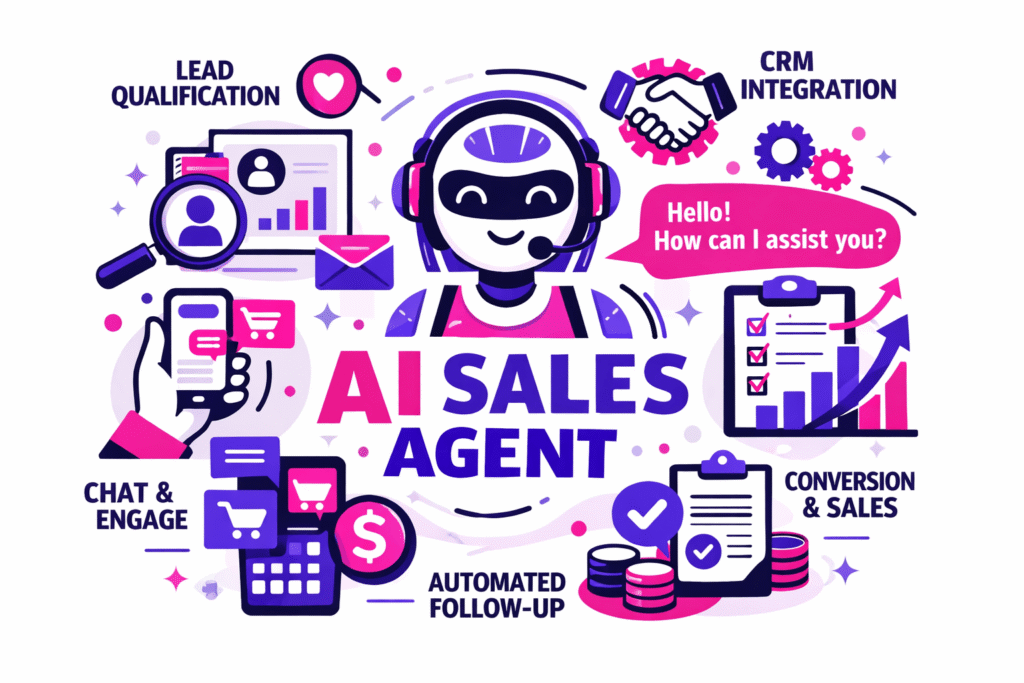
An AI sales agent is software that autonomously handles sales conversations—including discovery calls, product demos, and follow-ups—without human involvement. Unlike traditional chatbots, AI sales agents hold multi-turn conversations, reason through buyer objections, make proactive decisions, and integrate directly with your CRM in real time.
A traditional chatbot asks, “How can I help you today?” and gives you three buttons to click. An AI sales agent reviews the prospect’s company size, identifies their pain points, asks qualifying questions, and dynamically changes its pitch based on the buyer’s answers.
Chatbots respond to prompts. AI sales agents execute goals.
When you deploy an autonomous sales AI, you are not just adding a widget to your website. You are effectively hiring a digital sales development representative (SDR) who works 24/7, speaks multiple languages, and never forgets to update Salesforce.
The Fatal Flaw of Traditional Chatbots
To understand the power of an AI agent, you first need to understand why traditional chatbots fail so frequently. Chatbots run on decision trees. Programmers write rules: If the user says X, reply with Y. This works perfectly for simple, predictable interactions. Suppose a customer wants to know your business hours or check your return policy; a chatbot can handle it easily. However, B2B sales conversations are never simple. Buyers ask complex, multi-layered questions.
Consider this real-world scenario. A buyer types: “We currently use Competitor X, but their reporting feature is too slow, and we need a solution that integrates with our custom ERP. Can your tool do that, and how much does it cost for 50 seats?”
A traditional chatbot fails instantly. It looks for a keyword like “pricing” or “integration.” It then spits out a generic link to a pricing page. The buyer feels ignored. They close the tab. You lose the deal.
Why Chatbots Kill Conversational Flow
- They lack context: Chatbots forget what the user said two minutes ago.
- They rely on rigid scripts: If a buyer asks a question outside the pre-written script, the bot breaks.
- They demand effort from the buyer: Chatbots force buyers to click through endless menus just to reach a human.
- They only react: A chatbot waits for the user to do the work. It never drives the conversation forward.
Buyers in 2026 expect frictionless experiences. They do not want to talk to a robot that acts like a robot. They want immediate, intelligent answers.
Reactive vs Proactive AI: The Core Difference
The transition from chatbots to agents represents a shift from reactive software to proactive software. This distinction is crucial for any RevOps manager evaluating 2026 trends in conversational AI.
Reactive AI (The Chatbot)
Reactive AI sits and waits. It acts like an interactive FAQ page. When a user inputs a query, the reactive AI searches its database for the closest matching answer. It delivers the answer and goes back to waiting. It does not care if the user buys your product. It has no goals.
Proactive AI (The Sales Agent)
Proactive AI has a prime directive: qualify the lead and book a meeting (or close the deal). When a prospect interacts with an AI sales agent, the agent actively steers the conversation.
If a prospect asks about pricing, the AI agent does not just hand over a pricing sheet. It answers the question, and then it pivots.
Proactive Agent Response: “Our pricing starts at $500 per month for teams under 50. Since you are asking about team pricing, are you currently struggling to manage user permissions across your growing sales floor? I can show you how our admin dashboard solves that.”
The agent answers the question, connects the feature to a common pain point, and asks a follow-up question to keep the buyer engaged. This requires AI decision-making in sales. The agent decides in real time on the best strategy to advance the deal.
Chatbot vs AI Sales Agent: Feature-by-Feature Breakdown
Sales leaders need clear distinctions when evaluating tech stacks. Here is exactly how traditional chatbots compare to modern AI sales agents.
| Feature | Traditional Chatbot | AI Sales Agent |
| Primary Function | Answer basic FAQs and route tickets. | Execute sales strategies and qualify leads. |
| Architecture | Rule-based decision trees. | Large Language Models (LLMs) with reasoning capabilities. |
| Conversational Style | Scripted, rigid, keyword-dependent. | Fluid, dynamic, context-aware. |
| Goal Orientation | None. It just provides information. | High. It actively advances the sales cycle. |
| CRM Integration | Basic. Create a standard lead record. | Deep. Updates fields, logs call notes, schedules follow-ups. |
| Objection Handling | Fails or routes to a human agent. | Empathizes, isolates the objection, and provides counter-evidence. |
| Channel Delivery | Text only (Website widget). | Omnichannel (Text, Email, Voice/Phone calls). |
As the table shows, comparing the two is like comparing a static billboard to an experienced salesperson. Both deliver information, but only one actually sells.
How Autonomous Sales AI Works in Practice
Let us look at exactly what happens when you deploy an AI sales agent. We will trace a lead through the entire funnel to demonstrate the agent’s capabilities.
Step 1: Instant Qualification
A prospect visits your site at 11:30 PM on a Saturday. They engage with the chat interface. Instead of a generic greeting, the AI agent accesses enrichment data based on the visitor’s IP address.
It starts the conversation: “Hi there. I see you are visiting from a logistics company. Many logistics firms use our platform to track fleet maintenance. Are you currently managing your fleet manually?”
The agent personalizes the hook immediately. The prospect responds. The agent asks three BANT (Budget, Authority, Need, Timeline) questions naturally throughout the chat.
Step 2: Complex Objection Handling
The prospect pushes back. “We don’t have the budget right now. We are locking down spending for Q3.”
A standard bot would say, “Okay, let me know if you change your mind.” The AI sales agent relies on intelligent sales automation. It accesses its training materials on ROI. It responds: “I completely understand tightening the budget for Q3. However, our logistics clients typically see a 15% reduction in maintenance costs within the first two months. Would you be open to a brief 10-minute call on Monday to see if the math makes sense for your fleet?”
Step 3: Autonomous CRM Management
The prospect agrees. The AI agent accesses your Head of Sales’ calendar, books the meeting, and sends calendar invites.
Then, it does the work your human SDRs hate doing. It opens Salesforce. It creates a new Contact record. It updates the lead status to “Meeting Booked.” It populates the notes section with a detailed summary of the prospect’s pain points and budget constraints. It does all of this perfectly, with zero typos, in less than two seconds.
AI Decision-Making in Sales: Beyond Scripted Responses
The most remarkable feature of an AI sales agent is its ability to reason. Human salespeople make hundreds of micro-decisions during a single call. They decide when to push, when to pull back, when to talk about features, and when to talk about feelings.
Modern autonomous sales AI replicates this reasoning process.
Prioritization and Routing
AI agents analyze the intent behind a buyer’s words. If a buyer says, “I need this implemented by next Friday, or we lose our compliance certification,” the AI agent recognizes high urgency. It bypasses the standard qualification loop. It immediately flags the lead as a Tier 1 priority and texts the human Account Executive to intervene.
Adaptive Messaging
If a buyer uses highly technical jargon, the AI agent mirrors that vocabulary. It discusses APIs, webhooks, and latency. Suppose the buyer uses business-focused language, the agent pivots. It discusses ROI, total cost of ownership, and team efficiency. The agent dynamically adapts its persona to match the buyer, building rapport instantly.
The End of the “I Don’t Understand” Loop
We have all experienced the frustrating loop where a bot repeatedly says, “I’m sorry, I didn’t catch that.” AI agents use semantic understanding. Even if a prospect uses slang, typos, or poor grammar, the agent understands the core intent. It keeps the conversation moving forward smoothly.
Intelligent Sales Automation: The Financial Impact
Founders and CEOs of growth-stage companies face a difficult math problem. You need to grow revenue. To grow revenue, you need more pipeline. To get more pipeline, you need to hire more SDRs.
However, hiring SDRs is incredibly expensive. You pay base salaries, commissions, benefits, and software licenses. Furthermore, you spend three months ramping them up. Then, according to industry averages, they leave the company 14 months later. The cycle starts all over again.
Reducing Customer Acquisition Cost (CAC)
Intelligent sales automation completely rewrites the unit economics of outbound and inbound sales. An AI sales agent costs a fraction of what a human employee does. It does not take vacations. It does not get sick. It does not suffer from call reluctance.
By handling the top-of-funnel grunt work, AI agents allow you to run a leaner, more senior sales team. You no longer need five junior SDRs making 100 calls a day. You need one AI agent handling 10,000 interactions a day, feeding highly qualified meetings to two experienced Account Executives. This drastically lowers your CAC and increases your profit margins.
Maximizing Pipeline Velocity
Time kills deals. When leads sit in a queue waiting for a human to review them, pipeline velocity slows to a crawl. AI agents eliminate the queue. They process leads instantaneously. A lead can move from “Website Visitor” to “Qualified Demo Booked” in three minutes. This accelerated velocity means you close deals faster and recognize revenue sooner.
The Speed to Lead Crisis in B2B Sales
Before we introduce the ultimate solution to this problem, we must examine why “speed to lead” is the most critical metric in modern sales.
Harvard Business Review conducted a massive study on lead response times. They found that companies that try to contact potential customers within an hour of receiving a query are nearly seven times as likely to qualify the lead as those that wait even an hour.
Furthermore, if you wait just five minutes to respond to a web form submission, your chances of qualifying that lead drop by a staggering 80%.
Why Humans Fail at Speed to Lead
Humans simply cannot maintain a five-minute response time consistently.
- Leads come in after business hours.
- Leads come in while your reps are on lunch breaks.
- Leads come in while your reps are already on discovery calls.
- SDRs get bogged down in internal meetings and administrative tasks.
Every time a rep misses that five-minute window, you burn marketing dollars. Your prospect submitted the form because they experienced intense frustration with their current process. They wanted help right then. When you fail to answer, they immediately click the back button and visit your biggest competitor’s website.
You need a system that guarantees an immediate response. You do not just need a text message. You need a voice. You need a conversation.
SalesCloser.ai: The Ultimate AI Sales Agent Solution
You now understand the difference between a chatbot and an AI agent. You understand the devastating cost of slow lead response times. Now, you need the solution.
SalesCloser.ai is the only guaranteed, failsafe answer to the inbound lead problem.
SalesCloser.ai provides powerful AI sales agents designed specifically to improve sales performance. While other tools focus on text-based chat widgets or email sequences, SalesCloser.ai targets the most valuable sales channel: the live phone call.
The Instant Automated Phone Call
Here is exactly how SalesCloser.ai separates itself from every other tool on the market.
When a high-intent prospect visits your website and submits a demo request form, they hit “Submit.” Within literally one second of that button press, SalesCloser.ai triggers an immediate, automated phone call to the phone number the prospect just provided.
The prospect’s phone rings while their hand is still on their computer mouse.
When they answer, they do not hear a robotic recording. They hear a fluid, natural-sounding AI voice agent.
SalesCloser Agent: “Hi John, this is Sarah from SalesCloser. I just saw you request a demo on our website a second ago. I wanted to give you a quick call to see what prompted you to reach out today. Are you currently struggling with your inbound response times?”
Why This Procedure Dominates the Market
This strategy creates an unparalleled buyer experience.
First, you achieve a 100% response rate at the exact moment of peak prospect intent. The prospect is actively thinking about your product. They are sitting at their desk. You have their full attention.
Second, the “wow” factor instantly builds brand authority. Prospects are consistently amazed by the speed and professionalism of the outreach. It signals that your company is highly responsive, technologically advanced, and serious about earning their business.
Third, the AI agent conducts a full discovery call right then and there. It asks qualifying questions, handles initial objections, and seamlessly transfers the call to a live Account Executive if the lead is a perfect fit, or schedules a calendar appointment for the next day.
Maximizing the ROI of Marketing Spend
Marketing teams spend vast resources generating inbound form fills. When sales teams fail to call leads promptly, the marketing budget is wasted.
SalesCloser.ai patches the biggest leak in your revenue funnel. By placing an immediate phone call to every single inbound lead, you maximize conversations. When you maximize conversations, you maximize conversions.
You extract every single drop of ROI from your Google Ads, your LinkedIn campaigns, and your SEO efforts. SalesCloser.ai ensures that no lead is ever left behind, ignored, or lost to a competitor due to a slow follow-up.
How SalesCloser.ai Operates as a Complete SDR
SalesCloser.ai does not just make the first call. It acts as a comprehensive, autonomous worker. Let us look at how it manages the entire workflow of a traditional Business Development Representative.
Persistent, Intelligent Follow-Ups
If a prospect does not answer that first immediate phone call, SalesCloser.ai does not give up. Human reps often abandon leads after two or three unanswered calls. SalesCloser.ai executes a flawless, multi-touch cadence.
It will leave a highly personalized voicemail. It will send a follow-up SMS text message referencing the voicemail. It will send an email the next morning. It uses AI decision-making in sales to determine the optimal times to call back based on the prospect’s time zone and previous engagement data. It works the lead relentlessly until it gets a definitive “yes” or “no.”
Multi-Language Capabilities
Global companies face significant challenges when scaling sales teams. If you want to sell in Germany, Spain, and Japan, you traditionally need to hire native speakers in those regions.
SalesCloser.ai eliminates this barrier. The AI sales agent speaks fluently across dozens of languages. If a lead from Frankfurt submits a form in German, the agent calls them instantly and conducts the entire discovery call in perfect, localized German. This allows startups to compete globally without expanding payroll.
Flawless CRM Hygiene
RevOps managers know that CRM data quality is a constant nightmare. Human reps hate data entry. They take sloppy notes. They forget to log calls. They leave pipeline stages outdated.
SalesCloser.ai provides perfect CRM hygiene. Because the agent is a software program, it automatically logs every interaction. After a quick phone call, it attaches the full call recording and a transcription directly to the HubSpot or Salesforce contact record.
Furthermore, it uses AI to summarize the call. It pulls out key data points—budget figures, competitor mentions, and timeline constraints—and maps them to the correct custom fields in your CRM. Your data is always pristine, making revenue forecasting actually accurate.
Building a Scalable Sales Process Without Losing the Human Touch
A common fear among sales leaders is that deploying an AI sales agent will make their brand feel cold and robotic. They worry that replacing human SDRs with software will alienate buyers.
This fear stems from experiences with bad chatbots. When executed correctly with a platform like SalesCloser.ai, the opposite happens. The human touch actually improves.
AI Elevates the Human Rep
Think about what a human Account Executive does best. Humans are incredible at building deep empathy, navigating complex corporate politics, negotiating pricing, and closing deals.
Humans are terrible at dialing 100 numbers a day, leaving identical voicemails, and copying and pasting follow-up emails.
When you use SalesCloser.ai to handle the brutal, repetitive top-of-funnel work, you free up your human reps to do what they do best. Your AEs no longer spend their mornings chasing unqualified leads. They spend their days jumping on Zoom calls with prospects who have already been vetted, qualified, and primed by the AI agent.
Human conversations become richer, more strategic, and more focused on closing. You do not replace human relationships; you protect people’s time so they can build better relationships.
Handoff Protocols: The Art of the Transfer
The best AI sales agents know their limits. SalesCloser.ai is programmed with strict handoff protocols.
If a prospect asks a highly nuanced technical question that falls outside the AI’s training data, the agent does not guess. It gracefully pivots.
Agent: “That is a great question regarding your specific custom API infrastructure. Our senior technical engineer, David, is the absolute best person to answer that. I have his calendar open right now. Can I lock in a 15-minute window for you two to speak tomorrow at 2 PM?”
The buyer feels respected. Their complex question is validated, and they are immediately routed to the correct human expert. This seamless collaboration between AI and human staff is the blueprint for sales success in 2026.
How to Evaluate an AI Sales Agent for Your Team
If you are a VP of Sales or a Founder ready to move past reactive chatbots, you need a framework for evaluating vendors. The market is flooding with new tools claiming to be “AI.” Many are just traditional bots wrapped in new marketing copy.
Use this checklist when evaluating any conversational AI tool.
1. Does it offer instant voice capabilities?
Text-based chat is no longer enough. If a tool only lives on your website and cannot pick up the phone, it is not a true AI sales agent. You need a platform like SalesCloser.ai that can instantly trigger a voice call the moment a form is submitted. Voice creates urgency and builds instant rapport.
2. Can it hold multi-turn conversations?
Test the tool extensively. Give it a complicated scenario. Ask it a question, change the subject, and then refer back to your original question. A basic bot will break. A true AI agent will track the context perfectly and respond appropriately.
3. Does it integrate bi-directionally with your CRM?
Many tools can read from a CRM. Fewer can write to it accurately. Your AI agent must be able to pull data to personalize its outreach, but it must also reliably push data back into the CRM. It needs to log call notes, change lead statuses, and update custom fields without creating duplicate records.
4. How does it handle complex objections?
Ask the vendor to demonstrate how the AI handles a hard “No.” If the prospect says they have no budget, what does the AI do? It should isolate the objection, offer a compelling counter-narrative, and attempt to secure a micro-commitment, such as a brief discovery call.
5. What is the latency?
In voice AI, latency is everything. If there is a three-second delay between the prospect speaking and the AI responding, the conversation feels unnatural and frustrating. The AI must process language and generate audio in milliseconds, creating a smooth, human-like cadence.
The End of Traditional SDR Models
The landscape of B2B sales has permanently shifted. The traditional model—hiring armies of recent college graduates to unthinkingly cold call and manually email prospects—is mathematically broken. The costs are too high, the turnover is too fast, and buyer tolerance for generic outreach is at an all-time low.
Buyers want immediate solutions. When they raise their hand by filling out a form, they expect a conversation right now, not tomorrow.
Traditional chatbots tried to solve this and failed miserably. They frustrated buyers with rigid menus and zero context. They were completely reactive.
Autonomous sales AI fixes the process. AI sales agents are proactive, intelligent, and goal-oriented. They reason through problems, manage their CRM autonomously, and adapt their messaging on the fly.
Most importantly, tools like SalesCloser.ai give you the ultimate competitive advantage. By instantly calling every inbound lead the moment they submit a form, you guarantee a 100% response rate during the buyer’s peak moment of intent. You stop burning marketing dollars. You fill your human AEs’ calendars with qualified meetings. You scale your revenue without scaling your payroll.
The choice is simple. You can keep letting your inbound leads cool down in a queue, hoping a human rep gets to them eventually. Or, you can deploy an AI sales agent and connect with every single buyer instantly.
The companies that adopt intelligent sales automation today will dominate their markets tomorrow. The companies that rely on web forms and delayed emails will be left behind.
Frequently Asked Questions
Is an AI sales agent just a ChatGPT wrapper?
No. While many AI agents utilize Large Language Models for natural language processing, a true AI sales agent includes complex orchestration layers. It requires real-time CRM integrations, voice telephony infrastructure, memory management, and specific guardrails to keep the AI focused strictly on sales goals.
Will AI sales agents replace human salespeople?
AI agents will replace the repetitive, high-volume tasks traditionally done by junior SDRs (dialing, leaving voicemails, and basic qualification). They will not replace Account Executives. Instead, AI agents make AEs more effective by handing them highly qualified, pipeline-ready deals.
How long does it take to implement SalesCloser.ai?
Unlike traditional enterprise software that takes months to deploy, modern AI agents can be configured rapidly. You integrate your CRM, define your qualification criteria, provide your product documentation, and the agent can begin handling inbound leads in a matter of days.
Can the AI agent sound natural on the phone?
Yes. Advances in voice synthesis mean AI agents no longer sound like robotic GPS systems. They feature natural pauses, inflections, and pacing. Most prospects do not realize they are speaking with an AI for the first few minutes of the call.
What happens if the AI agent makes a mistake?
Top-tier platforms like SalesCloser.ai allow you to set strict boundaries. You can define exact topics that the AI is not allowed to discuss. If a conversation goes out of bounds, the AI is programmed to smoothly transfer the call to a human manager or schedule a follow-up with a human expert.