“AI SDR vs Human SDR: Which is better for your ROI? Compare costs, performance, and learn why hybrid sales teams are the future of high-growth revenue.”
The average Sales Development Representative (SDR) stays in their role for only 15 months. According to The Bridge Group, nearly half of that time is spent on ramp-up and training, leaving companies with less than a year of peak productivity before turnover hits. This revolving door creates a massive hole in your budget and your pipeline.
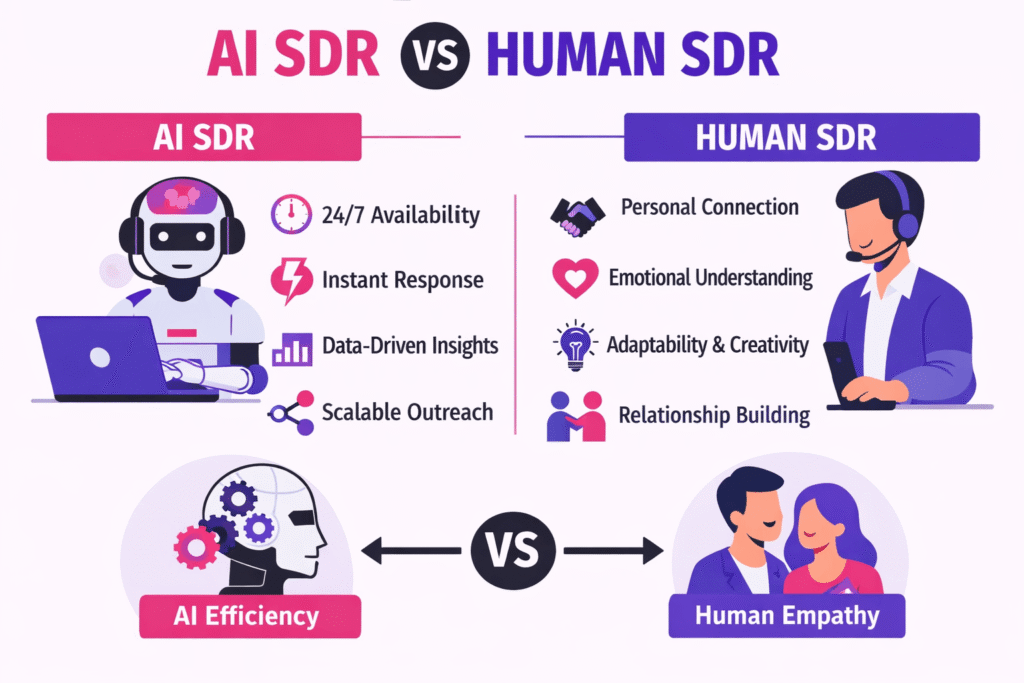
Sales leaders face a choice: do you keep hiring and training humans for high-rejection tasks, or do you deploy an AI SDR? The debate of AI SDR vs Human SDR isn’t about one replacing the other. It is about maximizing your sales hiring ROI. This guide breaks down the data on cost-per-meeting, performance metrics, and the specific scenarios where humans—or AI—provide the highest value.
What is an AI SDR?
An AI SDR is an autonomous software agent that handles the top-of-funnel sales process. It identifies prospects, sends personalized outreach across email and LinkedIn, and conducts discovery calls or demos using natural language processing. Unlike a simple chatbot, an AI SDR manages multi-turn conversations and integrates directly with your CRM to book meetings without human intervention.
The True Cost of a Human SDR in 2026
Hiring a human SDR involves much more than just a base salary. When you calculate the SDR headcount costs, you must include recruitment, benefits, taxes, and the “tech stack tax.”
Recruitment and Onboarding
Internal recruiters or agencies often charge 15% to 20% of the first-year salary. Even after you hire someone, they aren’t productive on day one. Most humans take three to four months to reach full quota. During this time, your cost per lead effectively doubles because you pay for training without seeing a return on the meetings you book.
Management Overhead
Humans require coaching, 1-on-1 meetings, and performance reviews. A manager overseeing ten SDRs spends roughly 10% of their time on each person. If your Sales Manager earns $150,000, that is $15,000 in management “drift” per SDR annually.
Tech Stack and Overhead
A modern SDR needs:
- A CRM seat (Salesforce/HubSpot)
- Sales engagement tools (Outreach/Salesloft)
- Data intelligence (ZoomInfo/Apollo)
- Physical office space or remote stipends
When you total these, a human SDR with a $60,000 base salary actually costs the company closer to $110,000 per year.
The Cost Efficiency of an AI SDR
When we look at AI SDR vs Human SDR from a purely financial perspective, the AI model wins on sheer volume and lack of overhead.
Zero Ramp-Up Time
An AI agent like SalesCloser.ai does not need four months to learn your product. You upload your sales playbooks, case studies, and objection-handling scripts. The AI is ready to go in hours. This immediate deployment significantly boosts your sales hiring ROI because you aren’t paying for “learning time.”
Fixed Scalability
If you want to double your outreach with humans, you must double your headcount. With AI, you simply increase your seat count or activity limit. There are no additional costs for health insurance, 401 (k) matching, or office snacks.
Comparison Table: AI SDR vs Human SDR
| Feature | Human SDR | AI SDR (SalesCloser.ai) |
| Annual Fully-Loaded Cost | $100k – $120k | $10k – $25k |
| Ramp-Up Time | 3 – 5 Months | 24 – 48 Hours |
| Daily Outreach Volume | 50 – 100 activities | 1,000+ activities |
| Work Schedule | 40 hours/week | 24/7/365 |
| Emotional Resilience | Subject to burnout | Immune to rejection |
| Data Integrity | Manual CRM entry | Instant CRM syncing |
Performance Metrics: Beyond the Hourly Wage
Performance isn’t just about how much you spend; it is about what you get back. To understand the AI productivity metrics, we have to look at how these two “workers” handle the sales funnel.
Lead Response Time
Speed to lead is the single most important factor in conversion. Gartner research shows that responding to a lead within five minutes increases the likelihood of a conversion by 9x. A human SDR might be at lunch, in a meeting, or asleep. An AI SDR responds in seconds, ensuring no lead goes cold.
Persistence and Follow-Up
Most sales happen after the 5th or 6th touchpoint. However, the average human SDR stops after two or three attempts due to the psychological weight of rejection. AI does not get discouraged. It follows the sequence exactly as programmed, every single time.
Quality of Discovery
Humans are prone to “happy ears”—they hear what they want to hear and move unqualified leads forward to hit their meeting quota. AI follows strict logic. If a prospect does not meet the BANT (Budget, Authority, Need, Timeline) criteria, the AI agent marks them as “not a fit” and moves on. This improves the quality of the pipeline for your Account Executives (AEs).
The Hybrid Sales Team: Redefining the Human Role
If AI is cheaper and faster, why hire humans at all? The answer lies in the hybrid sales teams model. AI handles the “grunt work,” while humans handle the high-value strategy.
High-Rejection Prospecting (AI)
Cold calling and cold emailing have a 95% rejection rate. This is the primary cause of SDR burnout. By assigning this to an AI SDR, you remove the most taxing part of the job. The AI acts as the “shield,” filtering through thousands of “not interested” responses to find the three people who actually want to talk.
High-Empathy Closing (Human)
When a deal reaches $50,000+, prospects want to look a person in the eye (or at least a Zoom screen). Humans excel at:
- Building deep rapport
- Navigating complex political landscapes within a target company
- Understanding nuances in tone and body language
- Handling “off-script” creative negotiations
In a hybrid sales team, the AI SDR books the meeting, and the Human AE closes it. This ensures your most expensive employees spend 100% of their time talking to qualified buyers instead of hunting for them.
Cost Per Meeting: The Ultimate Metric
To decide between an AI SDR vs. a human SDR, you must calculate your cost per lead AI vs human—specifically, your cost per meeting (CPM).
Human CPM Calculation
If a human SDR costs $9,000 per month (salary + overhead) and books 15 meetings, your CPM is $600. If half of those meetings are “no-shows” or unqualified, your true CPM for a qualified meeting jumps to $1,200.
AI CPM Calculation
An AI SDR subscription might cost $1,500 per month. Because it can handle a higher volume of leads, it might book 30 meetings in the same period. Your CPM is $50. Even if the conversion rate from meeting to deal is slightly lower than a human’s, the sheer volume of meetings at 1/12th the cost makes the math undeniable.
Sales Hiring ROI: When to Choose Each
When to Hire a Human SDR
- Highly Technical Niche: If your product requires a PhD to explain, and there is no online documentation for an AI to learn from.
- Relationship-Based Sales: If you are selling to a very small list of “whales” (e.g., only 50 potential customers worldwide), you need a high-touch, human-centric approach.
- Early Product-Market Fit: If your messaging changes every day, you need a human to provide qualitative feedback on why the market is reacting the way it is.
When to Deploy an AI SDR
- High Lead Volume: If you have more inbound leads than your team can call in 5 minutes.
- Large TAM (Total Addressable Market): If you have thousands of potential accounts to reach out to.
- Predictable Sales Cycles: If your discovery process is standardized and follows a clear set of questions.
- Budget Constraints: If you cannot afford the $100k+ risk of a new hire right now.
How SalesCloser.ai Optimizes the Funnel
SalesCloser.ai provides AI sales agents that go beyond simple email automation. These agents can engage in real-time voice and video conversations, showing your product and answering questions just like a human would.
By using SalesCloser, companies see an immediate improvement in their AI productivity metrics. The tool handles initial outreach, qualifies the lead through a discovery conversation, and then schedules the meeting directly on an AE’s calendar. It solves the “rejection problem” while keeping your human staff focused on what they do best: closing revenue.
Implementing AI SDRs in Your Workflow
Success with an AI SDR requires a change in management style. You aren’t managing a person; you are managing a system.
1. Data Integrity is King
An AI is only as good as the data you give it. Ensure your lead lists are clean. Use tools like LinkedIn Sales Navigator or Apollo to feed the AI high-quality prospects.
2. Standardize Your Playbooks
For an AI SDR to perform well, it needs a clear “if-this-then-that” framework. Document your most common objections and how your top performers answer them. The AI will use this library to handle tough questions without hesitation.
3. Review and Refine
Just because the AI is autonomous doesn’t mean you should ignore it. Review the call transcripts and email logs weekly. If you notice the AI is struggling with a specific new competitor, update its knowledge base. This constant refinement is how you maximize sales hiring ROI.
The Future of the SDR Role
The traditional SDR role is evolving into the “Sales Operations Architect.” Instead of making 50 calls a day, future sales professionals will manage 5-10 AI agents. They will monitor performance, tweak messaging, and step in only when a “human touch” is required to push a deal across the finish line.
This shift isn’t a threat; it is an opportunity. It allows sales professionals to escape the repetitive, soul-crushing tasks of prospecting and move into more strategic, higher-paying roles within the hybrid sales team.
Conclusion
The choice between an AI SDR vs. a human SDR is not a zero-sum game. The most successful sales organizations in 2026 use both. AI provides the scale, speed, and cost-efficiency needed to keep the pipeline full. Humans provide the empathy and complex problem-solving needed to win high-stakes deals.
By automating the high-rejection stages of the funnel, you lower your cost per lead and dramatically improve your sales hiring ROI. The data is clear: use AI for the volume, and save your humans for the value.
Ready to see how an AI SDR can transform your pipeline? Book a demo with SalesCloser.ai today and start booking meetings while you sleep.
FAQ
Is an AI SDR better than a human at cold calling?
In terms of volume and consistency, yes. AI never gets tired and follows the script perfectly. However, for extremely high-value enterprise accounts, a human’s ability to pivot based on subtle cues is still superior.
How does an AI SDR handle objections?
The AI uses a large language model trained on your specific product data and “battle cards.” It can recognize an objection (e.g., “too expensive”) and instantly provide the appropriate counterargument or case study.
Will AI SDRs replace human sales reps?
No. They replace the repetitive tasks that sales reps perform. Humans are still essential for building trust, navigating internal company politics, and closing complex contracts.