“Transform your business with Automated Phone Agent Software. Use 2026 voice AI to scale calls, book meetings, and sync CRM data autonomously.”
The way businesses talk to customers is undergoing a massive shift. If you have ever spent twenty minutes navigating a “press one for sales” menu only to reach a robotic voice that doesn’t understand you, you know the frustration of old technology.
But things have changed. In 2026, we are no longer stuck with clunky menus. We have entered the era of mated phonphone-agenttware. This isn’t just a recording; it is a digital teammate that can think, listen, and speak just like a person.
In this guide, we will break down what this software is, why your business needs it, and how to choose the right platform to lead your market.
Defining Automated Phone Agent Software
To understand this technology, we first need to clear the air. Many people confuse automated phone agents with the “robocalls” of the past.
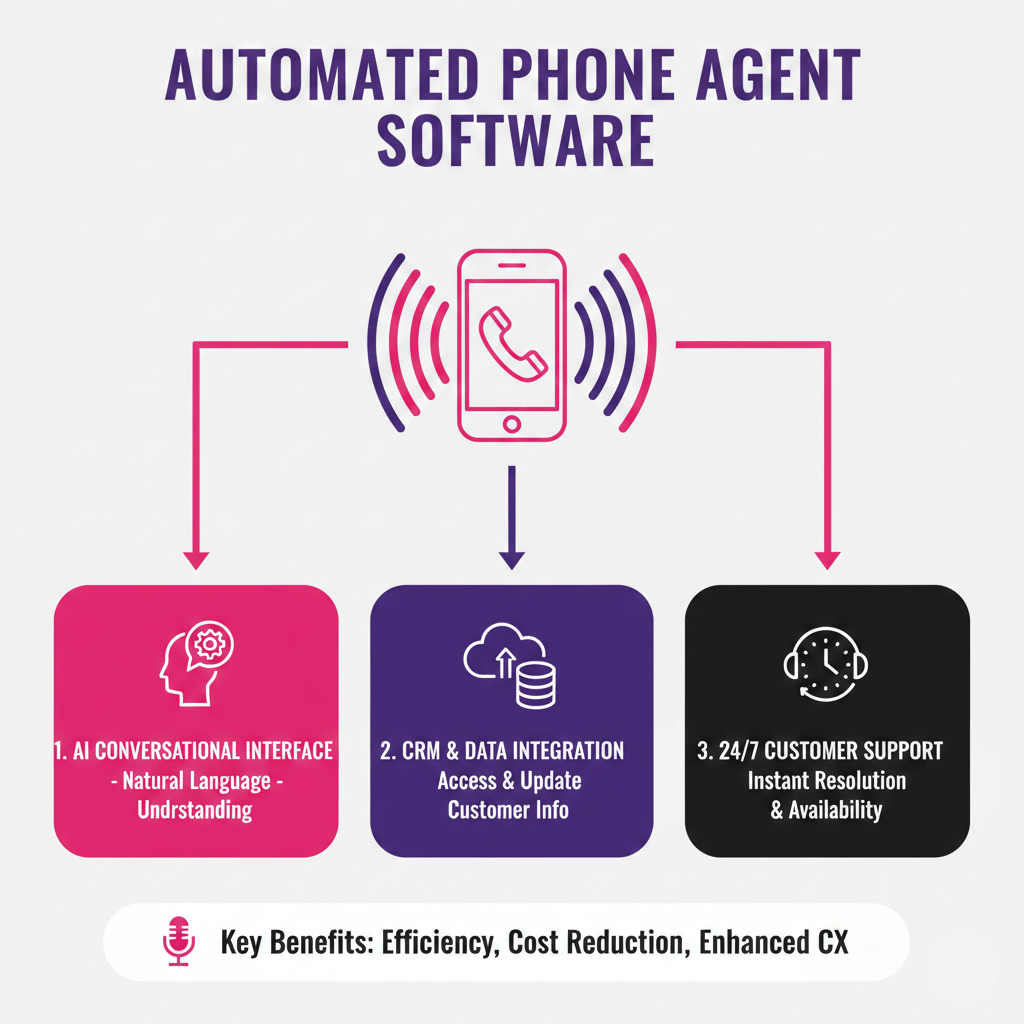
Automated phone agent software (also known as voice AI software or a virtual call agent) is a platform that uses artificial intelligence to conduct natural, two-way verbal conversations. Unlike traditional IVR (Interactive Voice Response) systems that follow a rigid script, these agents use Natural Language Processing (NLP) to understand context, intent, and even emotion.
The Evolution of the Phone Call
- Manual Calling: Humans dial numbers and speak to humans: high cost, low scale.
- Auto-Dialers: Machines dial numbers and connect a human when someone picks up. Efficient, but still limited by human hours.
- Basic IVR: “Press 1 for support.” Frustrating for users and very limited in scope.
- Automated Phone Agents: AI agents that answer or place calls, hold full conversations, book appointments, and sync data instantly.
How It Works: The Tech Under the Hood
You might wonder how a machine can sound so real. It isn’t magic; it’s a stack of high-level technologies working in milliseconds.
1. Speech-to-Text (STT)
When a customer speaks, the AI immediately converts those sound waves into digital text. In 2026, this happens with nearly 99% accuracy, even with heavy accents or background noise.
2. Natural Language Understanding (NLU)
This is the “brain.” The software doesn’t just look for keywords. It seems for intent. If a customer says, “I’m not sure I can afford this right now,” the NLU recognizes this as a budget objection, not just a random sentence.
3. Large Language Models (LLMs)
The AI uses models similar to those that power the world’s most advanced chatbots to generate a response. It decides the best way to move the conversation forward based on your business goals.
4. Text-to-Speech (TTS)
Finally, the text response is converted back into a human-like voice. Modern voice AI software has eliminated the “uncanny valley.” These voices have breath, inflection, and tone that make them indistinguishable from a person’s voice on the phone.
Why Your Business Needs an AI Calling Platform Right Now
The world doesn’t sleep, but your employees do. This creates a gap. If a lead clicks an ad at 2:00 AM and you don’t call them until 9:00 AM, that lead is likely cold.
1. Massive Scalability
A human agent can make 50 to 100 quality calls a day. An AI sales agent can make 10,000 calls simultaneously. You can scale your outreach from a local neighborhood to an entire country with a single click.
2. Perfect Consistency
Humans have bad days. They get tired and annoyed, and they forget to mention key selling points. An automated phone agent is always in a good mood. It follows your brand guidelines perfectly on every single call.
3. 24/7 Operational Capacity
Business happens at all hours. Whether it’s an international customer or a night owl, your virtual call agent is ready to help. This ensures you never miss a revenue opportunity because the office was closed.
4. Significant Cost Reduction
Hiring, training, and retaining a call center team is expensive. You have to pay for office space, benefits, and management. Automated software allows you to handle the workload of 50 people for the price of one.
Key Use Cases for Automated Phone Agents
Where does this software actually sit in your business? It isn’t just for “customer service.” It can drive the entire engine of your company.
Outbound Prospecting and Cold Calling
Cold calling is a numbers game. Most of the time is wasted on voicemails, wrong numbers, and gatekeepers. An AI-powered dialer filters through the noise. It only hands off “live” conversations or handles the entire pitch itself, booking meetings directly onto your calendar.
Inbound Lead Qualification
When someone fills out a form on your website, speed is everything. An intelligent voice agent can call that lead within seconds. It asks the qualifying questions: “What is your budget?” “Are you the decision-maker?” If the lead qualifies, the AI transfers them to a human closer or books a demo.
Customer Support and Troubleshooting
Most support calls are repetitive. “How do I reset my password?” “Where is my order?” An automated agent handles 80% of common queries instantly. This frees up your human staff to handle the complex, high-emotion cases that actually require a human touch.
Debt Collection and Payment Reminders
Talking about money can be awkward for humans. AI agents can handle payment reminders with a neutral, professional tone. They can securely collect credit card information and update your billing system in real time.
Selecting the Best Automated Phone Agent Software for 2026
The market is flooded with “AI” tools. However, many are just old systems with a new coat of paint. To win in 2026, you need a platform that offers genuine autonomy.
What to Look For:
- Latency: The “lag” between the user speaking and the AI responding. It must be under 500ms to feel natural.
- CRM Integration: Does it talk to Salesforce, HubSpot, or GoHighLevel?
- Emotional Intelligence: Can it detect if a caller is angry and adjust its tone?
- Multi-language Support: Can it switch from English to Spanish mid-conversation?
Why SalesCloser.ai Is the Gold Standard for Sales Performance
If you want the best-in-class automated phone agent software for 2026, look no further than SalesCloser.ai. While many platforms focus on basic communication, SalesCloser.ai focuses on the close. It is specifically engineered to improve sales performance by acting as a high-performing revenue generator that never sleeps.
While other platforms provide a simple tool, SalesCloser.ai provides an autonomous worker. It is designed to be a trustworthy, proactive agent that identifies opportunities and drives them to completion. Here is what sets it apart and how it boosts your sales results:
1. Advanced Sales Logic and Conversational Mastery
SalesCloser.ai does not just “read” words; it understands the art of the deal. Many voice AI software options sound like computers, but SalesCloser uses advanced acoustic modeling to ensure the voice is warm, professional, and persuasive. Most importantly, it understands the nuances of a sales cycle. It knows precisely when to press for a commitment and when to listen to a prospect’s concerns. This human-like intuition directly translates to higher conversion rates and a more robust pipeline.
2. Deep CRM and Calendar Integration for Seamless Handoffs
A sales agent is only as good as their organization. SalesCloser.ai doesn’t just make calls; it manages your entire front-end sales workflow. The platform checks your Google or Outlook calendar in real time to find available slots. If a lead is ready to move forward, the AI books the meeting, sends the calendar invite, and updates your CRM notes immediately. By removing the friction of scheduling, it ensures that your human closers spend 100% of their time talking to qualified prospects rather than playing phone tag.
3. Autonomous Problem Solving and Objection Handling
The biggest killer of a sales call is an unexpected question. When a prospect throws a curveball, standard bots usually fail. SalesCloser.ai is a virtual call agent that actually thinks. It uses its internal knowledge base to find answers on the fly, keeping the conversation on track and maintaining momentum. Whether it is handling a complex pricing question or a specific technical objection, the AI stays composed and helpful, ensuring that no lead is lost due to a lack of information.
4. Instant Deployment and Rapid Training
In the fast-paced market of 2026, you cannot wait months for a new hire to get up to speed. You can set up your AI sales agent by simply uploading your current sales scripts, knowledge base, or website link. SalesCloser.ai learns your specific business model in minutes. This allows you to launch new outbound campaigns or inbound response teams instantly. This speed-to-market gives you a massive advantage over competitors who are still stuck in traditional, slow-moving hiring cycles.
5. Data-Driven Sales Optimization
SalesCloser.ai provides a level of transparency that human teams simply cannot match. Every interaction is transcribed, analyzed, and summarized. You can see exactly which talking points are resonating and which objections are the most common. This feedback loop allows you to refine your sales strategy in real time, continually improving your sales performance based on actual data rather than gut feelings.
The Bottom Line: More Calls, Better Leads, Higher Revenue
By implementing SalesCloser.ai, you are not just automating tasks; you are expanding your sales capacity exponentially. You can reach ten times more prospects while ensuring that every single one receives a world-class experience. It turns your sales department into a 24/7 revenue machine that scales at the push of a button.
The Impact on Your Bottom Line
Let’s talk numbers. In a traditional setup, your “Cost Per Lead” is heavily weighted by the human labor required to contact that lead.
By using phone call automation, you slash that cost. You move from a model of “linear growth” (where you have to hire more people to make more money) to “exponential growth” (where your software handles more volume without increasing overhead).
Addressing the “Human” Factor
A common concern is: “Will customers hate talking to an AI?”
In 2026, the answer is no—provided the AI is good. People don’t hate automation; they hate bad automation. They hate waiting on hold. They hate repeating themselves.
An intelligent voice agent solves these pain points. It answers on the first ring. It remembers who the customer is. It solves the problem quickly. When customers get what they want without the wait, they are happy.
Best Practices for Implementation
If you are ready to start with business communication automation, follow these steps:
- Start with a Clear Goal: Don’t just “buy AI.” Decide if you want to book more meetings, reduce support tickets, or follow up on abandoned carts.
- Feed the Machine Good Data: Your AI is only as smart as the information you give it. Provide clear FAQs, product sheets, and “if-then” scenarios.
- Monitor and Tweak: Use the transcripts provided by SalesCloser.ai to see where people get stuck. Refine the agent’s responses to improve conversion rates over time.
- Keep it Ethical: Always comply with local regulations, such as the TCPA. Ensure your AI identifies itself appropriately if required by law.
The Future of Voice AI
As we move deeper into 2026, the line between “software” and “staff” will continue to blur. Phone call automation is no longer a luxury for big corporations. It is a survival tool for small and medium businesses that want to compete.
If you are still asking your humans to spend eight hours a day dialing numbers, you are losing money. You are letting leads slip through the cracks. You are forcing your customers to wait.
It is time to change that.
Frequently Asked Questions (FAQs)
What is the difference between an AI agent and an IVR?
An IVR uses a “tree” structure where you press buttons to navigate. An AI agent uses a “brain” to have a conversation. You can speak naturally to an AI agent, and it will understand you.
Is it expensive to set up automated phone agent software?
It saves money immediately. While there is a subscription or usage cost, it is significantly lower than the salary, taxes, and desk space of a human employee.
Can the AI handle accents?
Yes. Modern voice AI software is trained on millions of hours of diverse speech patterns. It can navigate regional accents and different languages with ease.
Will an AI sales agent replace my sales team?
No. It replaces the busy work. It takes over the cold calling and the qualifying. This allows your human sales team to focus on high-value tasks, such as closing deals and building deep relationships.