“Revolutionize your outreach with Autonomous Sales Agents for SaaS, the AI SDRs that provide 24/7 lead engagement and intelligent qualification.”
The sun has set. Your sales team went home hours ago. Their Slack bubbles are grey. But the internet doesn’t sleep.
Right now, a potential enterprise client is browsing your pricing page. They have a question. They check the small chat bubble in the bottom-right corner. They type, “Does this integrate with legacy Oracle databases?”
If you rely on a standard chatbot, it’s likely to reply, “Please select from the following options” or “Leave your email and we’ll get back to you.”
The prospect sighs. They close the tab. You just lost a $50,000 deal.
This scenario happens thousands of times every night across the SaaS industry. We have built incredible software products, yet we sell them using human schedules that date back to the industrial revolution. We try to patch the holes with “dumb” bots or static forms. It rarely works.
But a shift is happening. We are moving past the era of simple automation tools. We are entering the age of the Autonomous Sales Agent.
These are not chatbots. They are not glorified answering machines. They are AI SDRs capable of holding complex, multi-turn conversations, handling objections with nuance, and qualifying leads while your human team sleeps.
By 2026, the leading SaaS companies won’t just have a VP of Sales managing people; they’ll have a VP of Sales managing people. They will manage a hybrid workforce of humans and autonomous agents. And platforms like SalesCloser.ai are already making this future a reality today.
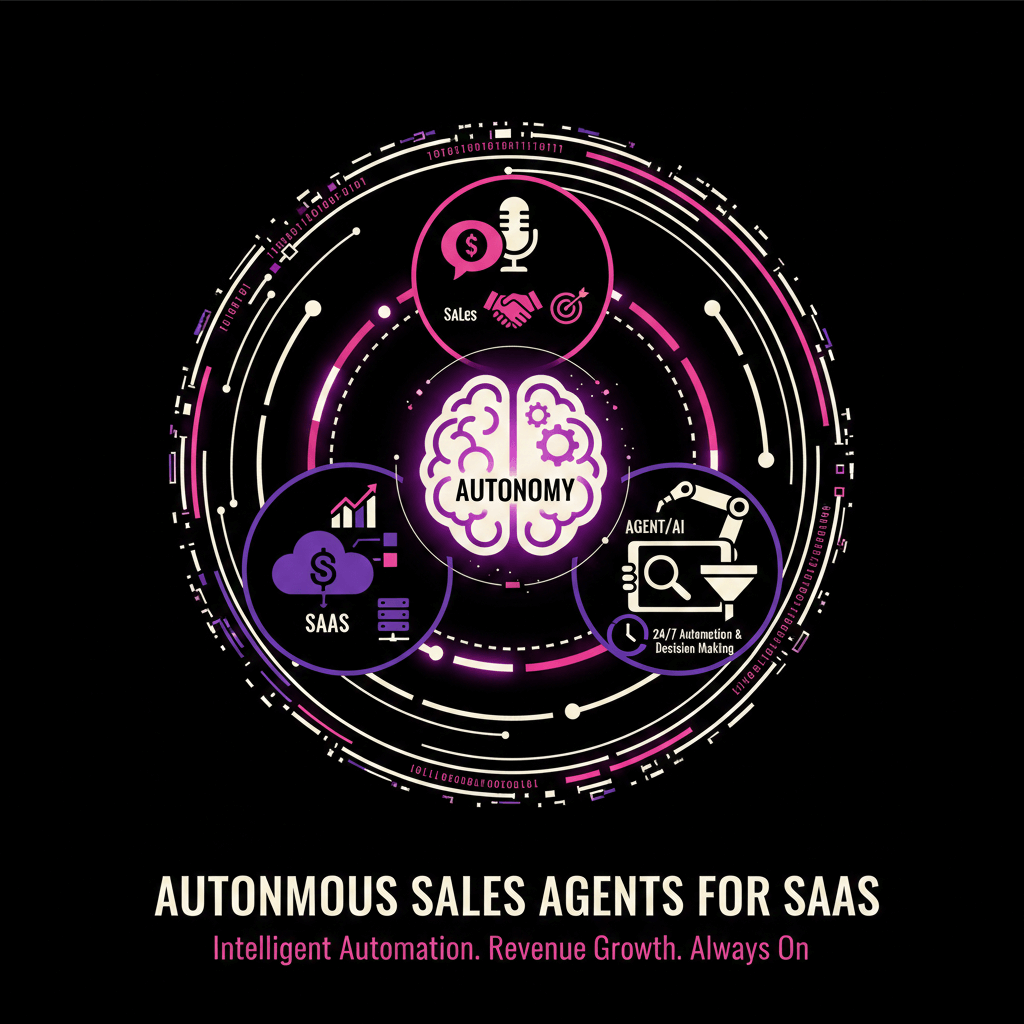
Part 1: Defining the Autonomous Sales Agent
To understand why this technology changes everything, we must first tear down the misconceptions. When people hear “AI in sales,” they usually think of two things:
- The Rule-Based Chatbot: These are the decision-tree bots we all know. If the user clicks A, show Message B. They are rigid. Suppose a prospect asks a question outside the pre-programmed path, the bot breaks. It cannot think; it only follows orders.
- The Auto-Dialer/Spam Bot: These are the nuisance tools that blast thousands of generic emails or robocalls. They rely on volume, not intelligence. They annoy prospects rather than engage them.
Autonomous Sales Agents for SaaS are different.
An autonomous agent acts much like a human virtual sales development rep. It possesses a “brain” powered by large language models (LLMs). It does not follow a script. It understands intent.
The Cognitive Difference
When a prospect says, “Your pricing seems high compared to Competitor X,” a chatbot panics. It doesn’t have a button for that.
An autonomous agent analyzes the statement. It recognizes three things:
- The Objection: Price sensitivity.
- The Context: Comparison to a specific competitor.
- The Goal: Justify value to keep the conversation moving.
The agent might reply, “That’s a fair observation. Competitor X is cheaper upfront, but our platform includes unlimited seats and 24/7 support, which they charge extra for. Are you looking to scale your team quickly?”
That is a multi-turn conversation. The agent listened, processed, countered, and ended with a question to advance the sale. It did this independently. No human clicked “send.”
True Independence
The word “Autonomous” is the key. These agents manage their own workflows. You give them a goal (e.g., “Book demos with VPs of Marketing in the UK”) and access to your calendar. The agent handles the rest.
It engages the lead. It answers technical questions. It decides if the lead is qualified. If the lead isn’t a good fit, the agent politely ends the chat to save your human team’s time. If the lead is hot, the agent books the meeting directly into the CRM.
Part 2: The Failure of Legacy “Automation”
Why do we need autonomous agents now? Because the old “automated prospecting tools” are failing.
For the last ten years, SaaS sales relied heavily on sequences. You load a list of 1,000 emails into a tool, write a generic template, and hit send.
This worked in 2015. In 2025, it is broken.
The Noise Problem
Everyone uses the same tools. Buyers receive hundreds of automated emails a week. They have developed “banner blindness” for sales emails. They know it’s a template. They know you didn’t really look at their LinkedIn profile.
Because response rates have plummeted, sales teams try to compensate by sending more volume. This creates a death spiral. More spam means lower trust, which leads to even lower response rates.
The Speed-to-Lead Gap
Data consistently shows that if you don’t respond to a lead within 5 minutes, your conversion rate drops by 400%.
Legacy automation helps with the first touch (the auto-responder), but it fails at the second touch.
- Scenario: A lead fills out a form at 6:00 PM.
- Legacy Auto: Sends an email saying, “Thanks! Let’s book a time.”
- Lead: Replies immediately, “Sure, are you free now?”
- Legacy Auto: Silence. The human SDR is at dinner.
- Result: By the time the human replies the next morning, the lead has moved on or found a competitor.
24/7 lead qualification is no longer a luxury; it is a requirement for survival. Your software works 24/7. Your billing system works 24/7. Your sales team must too. Since humans cannot work 24 hours a day without burnout, the only solution is an AI sales team.
Part 3: The Core Capabilities of a Modern AI SDR
What can these agents actually do? If you hire a solution like SalesCloser.ai, you aren’t just buying a script. You are deploying a digital worker with specific skills.
1. Intelligent Lead Conversion and Qualification
A human SDR spends hours looking at leads and asking, “Do they have the budget? Is this the right decision-maker?”
An autonomous agent does this in seconds during the conversation. It asks qualifying questions naturally.
- “How large is your current engineering team?”
- “What is your timeline for implementation?”
If the answers don’t match your criteria (e.g., the company is too small), the agent knows to steer the conversation toward self-serve resources. It filters out the noise, so your Account Executives only talk to people who are ready to buy.
2. Advanced Objection Handling
Objections are the most challenging part of sales. “It’s too expensive.” “We don’t have time right now.” “We are happy with our current vendor.”
Most rookie sales reps freeze here. Autonomous agents do not have egos. They do not get discouraged. They simply access their training data (which you provide) and offer the best logical response.
They can handle “smokescreens”—excuses that lead to getting off the phone. The agent knows how to probe deeper to find the real objection.
3. Emotional Intelligence Simulation
This sounds like science fiction, but it is standard for high-end AI agents today. The agent analyzes the sentiment of the user’s text or voice.
If the prospect sounds frustrated (“I’ve been trying to find this pricing page for twenty minutes!”), The agent adapts its tone. It becomes apologetic and direct.
- Agent: “I completely understand the frustration. Let me get that pricing breakdown for you immediately. Here is the link.”
If the prospect is chatty and casual, the agent matches that energy. This mirroring builds rapport, which is essential for intelligent lead conversion.
4. Perfect Recall and CRM Hygiene
Humans forget things. We forget to log calls. We fail to update the deal stage in Salesforce or HubSpot.
Autonomous agents never forget. Every interaction, every data point, and every sentiment score is logged instantly and accurately. Your CRM becomes a source of truth again, rather than a graveyard of outdated info.
Part 4: The 2026 Forecast—The Hybrid Sales Team
Where is this going?
We predict that by 2026, the structure of the SaaS sales organization will flip.
Currently, most companies have a pyramid:
- Bottom: Large army of human SDRs (Lead Gen)
- Middle: Account Executives (Closers)
- Top: VP/Managers
The Future Organization:
- Bottom: AI Sales Team (Handling 100% of initial inbound/outbound traffic)
- Middle: Specialized Human SDRs (Handling complex, high-ticket account mapping) + AEs (Closing)
- Top: VP/Managers
In this model, the “grunt work” of sales vanishes. No human will need to make 50 cold calls a day just to get hung up on. The autonomous prospecting engine handles the volume.
The Economic Impact
This shift impacts unit economics massively.
Hiring a human SDR is expensive. You have a base salary, commission, benefits, equipment, and training. Then there’s the “ramp time”—it takes 3 months for them to become productive. And the average tenure of an SDR is only 15 months.
An Autonomous Sales Agent costs a fraction of a human salary. It ramps up instantly. It never quits. It never takes a sick day.
For a SaaS startup, this levels the playing field. A small team with limited capital can deploy an army of AI agents that outperforms a legacy enterprise sales team of 50 people.
Part 5: SalesCloser.ai — The Platform for the New Era
How do you actually do this? You cannot just code an LLM from scratch and hope for the best. You need a platform designed for sales logic.
This is where SalesCloser.ai comes into play.
SalesCloser.ai is not just a tool; it is a platform for building, training, and managing your autonomous workforce. It positions itself as the pioneering solution for businesses ready to adopt this technology.
“Hiring” Your Agent
On SalesCloser.ai, you don’t just “set up” software. You build a persona.
You give your agent a name. You give it a job title. You define its voice.
- Do you want it to be professional and concise?
- Do you want it to be friendly and use emojis?
You upload your “Knowledge Base.” This includes your whitepapers, pricing documents, competitor comparisons, and past sales call transcripts. The agent consumes this information. It learns your business inside and out.
The Simulation Training Ground
One of the most powerful features of SalesCloser.ai is the ability to test your agent before it goes live. You can roleplay with it.
You act as the demanding customer. You throw strenuous objections at it. You see how it responds. Then, you tweak its instructions. “Don’t be so pushy on the first ask,” or “Emphasize our security features more.”
You iterate until the agent sounds exactly like your best salesperson. Then, you deploy it.
Multi-Channel Capabilities
SalesCloser.ai agents aren’t stuck in a chat widget. They can operate across voice and text. They can handle live demos.
Yes, the agent can navigate a visual presentation. It can walk a prospect through a slide deck or a product interface, explaining features as it goes and stopping to answer questions in real time. This is the holy grail of SaaS sales automation.
Part 6: Best Practices for Deployment
Implementing autonomous agents requires a strategy. If you turn it on without thought, you might confuse your customers. Here is how to do it right.
1. Start with Inbound
The safest place to start is your inbound traffic. These are people already coming to you. Replace your static “Contact Us” form with a SalesCloser.ai agent.
Monitor the conversations. See what questions people ask. You will be shocked by the data. You might find that 50% of your leads are confused about a specific feature. You can then fix your website copy and update the agent’s training.
2. Be Transparent
Do not trick the user. It is okay to say, “I am an AI assistant here to help get you answers instantly.”
People do not hate talking to bots; they hate talking to stupid bots. If the agent is helpful, fast, and accurate, customers prefer it over waiting 24 hours for a human.
3. The Human Handoff
Design a clear path for escalation. There will always be edge cases that an AI cannot handle. A VIP client may come in who demands a CEO conversation.
Your autonomous agent must know when to fold. It should be able to say, “That is a particular request. I am going to loop in our Senior Account Executive, Sarah, to handle this personally.”
4. Continuous Coaching
Treat your AI agents like employees. Review their chat logs weekly. Where did they win? Where did they lose?
SalesCloser.ai provides analytics on conversation performance. Use this data. If the agent is struggling with a new competitor’s objection, update its knowledge base. The more you coach it, the sharper it gets.
Part 7: The Future is Autonomous
The fear surrounding AI is usually about replacement. “Will robots take my job?”
In SaaS sales, the answer is nuanced. AI will take the parts of the job that humans hate. Humans hate data entry. Humans hate hearing “no” 50 times a day. Humans hate waking up at 3 AM to answer a lead from a different time zone.
Autonomous Sales Agents take these burdens. They free up human sellers to do what they do best: build deep relationships, negotiate complex partnerships, and close the massive deals that require a human touch.
We are standing at the edge of a revolution. The companies that cling to manual dialing and static forms will look like dinosaurs by 2026. The companies that embrace SalesCloser.ai and the autonomous workforce will dominate their markets.
The leads are there. They are waiting on your website right now. The only question is: Who is going to answer them?
Deep Dive: The Mechanics of “Autonomous Prospecting”
We have discussed inbound leads—people coming to your site. But what about autonomous prospecting (outbound)?
This is where the technology becomes truly aggressive (in a good way).
The Traditional Outbound Struggle
Outbound sales are grueling. You buy a list of data. You verify emails. You craft a campaign. You send emails. You wait.
The response rates are usually below 1%. This means 99% of your effort is wasted.
The AI Approach
An autonomous agent handles outbound differently. It connects to data sources (like LinkedIn or ZoomInfo). It scans for “buying signals.”
- Signal: A company just raised Series B funding.
- Signal: A company just posted a job opening for a “Head of SEO.”
The agent sees this. It knows you sell SEO software.
It doesn’t just send a template. It generates a hyper-personalized message based on that specific signal.
- “Hi [Name], saw you just posted for a Head of SEO. While you hunt for that hire, our software can help automate your technical audits…”
It sends the message. If the prospect replies with a question, the agent answers it immediately. It nurtures the conversation.
This is intelligent lead conversion at scale. It replaces the “spray and pray” method with “snipe and secure.”
Integration with the Tech Stack
A significant concern for Operations leaders is integration. “Will this break my Salesforce?”
Top-tier agents are designed to be “infrastructure agnostic.” Whether you use HubSpot, Salesforce, Pipedrive, or a custom setup, the agent acts as an API layer.
It reads data from the CRM to know who to talk to. It pushes data to the CRM to update records.
This seamless integration enables the “2026 Vision” of a hybrid workforce. The AI is not a rogue bot; it is a fully integrated team member with read/write access to the company’s central brain.
The Ethics of AI Sales
We must address the elephant in the room: Ethics.
As we deploy AI sales teams, we have a responsibility. There is a fine line between “persistent” and “harassment.”
Legacy auto-dialers crossed that line. They called people 10 times a day. Autonomous agents must be programmed with empathy and restraint.
SalesCloser.ai emphasizes “ethical selling.” This means:
- Respecting Opt-outs: If a user says “stop,” the agent instantly updates the suppression list.
- Honesty: The agent should not pretend to be a human if asked directly. Trust is the currency of sales.
- Value-First: The agent’s primary goal should be to provide value (information, answers, resources), not just to extract a meeting.
By adhering to these principles, autonomous agents can actually improve sales reputation. Instead of being seen as pests, they are seen as helpful assistants that are there when you need them and gone when you don’t.
Why Early Adopters Win
History repeats itself.
- In 2000, companies that adopted Salesforce (Cloud CRM) crushed those using Excel spreadsheets.
- In 2010, companies that adopted Marketing Automation (Marketo/HubSpot) crushed those sending manual emails.
- In 2025, companies adopting Autonomous Sales Agents will crush those relying on human-only bandwidth.
The advantage is speed. The advantage is data. The advantage is cost.
But the most significant advantage is consistency. A human sales rep has bad days. Maybe they broke up with their partner. Perhaps they are sick—their performance dips.
An AI agent performs at 100% capacity, every single second of every single day. It delivers the perfect pitch, every time. It follows up at the exact optimal moment, every time.
In a game of inches, that consistency is what builds empires.
SalesCloser.ai is the gateway to this consistency. It is not just about saving money; it is about creating a predictable, scalable revenue engine that operates independently of human limitations.
The evolution is here. The agents are ready—time to hire your new best performers.
Managing the Transition: A Guide for Sales Leaders
If you are a VP of Sales reading this, you might be wondering how to manage this change within your team. Change management is crucial.
Don’t frame it as a replacement. Frame it as a promotion for your humans.
Tell your SDRs: “We are bringing in AI to handle the tire-kickers and the unqualified leads. You are no longer required to sift through junk. You will only speak to people who have already spoken to the AI and confirmed they have a budget and interest.”
This increases job satisfaction. Your humans get to focus on high-value conversations. Their commission checks go up because their conversion rates on the calls they do take will skyrocket.
The “Pilot” Program: Do not fire your team and switch to AI overnight. Run a pilot.
- Take one territory or one vertical.
- Deploy SalesCloser.ai agents for that segment.
- Measure the results against a control group of human-only prospecting.
- Show the data to the team.
Once the team sees that the AI is feeding them better meetings, they will become the most prominent champions of the technology. They will start asking, “Can the AI handle this objection for me?” or “Can we tweak the AI to ask about X?”
You turn your sales team into “AI Coaches.” They become the strategists; the agents become the executors. This is the future of SaaS sales.
Final Thoughts
The journey from “Cold Calling” to “Autonomous Engaging” has been long. We have tried many tools. We have bought many lists. We have written many scripts.
But finally, the technology has caught up to the ambition. Generative AI and LLMs have bridged the gap between “robot” and “rep.”
Autonomous Sales Agents for SaaS are not a fad. They are the logical conclusion of digital sales. They solve the speed problem. They solve the volume problem. They solve the cost problem.
With platforms like SalesCloser.ai, the power is in your hands. You can build the sales machine you always dreamed of—one that never sleeps, never complains, and always closes.
Conclusion
The era of 9-to-5 lead engagement is over. The global market demands instant gratification and immediate answers. Autonomous Sales Agents for SaaS provide the only scalable way to meet this demand.
By leveraging tools like SalesCloser.ai, you can build a virtual sales development rep that never sleeps, never forgets a follow-up, and consistently drives qualified meetings into your pipeline. The future belongs to the businesses that automate the grind so their humans can focus on the growth.
Don’t let another lead slip away because your office lights were off. Embrace the autonomous revolution.
FAQs: Autonomous Sales Agents
Q: How is an AI Sales Agent different from a chatbot?
A: A chatbot follows a strict “if/then” script. It cannot handle questions outside of that script. An AI Sales Agent uses Large Language Models (LLMs) to understand context, intent, and sentiment. It can hold a natural, fluid conversation, handle unexpected objections, and make decisions without a pre-written path.
Q: Will these agents replace my human sales team?
A: No, they will augment them. Autonomous agents are best for the “top of the funnel”—finding, engaging, and qualifying leads. This allows your human team to focus on closing deals and managing relationships. Think of the AI as the ultimate assistant to your human stars.
Q: Can the agent really book meetings on its own?
A: Yes. Platforms like SalesCloser.ai integrate with your calendar (Google, Outlook, etc.). If a lead is qualified and ready to talk, the agent can check your availability in real time and book a slot directly in the chat.
Q: Is it difficult to set up an autonomous agent?
A: It is surprisingly fast. With SalesCloser.ai, you can upload your existing sales documents (PDFs, website URLs) to the “brain” of the agent. It learns from your content. You then refine its personality and rules. You can have a basic agent running in less than a day.
Q: Does it work for complex B2B sales?
A: Absolutely. In fact, it shines there. Complex sales often require answering many technical questions before a buyer is ready to commit to a demo. The agent can instantly access technical specs and answer detailed queries that a human SDR might struggle with.
Q: What happens if the AI doesn’t know the answer?
A: You can program “guardrails.” If the agent encounters a question it cannot answer with high confidence, it can be instructed to collect the user’s details and escalate the query to a human expert, ensuring you never provide incorrect information.
Q: Is this technology expensive?
A: Compared to hiring human staff, it is very cost-effective. You save on recruiting, training, benefits, and turnover costs. Plus, the AI works 24/7, effectively giving you three shifts of coverage for the price of one software subscription.