
An AI sales pitch is a sales message written by artificial intelligence from prospect data such as CRM records, past interactions, social activity and public company information. The AI spots patterns and likely needs, then drafts a pitch that speaks to that prospect’s specific pain points instead of a generic overview.
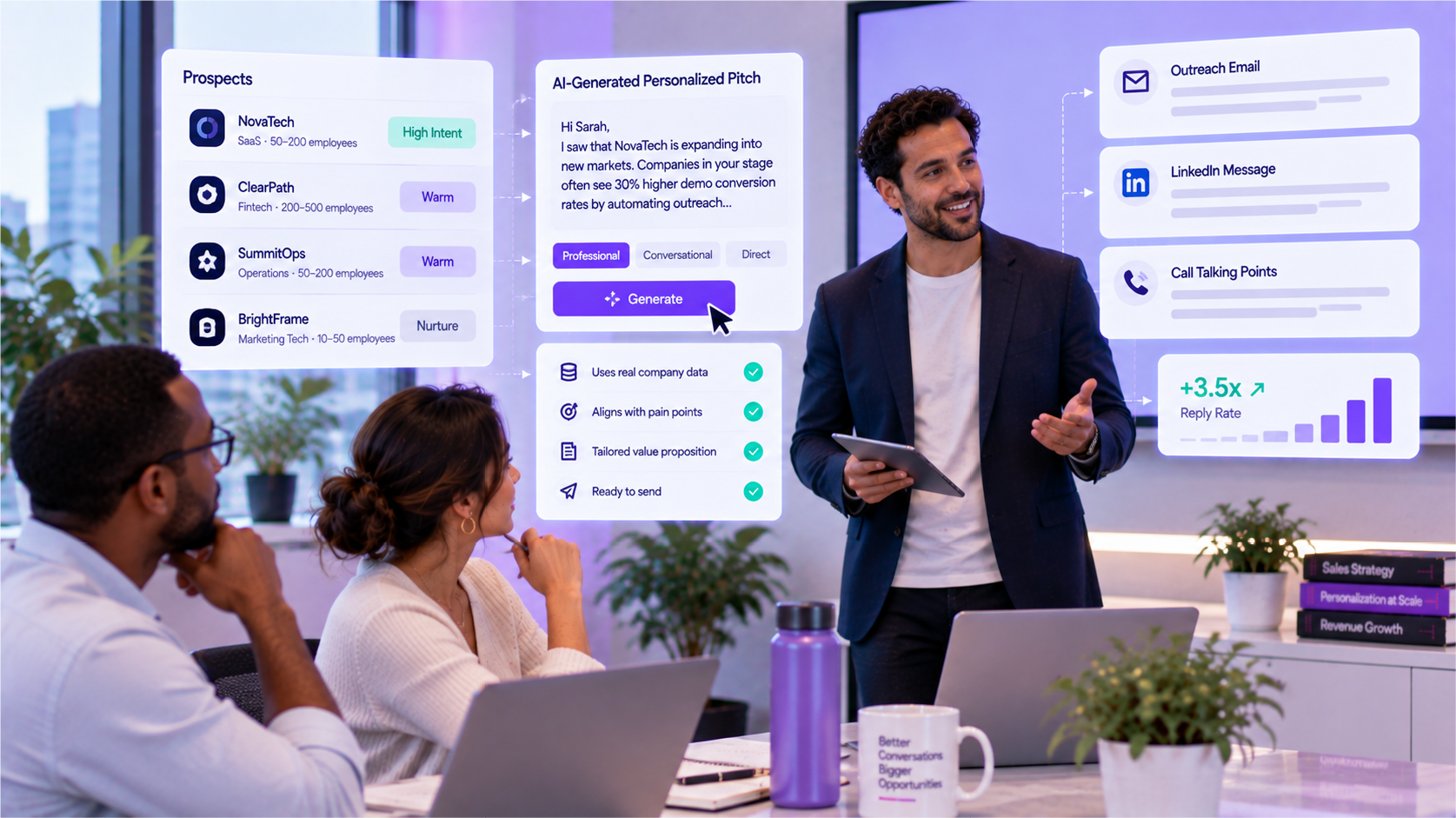
In today’s competitive sales landscape, generic sales pitches often go nowhere. Prospects face a constant flood of information, quickly dismissing messages that don’t directly address their needs. This is where AI-generated personalized sales pitches come into play, radically changing how sales professionals connect with potential clients and significantly boosting conversion rates. Using data-driven insights, AI allows for unmatched customization, making every sales interaction feel unique and relevant. This article explores the power of AI in sales automation, offering practical tips, real-world examples, and research-backed strategies to help sales professionals use this technology for better results.
The Evolution of Sales Pitches
Sales relied heavily on gut feelings, charm, and standard scripts for decades. Sales professionals often used a one-size-fits-all method, hoping a broad message would appeal to a wide audience. This approach usually led to low engagement, missed chances, and many rejected pitches.
Then came basic personalization, where sales teams manually insert a prospect’s name or company into an email. While an improvement, this method still lacked real depth. It didn’t solve the main problem: understanding what motivates each prospect. The process remained slow, and the impact was limited.
Today, AI in sales automation marks a considerable change. It goes beyond simple personalization, digging deep into data to understand individual prospect behavior, preferences, and pain points. This understanding forms the base for customized messages, making AI-generated personalized sales pitches a game-changer.
What Are AI-Generated Personalized Sales Pitches?
AI-generated personalized sales pitches are dynamic, data-driven communications created by artificial intelligence to connect with individual prospects. These are not just automated messages; they are intelligent, adaptable conversations made to have maximum impact.
Here’s how they work: AI sales tools analyze vast amounts of data, including CRM data, social media activity, past interactions, industry trends, and even public information about a prospect’s company. The AI finds patterns, predicts needs, and then builds a sales pitch directly addressing those insights.
For example, an AI sales pitch generator can see that a prospect recently downloaded an e-book on digital marketing. It will then automatically suggest a pitch focusing on how your product or service can specifically improve their digital marketing efforts, rather than a general overview. This level of accuracy is nearly impossible to achieve manually at scale.
The Core Mechanisms of AI Sales Tools
AI-powered sales assistant platforms use several key technologies to create powerful pitches:
- Natural Language Processing (NLP): This technology lets AI understand and create human language. NLP is vital for analyzing prospect communications, extracting key information, and crafting pitch content that sounds natural and convincing. It helps the AI understand emotions, find keywords, and even recognize subtleties in communication.
- Machine Learning (ML): ML algorithms learn from data over time. The more data an AI sales tool processes, the better it predicts which pitches will work best for different prospect groups. This continuous learning process refines sales pitch optimization, leading to increasingly accurate and high-converting messages.
- Data Analytics: This is the backbone of personalized sales strategies. AI platforms collect and analyze data points from various sources, including customer relationship management (CRM) systems, marketing automation platforms, and public databases. This thorough data analysis provides the insights needed to customize pitches precisely. It identifies buying signals, preferred communication methods, and even the best time for outreach.
- Predictive Modeling: Based on past data, AI can predict how likely a prospect is to convert. This allows sales teams to prioritize leads and focus their efforts on those most likely to become customers. This means sales professionals can spend more time on high-value interactions rather than chasing unlikely prospects.
These mechanisms combine to form powerful sales personalization software that enables sales teams to work efficiently and effectively.
Why AI Personalization Matters for Conversion Rates
The direct link between AI personalization and increased conversion rates is clear. Here’s why:
- Relevance: When a sales pitch is highly relevant to a prospect’s needs, they are more likely to engage. Generic pitches often get deleted or ignored, while personalized messages cut through the noise, showing the prospect that you understand their challenges.
- Engagement: Personalized content creates deeper engagement. Prospects feel heard and understood when the message speaks directly to their pain points and hopes. This leads to more meaningful conversations and a higher chance of moving to the next stage of the sales funnel.
- Trust and Credibility: A well-researched, personalized pitch shows you’ve done your homework. This builds trust and credibility, positioning you as a knowledgeable problem-solver rather than just another salesperson. It shows you value their time and business.
- Efficiency: AI for lead conversion automates the difficult task of researching individual prospects and creating unique messages. Sales professionals save significant time, letting them focus on building relationships and closing deals. This increased efficiency directly leads to more conversions per sales representative.
- Scalability: Manual personalization is naturally limited by time and resources. AI-driven sales pitches allow for personalization at scale. You can simultaneously send thousands of uniquely tailored messages, reaching a broader audience with personalized content without losing quality. This is a vital advantage for businesses looking to grow quickly.
- Improved Sales Cycles: By delivering highly relevant messages from the start, AI helps shorten sales cycles. Prospects grasp the value proposition faster, reducing the back-and-forth typical of discovery and negotiation. This faster progress means more deals closed in less time.
- Competitive Advantage: Businesses that use AI-generated personalized sales pitches gain a significant edge over competitors still using traditional, less effective methods. In a crowded market, personalization can be the difference that wins the deal.
Real-World Examples of AI in Sales Success
Consider these situations where AI sales tools have made a clear difference:
- B2B Software Company: A company selling project management software used an AI sales pitch generator. The AI analyzed public financial reports and news articles about a target company, finding recent mergers and acquisitions. The AI then crafted a pitch emphasizing how their software could streamline post-merger integration and improve team collaboration, a critical need for the prospect. This tailored approach led to a 40% higher response rate than their generic pitches.
- Financial Services Provider: An investment firm used AI sales tools to personalize outreach to high-net-worth individuals. The AI searched economic news and market trends, identifying prospects whose portfolios might be at risk from specific market shifts. The personalized pitches offered proactive strategies to lessen these risks, significantly increasing client consultations and new assets under management.
- E-commerce Retailer (B2C with B2B Sales): While mainly B2C, this retailer also had a B2B arm for bulk orders. They used AI for lead conversion by analyzing businesses’ purchasing histories. If a business often ordered office supplies, the AI would generate a pitch for their new corporate bulk discount program, highlighting specific products relevant to past purchases. This data-driven sales pitch approach boosted their B2B sales by 25%.
- Healthcare Technology Vendor: An AI-powered sales assistant helped a healthcare tech vendor target hospitals. The AI analyzed hospital reviews, patient demographics, and recent technology investments. The resulting pitches focused on improving patient flow and reducing administrative burdens, directly addressing the pain points the AI identified. This led to a substantial increase in demo requests.
These examples show that AI in B2B sales is not just an idea; it delivers measurable results across different industries.
Practical Tips for Implementing AI-Generated Pitches
Using AI in your sales strategy requires careful planning and execution. Here are some practical tips to get the most success:
- Start with Clean Data: The effectiveness of any AI system depends on the quality of its input data. Before using an AI sales pitch generator, ensure your CRM is updated, accurate, and complete. Clean data means better insights and more effective pitches. Remove duplicates, fill in missing information, and standardize formats.
- Define Your Ideal Customer Profile (ICP): Even with AI, understanding your target audience is most important. Clearly define your ICPs, including demographics, company details, pain points, and goals. This gives the AI a strong framework for personalization. The more specific your ICP, the more targeted the AI’s output.
- Integrate AI Tools Seamlessly: Choose AI sales tools that integrate well with your existing sales tech stack, especially your CRM. Smooth integration ensures data flows freely, allowing the AI to access the information it needs and update records efficiently. This reduces manual effort and improves data accuracy.
- Train Your AI (and Your Team): AI models need to learn. Provide examples of successful pitches, prospect interactions, and relevant content to your AI sales assistant. Continuously feed it new data and feedback. At the same time, train your sales team to use AI tools effectively, understand its suggestions, and refine its output. They need to understand the ‘why’ behind the AI’s recommendations.
- Test and Iterate: Don’t expect perfection from day one. Use A/B testing for different pitch versions created by AI. Analyze metrics like open rates, click-through rates, and conversion rates. Use these insights to refine your AI models and sales pitch optimization strategies continuously. This ongoing process is key to long-term success.
- Maintain Human Oversight: While AI is powerful, it’s a tool, not a replacement for human judgment. Sales professionals should review AI-generated pitches, adding unique insights and ensuring the tone and content match their selling style and the prospect’s personality. The human touch remains crucial for building connections.
- Focus on the Conversation, Not Just the Pitch: AI helps open doors, but the real magic happens in the following conversation. Once the personalized pitch has caught the prospect’s attention, give your sales team the skills to engage effectively. Teach them to listen carefully, ask detailed questions, and adapt their approach in real time.
- Prioritize Continuous Learning: The sales world and your AI are changing. Stay updated on new AI capabilities and regularly review your strategies. Encourage your team to give feedback on the AI’s performance, allowing for ongoing improvements and adaptations.
- Embrace Data-Driven Decisions: Use the analytics provided by your AI sales tools to make informed choices. Understand which personalization strategies are working best, find areas for improvement, and assign resources effectively. Data-driven sales pitches lead to data-driven success.
Research-Backed Strategies for AI in Sales
Academic and industry research consistently supports how effective AI is in sales. Here are some strategies backed by research:
- Hyper-Personalization Drives Higher ROI: Studies show that hyper-personalization, made possible by AI, yields significantly higher returns on investment compared to basic personalization. This means going beyond just names to understand and address individual needs and preferences.
- Predictive Analytics for Lead Scoring: Research indicates that using AI’s predictive analytics for lead scoring greatly improves the efficiency of sales teams. By focusing on leads most likely to convert, sales professionals optimize their time and effort, leading to a higher conversion rate for their overall pipeline.
- Automated Content Generation Increases Velocity: AI-powered sales assistant tools that automate content creation (like email copy, social media posts, and pitch outlines) allow sales teams to increase their outreach speed without sacrificing quality. This means more personalized touchpoints in less time.
- Sentiment Analysis for Better Engagement: AI’s ability to perform sentiment analysis on prospect communications (emails, calls, chat) allows sales professionals to gauge a prospect’s emotional state and adjust their pitch accordingly. This emotionally intelligent approach leads to more empathetic and effective interactions, as research suggests.
- AI-Driven Sales Coaching Improves Performance: Beyond just generating pitches, some AI sales tools offer sales coaching by analyzing call transcripts and identifying areas for improvement in a sales professional’s communication style. This continuous feedback loop helps sales teams refine their skills and deliver compelling pitches.
- Optimized Timing and Channel Selection: Research confirms that the timing and channel of a sales message significantly affect its effectiveness. AI can analyze past engagement data to suggest the best time of day and the preferred way to communicate (email, phone, social media) for each prospect, maximizing the chances of the pitch being seen and acted upon.
These research-backed strategies highlight that AI is not just a trend; it’s a fundamental change in how sales operations achieve their best performance.
Overcoming Challenges in AI Implementation
While the benefits are clear, using AI in sales comes with its own set of challenges. Addressing these directly ensures a smoother transition and greater success:
- Data Privacy Concerns: Handling prospect data requires strict adherence to privacy rules like GDPR and CCPA. Ensure your AI sales tools comply and have clear data collection, storage, and use policies. Being transparent with prospects about their data use can also build trust.
- Integration Complexities: Connecting new AI platforms with existing CRM and marketing automation systems can be complex. Work with vendors who offer strong integration features and consider a gradual rollout to minimize disruption, plan for potential data migration challenges.
- Resistance from Sales Teams: Some sales professionals might initially resist AI, fearing it will replace their jobs or make their work useless. It’s crucial to present AI as an assistant, a tool that boosts their abilities, frees them from tedious tasks, and helps them sell more effectively. Emphasize how AI helps them achieve their goals, not hinders them.
- Maintaining the Human Touch: There’s a concern that AI will make sales interactions impersonal. The key is to use AI to improve, not replace, human connection. AI provides the initial insights and tailored messages, but the human sales professional brings empathy, active listening, and the ability to build genuine relationships.
- Cost of Implementation: Investing in advanced AI sales tools can be expensive. Do a thorough cost-benefit analysis to show the potential return on investment. Start with pilot programs to prove value before a full rollout.
- Bias in Data: If the AI’s training data contains biases, the AI-generated personalized sales pitches might continue those biases. Regularly check your data and AI algorithms to ensure fairness and prevent unfair outcomes. Diverse and representative data sets are crucial for unbiased AI.
By proactively addressing these challenges, businesses can unlock the full potential of AI-generated personalized sales pitches.
The Future of Sales: A Human-AI Partnership
The future of sales isn’t about machines replacing humans, but about a powerful partnership between human creativity and artificial intelligence. AI handles the hard work of data analysis, personalization at scale, and finding key insights. Sales professionals then use these insights to build stronger relationships, have more meaningful conversations, and close deals more effectively.
Imagine a sales professional who walks into a meeting already knowing a prospect’s exact pain points, preferred communication style, and even their favorite hobbies, all thanks to AI. This allows for a deeper, more relevant conversation from the first moment, building trust instantly.
This collaboration empowers sales teams to move beyond simple transactions. Instead, they become trusted advisors, offering solutions that truly fit individual needs. This shift increases conversion rates, improves customer satisfaction, and builds long-term loyalty. AI sales tools become essential to the sales ecosystem, constantly learning and adapting to market changes and customer behavior. The continuous feedback loop between human interaction and AI analysis creates a flexible and highly effective sales engine.
Introducing SalesCloser AI: Your Advanced AI Sales Agent Platform
As we’ve explored the transformative power of AI in crafting personalized sales pitches, it’s clear that the right platform can make all the difference. This brings us to SalesCloser AI, a leading AI sales agent platform designed to revolutionize your sales operations.
SalesCloser AI stands out by offering advanced AI personalization capabilities that go beyond basic customization. It empowers sales teams to craft dynamic, high-converting sales pitches using sophisticated algorithms and deep data analysis. The platform acts as an intelligent sales pitch generator, carefully analyzing prospect data, market trends, and your product or service offerings to create messages that truly connect.
Here’s how SalesCloser AI helps you convert more leads:
- Dynamic Pitch Generation: SalesCloser AI doesn’t just create static templates. It generates dynamic pitches that adapt in real-time based on new information or prospect interactions. This ensures your message is always relevant and impactful.
- Deep Personalization: The platform digs deep into prospect data, finding unique needs, preferences, and buying signals. It then uses these insights to customize every part of the pitch, from the opening line to the call to action.
- AI-Powered Sales Assistant Features: Beyond pitch generation, SalesCloser AI offers a suite of AI sales tools that act as comprehensive AI-powered sales assistants. These tools provide insights, suggest next steps, and help automate tedious tasks, freeing your sales team to focus on high-value activities.
- Optimization for Conversion: SalesCloser AI is built with conversion in mind. It constantly learns from the performance of your pitches, suggesting improvements and refining strategies for maximum impact. This sales pitch optimization means your messages get better over time.
- Seamless Integration: Made for ease of use, SalesCloser AI integrates smoothly with your existing CRM and sales platforms, ensuring a unified and efficient workflow. This seamless integration means your team can quickly adopt and benefit from its capabilities.
- Data-Driven Insights: The platform provides comprehensive analytics on pitch performance, allowing you to track what works and what doesn’t. This data-driven sales pitches approach enables continuous improvement and strategic decision-making.
By choosing SalesCloser AI, you invest in cutting-edge sales personalization software that redefines your lead conversion approach. It’s an investment in a brighter, more efficient, and ultimately more profitable sales future. Visit SalesCloser AI to discover how its advanced AI can transform your sales pitches into powerful conversion engines.