“Stop manual prospecting. Master AI outbound sales in 2026 to send hyper-personalized outreach at scale, engage via signals, and book demos.”
Traditional cold outreach is failing. Today, 98% of standard cold emails go completely unread, blocked by aggressive spam filters and buyer fatigue. If your sales team still relies on buying massive lead lists and blasting identical messages, you are actively burning your total addressable market.
You need a system that books meetings while your team sleeps. You need AI outbound sales.
This guide breaks down the new era of outbound prospecting in 2026. We will contrast the outdated volume-based methods with modern, one-to-one AI interactions at scale. You will learn exactly how to build an autonomous engine, select the right tech stack, and prevent pipeline droughts once and for all.
What is AI Outbound Sales?
Many sales leaders misunderstand what artificial intelligence actually does for a revenue team. They treat it like a glorified spellchecker or a simple email scheduler. That completely misses the mark.
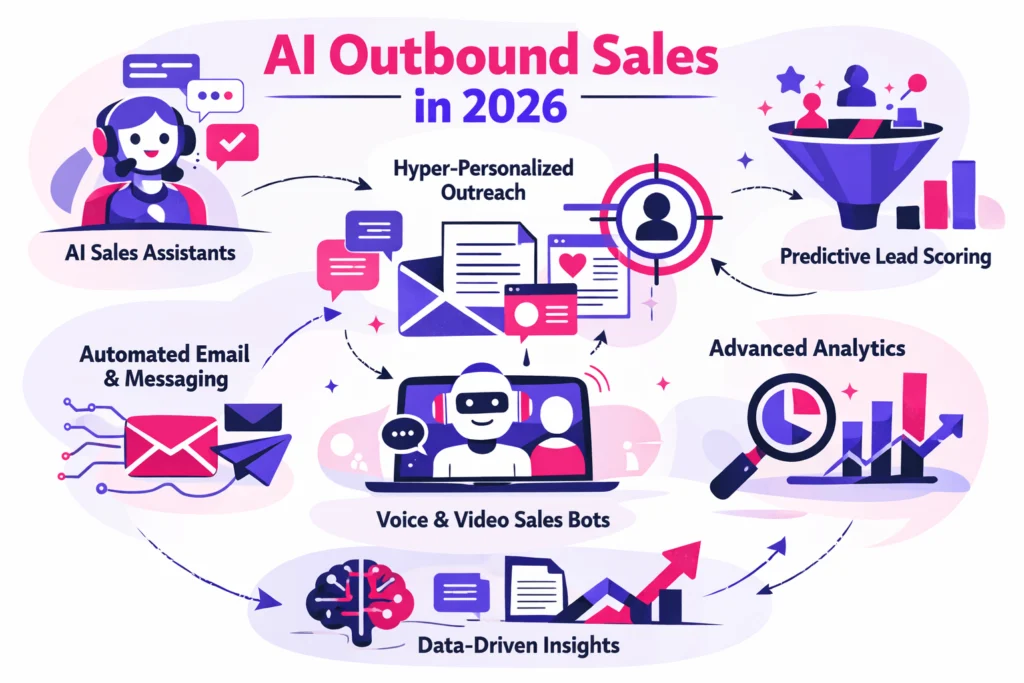
AI outbound sales is the process of using autonomous software agents to handle the entire top-of-funnel prospecting motion. This includes building lead lists, researching prospects, writing hyper-personalized outreach, and autonomously managing follow-ups without requiring human intervention until a meeting is booked.
This represents a massive shift in how companies grow revenue. In the past, scaling outbound meant hiring armies of SDRs to make hundreds of dials a day. Now, an autonomous outbound engine scales your capacity infinitely while keeping the cost per acquisition flat.
AI systems do not get tired. They do not forget to follow up on day four. They analyze buyer signals in real time and trigger the right message at the right moment.
2026 Prospecting Trends: The End of “Spray and Pray.”
The “spray and pray” methodology defined the last decade of sales. Software made it incredibly cheap to send thousands of emails daily. As a result, buyers stopped paying attention.
By 2024, major email providers instituted strict spam policies that punished high-volume senders. In 2026, those filters are impenetrable to generic blasts. If you send the same template to 500 people, your domain reputation will plummet.
The Shift to Hyper-Personalized Sales at Scale
The defining trend of 2026 is hyper-personalized sales at scale. Buyers demand relevance. They expect you to know their company’s recent funding, specific role challenges, and hiring trends before you reach out.
Human reps cannot manually research 100 accounts a day and write highly specific emails for each one. AI can do this in seconds. It scrapes LinkedIn, reads recent company press releases, and synthesizes that data into a unique message.
Signal-Based Prospecting Replaces Static Lists
Static lead lists decay the moment you download them. People change jobs, companies shift priorities, and budgets freeze.
The new trend relies on signal-based prospecting. AI agents monitor the web for specific buying triggers. When a target account hires a new VP of Marketing, the AI instantly triggers a personalized sequence referencing that specific hire.
AI Outbound vs Inbound Strategies
Revenue leaders often debate whether to invest more in outbound or inbound marketing. In 2026, the best teams will integrate both using AI.
However, they serve fundamentally different purposes in your pipeline generation strategy.
| Feature | AI Outbound Sales | Inbound Marketing |
| Speed to Pipeline | Fast. You target exactly who you want immediately. | Slow. Requires building SEO, content, and brand over time. |
| Control | High. You dictate the exact accounts and personas you engage. | Low. You cannot completely control who fills out a form. |
| Scalability | Instant. Add more AI agents to increase volume. | Gradual. Traffic scales organically over months or years. |
| Cost | Predictable SaaS and data costs. | Variable depending on ad spend and content production. |
Inbound leads generally convert at a higher rate because the buyer raised their hand. But you cannot rely on inbound alone if you need to hit aggressive revenue targets. You cannot force a Fortune 500 decision-maker to read your blog.
AI outbound allows you to hunt enterprise whales proactively. It gives you the control to systematically attack specific verticals. When you combine inbound intent data with an AI-powered outbound motion, you create a seamless revenue machine.
Building Your AI Outbound Sales Strategy
Deploying AI requires a structural shift in your revenue operations. You cannot simply plug an AI tool into a broken process and expect a surge in booked demos.
Here is the exact step-by-step playbook to build your AI outbound sales strategy this year.
Step 1: Establish Bulletproof Data Hygiene
AI is only as intelligent as the data you feed it. If your CRM is full of outdated contacts and duplicate accounts, your AI agent will send the wrong message to the wrong person.
Start by cleaning your database. Use automated enrichment tools to verify email addresses and update job titles. According to a 2025 Gartner B2B Sales Report, companies with automated data hygiene processes saw a 40% increase in outbound connection rates.
You must build a data waterfall. Do not rely on a single data provider. Set up your system to ping three different databases in sequence to find the most accurate contact information.
Step 2: Define Your Buying Signals
Stop targeting broad demographics like “Companies in SaaS with 100-500 employees.” That is too generic. Instead, build your lists based on specific buying signals.
Identify what happens in a company right before they buy your product. Do they post a specific job opening? Do they adopt a new piece of technology? Do they raise a Series B?
Map out 5 to 10 core buying signals. Program your autonomous agents to scrape job boards, technology lookup sites, and financial news sources to detect these signals in real time.
Step 3: Architect the AI Sales Orchestration
AI sales orchestration seamlessly coordinates multiple channels. Your buyers do not live solely in their email inboxes. They use LinkedIn, they answer phone calls, and they read text messages.
Your strategy must encompass a multi-channel approach. Program your AI to send a personalized connection request on LinkedIn. If the prospect accepts, the AI automatically sends a direct message. If they do not accept within 48 hours, the AI triggers an email referencing a recent company milestone.
This orchestration requires strict rules of engagement. You must cap the number of touches per week to avoid annoying the prospect.
Step 4: Crafting the AI Prompts
You do not write templates anymore. You write prompts.
Instead of writing a static email, you instruct the AI on how to write the email. A strong prompt provides the AI with strict parameters regarding tone, length, and value proposition.
For example, instruct the AI to limit emails to 75 words. Tell it to start the email by referencing a specific line from the prospect’s LinkedIn about section. Command the AI to ask a single, low-friction question at the end of the message.
Step 5: Implement Autonomous Follow-Ups
The fortune remains in the follow-up. Human SDRs consistently fail to follow up past the third touchpoint. Autonomous follow-ups solve this problem permanently.
Set your AI agents to handle replies automatically. If a prospect asks for pricing, the AI instantly reads your pricing documentation and provides the exact figures. If the prospect says “reach out in Q3,” the AI automatically pauses the sequence and schedules a new touchpoint for July 1st.
This ensures absolutely no leads fall through the cracks. Every single response receives an immediate, contextually relevant reply.
The Essential Tools and Tech Stack
You cannot execute a 2026 outbound motion with tools built in 2018. Your tech stack needs to prioritize autonomy, API connectivity, and native machine learning capabilities.
Data Enrichment Platforms
You need tools that scrape the web in real-time. Legacy databases update their records every few months. You need platforms that verify data in real time during outreach. Connect your CRM to tools that continuously track intent data and tech stack changes.
Email Deliverability Infrastructure
Sending infrastructure is now a specialized discipline. You must use tools that automatically rotate sending domains, warm up new inboxes, and monitor your spam score. If your deliverability drops, your AI agent is effectively shouting into a void.
The Autonomous Sales Agent
This is the core of your new engine. You need software that actually executes the work.
SalesCloser.ai provides specialized AI agents that improve sales performance across the board. Unlike basic email tools, SalesCloser AI handles the entire lifecycle of a conversation. It reads inbound replies, categorizes the prospect’s intent, and writes a human-like response in seconds. It allows your human closers to focus entirely on running discovery calls and negotiating contracts.
Metrics to Track in an Autonomous Outbound Engine
The old metrics are dead. Tracking “emails sent” or “calls made” makes no sense when an AI can execute 10,000 actions in an hour. You must track metrics that reflect actual pipeline generation and conversation quality.
- Positive Reply Rate: Open rates are highly inaccurate due to email privacy protections. Click rates often trigger spam filters. The only top-of-funnel metric that matters is the percentage of prospects who reply positively. Aim for a positive reply rate of at least 3-5%.
- Meetings Booked per Agent: Track the direct ROI of your software. How many qualified meetings did the AI schedule this month? Compare this to the software’s cost to determine your cost per meeting.
- Lead-to-Opportunity Conversion: An AI can book a lot of meetings, but are they the right meetings? Track how many of these AI-sourced meetings progress to a qualified pipeline opportunity. If this number is low, your AI is targeting the wrong persona.
- Bounce Rate and Spam Complaints: Monitor these obsessively. If your bounce rate exceeds 2%, or if your spam complaint rate rises above 0.1%, stop your campaigns immediately. You need to fix your data or soften your messaging before you destroy your domain reputation.
Common Mistakes in AI-Powered Cold Outreach
Even with powerful technology, revenue teams make critical errors during implementation. Avoid these common pitfalls to ensure your AI-powered cold outreach actually converts.
Mistake 1: Sounding Like a Robot
Buyers spot AI-generated text instantly if you do not restrict the model. If your emails contain words like “delve,” “testament,” or “paradigm,” prospects will delete them immediately. You must prompt your AI to write in a casual tone. Force it to use simple language, lowercase subject lines, and short sentences.
Mistake 2: Scaling Bad Messaging
AI acts as a multiplier. If your core value proposition is weak, AI will simply send that weak message to thousands of people faster. You must manually validate your messaging before letting the AI scale it. Test your hooks and offers with a small batch of prospects. Once you find a message that converts, unleash the AI.
Mistake 3: Ignoring Deliverability
Many teams buy an AI tool, load up 10,000 contacts, and blast them all on day one. This guarantees a permanent ban from major email providers. You must scale volume gradually. Send 30 emails per inbox per day. Add new inboxes slowly. Treat your domain reputation like a fragile asset.
Mistake 4: Removing the Human Element Completely
AI agents are incredible at securing the meeting. They are terrible at closing complex enterprise deals. Do not try to automate the discovery call or the negotiation phase. Use AI to handle the tedious, repetitive work of prospecting. Let your human account executives do what they do best: build relationships, navigate company politics, and close revenue.
How SalesCloser AI Fits Into Your Strategy
Transitioning to an autonomous outbound engine requires the right partner. SalesCloser.ai is designed specifically for B2B revenue teams that need to scale their pipeline without scaling headcount.
Our platform integrates directly into your existing CRM. It monitors your target accounts for buying signals 24/7. When a signal hits, SalesCloser AI drafts a unique message, sends it through a highly deliverable infrastructure, and manages the entire back-and-forth conversation until the prospect agrees to a meeting.
Conclusion
The era of manual, volume-based prospecting is permanently over. The future belongs to teams that leverage AI to deliver hyper-personalized sales at scale.
By building an autonomous outbound engine, you eliminate pipeline droughts, dramatically lower your customer acquisition costs, and free your sales team to focus on actual selling. You must adopt signal-based targeting, enforce strict data hygiene, and rely on specialized AI agents to handle the top of the funnel.
Stop wasting your total addressable market on generic spam. Start building your modern outbound machine today. Book a demo with SalesCloser.ai to see our autonomous agents in action.