“Drive revenue and increase NRR with AI sales agents for upsell calls. Automate proactive outreach to expand accounts at scale.”
Research from Bain & Company shows that increasing customer retention by just 5% can boost profits by 25% to 95%. Yet, most sales organizations spend 80% of their resources chasing net-new logos. They leave massive revenue potential sitting dormant within their existing customer base. Account managers respond to inbound support tickets and handle renewal dates, but they rarely have time to pitch upgrades proactively.
You need a systematic customer expansion strategy. You need a way to monitor product usage, identify growth signals, and initiate value-driven conversations without burning out your human team. An AI sales agent for upsell calls solves this exact problem.
This guide will show you how to move from sporadic, reactive check-ins to a proactive, data-driven revenue engine. We will cover how to identify behavioral triggers, script effective conversations, and deploy SalesCloser.ai to automatically book highly qualified expansion meetings.
What is an AI Sales Agent for Upsell Calls?
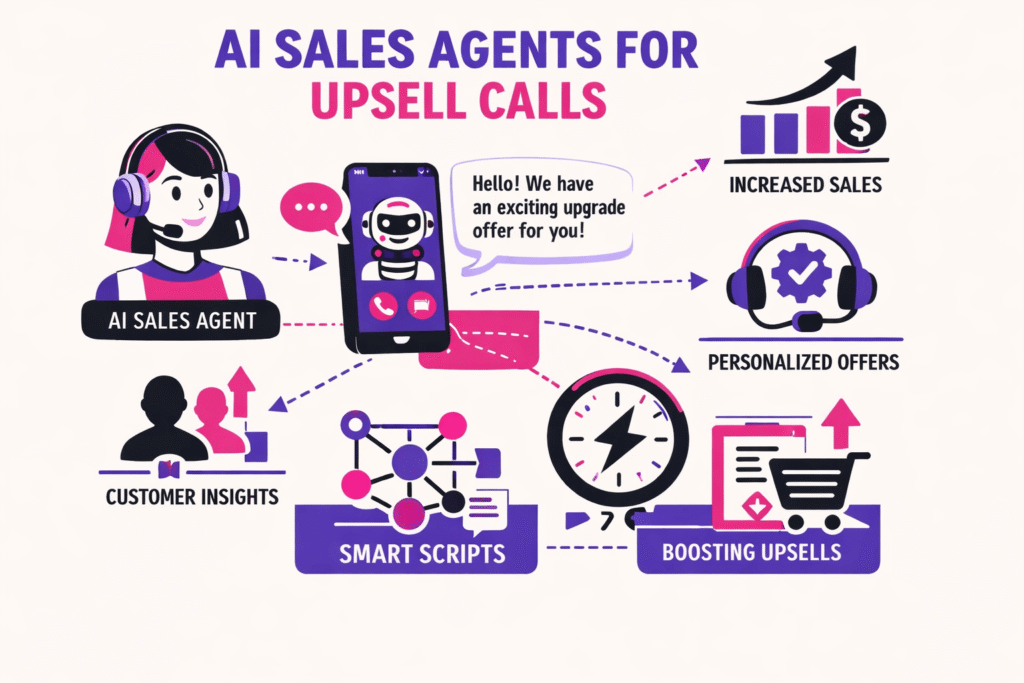
An AI sales agent for upsell calls is an autonomous voice software that contacts existing customers to discuss upgrades, new features, or expanded licenses. It analyzes CRM data to trigger calls based on usage milestones, engages customers in natural conversations, and routes interested accounts to human managers to close the deal.
Unlike basic chatbots, these voice agents understand context. They do not just read scripts; they handle objections, answer product questions, and adapt their tone based on the customer’s responses. They bridge the gap between automated marketing emails and expensive human phone calls.
Organizations use these tools to ensure no customer falls through the cracks. When an account hits a specific milestone, the AI acts immediately. This immediate action creates a consistent pipeline of expansion opportunities.
The Mathematics of Customer Expansion Revenue
Customer expansion revenue represents the money generated from your existing customer base through upsells, cross-sells, and add-ons. It is the most profitable revenue your business can generate. Acquiring a new customer costs significantly more than expanding an existing one.
According to Gartner research on B2B buying behaviors, existing customers are much more likely to convert than cold prospects. They already trust your brand. They already understand your product’s core value. They simply need guidance on how additional features solve their new, evolving problems.
The Cost of Acquisition vs. Expansion
When you focus solely on new customer acquisition, your Customer Acquisition Cost (CAC) eats into your profit margins. You spend money on advertising, outbound prospecting, and lengthy discovery cycles. Expansion revenue bypasses these initial hurdles.
The existing customer requires zero top-of-funnel marketing spend. The sales cycle is shorter because you skip the vendor evaluation phase. Consequently, a strong expansion motion drastically reduces your overall payback period and drives immediate cash flow.
The Impact on Net Revenue Retention
Net Revenue Retention (NRR) measures the percentage of recurring revenue retained from existing customers over a specific period, including upgrades and downgrades. Top-tier SaaS companies aim for an NRR of 120% or higher. This means their customer base grows in value by 20% each year, even if they acquire zero new logos.
You cannot hit 120% NRR through renewals alone. You must actively sell more seats, higher tiers, and complementary products. Automated upselling systems guarantee that every account receives the attention needed to drive that NRR metric upward.
Why Manual Proactive Account Management Fails at Scale
Many companies attempt to implement proactive account management using their existing human workforce. This approach rarely scales. Account managers inevitably become bogged down by administrative tasks, onboarding, and firefighting urgent customer issues.
When a critical bug surfaces, the account manager drops their upselling tasks to manage the crisis. Proactive outreach gets pushed to the next quarter. Eventually, the strategy devolves into reactive order-taking.
The Bandwidth Problem
A single human account manager can only effectively manage a limited number of relationships. Depending on the contract size, that number ranges from 20 to 100 accounts. Once a company scales past 1,000 customers, maintaining personal, proactive contact becomes mathematically impossible without hiring a massive, expensive team.
Sales reps also suffer from call reluctance when pitching existing customers. They fear jeopardizing the renewal by appearing too pushy. This hesitation leads to missed opportunities and stagnant account growth.
The Data Action Gap
Modern CRMs capture thousands of data points about customer behavior. We know when they log in, what features they use, and when they hit their usage limits. However, human teams struggle to act on this data in real-time.
A report might flag 50 accounts that exceeded their API limits this week. A human rep might call five of them before getting distracted. The data action gap—the time between a signal occurring and a salesperson acting on it—kills conversion rates. An AI agent completely closes this gap.
Identifying Triggers for Automated Upselling
To succeed with AI for customer success, you must define the exact moments when a customer is most receptive to an upgrade. You cannot call them randomly. You must map your outreach to specific, observable behaviors.
These behaviors act as triggers. When a trigger fires in your product analytics tool, it signals your CRM to dispatch the AI agent. This creates a highly contextual, relevant conversation.
Seat Utilization Triggers
Seat utilization is the most straightforward expansion trigger. If a customer buys 10 software licenses and assigns all 10 within the first month, they are growing fast. They will likely need more seats soon.
Do not wait for them to request a new seat. Configure your system to trigger a call when seat utilization hits 85%. The AI can call the administrator, acknowledge their successful adoption, and offer a frictionless way to add a block of new licenses before they hit a hard limit.
Feature Adoption Milestones
Sometimes, a customer uses a basic feature so frequently that they clearly need the advanced version. For example, if a user exports basic reporting data 20 times a week, they would benefit from the automated analytics dashboard available on the premium tier.
You map these feature milestones in your analytics platform. When the customer hits the threshold, the AI reaches out. The conversation focuses specifically on the time they spend exporting data and introduces the premium dashboard as a time-saving solution.
Usage Limit Warnings
Many subscription models operate on usage tiers—such as the number of emails sent, API calls made, or gigabytes stored. Approaching a limit creates friction for the user. It also creates a perfect upselling opportunity.
When a client hits 90% of their monthly limit, the AI agent makes a proactive call. It alerts the customer to the impending limit and offers to upgrade their tier to prevent service disruption. This frames the upsell as a helpful, protective measure rather than a sales pitch.
Company Growth Signals
External data can be a powerful driver of customer expansion. If an existing client announces a new round of funding, acquires another company, or opens a new office, their operational needs will change rapidly.
Integrate your CRM with data enrichment tools to monitor these external signals. When a client raises Series B funding, the AI can call the decision-maker to congratulate them and discuss how your enterprise-tier features can support their new scaling initiatives.
Structuring the Customer Retention Automation Funnel
Customer retention automation requires a structured funnel, much like your inbound marketing funnel. You must move the customer from their current state, through the realization of new value, to a closed expansion deal.
The AI agent does not operate in isolation. It functions as the crucial middle step between data analysis and the final human negotiation. Building this funnel requires precise planning and execution.
Segmenting Your Customer Base
You cannot treat all customers equally. Segment your base into distinct cohorts based on company size, industry, current product tier, and historical health scores. A small business on a starter plan needs a different conversation than an enterprise client on a legacy contract.
Assign specific AI agents to different segments. Give each agent a specialized knowledge base and a customized script framework. This segmentation ensures the AI speaks the customer’s language and references relevant use cases.
The Warm-Up Sequence
Do not let an AI voice agent make a cold call out of nowhere. Precede the call with automated, personalized email communications. This warms up the account and sets the stage for the conversation.
Send an email highlighting the customer’s recent successes with your platform. Mention that an account specialist will call them shortly to discuss optimizing their workflow. When the AI agent dials their number, the customer already has context for the call.
The AI Qualification Call
The AI agent initiates the phone call. Its primary goal is not to finalize a complex contract over the phone. Its goal is to confirm the customer’s new pain point, introduce the value of the upgrade, and secure a commitment to review a proposal.
During this call, the AI gathers vital intelligence. It asks qualifying questions about the customer’s budget timeline and current priorities. It logs all this data directly back into the CRM, enriching the account record.
The Human Handoff
Once the AI confirms interest, it seamlessly routes the deal to a human Account Executive or Account Manager. The AI can book a calendar meeting in real-time while still on the line with the customer.
The human rep steps into the scheduled meeting with a complete transcript of the AI’s conversation. They know exactly what the customer wants and why. They spend their time negotiating terms and closing the deal, rather than qualifying the initial interest.
Value-Based Selling: Scripting AI Conversations
The success of your AI sales agent for upsell calls depends entirely on the script’s framework. You must adopt a value-based selling approach. The AI must focus on the customer’s business outcomes, not your product’s technical features.
Customers do not buy software upgrades; they buy saved time, increased revenue, or reduced risk. The AI’s dialogue must reflect this reality. Write scripts that guide the AI to uncover the specific value the customer seeks.
Opening the Conversation
The opening must be clear, polite, and immediately relevant. Avoid generic greetings. The AI should state its purpose quickly and tie the call directly to a recent customer action or milestone.
Example Framework: “Hi [Name], this is Alex calling from [Company]. I noticed your team successfully processed 500 invoices through our platform last week. I am calling to share a quick idea for automating the approval routing for those invoices. Do you have two minutes?”
This opening respects their time, proves the caller knows their account, and immediately offers a valuable idea.
Asking Discovery Questions
Even in an upsell scenario, discovery remains crucial. The AI must ask open-ended questions to understand how the customer currently handles their expanded workload. These questions reveal the friction points that justify the upgrade.
- “How is your team currently managing the reporting for all those new user accounts?”
- “What impact does the manual data entry have on your weekly turnaround times?”
- “As you expand into the European market, how are you handling compliance tracking?”
The AI processes their verbal responses and uses that information to tailor the subsequent pitch.
Positioning the Upgrade
When pitching the upgrade, the AI must link the new feature directly back to the pain point uncovered during discovery. It should use the customer’s own words whenever possible.
Example Framework: “You mentioned that manual reporting takes your team five hours every Friday. Our Enterprise tier includes an automated analytics module that generates those exact reports instantly. Based on your current usage, upgrading would save your team roughly 20 hours a month. Would it make sense to schedule a quick screen-share with an account manager to see how that looks?”
This approach removes the pressure. It presents a logical, data-backed solution and asks for a low-friction next step.
Automated Cross-Selling vs. Upselling
While often used interchangeably, cross-selling and upselling require different conversational strategies. Your AI agents must understand the distinction and apply the correct tactics for each scenario.
Upselling involves moving a customer to a higher, more expensive tier of their current product. Cross-selling involves selling a completely different, complementary product to an existing customer. Both strategies drive subscription growth, but they address different psychological needs.
Strategies for Automated Cross-Selling
Cross-selling requires more education than upselling. The customer already understands product A, but they might know nothing about product B. The AI must introduce the new concept and explain how it integrates with what they already use.
Identify natural product pairings. If a customer uses your email marketing software, they are a prime candidate for your SMS marketing add-on. The AI agent should highlight the synergy between the two tools.
“Since you are already seeing great engagement with our email platform, I wanted to introduce our new SMS tool. It syncs directly with your existing email lists, allowing you to trigger text messages based on email opens.”
Strategies for Automated Upselling
Upselling is generally an easier conversion. The customer already relies on the core product; they simply need more capacity or advanced capabilities. The conversation focuses heavily on eliminating current constraints.
The AI should emphasize continuity. The customer does not need to learn a new system or migrate data. They simply unlock new buttons inside their familiar dashboard. Keep the focus on the immediate removal of their current bottlenecks.
SalesCloser.ai: Your Dedicated AI Account Manager
Building an in-house voice AI infrastructure requires immense technical resources. You need natural language processing experts, telephony engineers, and CRM integration specialists. SalesCloser.ai provides this infrastructure out of the box, functioning as your ultimate AI account manager.
We built SalesCloser.ai specifically for revenue teams. It goes beyond simple voice recognition; it understands complex B2B sales motions, handles objections gracefully, and integrates deeply with your existing revenue stack.
Hyper-Realistic Voice Capabilities
Customers hang up on robotic, stilted voices. SalesCloser.ai uses advanced generative audio models to produce hyper-realistic human voices. The agents breathe, pause naturally, and use appropriate inflections based on the conversation’s context.
You can customize the voice to match your brand persona. Choose a confident, energetic voice for your SMB segment, or a calm, consultative voice for your enterprise accounts. This realism builds immediate trust and keeps the customer engaged throughout the call.
Real-Time CRM Read and Write
An AI agent is useless if it operates in a silo. SalesCloser.ai offers bi-directional integration with major CRMs like Salesforce, HubSpot, and Pipedrive.
Before the call, the agent pulls the most recent account data, usage metrics, and historical notes. During the call, it references this data accurately. After the call, it logs a complete transcript, writes a summary paragraph, and automatically updates the deal stage. Your human team never has to perform manual data entry.
Dynamic Objection Handling
Customers will push back. They will cite budget constraints, lack of time, or skepticism about new features. SalesCloser.ai features dynamic objection handling capabilities. It does not just repeat the script louder; it actively listens and responds with pre-trained counter-arguments.
If a customer says, “We don’t have the budget right now,” the AI can pivot. “I completely understand. Many of our clients feel the same way initially. However, the automated reporting feature typically saves enough labor hours to pay for the upgrade within two months. Would you be open to a quick ROI breakdown next week?”
Step-by-Step: Deploying Your Subscription Growth Strategy
Implementing an AI-driven expansion strategy requires careful planning. Follow these precise steps to launch your automated upselling campaigns and start generating revenue.
How to Implement AI for Customer Upsells
- Audit your data: Ensure your product analytics tool accurately tracks user behavior and syncs seamlessly with your CRM.
- Define your triggers: Select 2-3 high-intent behaviors (e.g., hitting 90% seat capacity) to trigger AI outreach.
- Draft the conversation pathways: Write the core scripts, discovery questions, and objection rebuttals for your specific upgrade offers.
- Configure SalesCloser.ai: Connect the platform to your CRM, select your preferred voice profile, and upload your conversation pathways.
- Run a controlled pilot: Test the AI agent on a small, low-risk segment of 50-100 customers to monitor performance.
- Analyze the transcripts: Review the initial call recordings. Identify areas where the AI struggled and refine the scripts accordingly.
- Scale the deployment: Once the pilot hits your target conversion rate, expand the triggers to cover your entire customer base.
- Establish the handoff protocol: Train your human Account Managers to conduct the follow-up meetings scheduled by the AI.
Overcoming Objections in Automated Cross-Selling
Even with the best triggers and scripts, the AI will face resistance. You must program your AI sales agent for upsell calls with specific logic to handle common expansion objections. This requires anticipating the customer’s hesitations and providing the AI with logical, data-backed responses.
The “We are too busy to implement this” Objection
This is the most common objection when pitching new features or cross-selling new products. Customers fear the onboarding process more than the financial cost. They worry the new tool will disrupt their current operations.
Program your AI to immediately neutralize this fear. The AI must emphasize deployment speed and support availability.
Response Framework: “I hear that completely. Your team’s bandwidth is the priority. The good news is that the new module requires zero technical setup on your end. Our onboarding team handles the entire configuration in the background. It simply appears in your dashboard on Monday. Does a hands-off setup change your perspective?”
The “Our current plan is fine” Objection.
Customers naturally default to the status quo. If their current plan technically works, they see no urgent reason to spend more money. The AI must gently challenge the status quo by introducing a cost of inaction.
The AI needs to reference the data trigger that prompted the call. It must show the customer that “fine” is actually costing them time or efficiency.
Response Framework: “I am glad the current plan is serving your basic needs. However, I noticed your team spent three hours yesterday manually exporting data. While the current plan works, the Enterprise tier automates those exports completely. We want to give those three hours back to your team every week. Could we show you how that automation works?”
The “We don’t have the budget” Objection.
Budget objections in expansion deals differ from net-new sales. The customer already pays you. They have already established a vendor relationship. The objection usually means they do not perceive enough value in the upgrade to justify requesting additional funds from their finance department.
The AI must pivot the conversation away from cost and toward return on investment (ROI). It needs to secure a meeting where a human rep can build a customized business case.
Response Framework: “I completely understand budget constraints are tight this quarter. My goal today isn’t to ask for a commitment, but rather to see if the ROI justifies a future discussion. If we can prove this upgrade saves you $2,000 a month in operational costs, would it be worth a 15-minute review with your director?”
Measuring Success: How to Increase Customer Lifetime Value
You must rigorously track the performance of your AI agents. You cannot improve what you do not measure. A successful AI deployment directly impacts your Customer Lifetime Value (CLV). CLV represents the total revenue a single account generates over its entire relationship with your company.
By automating the expansion process, you extend an account’s average lifespan and increase its monthly recurring revenue. Track the following metrics to ensure your strategy generates a positive return.
Key Metrics for AI Account Management
| Metric | Definition | Target Benchmark |
| Trigger Conversion Rate | Percentage of AI calls that result in a booked follow-up meeting. | 15% – 25% |
| Expansion Win Rate | Percentage of AI-booked meetings that result in a closed upgrade. | 30% – 40% |
| Time to First Upsell | The average number of days between initial onboarding and the first expansion deal. | < 90 Days |
| Net Revenue Retention (NRR) | Total revenue retained from existing customers, including upgrades and downgrades. | > 120% |
If your Trigger Conversion Rate falls below 15%, your AI scripts lack relevance, or your data triggers are firing at the wrong time. Review the call transcripts to see where customers drop off.
If your Expansion Win Rate is low, the AI is booking unqualified meetings. You must tighten the qualification criteria. Program the AI to ask harder questions about budget and timeline before offering a calendar link.
Continuous Optimization
AI systems require maintenance. Your product evolves, your pricing changes, and your customers’ needs shift over time. You must schedule monthly reviews of your AI agent’s performance.
Analyze the questions customers ask the AI that it cannot answer. Add those answers to the agent’s knowledge base. Update the scripts to reflect new feature releases. A well-maintained AI agent continually improves its conversion rates month over month.
Conclusion
The revenue potential trapped inside your existing customer base is massive. Relying solely on manual check-ins and reactive support tickets guarantees you will miss countless expansion opportunities. Your team simply cannot scale personal outreach to thousands of accounts.
By deploying an AI sales agent for upsell calls, you build a continuous, automated revenue engine. You ensure every account receives proactive attention at exactly the moment they need it most. You eliminate the data action gap, reduce customer churn, and drastically increase your Net Revenue Retention. Stop leaving money on the table. Start automating your customer expansion strategy today.
Ready to see how an AI Account Manager handles a real upsell conversation?
Book a live demo of SalesCloser.ai today and watch our agents in action.
Frequently Asked Questions
Can an AI sales agent handle complex enterprise contracts?
No, AI agents do not negotiate multi-year enterprise agreements or redline legal contracts. They handle the initial outreach, discovery, and qualification. They confirm the customer’s interest in expanding and then route the complex negotiation to a senior human Account Executive.
Will my customers get annoyed by automated phone calls?
Customers get annoyed by irrelevant, poorly timed cold calls. If you use precise data triggers (like a usage limit warning) and focus the script on adding value, customers view the call as proactive support rather than a nuisance. Relevance prevents annoyance.
How long does it take to implement SalesCloser.ai?
Most organizations deploy their first AI agent within two weeks. The timeline depends primarily on the cleanliness of your CRM data and the complexity of your upselling triggers. The technical integration itself takes less than an hour.
Does the AI leave voicemails if the customer does not answer?
Yes. You can program the AI to leave highly personalized voicemails referencing the specific trigger that prompted the call. It can also follow up with an automated SMS or email containing a calendar link.
What happens if the customer asks a question that the AI does not know?
SalesCloser.ai features a graceful fallback protocol. If the AI encounters a question outside its knowledge base, it acknowledges the limitation professionally. It offers to have a human specialist follow up with the exact answer via email or phone.