
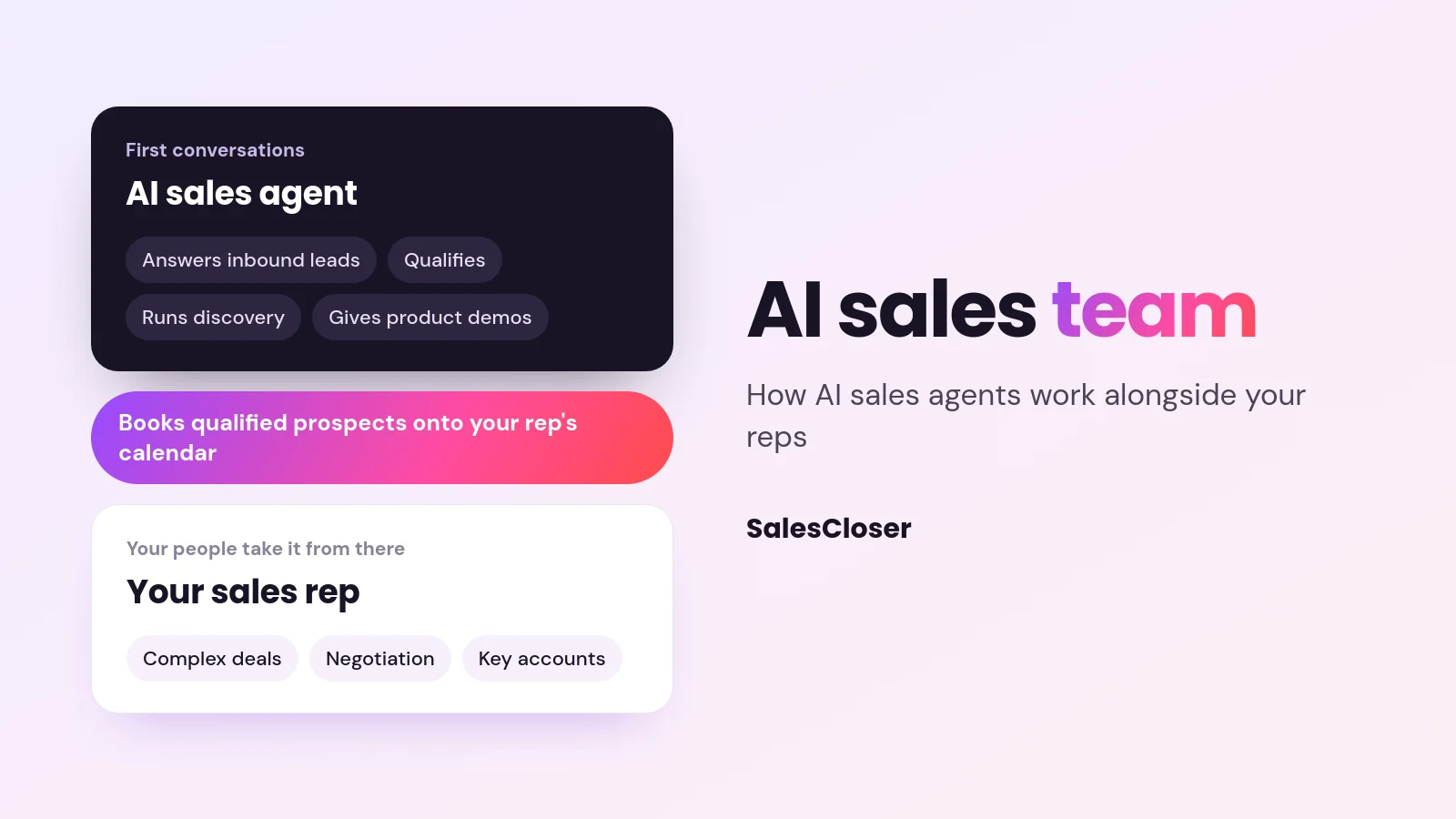
An AI sales team is a group of AI sales agents that work alongside your human reps. The agents handle the first conversations with leads by phone, video or chat: answering questions, asking qualifying questions, running discovery, giving product demos and booking qualified prospects onto your reps’ calendars. Your people take it from there.
Most sales teams have the same problem in a different shape. Leads come in faster than reps can talk to them. Some wait hours for a reply. Some book a demo and turn out to be a poor fit. Some fill in a form at night or on a weekend and hear nothing until Monday.
An AI sales team is one way to handle that first stretch of the conversation without asking your reps to work longer hours.
This guide explains what an AI sales team is, which roles AI agents can fill today, what still needs a person, how to set one up step by step, what to look at when you evaluate cost and how to measure whether it is working.
What is an AI sales team?
An AI sales team is a set of AI sales agents, sometimes called AI sales reps or an AI sales person, that hold real two-way sales conversations for your business. Each agent is set up for a job, such as qualifying inbound leads or giving a first product demo, and works from your own content and rules.
It is not a chatbot that follows a fixed script, and it is not a dialer that connects calls to people. A virtual AI agent for sales calls listens to what the prospect says, answers from your knowledge base, asks follow up questions and takes a next step, such as booking a meeting with a rep.
The word “team” matters. The agents do not work on their own. They sit in front of your human sellers, take the repeatable early conversations and pass the qualified ones to people who can build the relationship and handle the deal.
What roles can AI sales agents fill?
Think of the roles in terms of the conversations they cover. These are the ones AI agents handle well today:

- Inbound lead response. The agent answers a new lead by phone, chat or video soon after they reach out, instead of the lead waiting in a queue. Our guide to speed to lead explains why the first response matters.
- Lead qualification. It asks the same qualifying questions every time, such as company size, use case, timeline and who else is involved, and records the answers. See AI for instant lead qualification for how to design the questions.
- Discovery. It asks what the prospect is trying to solve and what they use today, so the rep starts the next call with context.
- Product demos. It can walk a prospect through the product on a live screen share or by presenting a product video, and answer questions as it goes.
- Meeting booking. When a prospect qualifies, it offers times on a rep’s calendar and books the meeting.
- Follow up on your own leads. It can call leads who requested a demo but never booked, or contacts who went quiet. Our article on AI agents for outbound sales covers this in detail.
- Onboarding and support conversations. After the sale, agents can answer common setup and product questions, and your team handles the rest.
In practice, many teams start with one role, usually inbound qualification or first demos, and add others once the first one runs well.
For how AI fits each stage of the funnel, from first response to follow-up, see our guide to AI for sales.
What still needs a human sales rep?
AI agents are good at volume, speed and consistency. People are better at judgment, trust and anything that does not fit a pattern. Keep these with your reps:
- Complex deals with several decision makers. Mapping who matters, what each person needs and how the buying process really works.
- Negotiation and pricing exceptions. Discounts, custom terms and contracts should be handled by someone with authority.
- Relationships with key accounts. Long-term trust is built by people who remember the history and follow through.
- Sensitive or upset prospects. Anyone frustrated, confused or asking for a person should reach one quickly.
- Questions outside your knowledge base. When the agent does not have the answer, it should say so and hand off rather than guess.
- Strategy and coaching. Deciding who to target, what to say and how to improve the agents is human work.
The handoff is where most of the value is won or lost. Write clear rules for when the agent books a meeting, when it passes a lead to a person and when it marks a lead as not a fit.
AI sales rep vs human sales rep: how do they compare?
This is not a contest. Each is better at different parts of the job, and a good AI sales team gives each the work it suits.

| Task | AI sales rep | Human sales rep |
|---|---|---|
| Responding to new leads | Answers soon after the lead arrives, at any hour | Limited by working hours and current workload |
| Handling many conversations at once | Strong | One conversation at a time |
| Asking the same qualifying questions | Consistent every time | Varies by person and by day |
| Conversations in other languages | Can work in 50+ languages | Depends on who is on the team |
| First product demo | Can present a standard demo and answer common questions | Strong, especially for tailored demos |
| Complex, multi-stakeholder deals | Hand off | Strong |
| Negotiation and contracts | Hand off | Strong |
| Building long-term relationships | Supports with timely follow up | Strong |
| Reading unusual situations | Follows rules; hands off when unsure | Strong |
For a closer look at the earliest stage of the funnel, see AI SDR vs human SDR.
How do you set up an AI sales team step by step?
You do not need to change everything at once. A focused start is easier to test and easier to fix.

- Pick one conversation to start with. Choose a high-volume, repeatable conversation, such as answering new demo requests or qualifying inbound calls.
- Define what a qualified lead is. Agree with your reps on the questions that matter and the answers that mean “book a meeting”, “send to a person” or “not a fit”.
- Gather your knowledge base. Collect the website pages, product documents and FAQs that answer what prospects ask most. Remove anything out of date.
- Write the rules. Decide what the agent may and may not discuss, how it handles pricing questions, how it responds to common objections and when it hands off. Our guide to AI sales objection handling has examples.
- Decide how the agent introduces itself. Choose whether it says it is an AI at the start of the conversation, and tell it to always answer truthfully when asked. Check the rules in the places you sell; some require disclosure.
- Connect your calendar and CRM. Make sure booked meetings land on the right rep’s calendar and that lead details and the call summary reach your CRM.
- Test it yourself. Have your team play difficult prospects. Ask unusual questions, push back on price and ask to speak to a person.
- Go live on a small share of leads. Review the conversations every day for the first weeks, fix wrong answers in the knowledge base and adjust the rules.
- Expand one role at a time. Once the first conversation works, add the next one, such as first demos or follow up on old leads.
What does it cost to evaluate an AI sales team?
Vendors price AI sales agents in different ways, so compare the full cost of running a pilot rather than a headline number. Ask each vendor about:
- The pricing model. Whether you pay by usage, such as conversation minutes, by agent or seat, by platform plan, or a mix.
- What is included. Voice, video and chat, the number of agents, integrations, phone numbers and recordings may be priced separately.
- Phone costs. Calling usually needs a phone number and carrier usage, either through your own account or one the vendor manages.
- Setup effort. How much of the setup your team does and how much help the vendor gives.
- Your team’s time. Someone has to own the knowledge base, review conversations and tune the rules, especially in the first month.
- Contract terms. Commitment length and what happens if the pilot does not meet your goals.
Then set the cost against what you measure today: how fast leads get a first reply, how many leads never get a conversation and how much rep time goes to calls that were never a fit. Our article on unqualified demo calls shows how to size that last problem.
How do you measure an AI sales team?
Measure the AI agents on the same outcomes you use for the rest of the funnel, and compare against your numbers before the pilot.
- Time to first response. How long a new lead waits before a real conversation starts.
- Share of leads who get a conversation. How many inbound leads actually talk to someone, human or AI.
- Meetings booked and meetings held. Bookings only count if the prospect shows up.
- Meetings reps accept as qualified. The best check on whether your qualifying rules are right.
- Pipeline from AI-sourced meetings. Track these opportunities through to the outcome in your CRM.
- Answer accuracy. Sample conversations every week and check the answers against your knowledge base.
- Handoff quality. Ask reps whether the notes and qualification answers gave them what they needed.
If bookings rise but reps reject the meetings, tighten qualification. If accuracy slips, fix the knowledge base before you add more volume.
How SalesCloser fits
SalesCloser is your AI sales team. Its AI sales agents work alongside your reps and hold real conversations by voice, video or chat: on the phone or in the browser.
They answer inbound leads, ask qualifying questions, run discovery, give product demos by live screen share or by presenting your product video, and book qualified prospects onto your team’s calendar through Calendly or Cal.com.
You can set up demo, discovery, onboarding and support agents without code by giving them your knowledge base and rules. SalesCloser connects to HubSpot, Pipedrive, Zoho, GoHighLevel and Zendesk and saves the lead, a call summary and the qualification answers. Agents work around the clock in 50+ languages.
Conversations are recorded and transcribed so your team can review them. You control how the agent introduces itself, including whether it says it’s an AI up front, and you can tell it to always answer truthfully when asked. You can book a demo to talk to an agent yourself.
Conclusion
An AI sales team does not take the place of your sellers. It gives every lead a prompt, consistent first conversation and sends your reps the prospects who are ready to talk. Start with one repeatable conversation, define what qualified means, keep people in charge of complex deals and measure the results against your own baseline before you expand.