
77% of B2B buyers say their latest purchase was overly complex and difficult to navigate. This complexity creates friction, and friction kills deals. Sales leaders often invest heavily in top-of-funnel prospecting, using software to generate hundreds of leads per week. However, they neglect the bottom of the funnel, where high-value deals go to die in a sea of unreturned emails, delayed legal reviews, and forgotten follow-ups.
You do not need more leads if your team cannot close the ones they already have. This is exactly where an AI virtual closer for sales teams changes the equation. Automation is no longer just for cold outreach. Strategic deployment of automated agents in the final stages of a deal eliminates logistical friction.
This post explains how you can accelerate the sales cycle by automating late-stage logistics. We will cover how to identify deal stall points, optimize your pipeline, and deploy SalesCloser.ai to handle the heavy lifting. Ultimately, this allows your human closers to focus entirely on strategy, relationship building, and high-level negotiation.
What is an AI Virtual Closer?
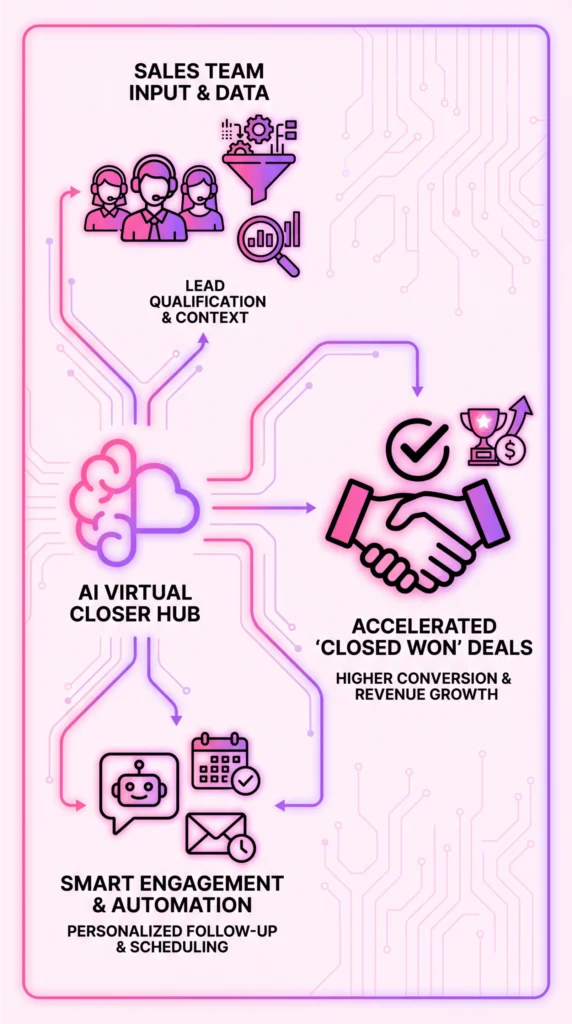
An AI virtual closer is a specialized sales enablement tool that autonomously manages late-stage deal logistics. It handles proposal follow-ups, schedules implementation calls, answers routine security questions, and routes contracts for signature without human intervention. By automating these administrative tasks, the software prevents deal momentum from stalling and allows human account executives to focus on complex negotiations.
Most sales professionals mistakenly believe automation only belongs at the top of the funnel. They use AI SDRs to blast thousands of cold emails. They automate LinkedIn connection requests. But once a prospect agrees to a demo, the automation abruptly stops.
Suddenly, the human Account Executive (AE) takes over entirely. That AE must now manage discovery, custom demonstrations, and pricing negotiations. Furthermore, they must remember to send the NDA, ping the prospect 3 days after sending the proposal, and follow up with the champion to secure a signature.
This manual approach leads to administrative overload. Consequently, AEs drop the ball on critical follow-ups. An AI virtual closer steps into this gap. It acts as a dedicated administrative partner that specifically handles post-demo logistics.
The Late-Stage Trap: Why Solid Deals Stall Out
Every sales professional knows the sting of a stalled deal. You run a flawless discovery call. You deliver a highly customized, compelling product demonstration. The prospect verbally agrees that your solution solves their primary pain point. You send over the pricing proposal with high hopes.
Then, you hear absolute silence.
Days turn into weeks. The momentum you built during the live calls completely evaporates. Harvard Business Review research shows that companies that contact potential customers within an hour of receiving a query are nearly 7 times as likely to qualify the lead. That same urgency applies to late-stage follow-ups. Let us examine the three primary areas where deals stall.
1. The Proposal Follow-Up Void
Sending a proposal feels like a major milestone, but it actually represents the most vulnerable phase of the sales cycle. The buyer must now take your document and sell it internally to their stakeholders. They get busy with their own daily tasks. If your AE forgets to check in, the proposal gets buried under a mountain of other priorities.
2. The Final Q&A and Security Review
Enterprise deals require rigorous security and compliance reviews. Your champion forwards your software to their IT department. IT responds with a complex, 50-point security questionnaire. Your AE now has to hunt down the Sales Engineering team to answer these questions. This internal bottleneck can add weeks to your timeline and severely impact sales process optimization.
3. Scheduling Implementation Calls
Once a prospect agrees to move forward, the logistical nightmare of scheduling begins. Coordinating calendars between your onboarding team, the buyer, and their IT staff requires endless back-and-forth emails. Every day wasted on scheduling is a day that delays recognized revenue.
How Deal Closing Automation Accelerates Sales Velocity
Sales velocity is the ultimate metric for any revenue team. It measures how quickly you generate revenue. Increasing this metric is the primary goal of any modern sales organization. Deal-closing automation directly affects the core variables of this critical equation.
To understand the impact, look at the standard sales velocity formula:
Sales Velocity = (Number of Opportunities × Deal Value × Win Rate) / Length of Sales Cycle
Most teams focus purely on increasing the number of opportunities. However, an AI sales assistant specifically targets the denominator: the length of the sales cycle.
When you automate proposal follow-up, you remove the “dead days” where a contract simply sits in an inbox. When an automated agent handles security Q&A by pulling from a pre-approved knowledge base, you cut weeks out of the legal review process. Reducing the time to close mathematically increases your overall sales velocity.
Furthermore, automation improves your win rate. Deals are highly emotional. Excitement peaks during the initial demonstration. As time passes, that excitement fades, and the perceived urgency of solving the problem diminishes. Automated contract follow-up ensures you strike while the iron is hot.
Enter SalesCloser.ai: Your Dedicated AI Sales Assistant
You cannot afford to let highly paid Account Executives act as highly paid administrators. Human closers should spend their time reading the room, building rapport, and negotiating complex terms. They should not spend their afternoons writing “just checking in” emails.
This is where SalesCloser.ai transforms your revenue operations. SalesCloser.ai is not a generic chatbot. It is a purpose-built AI sales assistant designed specifically to partner with your closing team.
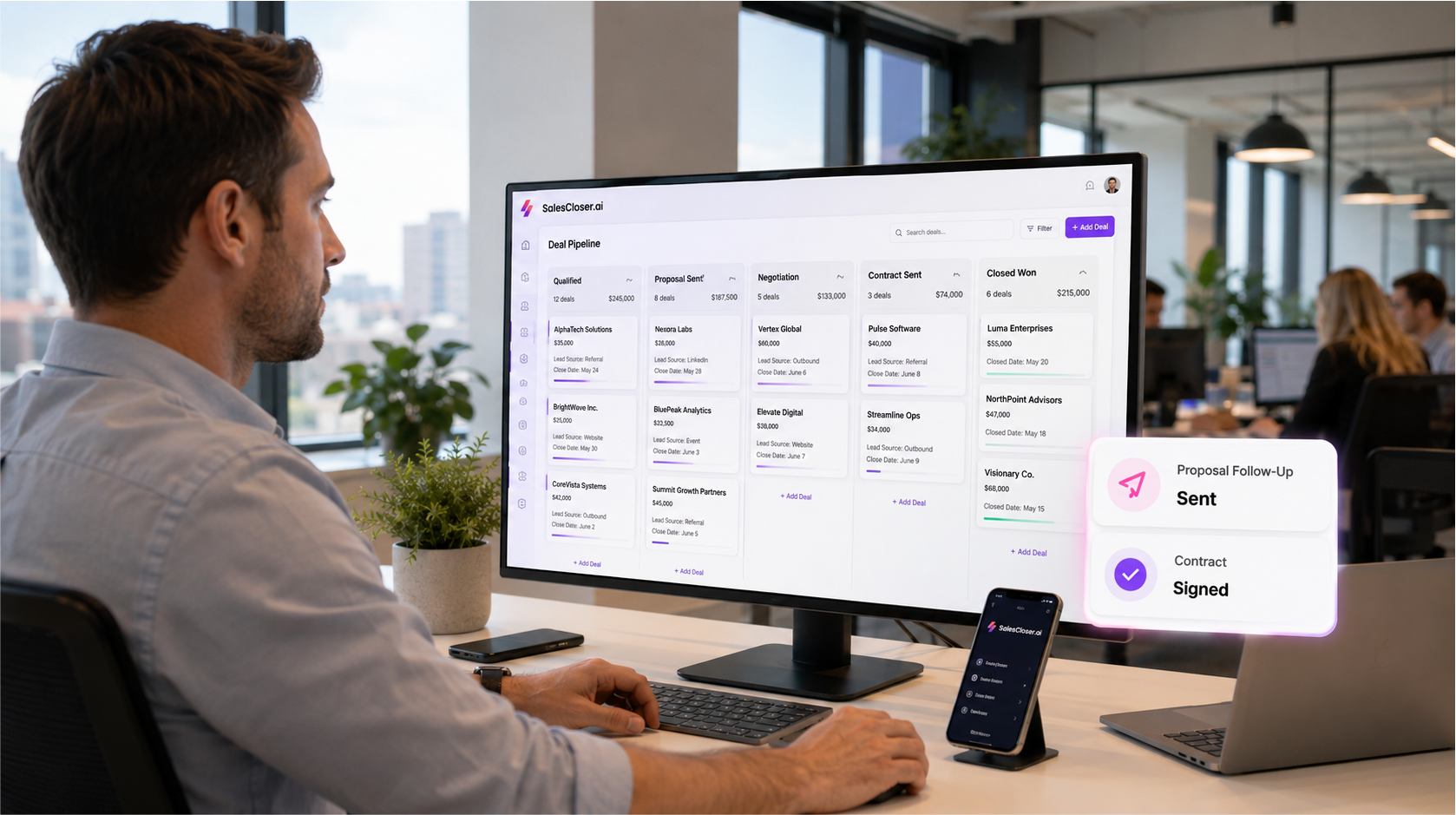
SalesCloser.ai operates quietly in the background of your CRM. It monitors the status of every single deal in the pipeline. When an AE moves a deal stage to “Proposal Sent,” the AI takes over the administrative follow-up process. It crafts personalized, context-aware emails based on the specific details discussed in the prior calls.
If the prospect asks a routine question about SOC2 compliance, SalesCloser.ai answers it instantly using your approved security documentation. It maintains total visibility, keeping the human AE updated via Slack or Microsoft Teams. When the prospect is ready to negotiate pricing or terms, the AI seamlessly hands the conversation back to the human expert.
5 Ways to Automate Proposal Follow-Up Without Losing the Personal Touch
The biggest fear sales leaders have regarding automation is sounding robotic. Buyers immediately ignore generic, templated follow-ups. You must deploy automation strategically. Here are five ways to use an AI virtual closer for sales teams effectively:
- Trigger an outreach email based on document engagement: Automate it exactly 30 minutes after the prospect opens your pricing PDF.
- Reference specific pain points: Use AI to extract exact quotes from the discovery call transcript and include them in the follow-up email.
- Provide incremental value: Instead of saying “checking in,” automate the delivery of a relevant case study three days after sending the proposal.
- Automate multi-channel outreach: Program the AI to send a polite LinkedIn message if the prospect ignores two consecutive emails.
- Pave the way for the champion: Automate an email containing a pre-written business case that your buyer can easily forward to their CFO.
By utilizing these tactics, your automated contract follow-up feels highly personalized and deeply relevant to the buyer’s specific situation.
Comparing Traditional Closing vs. AI-Assisted Closing
To truly understand the value of deal closing automation, you must examine how your Account Executives spend their hours. The traditional model forces humans to context-switch constantly between high-value strategy and low-value administration.
| Sales Activity | Traditional Model (Human Only) | AI-Assisted Model (SalesCloser.ai) |
| Sending Proposals | AE spends 45 mins customizing a template. | AE reviews an AI-generated proposal in 5 mins. |
| Proposal Follow-up | AE relies on memory or manual CRM tasks. Often forgotten. | AI sends context-aware follow-ups exactly on schedule. |
| Answering Security Q&A | AE waits 4 days for the internal IT team to respond. | AI instantly answers based on a trained knowledge base. |
| Scheduling Next Steps | 5-6 back-and-forth emails over 3 days. | AI uses natural language to coordinate calendars instantly. |
| CRM Data Entry | AE spends Friday afternoon updating deal stages. | AI logs all interactions and automatically updates pipeline stages. |
The data in this table clearly illustrates the massive efficiency gains. By shifting the administrative burden to software, you effectively double your human sales team’s capacity without increasing headcount.
Mastering Sales Pipeline Management with AI
Sales pipeline management requires absolute data integrity. Unfortunately, human beings are terrible at maintaining data hygiene. AEs frequently forget to log emails, update deal stages, or record the outcome of a phone call. Consequently, sales leaders make forecasting decisions based on inaccurate information.
An AI virtual closer fundamentally solves this data integrity problem. Because the software handles the communication, it automatically logs every single touchpoint in the CRM. It analyzes the sentiment of the buyer’s replies. If a prospect uses hesitant language about pricing, the AI flags the deal as “at risk” for the sales manager.
This constant, automated analysis provides unprecedented visibility into your pipeline. You no longer have to interrogate your reps during weekly one-on-one meetings to find out what is actually happening with a specific account. The system automatically highlights stalled deals and recommends specific actions to revive them.
Furthermore, AI prevents pipeline rot. Pipeline rot occurs when deals sit in the same stage for months without any meaningful engagement. Automated agents continuously nurture these dormant opportunities. They send relevant industry news or product updates, keeping your brand top-of-mind until the buyer is finally ready to engage.
Real-World Use Cases: How AEs Use Sales Enablement Tools
The theory of automation sounds great, but practical application matters more. Let us examine how high-performing teams actively use these tools to accelerate the sales cycle and reduce time to close.
Consider a mid-market SaaS company selling complex HR software. Their average sales cycle previously lasted 90 days. The primary bottleneck occurred immediately after the technical demonstration. Buyers needed to get approval from both their HR director and their IT department.
The company implemented SalesCloser.ai to manage this specific gap. After the human AE finished the demo, the AI took over. It immediately emailed the customized proposal to the HR director. Simultaneously, it sent the technical documentation and security certifications directly to the IT contact.
When the IT contact asked highly specific questions about data encryption, the AI instantly provided the correct technical answers. Meanwhile, the AI followed up with the HR director, sharing a case study of a similar company. By parallel-processing these tasks, the software eliminated weeks of internal delay. The company reduced its average sales cycle from 90 days to 54 days.
This is the true power of sales process optimization. You do not just save time; you fundamentally change how buyers experience your company. You provide a faster, more responsive purchasing journey.
The Financial Impact: Reduce Time to Close
Every day a deal remains open costs your company money. Extended sales cycles drastically increase your Customer Acquisition Cost (CAC). You are paying your AEs’ base salaries, covering software licenses, and funding marketing campaigns while waiting for a signature.
When you deploy deal closing automation, the financial impact is immediate. First, you lower your CAC by reducing the labor hours required per closed won deal. Second, you accelerate cash flow. Getting a signed contract two weeks earlier means you can begin recognizing revenue and billing the client two weeks earlier.
Third, and perhaps most importantly, you increase the Lifetime Value (LTV) of your customers. A smooth, fast, and highly responsive buying experience sets the tone for the entire customer relationship. Buyers who experience a frictionless sales process are significantly more likely to renew their contracts and expand their usage over time.
Step-by-Step: Implementing an AI Virtual Closer
Implementing a new sales enablement tool requires a strategic approach. You cannot simply turn the software on and expect miracles. You must integrate it thoughtfully into your existing workflows. Here is a proven, step-by-step process for rolling out an AI virtual closer for sales teams.
Step 1: Audit Your Current Sales Process
Map out every single step your team takes from the moment a demo concludes to the moment a contract is signed. Document exactly who does what. Identify your specific bottlenecks. Are deals stalling at the proposal stage? Are security reviews taking too long? You must know where the friction lives before you can automate it away.
Step 2: Define Your Human-AI Boundaries
Determine exactly which tasks belong to the machine and which belong to the human. Generally, humans should handle complex negotiations, emotional relationship building, and strategic problem-solving. AI should handle scheduling, document routing, initial Q&A, and persistent follow-ups. Clearly define these boundaries so your AEs know exactly how to leverage the tool.
Step 3: Train the AI on Your Best Material
An automated agent is only as good as the data it consumes. Feed your AI your best-performing email templates, your most comprehensive case studies, and your complete security documentation. Upload transcripts of your top reps closing deals.
Read our guide on AI SDRs to see how proper training drastically improves response quality.
Step 4: Run a Phased Pilot Program
Do not roll the software out to your entire sales floor simultaneously. Select two or three of your most tech-savvy Account Executives. Have them use SalesCloser.ai on a subset of their deals. Monitor the interactions closely. Refine the AI’s prompts and messaging based on real-world buyer responses.
Step 5: Measure, Iterate, and Scale
After 30 days, compare the pilot group’s metrics to the rest of the team. Look specifically at their sales velocity and their average time to close. Once you have documented success, roll the software out to the entire department. Continuously monitor the AI’s performance and update its knowledge base as your product evolves.
Overcoming Common Objections to AI Sales Enablement Tools
Change management is difficult. When you introduce AI to a sales team, you will inevitably face pushback. AEs are fiercely protective of their pipelines. They fear that software will make them look foolish in front of important prospects.
The most common objection is: “The AI will send something embarrassing and blow my deal.”
You overcome this by implementing strict approval workflows during the initial rollout. Require the human AE to review and approve every AI-generated message before it goes out. As the AI proves its competence and accuracy, the AEs will naturally begin to trust it. Eventually, they will eagerly switch the system to fully autonomous mode because they want their time back.
Another frequent objection is the fear of job replacement. Sales leaders must communicate clearly that the goal is augmentation, not replacement. The AI handles the administrative chores that AEs secretly hate doing anyway. By removing this burden, the company empowers the AEs to take on more deals and earn larger commission checks. Framing the software as a dedicated assistant changes the entire internal narrative.
Conclusion
The era of manual, tedious late-stage sales execution is over. Relying solely on human memory to manage complex proposal follow-ups and logistical coordination is a recipe for stalled pipelines and lost revenue. Automation must extend beyond top-of-funnel prospecting to truly impact your bottom line.
By deploying an AI virtual closer for sales teams, you eliminate the friction that kills good deals. You accelerate your sales cycle, improve your win rates, and allow your human talent to focus on what they do best: building relationships and negotiating strategy. Do not let your competitors close the door on your prospects while you are busy writing “just checking in” emails.