
An AI sales engineer starts a technical demo by setting the agenda and asking a few targeted discovery questions, then tailors the walkthrough to the answers. It shares its screen, navigates the product, explains features and integrations using your technical documentation, and hands complex deals to a human solution architect.
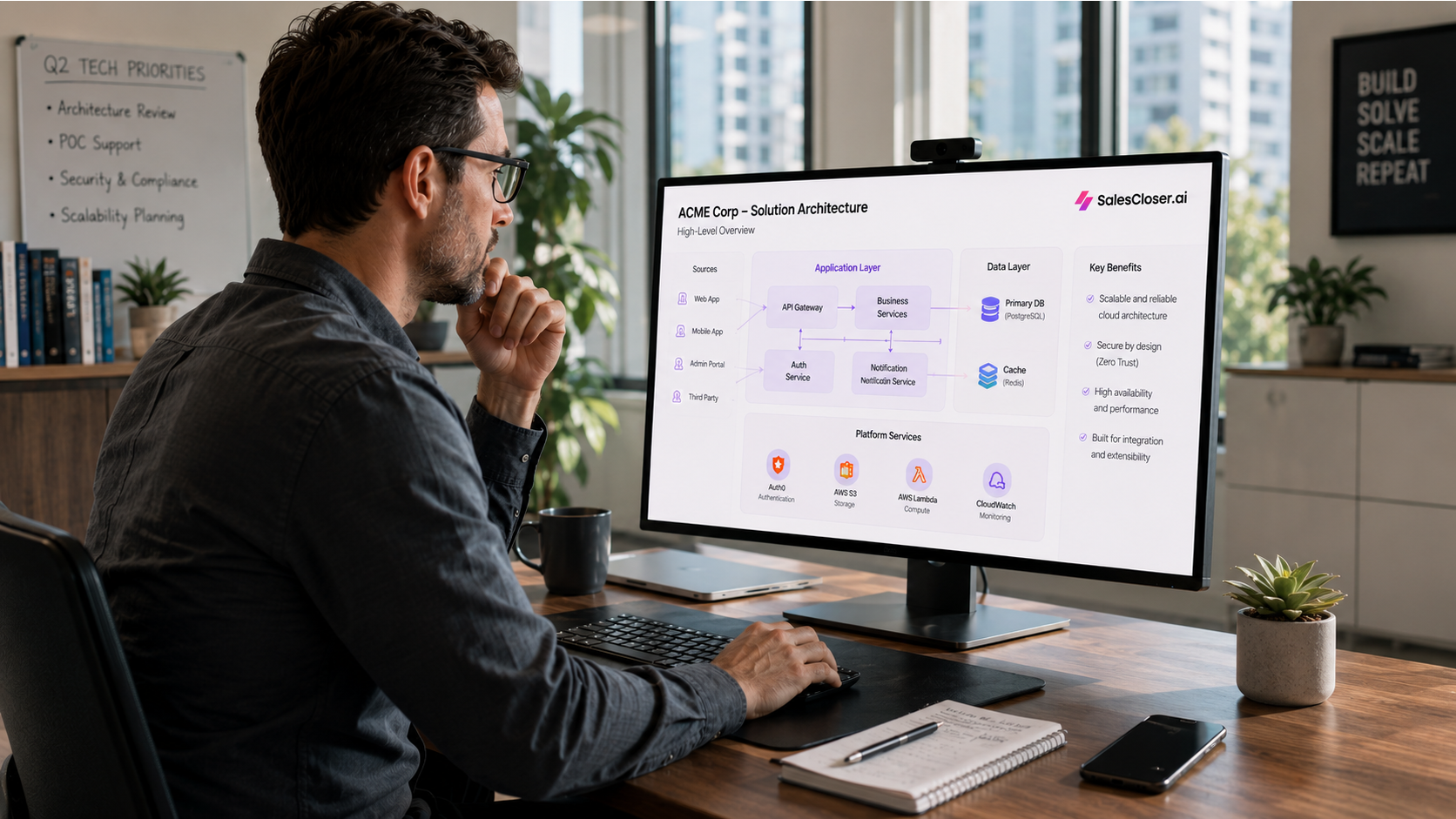
Sales engineers spend a large share of their week answering the same foundational technical questions. You hire brilliant solution architects to design complex, custom deployments, yet they spend endless time on top-of-funnel discovery calls explaining basic API limits and SOC 2 compliance. This severe resource misalignment burns out your best talent, increases your Customer Acquisition Cost (CAC), and stalls your pipeline. You need a highly effective method to handle early-stage technical vetting without sacrificing the buyer experience.
This guide breaks down exactly how to implement AI virtual sales engineers to automate repetitive technical qualification. We will show you how to structure a two-tiered presales process, vet prospect environments instantly, and protect your most expensive technical resources. Furthermore, you will learn how platforms like SalesCloser AI execute automated technical discovery, so your human SEs step in only for the highly qualified, deep-dive demonstrations.
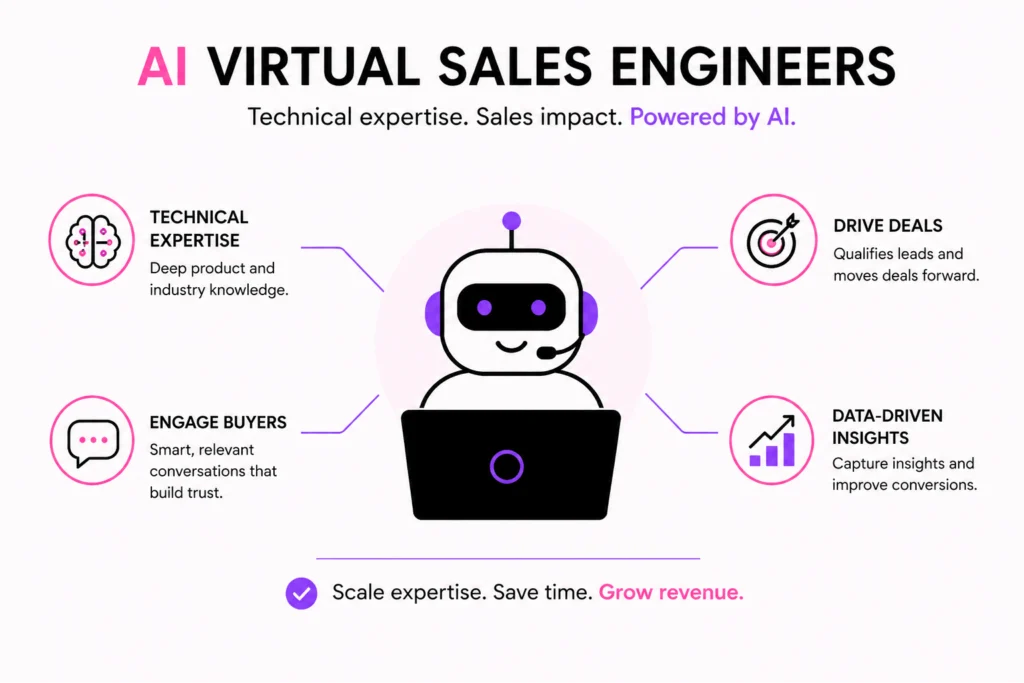
What Are AI Virtual Sales Engineers?
An AI virtual sales engineer is an autonomous software agent that handles initial technical discovery calls, answers routine product questions, and conducts baseline environment vetting without human intervention. These agents analyze prospect requirements and instantly qualify technical fit before involving expensive presales resources.
Unlike basic chatbots that rely on rigid decision trees, modern virtual SEs utilize advanced large language models. They actively listen to a prospect’s technical requirements over live audio or video calls. They process complex questions regarding infrastructure, integrations, and security. Consequently, they provide accurate, context-aware answers pulled directly from your proprietary technical documentation.
An AI SE does not replace your human solution architects. Instead, it acts as a massive filter at the top of your sales funnel. It ensures that any prospect who reaches a human SE already meets your baseline technical criteria.
The True Cost of Manual Top-of-Funnel Discovery
Tech companies severely mismanage their presales resources, and buyers demand deep product knowledge on the very first call. Account Executives (AEs) often lack this depth.
Therefore, AEs drag Sales Engineers onto preliminary calls “just in case” the prospect asks a hard question. This habit creates a massive financial drain. Consider the hard numbers behind this inefficiency. A senior Sales Engineer typically commands a base salary of $150,000 or more. If that SE spends ten hours a week on initial qualification calls for deals that ultimately go nowhere, your business wastes tens of thousands of dollars annually per engineer.
“Bringing a senior solution architect onto a first-touch discovery call is like using a surgeon to take a patient’s temperature. It wastes premium expertise on a baseline task.”
Moreover, the hidden cost involves pipeline velocity. When AEs must wait for an SE to have an open slot on their calendar, deals stall. A prospect may wait two weeks to get a basic technical overview. In that time, a competitor using sales engineering automation can swoop in, vet the prospect instantly, and move them to the proposal stage.
Why Traditional Presales Workflows Fail
The standard enterprise sales motion remains fundamentally broken. Most organizations follow a predictable, highly inefficient pattern. First, a Sales Development Rep (SDR) books a meeting. Next, the AE conducts a high-level discovery call. Then, the AE schedules a technical demonstration and brings the SE.
During this technical demonstration, the SE often delivers a generic “harbor tour” of the product. They show the same features to every prospect. They answer the same questions about single sign-on (SSO) and REST APIs. The prospect realizes halfway through the call that your platform lacks a critical native integration they require. The deal dies.
The AE wasted their time. The SE wasted their time. The prospect leaves frustrated.
This traditional workflow fails because it pushes technical discovery too far down the funnel. Companies delay asking the hard, disqualifying questions until the most expensive people enter the room. To fix this, revenue leaders must shift technical vetting left. They must gather deep architectural requirements at the very beginning of the sales cycle. Doing this manually is impossible without doubling your presales headcount. This exact problem necessitates presales automation.
Structuring a Two-Tiered Technical Discovery Process
To scale your operations efficiently, you must restructure your presales motion into two distinct phases. This model leverages AI for the heavy lifting and reserves humans for strategic closing.
How to structure a two-tiered automated technical discovery process:
- Deploy the AI Virtual SE: Route all initial technical demo requests to your AI agent.
- Conduct Baseline Vetting: The AI agent asks mandatory technical qualification questions.
- Deliver the Micro-Demo: The AI provides a tailored, high-level product demonstration based on early inputs.
- Analyze the Technical Fit: The system compares the prospect’s answers against your ideal customer profile (ICP).
- Route to Human Experts: The AI hands off highly qualified, complex deals to a human SE for a deep-dive architecture session.
This structure immediately removes the friction from your top-of-funnel motion. Prospects get immediate access to technical answers. AEs keep their pipelines moving. Most importantly, your human SEs wake up to a calendar filled only with late-stage, highly qualified opportunities that actually require their specific expertise.
Vetting Environments: The Technical Sales Qualification Matrix
Effective qualification requires a systematic approach to technical discovery. You must define exactly what makes a prospect viable. An AI agent excels at running through rigid qualification matrices without skipping steps or forgetting questions.
Below is an example of how you divide responsibilities between your AI virtual SE and your human team during the technical sales qualification process.
| Qualification Category | AI Virtual SE Responsibilities (Tier 1) | Human SE Responsibilities (Tier 2) |
| Integrations | Verifies necessary native CRM/ERP integrations exist. | Designs custom API middleware solutions. |
| Security & Compliance | Confirms SOC 2, HIPAA, or GDPR compliance status. | Reviews custom security questionnaires with InfoSec. |
| Data Migration | Explains standard CSV and database import processes. | Maps complex, multi-source data migration schemas. |
| User Volume & Scale | Checks whether the prospect user count fits the licensing tiers. | Architects load-balancing for enterprise deployment. |
| Infrastructure | Verifies cloud provider compatibility (AWS, Azure). | Plans on-premise or hybrid custom deployments. |
The AI virtual sales engineer handles the binary questions. Does the prospect use Salesforce? Do they require HIPAA compliance? Do they have fewer than 10,000 active daily users? The AI effortlessly handles these technical constraints. If the prospect fails the baseline technical requirements, the AI politely disqualifies them, saving your human team hours of wasted effort.
SalesCloser AI: Your Dedicated Virtual SE
You cannot rely on basic conversational bots to handle complex technical discovery. You need a purpose-built platform. SalesCloser AI functions as a dedicated AI virtual sales engineer, specifically engineered to manage technical presales workflows.
SalesCloser AI joins video calls, shares its screen, and speaks directly with your prospects in real time. It sounds human, acts professionally, and possesses an encyclopedic knowledge of your product suite. Because it processes natural language, prospects can interrupt the AI, ask clarifying questions, and pivot the conversation exactly as they would with a human engineer.
When a prospect asks, “How does your system handle rate limits on the reporting API?” SalesCloser AI does not spit out a generic link to a help center article. Instead, it explains the exact token bucket algorithm your platform uses, details the burst limits, and outlines how enterprise customers typically manage high-volume data extraction.
This level of depth builds immediate trust with technical buyers. Developers and IT directors respect vendors who provide direct, accurate answers without the typical sales fluff. SalesCloser AI delivers that technical authority on every single call, operating 24 hours a day, 7 days a week.
How to Train AI on Your Technical Knowledge Base
A virtual SE is only as good as the data you feed it. To ensure accuracy and prevent hallucinations, you must build a robust training foundation. SalesCloser AI makes this process straightforward and highly secure.
First, you connect the platform to your existing technical documentation. You upload your API references, developer guides, and architecture diagrams. You ingest your security whitepapers, compliance certifications, and historical RFP responses.
Second, you feed the AI your historical call recordings. You upload transcripts of your best human SEs delivering technical demos. The AI analyzes these transcripts to learn the nuances of your specific sales motion. It learns how your team handles objections regarding pricing models. It learns how your team positions your platform against your biggest competitors.
Third, you define strict guardrails. You explicitly tell the AI what it cannot say. For example, you instruct the AI never to promise custom feature development. You restrict it from quoting enterprise pricing without human approval. By establishing these boundaries, you guarantee that the AI virtual sales engineer represents your company safely and accurately during every interaction.
Executing the AI Product Demo
The days of making buyers wait a week for a basic software walkthrough are over. Modern B2B buyers expect an immediate AI product demo. SalesCloser AI transforms the demo experience from a static presentation into a dynamic, interactive session.
When the prospect joins the call, the AI immediately establishes the agenda. It asks two or three highly targeted discovery questions. Based on those answers, the AI instantly curates a personalized demonstration. If the prospect indicates they care primarily about the analytics dashboard, the AI skips the administrative settings and jumps directly into the reporting suite.
Furthermore, the AI virtual SE utilizes screen sharing just like a human. It navigates through the product interface, highlighting key features while explaining the underlying technology. If the prospect asks to see a specific integration in action, the AI navigates to that module and explains the data flow.
This interactive capability drastically reduces the sales cycle. Prospects get the visual and technical validation they need on day one. They do not have to schedule a follow-up call just to see the software. The AI handles the “show and tell” phase seamlessly, driving faster pipeline velocity.
Protecting SE Resources with Solution Architect Tools
Your senior technical staff should focus on high-leverage activities. They should design complex solutions, build custom proof-of-concept (POC) environments, and strategically guide your largest enterprise deals. They cannot do this if they drown in routine discovery tasks.
Implementing virtual SEs acts as a shield for your technical team. We consider SalesCloser AI one of the most critical solution architect tools available today because it actively protects SE resources. By filtering out the noise, the AI ensures that when a deal finally reaches a human solution architect, it is real, scoped, and ready for advanced engineering work.
This protection directly impacts employee retention. Sales engineers frequently cite top-of-funnel burnout as their primary reason for leaving an organization. They hate repeating the same basic presentations. When you automate the mundane aspects of their job, you increase their job satisfaction. You empower them to do the deep, creative problem-solving they actually enjoy.
Consequently, your SE-to-AE ratio improves. Traditionally, companies aim for one SE for every three or four AEs. With automated technical discovery handling the first tier, a single human SE can support six, eight, or even ten AEs. You scale your revenue organization without linearly scaling your most expensive headcount.
Overcoming Objections: AI for Complex Sales
Many revenue leaders hesitate to adopt AI for complex sales. They argue their product is too intricate or their buyers are too sophisticated for an automated agent. This objection stems from a fundamental misunderstanding of the AI virtual SE’s role.
We do not expect the AI to close a multi-million dollar enterprise deal independently. Enterprise sales require relationship-building, executive alignment, and complex commercial negotiations. AI cannot replace the human element of high-stakes trust.
However, even the most complex enterprise deals start with basic technical fact-finding. The enterprise IT director still needs to know if your platform supports SAML 2.0. The procurement officer still needs your SOC 2 Type II report. The AI handles these foundational requirements flawlessly. It maps the stakeholder landscape and gathers the initial architectural constraints.
When the human SE finally enters the enterprise deal, they do not start from scratch. They review the comprehensive technical brief generated by the AI. They enter the first human-to-human meeting with a deep understanding of the prospect’s environment. This preparation makes the human SE look incredibly competent and highly prepared, ultimately accelerating the complex sales cycle.
Key Metrics for Sales Engineering Automation
To prove the ROI of your AI virtual sales engineer, you must track specific performance indicators. Traditional sales metrics like quota attainment remain important, but presales automation requires tracking efficiency and resource utilization.
Track these primary metrics to measure success:
- SE Utilization Rate: Measure the percentage of time your human SEs spend on late-stage, highly qualified deals versus early-stage discovery. This number should drastically increase after deploying AI.
- Time-to-Demo: Track the average time it takes a prospect to receive a technical demonstration after expressing interest. AI should reduce this from days to minutes.
- Technical Disqualification Rate: Monitor how many unqualified prospects the AI filters out before they reach a human. A higher rate here indicates the AI successfully protects your team’s time.
- SE-to-AE Ratio: Evaluate how many AEs a single human SE can support. As the AI absorbs the top-of-funnel volume, this ratio should widen, indicating increased leverage.
- Customer Acquisition Cost (CAC): Calculate the cost of presales resources divided by closed-won deals. Reducing the time spent on lost deals will rapidly lower your CAC.
By relentlessly monitoring these metrics, you validate your investment in sales engineering automation. You prove to your CFO that the technology directly impacts the bottom line by optimizing your most expensive labor force.
Illustrative Example: Scaling Presales Without Adding Headcount
For example, consider a hypothetical, rapidly growing B2B SaaS company specializing in data warehousing infrastructure. They experienced massive top-of-funnel lead generation following a successful marketing campaign. However, their presales team consisted of only three highly skilled data architects.
These architects quickly became overwhelmed. They spent eight hours a day running generic product demos and answering basic questions about data ingestion rates. Pipeline velocity ground to a halt. Deals stalled because AEs could not secure technical resources for critical meetings. The VP of Sales faced a difficult choice: hire three more expensive data architects, or find a way to scale the existing team.
They chose to implement an AI virtual sales engineer using SalesCloser AI. They trained the platform on their extensive API documentation and previous successful demo recordings. They instituted a strict two-tiered process. Every inbound lead first interacts with the AI SE.
In a scenario like this, the AI agent could handle a large share of routine technical discovery calls without human intervention. It accurately answered integration queries and provided interactive data-flow demonstrations. It automatically disqualified prospects who lacked the necessary baseline infrastructure.
Consequently, the three human data architects saw their calendars clear. They stopped running generic demos. Instead, they focused entirely on designing custom data schemas for enterprise clients who had already passed the AI’s rigorous qualification matrix. The company could grow closed-won revenue without hiring a single additional presales engineer. They successfully utilized AI to scale sales engineering efficiently.
The Future of Automated Technical Discovery
The role of the traditional Sales Engineer is evolving rapidly. As buyers become more self-directed and technical products become more commoditized, the patience for slow, manual discovery processes will vanish entirely. B2B buyers want immediate answers. They want frictionless technical validation.
In the near future, deploying an AI virtual sales engineer will not serve as a competitive advantage; it will become a baseline requirement for survival in the B2B tech space. Companies that force prospects to wait a week to speak with a human engineer will lose deals to competitors who offer instant, AI-driven technical discovery.
Furthermore, the technology itself will continue to advance. Future iterations of virtual SEs will seamlessly execute highly complex, multi-stage proof-of-concept deployments autonomously. They will write custom integration scripts on the fly during live calls. They will analyze a prospect’s live environment and instantly generate comprehensive architecture proposals in real time.
To stay ahead of this curve, revenue leaders must begin implementing presales automation today. You must build the infrastructure, train the models, and adapt your workflows now. Waiting for the technology to perfect itself ensures you will fall permanently behind your more agile competitors.
Automate Your Presales Workflow Today
The data remains clear. Relying exclusively on expensive human talent for routine technical discovery damages your pipeline, inflates your acquisition costs, and burns out your best engineers. You must adapt to buyer expectations and streamline your presales motion.
By implementing an AI virtual sales engineer, you instantly automate top-of-funnel technical qualification. You provide your buyers with the immediate technical validation they demand, while simultaneously protecting your human SEs for high-value, strategic solution design. This two-tiered approach represents the modern standard for technical sales.
Stop treating your highly-paid solution architects like basic tech support. Scale your revenue organization intelligently. Book a demo with SalesCloser AI today and watch our AI virtual sales engineer instantly transform your technical discovery process.