
Most product managers live in a state of constant guessing. You ship a feature, check the analytics, and see a 10% drop in engagement. You send an email survey to 5,000 users asking “Why?” and only 12 people respond with “It’s okay.” This gap between data and “the why” is where products go to die.
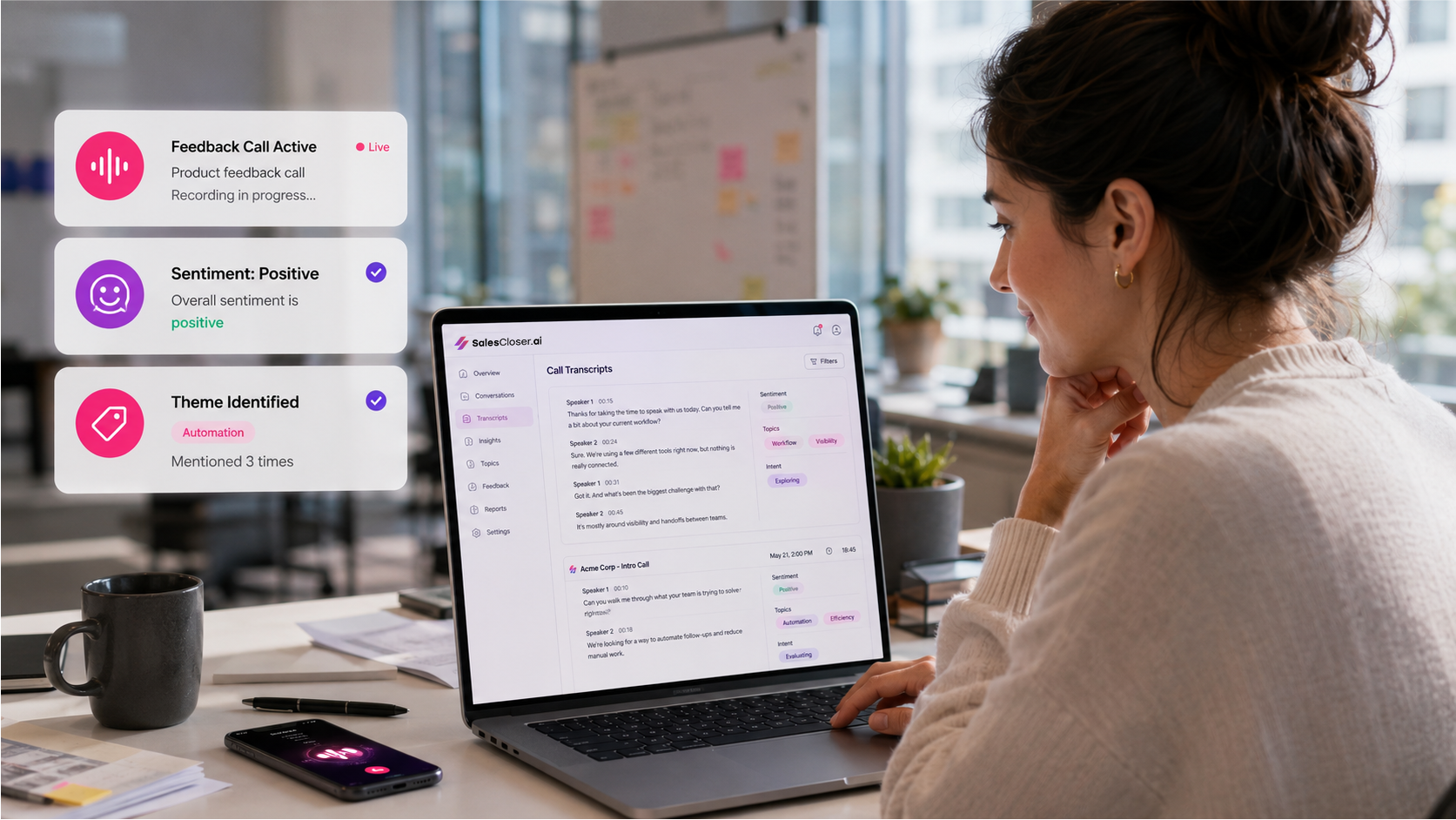
AI voice calls for product feedback. Solve this by replacing dry, ignored forms with actual conversations. Instead of hoping for a 2% click-through rate on a Google Form, you can deploy an AI agent to call your users, ask nuanced questions, and listen to their stories.
In this guide, we will show you how to automate user research, structure conversational scripts, and use SalesCloser.ai to achieve product-market fit faster than ever.
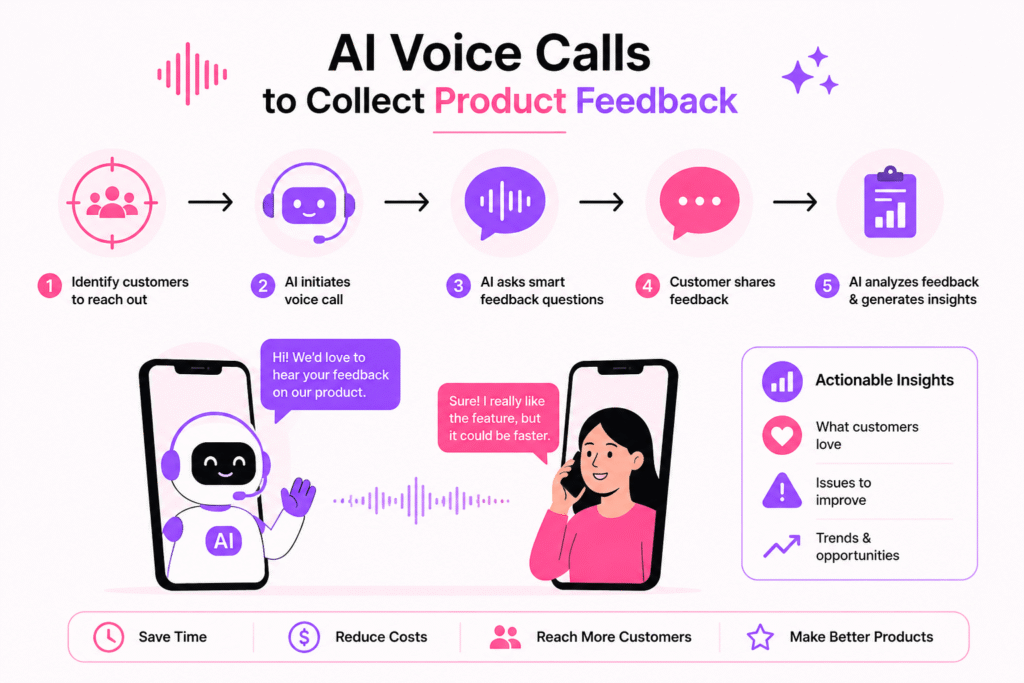
What are AI Voice Calls for Product Feedback?
AI voice calls for product feedback use autonomous agents to conduct verbal interviews with users. Unlike static surveys, these agents ask open-ended questions, follow up on specific pain points, and record nuances in tone. This process transforms qualitative user research into a scalable, automated system.
Historically, you had two choices: send a mass survey (large-scale, low depth) or conduct manual interviews (low scale, high depth). AI agents remove this trade-off. They allow you to “interview” 1,000 customers in a single afternoon, providing you with a mountain of qualitative data that would take a human researcher months to collect.
Why Traditional Surveys Are Killing Your Product Insights
Email surveys are dying. According to recent industry benchmarks, the average response rate for an external survey is often below 5%. When you only hear from 5% of your users, you aren’t getting a representative sample. You are getting feedback from the “extremes”—the people who love you and the people who hate you.
The Problem of “Survey Fatigue”
Users are tired of clicking boxes. A survey feels like work. It feels like a chore that offers the user no value. Consequently, they rush through the questions. They give one-word answers. They select “3” for every rating just to reach the end.
Lack of Nuance in Quantitative Data
Quantitative data tells you what happened, but it never tells you why. You see that users are dropping off at the checkout page. Is the button too small? Is the shipping cost too high? Is the UI confusing? A survey might give you a hint, but a conversation provides the answer.
The Speed of Feedback Loops
In a competitive market, speed wins. Waiting two weeks for survey results to trickle in is too slow. AI voice calls for product feedback deliver insights in hours. You can call users who churned today and have a full report on your desk by tomorrow morning.
How to Structure Open-Ended Questions for AI Agents
The quality of your feedback depends entirely on the quality of your questions. If you ask a “yes or no” question, you waste the potential of the AI. To get the most out of your automated customer feedback strategy, you must master the art of the open-ended question.
Avoid Leading Questions
Don’t ask: “How much do you like our new dashboard?” This assumes they like it.
Instead, ask: “Walk me through your experience with the new dashboard. What stood out to you?”
The “Mom Test” Approach
Based on the principles of The Mom Test, you should ask about specific past behaviors rather than future possibilities.
- Bad: “Would you use a feature that does X?”
- Good: “Tell me about the last time you tried to solve [Problem X]. How did you do it?”
Use “Mirroring” Techniques
SalesCloser.ai agents can be scripted to mirror user responses. If a user says, “I found the interface a bit clunky,” the AI doesn’t just move to the next question. It asks, “You mentioned it felt clunky—could you give me a specific example of where you felt stuck?” This is how you get the “gold” in user research.
| Question Type | Goal | Example |
| Discovery | Understand the problem | “What is the hardest part about your daily workflow?” |
| Comparative | Evaluate alternatives | “How does our tool compare to the previous method you used?” |
| Impact | Measure value | “If this feature disappeared tomorrow, how would your work change?” |
Using SalesCloser.ai for User Research Automation
SalesCloser.ai is not just for closing deals; it is a powerful engine for voice of the customer AI. The same technology that allows our agents to handle complex sales discovery calls makes them perfect for conducting product interviews.
Natural Conversational Flow
Most “voice bots” sound like robots. They have long pauses and “um” and “ah” in the wrong places. SalesCloser.ai uses advanced latency reduction and natural language processing. When your user picks up the phone, they talk to an agent that sounds human, listens intently, and responds in real-time.
Complete Transcription and Sentiment Analysis
Every call is transcribed with 99% accuracy. More importantly, the system analyzes the sentiment of the user. It identifies frustration, excitement, or indifference. This allows product managers to filter thousands of calls to find the exact moments where users expressed pain.
CRM and Product Stack Integration
Don’t let your feedback sit in a silo. SalesCloser.ai integrates with your CRM. If a user gives a glowing review during an AI feedback call, that data can trigger an automated request for a G2 review or a case study interview. If they express intent to churn, a task is immediately created for the Customer Success manager.
5 Use Cases for AI Voice Calls in Product Development
Integrating AI into your product development feedback loop changes how you prioritize your roadmap. Here are five practical ways to use it today.
1. Post-Onboarding Check-ins
Call every user 48 hours after they sign up. Ask them what was confusing. Ask them if they achieved their “Aha!” moment. This identifies friction in your funnel that analytics might miss.
2. Churn Analysis Interviews
When a user cancels their subscription, an automated email is usually ignored. An AI voice call feels more personal. You can ask, “I’m sorry to see you go. To help us improve, could you tell me the main reason you decided to cancel?” The response rate for these calls is significantly higher than that of exit surveys.
3. Beta Feature Validation
Before you roll a feature out to 100% of your users, call your beta testers. Ask them to describe the feature in their own words. If they can’t explain what it does, your UI has failed, even if the code is perfect.
4. Pricing Strategy Research
Pricing is the hardest lever to pull. Use AI agents to ask users about their perceived value. “On a scale of 1 to 10, how much of a struggle would it be if you didn’t have this tool?” This helps you determine price elasticity without risking a public backlash.
5. Competitive Intelligence
Ask users what other tools they considered before choosing yours. Use the AI to dig deeper: “What did that other tool have that we don’t?” This is how you build a defensive moat around your product.
Moving from Qualitative Data to Actionable Insights
Collecting data is only half the battle. The real challenge is synthesis. When you use AI for product managers, you don’t just get a list of recordings. You get a summarized report of themes.
Identifying Patterns at Scale
If 50 users out of 500 mention that the “export” button is hard to find, that is a pattern. SalesCloser.ai can aggregate these mentions automatically. You don’t have to listen to 500 calls. You read a summary that says: “Recurring Theme: UI discoverability issues with the export function.”
Sharing the “Voice of the Customer”
Nothing convinces a skeptical engineering team like a recording of a real user struggling. You can take snippets of these AI calls and share them in Slack or during sprint planning. It moves the conversation from “I think the users want this” to “The users are literally saying this.”
Comparing Feedback Methods
| Feature | Email Surveys | Manual Interviews | AI Voice Calls (SalesCloser.ai) |
| Response Rate | Very Low | High | Medium-High |
| Scalability | Infinite | Very Low | Infinite |
| Data Depth | Shallow | Deep | Deep |
| Cost | Low | Very High | Low-Medium |
| Speed to Insight | Slow | Very Slow | Instant |
As the table shows, AI voice calls for product feedback offer the best of both worlds. You get the depth of a human interview with the scale of a digital survey. This is the future of user feedback tools.
Overcoming the “Creepiness” Factor in AI Calls
A common concern for product teams is whether users will be put off by an AI calling them. The key is transparency and value.
Be Upfront About the AI
Start the call by identifying the agent. “Hi, I’m an AI assistant for [Company Name]. We’re doing a quick check-in to see how you’re liking the new feature.” Users actually appreciate the honesty. They also feel less “judged” when giving negative feedback to an AI than to a human.
Keep It Short
Respect the user’s time. An AI feedback call should never last more than 3-5 minutes unless the user is highly engaged and wants to keep talking. SalesCloser.ai agents are programmed to recognize when a user is in a hurry and can wrap up the conversation gracefully.
Offer an Incentive
Just like a survey, a small “thank you” goes a long way. “For helping us with this feedback, we’ve added a $10 credit to your account.” Because the AI records the entire call, you can ensure the credit is only applied to users who actually provided meaningful responses.
The Technical Setup: How to Start in 24 Hours
Setting up customer interview automation doesn’t require a team of developers. With SalesCloser.ai, the process is streamlined.
- Define Your Segment: Export a list of users from your database (e.g., “Users who haven’t logged in for 7 days”).
- Upload the List: Import your CSV or sync your CRM directly to SalesCloser.ai.
- Draft Your Script: Use our templates for discovery or feedback calls. Focus on those open-ended questions we discussed.
- Set Your Parameters: Choose the time of day for calls and the specific voice profile you want for your agent.
- Launch and Analyze: Hit start. Watch the transcripts roll in in real-time.
Conclusion: Stop Guessing and Start Listening
Product-market fit is not a destination; it is a continuous process of adjustment. If you rely on lagging indicators like churn rates or low-context data like survey clicks, you will always be two steps behind your competitors.
AI voice calls for product feedback give you a direct line to the thoughts, frustrations, and desires of your users. By using SalesCloser.ai, you can automate the tedious parts of user research—the scheduling, the calling, the transcribing—and focus on what actually matters: building a product people love.