“Slash your overhead with automation tools that replace SDR tasks. Use AI to handle dials, lead vetting, and booking while you close deals.”
Most Sales Development Representatives (SDRs) spend less than a third of their day actually talking to prospects. The rest of their time disappears into a black hole of manual data entry, lead scraping, and leaving voicemails that no one ever hears. According to Salesforce’s latest State of Sales report, sales reps spend a staggering 72% of their time on tasks other than selling. This inefficiency is the primary driver of SDR burnout and high turnover rates in modern B2B organizations.
If your growth strategy relies on humans performing high-volume, repetitive tasks, you are overpaying for underperformance. The solution lies in choosing the right automation tools to replace SDR tasks that don’t require human empathy or complex negotiation. By shifting “robotic” work to AI, you allow your human team to focus on high-value closing activities.
This guide breaks down the specific workflows you should automate today and explores how SalesCloser.ai serves as a comprehensive virtual SDR to handle your entire top-of-funnel process.
The SDR Productivity Crisis: Why Manual Methods Fail
The traditional SDR model is broken. Historically, companies solved the pipeline problem by hiring more “feet on the street.” They hired fresh graduates, gave them a list of names, and told them to make 100 dials a day. In 2026, this model is not only expensive—it is obsolete.
The True Cost of a Human SDR
When you factor in base salary, commissions, benefits, tech stack costs, and management overhead, a single human SDR can cost a company upwards of $100,000 per year. If that SDR only spends 28% of their time selling, you are paying $72,000 for them to perform administrative tasks.
Furthermore, the average SDR tenure has dropped significantly. Most reps stay in their role for less than 18 months. By the time they become fully proficient, they are already looking for a promotion or a new company. This constant cycle of hiring and training creates a “leaky bucket” in your sales department.
The “Robotic” Burden
Manual sales development involves three main bottlenecks:
- Lead Research: Spending hours on LinkedIn or Apollo looking for the right title and contact info.
- Cold Outreach: Manually clicking “call” or “send” on hundreds of leads, most of whom will not answer.
- Scheduling Logistics: The back-and-forth “Does Tuesday at 2 PM work for you?” emails that clutter inboxes.
These tasks are predictable and repetitive. They follow a logic-based pattern, which makes them prime candidates for SDR automation software.
Identifying Robotic SDR Tasks for Automation
Before you buy a dozen different tools, you must audit your current sales process. Identify where your reps feel the most “robotic.” Ian “If-This-Then-That” logic can describe a task; an AI can likely do it better, faster, and cheaper.
1. Data Prospecting and Cleaning
Manually searching for leads is the biggest time-sink in sales. Automation tools to replace SDR tasks in this category focus on intent data and lead scraping. Instead of an SDR searching for companies that just raised a Series B, AI tools can automatically pull those lists and verify email addresses in real time.
2. High-Volume Cold Calling
The “spray and pray” method of manual calling is dead. However, cold calling itself remains one of the most effective ways to generate meetings—if done correctly. Cold-calling tools can now handle initial calls, navigate phone trees, and even leave personalized voicemails.
3. Lead Qualification
Not every lead who downloads a whitepaper is a good fit. Traditional SDRs spend hours “qualifying” leads through basic discovery questions. What is your budget? Who is the decision-maker? What is your timeline? These are standard questions that an AI sales development agent can handle during an initial conversation or via an interactive chat.
4. Appointment Scheduling
The logistics of booking a meeting do not require a college degree. Yet, SDRs spend a huge portion of their week managing calendars. An AI appointment scheduler removes the friction, allowing prospects to book directly into a closer’s calendar the moment they show interest.
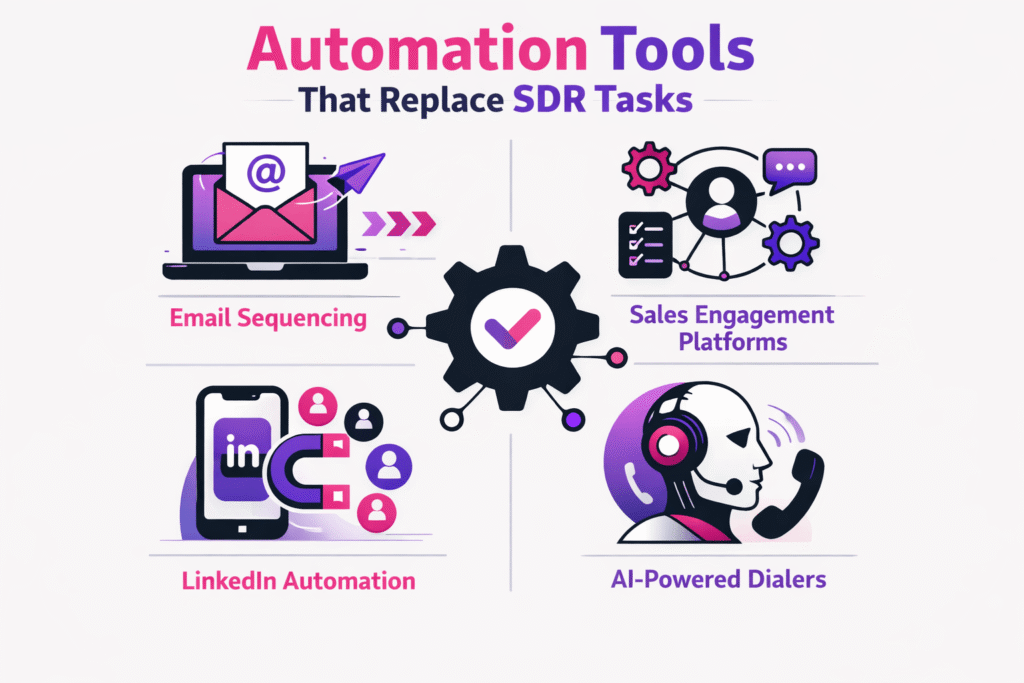
The Best Automation Tools to Replace SDR Tasks by Category
To build a high-performance sales machine, you need a stack that covers every stage of the top-of-funnel. Here is a breakdown of the leading technologies in 2026.
Prospecting and Lead Intelligence
Tools like ZoomInfo, Apollo.io, and Lusha have moved beyond simple databases. They now use AI to predict which accounts are “in-market” based on browsing behavior.
- How it replaces SDR tasks: It eliminates the need for manual list building. Instead of an SDR finding 50 leads, the system automatically delivers 50 high-intent leads to the CRM.
Automated Outreach and Sequencing
Salesloft and Outreach were the pioneers here, but new top-of-funnel automation tools are taking it further. They don’t just send emails; they use generative AI to write personalized messages based on the prospect’s recent LinkedIn activity or company news.
- How it replaces SDR tasks: It removes the “blank page” problem. SDRs no longer write emails; they simply approve the AI-generated drafts.
AI Cold Calling and Voice Agents
This is where the most significant shift is happening. New virtual SDR platforms can now engage in full, two-way voice conversations. They don’t sound like robots; they sound like professional sales reps.
- How it replaces SDR tasks: These tools handle the “first touch.” They call the lead, conduct a mini-discovery, and if the lead is qualified, they pass them to a human closer.
Comparison of Manual vs. Automated SDR Tasks
| Task | Manual SDR Time | AI/Automated Time | Efficiency Gain |
| Finding 100 Leads | 4 Hours | 30 Seconds | 99% |
| Calling 100 Leads | 6 Hours | 15 Minutes | 96% |
| Scheduling a Meeting | 15 Minutes | 0 Minutes (Auto) | 100% |
| CRM Data Entry | 2 Hours/Day | Real-time | 100% |
Why SalesCloser.ai is the Ultimate Virtual SDR
While many tools handle one specific part of the process, SalesCloser.ai is designed to replace the entire SDR workflow. It is not just a dialer or an email sender; it is a fully autonomous AI sales development platform that acts as a member of your team.
What is an AI sales agent?
An AI sales agent is software that autonomously handles sales conversations—including discovery calls, product demos, and follow-ups—without human involvement. Unlike traditional chatbots, AI sales agents can hold multi-turn voice or text conversations, handle objections, and integrate with your CRM in real-time.
Full-Scale Top-of-Funnel Automation
SalesCloser.ai goes beyond simple automation. It uses advanced neural networks to understand context. When it calls a prospect, it doesn’t just read a script. It listens, responds to questions, and handles objections like “We don’t have the budget right now” or “Send me an email instead.”
Key Features of SalesCloser.ai:
- 24/7 Prospecting: Your AI agent doesn’t sleep. It can reach out to leads in different time zones the moment they land in your CRM.
- Infinite Scalability: You can’t hire 1,000 SDRs overnight, but you can deploy 1,000 AI agents in minutes.
- Perfect CRM Hygiene: Every interaction is automatically logged, summarized, and synced with Salesforce or HubSpot. No more “I forgot to update the notes” excuses.
- Multilingual Capabilities: SalesCloser.ai can speak dozens of languages fluently, allowing you to expand into global markets without hiring local teams.
Real-Time Lead Qualification
The “Discovery Call” is the traditional domain of the SDR. SalesCloser.ai masters this. It asks the qualifying questions you define (BANT, MEDDIC, etc.) and determines if the lead is worth your Account Executive’s (AE) time. If they meet the criteria, the AI agent uses its AI appointment scheduler to put the meeting on the AE’s calendar instantly.
Building a Strategic Framework for AI Sales Development
Switching to sales process automation requires more than just buying software. You need a strategy to ensure your AI and humans work in harmony. Use the following framework to transition.
Step 1: Map Your Current Sales DNA
Document every step an SDR takes from “Lead Created” to “Meeting Booked.” Identify the specific hurdles. Is it the volume of calls? Is it the quality of the data? Once you map the process, you can see exactly where SalesCloser.ai fits.
Step 2: Set Guardrails for the AI
AI is powerful, but it needs direction. Define your “Ideal Customer Profile” (ICP) and your “Disqualifiers.” Teach the AI which objections are “hard nos” and which are “soft nos” that require more exploration.
Step 3: Shift Humans to “High-Empathy” Tasks
Once SalesCloser.ai handles cold calls and scheduling, what do your human SDRs do? They become SDR Managers or Junior AEs. They focus on:
- Account-Based Marketing (ABM): Crafting deep strategies for your top 10 “whale” accounts.
- Complex Negotiations: Handling the nuanced conversations that require deep human intuition.
- Creative Content: Building social authority on LinkedIn to support the AI’s outreach.
Step 4: Monitor and Iterate
The beauty of AI is that it never makes the same mistake twice if you coach it. Review the AI call transcripts. If it struggled with a new competitor’s name, update its knowledge base. This creates a feedback loop that makes your “Virtual SDR” smarter every single day.
The Impact on Your Bottom Line
When you increase SDR productivity through automation, the financial impact is immediate. You aren’t just saving money on salaries; you are increasing the volume of your pipeline.
Lowering CAC (Customer Acquisition Cost)
By replacing a fleet of human SDRs with SalesCloser.ai, you drastically reduce your cost per lead. Gartner research indicates that companies adopting AI in sales can reduce costs by up to 30% in their lead-to-opportunity cycle.
Eliminating Lead Decay
Speed to lead is the most important metric in modern sales. If a lead fills out a form and you wait four hours to call them, your chances of qualifying them drop by 80%. SalesCloser.ai calls leads in seconds, ensuring you catch them while the problem is top of mind.
The Future of the SDR Role
Is the SDR role dead? Not exactly. But it is changing. The “Entry-Level Caller” is a role of the past. The future belongs to the “Sales Technologist.”
Future sales leaders will not manage rooms full of people making phone calls. They will manage a fleet of AI agents. They will spend their time analyzing data, refining scripts, and ensuring that the brand voice is consistent across all automated channels. This enables more “virtual SDR” mode, in which a single person can manage the output of 50 AI agents, effectively doing the work of an entire department.
Conclusion: Stop Dialing, Start Closing
The era of manual cold calling and tedious lead scraping is over. Automation tools to replace SDR tasks are no longer a luxury for tech giants; they are a necessity for any business that wants to scale efficiently. By identifying your robotic tasks and deploying a virtual SDR like SalesCloser.ai, you can build a 24/7 pipeline that never sleeps, never burns out, and never misses a lead.
The goal of sales is to build relationships and solve problems. Let the AI handle the data, the dials, and the schedules so your team can focus on what they do best: closing deals.
Ready to see how an AI SDR can transform your pipeline?
Book a demo with SalesCloser.ai today and experience the future of autonomous sales.
Frequently Asked Questions (FAQ)
Q: Will prospects know they are talking to an AI?
A: Modern AI, like SalesCloser.ai, is incredibly life-like. However, transparency is often a good policy. Many companies find that prospects don’t mind talking to an AI if the AI provides immediate value and solves their problem quickly.
Q: Can AI handle complex B2B objections?
A: Yes. By training the AI on your specific sales methodology and past call recordings, it can learn to navigate complex objections regarding pricing, competition, and technical requirements.
Q: How long does it take to set up SDR automation software?
A: Basic tools can be set up in a day. A full implementation of an AI SDR like SalesCloser.ai typically takes 1-2 weeks to ensure it is fully integrated with your CRM and trained on your specific product knowledge.