
Autonomous sales agents for SaaS are AI agents that hold sales conversations on their own, within rules you set. They answer inbound leads by chat, phone or video, answer product questions from your knowledge base, ask qualifying questions, run demos and book qualified buyers with your account executives, handing complex or sensitive topics to a person.
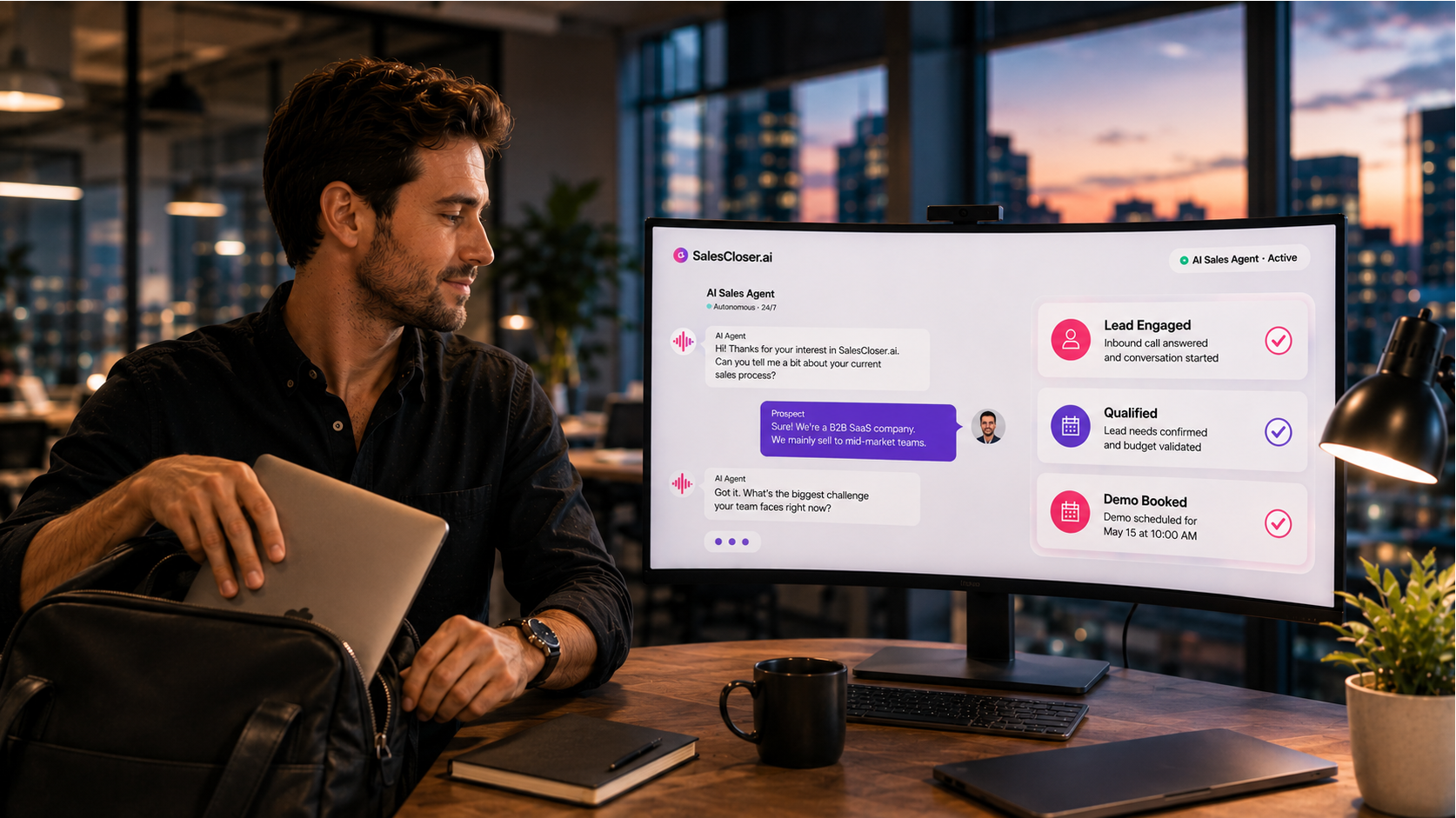
A SaaS buyer lands on your pricing page at 9 p.m. They have one question about seats, one about integrations, and a budget meeting tomorrow. If nobody answers, they open a competitor’s tab.
Autonomous sales agents exist to handle that moment. This guide explains what they are, what they can and cannot do for a SaaS team, how they compare with chatbots and commission-only reps, and how to roll one out without confusing your buyers or your sellers.
What is an autonomous sales agent?
An autonomous sales agent is AI software that runs a sales conversation on its own, from first reply to booked meeting, inside rules you set. It is built on a large language model, so it understands what a buyer is asking instead of matching keywords to a menu.
“Autonomous” does not mean unsupervised. It means the agent can complete a task without a person approving each message. You still define the goal, the knowledge it can use, the questions it must ask, and the point where it hands off to a human.
In SaaS, the most common jobs for an autonomous agent are:
- Answering inbound leads the moment they arrive, by chat, phone or video.
- Asking qualifying questions and recording the answers.
- Running a first discovery conversation about the buyer’s problem and current tools.
- Giving a product demo, either by sharing the screen live or by presenting a product video.
- Booking qualified buyers onto an account executive’s calendar.
- Supporting new customers during onboarding and answering routine support questions.
Autonomous agent vs chatbot vs AI SDR tool
Buyers have been burned by rigid chatbots, so it helps to be precise about the difference. A rule based chatbot follows a decision tree. An outbound AI SDR tool usually writes and sends email sequences. An autonomous conversational agent holds a live, two way conversation and decides what to ask next.
| Rule based chatbot | Outbound AI SDR tool | Autonomous conversational agent | |
|---|---|---|---|
| Main job | Route visitors through set options | Write and send prospecting messages | Talk with leads, qualify, demo and book |
| Handles unexpected questions | Poorly, falls back to a form | Mostly through replies to email | Yes, using your knowledge base |
| Channels | Website chat | Email, sometimes social | Chat, phone and video, depending on product |
| Qualification | Fixed fields | Based on data enrichment | Asked in conversation, with follow up questions |
| Best fit | Simple routing and FAQs | Top of funnel volume | Inbound demand and high intent buyers |
Many teams use more than one. The key question is where your pipeline leaks. If leads arrive and wait hours for a reply, a conversational agent fixes the bigger problem.
Why SaaS teams are adopting autonomous sales agents
Speed to lead
SaaS buyers research on their own schedule, across time zones. A form that promises “we’ll get back to you” puts your fastest moving prospects in a queue. An agent can reply within seconds, any hour, and keep the conversation going when the buyer answers back.
Consistent qualification
Different reps ask different questions. An agent asks the same qualifying questions every time and records every answer, so your account executives see the same information for each lead. If demo calls are full of poor fits, our guide to stopping unqualified demo calls covers the criteria to set first.
Product questions answered on the spot
Technical buyers often need a few specific answers before they will commit to a meeting. An agent trained on your docs, help center and pricing page can answer those questions in the conversation, rather than collecting an email and promising a follow up.
Your sellers spend time on the right calls
When the first conversation, qualification and booking happen automatically, account executives spend their hours with buyers who have already shared their needs, timeline and role.
Commission sales agents for SaaS vs autonomous AI agents
Some founders searching for sales help are weighing a different option: independent, commission-only sales agents who sell your product in exchange for a share of revenue. Both approaches can work, but they solve different problems.
| Commission-only sales agent | Autonomous AI sales agent | |
|---|---|---|
| What they do | Find and work their own prospects, run the full sales cycle | Respond to and qualify leads you already attract, book meetings |
| Availability | Their own working hours | Around the clock |
| Product knowledge | Depends on your onboarding and their focus | Limited to the knowledge base and rules you give it |
| Control over messaging | Shared with the agent | Set by you, reviewable in every recording |
| Relationships and negotiation | A strength | Handed to your human team |
| Main risk | Divided attention across several clients | Weak setup leads to weak answers |
A practical pattern for early stage SaaS: let an AI agent cover inbound response and qualification, and point any commission or full time sellers at the qualified meetings it books.
What “autonomous qualification” means in practice
Autonomous deal qualification means the agent decides, during the conversation, whether a lead meets your criteria and what should happen next. It is not a lead score calculated in the background. It happens through questions.
A typical setup for a B2B SaaS product looks like this:
- Fit: company size, industry, and the system the buyer uses today.
- Need: the problem they want solved and how they handle it now.
- Authority: their role and who else is involved in the decision.
- Timing: when they want to be live.
- Next step: book with an account executive, send to self serve resources, or route to support.
The agent asks follow up questions when an answer is vague, and it should save the answers to your CRM so nobody asks them twice. See how this works on the lead qualification use case page.
What about autonomous deal execution?
You will see vendors describe agents that “execute deals” end to end. Be careful with that claim. For most SaaS companies, contract terms, pricing exceptions, security reviews and procurement still need a person. A sensible split is that the agent runs the conversation and the handoff, while your team and your CRM workflows manage the deal itself.
Inbound vs outbound: where to deploy first
If you are choosing the best autonomous agent for inbound and outbound SaaS sales, start by separating the two jobs.
- Inbound buyers already want to talk. The agent’s job is to answer fast, qualify, demo and book. This is where most teams see value first because the intent is already there.
- Outbound starts with a cold list. The work is research, personalization and follow up, and the risk to your brand is higher if messages feel generic.
Start with inbound. It has the clearest success signal (qualified meetings booked) and the lowest risk. Our inbound lead response page shows the flow in more detail.
How to roll out an autonomous sales agent in a SaaS company
- Pick one entry point. Your demo request form, pricing page chat, or inbound phone line. Do not launch everywhere at once.
- Write your qualification rules. Agree with sales leadership on what makes a lead worth an account executive’s time, and what happens to everyone else.
- Build the knowledge base. Add your website, product docs, pricing explanations, security answers and common objections. Remove outdated material, because the agent will use it.
- Decide on disclosure. Choose whether the agent introduces itself as an AI at the start. It should always say so honestly if a buyer asks.
- Define the handoff. List the topics that go straight to a person, such as contract changes, custom pricing or an unhappy customer.
- Test with your own team. Have reps play difficult buyers. Fix weak answers before real leads see them.
- Review every week. Read transcripts, look for questions the agent struggled with, and update the knowledge base.
Also check your own legal obligations for recording calls, data storage and AI disclosure in the regions where you sell. Rules differ by country and state.
Mistakes to avoid
- Thin knowledge base. The agent can only be as accurate as the material you provide.
- No exit path. If a buyer asks for a person, they should get one quickly.
- Qualifying too hard. Five questions before any answer feels like an interrogation. Answer first, then ask.
- Ignoring your reps. Involve sellers in setup. They know the objections and they will trust the meetings more.
- Set and forget. Products, pricing and competitors change. The agent’s knowledge needs to change too.
For a wider view of how AI and human roles fit together, read how to build an AI sales team.
How SalesCloser fits
SalesCloser AI builds sales agents that hold real conversations by voice, video or chat: on the phone, on Zoom, or in the browser. You can set up demo, discovery, onboarding and support agents.
The agents answer inbound leads, ask your qualifying questions, run discovery, and give product demos by live screen share or by presenting your product video. Qualified prospects are booked onto your team’s calendar through Calendly or Cal.com.
Setup is no code. You give the agent your knowledge base (website, documents, FAQs) and your rules. SalesCloser connects to HubSpot, Pipedrive, Zoho, GoHighLevel, Zendesk and Intercom, saving the lead, a call summary and the qualification answers. Creating or moving deals in your CRM is handled through Zapier.
Every conversation is recorded and transcribed for review. The agent never claims to be human when asked, and you decide whether it introduces itself as an AI up front. It works around the clock and in many languages.
Conclusion
Autonomous sales agents give SaaS teams a way to answer every lead quickly, qualify consistently, and send account executives better prepared meetings. They work best on inbound demand, with clear rules, a strong knowledge base and an obvious path to a human.
Start small, review the conversations, and expand once the meetings it books are ones your team wants. If you want to see a conversational agent run a discovery call and book a meeting, you can book a demo.