
Buyers leave your website the second your chatbot answers a direct pricing question with a generic help center link. You spend thousands of dollars driving high-intent traffic to your landing pages. Then, you hand those valuable prospects over to a basic, script-following widget that cannot actually explain what you sell. This creates massive friction in the buying process.
Modern buyers expect immediate, accurate answers to complex questions. When they ask about specific integration capabilities or usage limits, a pre-programmed decision tree falls apart. This frustrating experience kills your conversion rates and sends prospects straight to your competitors.
You need to upgrade from basic automation to real intelligence. This guide explains how to deploy custom AI sales bots trained deeply on your specific offerings. You will learn how to feed an AI your unique feature sets, pricing tiers, and competitor data. By the end, you will see exactly how platforms like SalesCloser AI transform a standard website into a highly effective, automated pipeline generation machine.
What Are Custom AI Sales Bots?
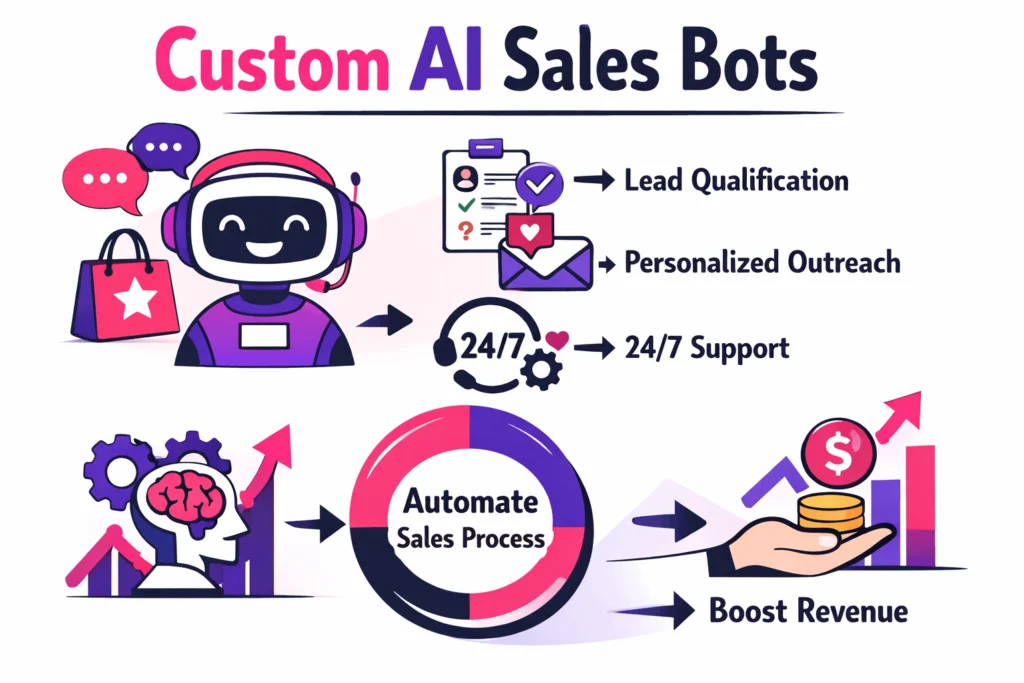
A custom AI sales bot is an intelligent software agent trained exclusively on your company’s proprietary data to handle complex, multi-turn sales conversations. Unlike traditional chatbots that rely on rigid scripts, these custom agents understand deep product context, accurately answer specific technical questions, handle sales objections, and autonomously book qualified demos directly onto your sales team’s calendar.
Generic chatbots simply route traffic. They ask for an email address, offer a few multiple-choice options, and promise a human will follow up later. This delay costs you money.
A product-specific AI agent acts like your best sales development representative (SDR). It actively listens to the prospect’s unique use case. It analyzes the context of the conversation and formulates responses based on the exact parameters of your product.
This level of intelligent sales automation requires a different underlying technology. Instead of manually mapping out conversational branches, you provide the AI with raw knowledge. The AI then uses large language models to generate responses that fit the specific situation dynamically. This ensures every prospect gets a highly relevant, deeply personalized experience.
Generic Bots vs. Product-Specific AI Agents
| Feature | Generic Chatbot | Product-Specific AI Agent |
| Knowledge Base | Static scripts and links | Deep, dynamic product documentation |
| Conversation Style | Rigid, menu-driven | Natural, multi-turn, context-aware |
| Objection Handling | Fails or routes to human | Addresses specific concerns with facts |
| Demo Booking | Captures email only | Qualifies fully and books the meeting |
| Maintenance | Requires manual script updates | Learns from updated documents instantly |
Why Generic Chatbots Kill Your Sales Pipeline
B2B buyers have changed. They want to self-educate before they ever speak to a human. According to recent Gartner research on B2B buying behavior, buyers spend only 17% of their total buying journey meeting with potential suppliers.
When your website relies on a generic bot, you waste that critical window of independent research. If a buyer asks, “Does your software integrate with Salesforce Custom Objects?” and the bot replies, “Please leave your email for our team,” the buyer immediately loses momentum.
This friction directly reduces pipeline generation. A frustrated buyer rarely waits 24 hours for an SDR to respond. They simply click the back button and find a competitor whose website answers their technical questions immediately.
Furthermore, generic bots generate a high volume of unqualified leads. Because they cannot dive deep into product limitations or pricing requirements, they pass everyone through to your sales team. Your account executives waste countless hours on discovery calls with prospects who do not fit your ideal customer profile (ICP). You need an AI-powered product expert who filters out bad fits while fast-tracking the good ones.
The Anatomy of a Product-Specific AI Agent
To build a trainable AI sales assistant, you must move beyond basic prompt engineering. You need to structure your company’s knowledge so the AI can retrieve and apply it instantly. This requires feeding the AI four distinct categories of information.
1. Feature and Technical Specifications
Your custom voice AI bot or text agent needs granular detail about what your product actually does. Do not just upload marketing fluff. You must provide the AI with the exact technical specifications, integration lists, and operational limits of your software or service.
If a user asks about API rate limits, the AI needs the exact number. If they ask about security or compliance, the AI should share only facts you have documented and approved, and offer to connect them with your team for anything beyond that. Providing this level of detail turns your bot into a trusted technical advisor.
2. Complex Pricing Tiers
Pricing is the most common topic prospects ask about. Generic bots usually deflect pricing questions to avoid giving wrong information. A well-trained custom AI sales bot can navigate complex, usage-based pricing models effortlessly.
You train the AI by uploading your full pricing matrix. Teach it how to calculate estimated costs based on user inputs. For example, if a prospect says, “We have 50 users and need the analytics add-on,” the AI should calculate the exact monthly cost and explain the volume discount applied.
3. Competitor Battlecards
Buyers constantly compare you to other vendors. Your AI must know how to handle these comparisons gracefully and persuasively. Upload your internal competitor battlecards into the AI’s knowledge base.
When a prospect asks, “How are you different from Competitor X?”, the AI should not bash the competitor. Instead, it should state the factual differences calmly. It should highlight your specific advantages, such as faster implementation times or superior reporting features, keeping the conversation focused on value.
4. Customer FAQs and Objection Handling
Your human sales team answers the same twenty questions every single day. Document these common objections and your best responses. Feed this document to your personalized sales AI.
If prospects frequently object to your setup fees, train the AI to explain the long-term ROI of your premium onboarding process. By addressing objections head-on in the chat interface, the AI warms up the prospect significantly before the actual demo.
How Automated Product Qualification Works
Standard chatbots ask qualifying questions in a rigid sequence. “What is your company size?” followed by “What is your budget?” This feels like an interrogation. Automated product qualification with a custom AI agent feels like a natural conversation.
Here is how intelligent conversational AI for sales qualifies a lead:
- Contextual Inquiry: The AI asks open-ended questions based on the page the user is viewing.
- Dynamic Follow-up: If the user mentions a specific problem, the AI drills down into that specific pain point rather than moving to the next unrelated script question.
- Threshold Matching: The AI compares the user’s answers against your hidden ICP rules (e.g., minimum employee count or a specific tech stack).
- Seamless Routing: If the prospect matches the criteria, the AI initiates AI demo scheduling. If they do not, the AI politely offers a lower-tier self-serve option.
This automated product qualification ensures your human sales reps only spend time on deals that can actually close. It dramatically lowers your Customer Acquisition Cost (CAC) and improves team morale.
According to G2 software buyer behavior data, buyers prioritize software vendors that offer immediate, frictionless purchasing experiences. Automated qualification provides exactly that.
Building Your Trainable AI Sales Assistant with SalesCloser AI
Creating a custom AI sales bot used to require a team of developers and data scientists. You had to build custom integrations, manage vector databases, and constantly tweak the language model. SalesCloser AI eliminates all of this technical overhead.
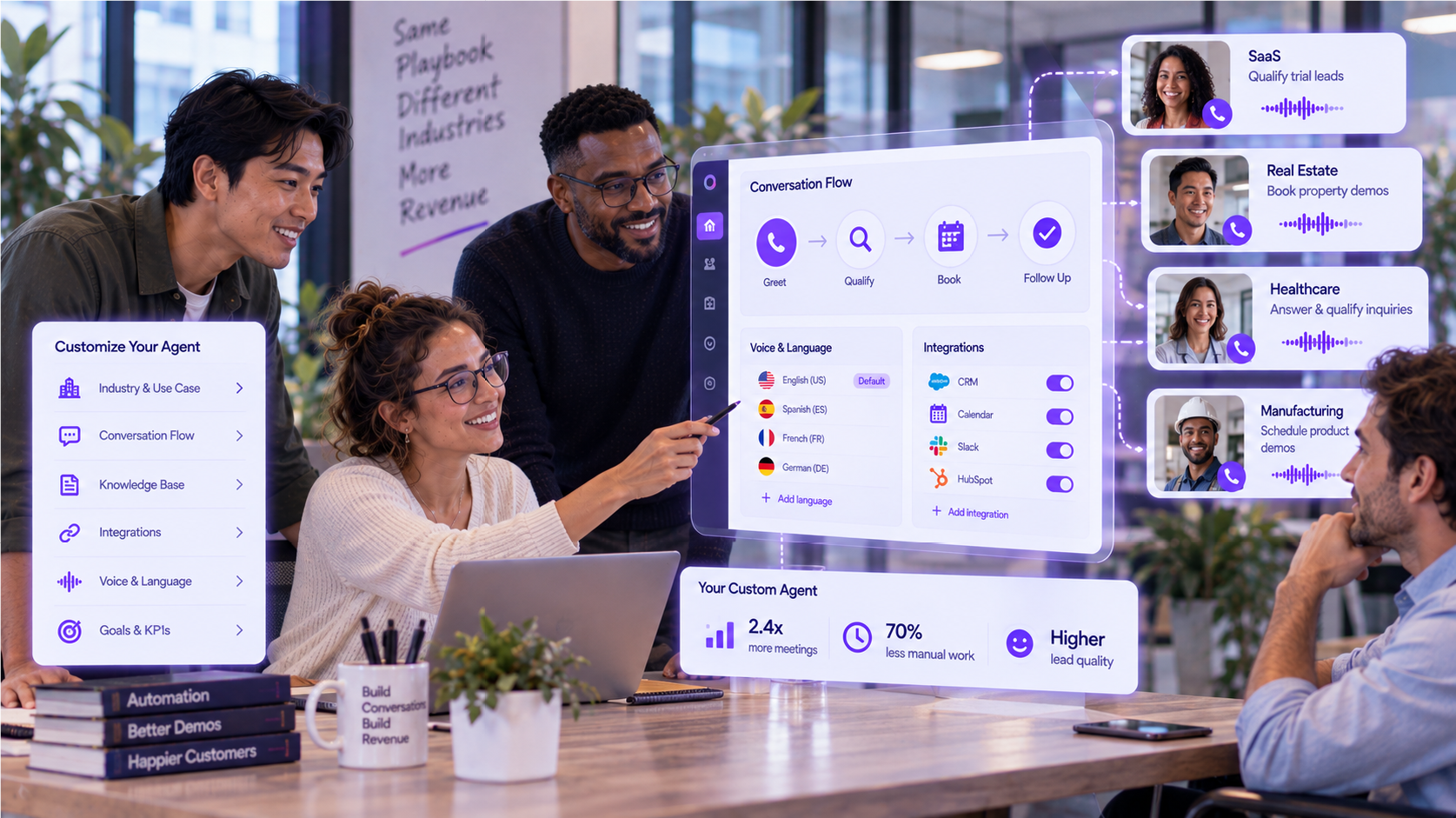
SalesCloser AI is a purpose-built platform for creating intelligent, product-specific AI agents. It allows revenue teams to deploy sophisticated sales bots in hours, not months. Here is how the process works.
Step 1: Ingesting Product Knowledge
With SalesCloser AI, you do not write scripts. You simply connect your existing knowledge sources. You can upload PDFs, link your entire website domain, or import your Notion workspace.
The platform’s ingestion engine automatically reads and categorizes your product documentation, case studies, and pricing sheets. It creates a secure, proprietary knowledge base dedicated solely to your custom AI sales bot. When your product updates, you simply sync the new documents, and the AI learns the new features instantly.
Step 2: Setting Custom Qualification Rules
Next, you define what makes a qualified lead. Inside the SalesCloser AI dashboard, you establish your exact ICP parameters. You tell the AI which questions it must ask before offering a calendar link.
You can set strict boundaries. For example, you can instruct the AI: “Never book a demo if the company has fewer than 10 employees. Instead, direct them to the self-serve checkout page.” The AI follows these rules flawlessly during every interaction, ensuring absolute consistency in your pipeline generation. Read more about setting these parameters in our AI SDR guide.
Step 3: Enabling Conversational AI for Sales
Once trained, you deploy the agent. SalesCloser AI offers seamless integration with your website, CRM, and calendar system.
The AI engages visitors using natural language. It handles technical questions, manages objections, and schedules AI demos by checking your reps’ real-time availability. It then logs the entire transcript and a neat summary directly into your CRM (like Salesforce or HubSpot). Your sales team wakes up to a calendar full of highly qualified meetings, complete with deep context about what the prospect needs.
Illustrative Scenarios: AI-Powered Product Experts in Action
Understanding the theory is helpful, but a few illustrative scenarios show how these custom AI sales bots could work. Different industries leverage product-specific AI agents to solve unique pipeline problems.
Scenario 1: Complex B2B SaaS Platforms
Illustrative example: a cybersecurity software company with a highly technical product could find that generic bots fail because prospects ask about specific encryption protocols and compliance standards.
The company could deploy a SalesCloser AI agent trained on its approved product documentation. When a Chief Information Security Officer (CISO) visits the site at 2:00 AM with a security question, the agent could answer from that approved material, offer to connect the CISO with the company’s security team for anything deeper, qualify them on company size, and book a technical deep-dive demo for the next morning.
Scenario 2: High-Volume Service Agencies
Illustrative example: a digital marketing agency receives hundreds of inbound inquiries weekly, but many of them lack the minimum budget required to hire the agency. Its human sales team burns out on unqualified discovery calls.
With a custom AI sales bot, the agency could automate financial qualification. The AI acts as a consultative advisor, asking about marketing goals and current ad spend. If the prospect’s budget is too low, the AI gently redirects them to the agency’s lower-cost online course. If the budget fits, the AI books a strategy call, so the sales team spends its time with vetted buyers.
The Financial Impact of Automated Product Qualification
Investing in intelligent sales automation is not just about adopting new technology. It is about fundamentally improving your unit economics. Generic chatbots represent a sunk cost; they sit on your website and add little measurable pipeline value. Custom AI sales bots act as revenue multipliers.
When you deploy a trainable AI sales assistant, you drastically reduce your cost per lead. The AI handles thousands of concurrent conversations without needing a salary, benefits, or sleep. It captures demand exactly when the buyer’s intent is highest.
Furthermore, because the AI handles the repetitive top-of-funnel education and qualification, your human account executives can focus purely on closing. They spend their time negotiating contracts and building relationships rather than answering basic feature questions. This shift in focus accelerates your sales cycle and increases your average contract value.
Conclusion
Relying on generic chatbots is a massive liability for your sales pipeline. Modern buyers demand immediate, highly specific answers to their product questions. By upgrading to custom AI sales bots, you provide prospects with an intelligent, context-aware experience that builds trust instantly.
Training a product-specific AI agent on your features, pricing, and battlecards ensures every conversation drives value. It automates deep qualification and seamlessly handles AI demo scheduling, saving your sales team hundreds of hours.