
The “Sales Development Representative” (SDR) model is broken.

For the last decade, the playbook was simple. You hire twenty recent college graduates. You give them a script. You buy a list of phone numbers. Then, you tell them to dial until their fingers bleed. If you burn through the list, you buy more data. If you burn through the reps, you hire a new batch.
It was a brute-force attack on the market. But in 2026, brute force doesn’t work.
Buyers have built taller walls. Their inboxes are fortresses protected by AI filters. Their phones screen unknown callers automatically. The human connect rate has plummeted to single digits. We are reaching a tipping point where the cost of a human sending an email or making a cold call exceeds the deal’s potential revenue.
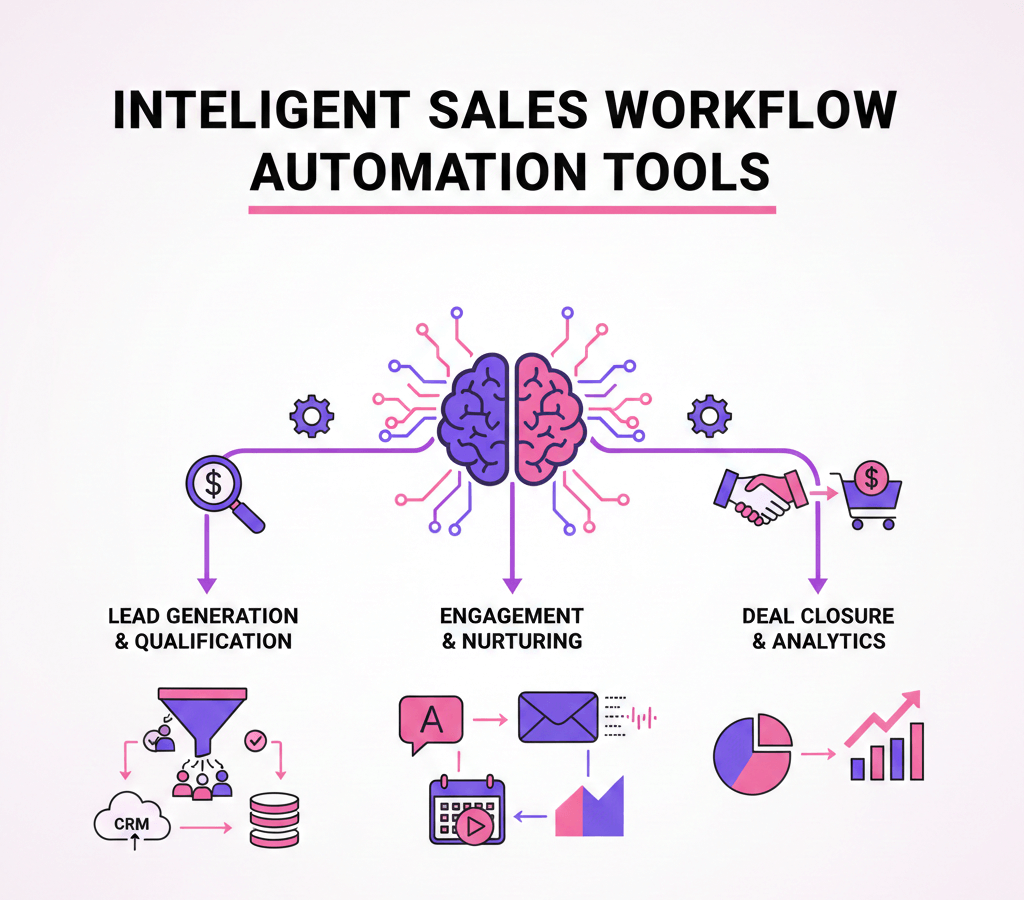
We are entering the era of Intelligent Sales Workflow Automation Tools.
This isn’t about “sales enablement.” We aren’t trying to make manual reps 10% faster. We are looking at a fundamental shift toward autonomous sales development. We are moving from tools that help humans work to agents that do the work.
This guide explores the architecture of the 2026 sales stack. We will look at how AI agents manage entire top-of-funnel sequences. We will look at the death of the “click-to-dial” button. And we will examine how platforms like SalesCloser AI are bridging the final gap, acting as the autonomous voice-and-video engine that turns workflow logic into revenue.
Part 1: The Death of “If-Then” Logic
To understand where we are going, look at where we are stuck.
Most “automation” today is actually just digitization. You use a platform like Outreach or Salesloft. You build a sequence:
- Day 1: Send Email A.
- Day 3: If no reply, send Email B.
- Day 5: Create a task for a human to call.
This is simple “If-Then” logic. It is rigid. It is dumb. If a prospect replies, “Not interested right now, ask me in Q3,” a standard automation tool doesn’t know what to do. It stops. It flags a human. The human has to read the email, understand the context, go to the CRM, and set a reminder for July.
That is not automation. That is just digital nagging.
The Shift to “Think-Act” Workflows
In 2026, sales process automation is moving to “Think-Act” loops.
New tools don’t just follow a track; they assess the terrain. When an AI agent receives a reply, it doesn’t just scan for keywords. It reads for intent.
- Input: Prospect says, “We are currently undergoing a merger, so budgets are frozen until September.”
- Old Automation: Stops sequence. Alerts human.
- 2026 Intelligent Automation:
- Understands “Merger” = High stress, potential tech stack consolidation.
- Understands “September” = Specific timeline.
- Action: The AI automatically moves the lead to a “Nurture – Merger” bucket. It schedules a follow-up for August 15th. It researches the merger to see which company is acquiring which. It drafts a hyper-personalized email referencing the acquisition to be sent in late August.
No human touched this. The workflow didn’t break; it adapted. This is the core difference between the tools of yesterday and the AI sales orchestration of tomorrow.
Part 2: The Anatomy of an Autonomous Sales Team
You cannot replace a sales rep with a single piece of software. A human rep is a bundle of capabilities: they research (eyes), they decide (brain), and they communicate (voice/fingers).
To build an autonomous workflow, you need a tech stack that replicates these biological functions. In 2026, the successful GTM (Go-to-Market) stack looks like a digital organism.
1. The Brain (Orchestration Layer)
This is the central nervous system. It holds the strategy. Tools in this category connect your CRM, your data sources, and your execution tools. They decide who to contact and what strategy to use.
This layer uses Large Language Models (LLMs) to analyze your total addressable market. It looks at buying signals, hiring sprees, funding rounds, tech stack changes, and decides, “Okay, we need to target the VP of Sales at Company X today.”
2. The Eyes (Data & Enrichment)
You cannot automate sales if your data is dirty. Lead management automation relies on pristine inputs.
In the past, you bought static lists. Now, AI agents scour the web in real-time. Before an outreach attempt is made, the system’s “Eyes” verify that the prospect is still employed. They check the prospect’s LinkedIn for recent posts to use as hooks. They listen to earnings calls to find pain points.
3. The Hands (Text Execution)
This is where AI-powered prospecting has been for the last two years. These agents write emails. They send LinkedIn DMs. They handle the text-based back-and-forth.
But this is also where the system usually fails.
Part 3: The “Action Gap”, Why Text Isn’t Enough
Here is the problem. You can build the most brilliant text-based AI in the world. It can write Shakespearean cold emails. It can handle objections over chat.
But high-value B2B sales do not happen over email.
You cannot close a $50,000 contract via text. You cannot build trust through a chat window. At some point, a voice needs to speak to another voice. A face needs to be seen.
This is the “Action Gap.”
For years, automation stopped at the meeting. The goal of the bot was just to “book a time.” Once the calendar invite was sent, the robot retired, and a human Account Executive (AE) had to step in actually to talk.
This created a bottleneck. You can scale text outreach to infinity, but you are limited by the number of human AEs you have available to take the calls. If your AI generates 1,000 leads, but you only have 3 humans to talk to them, your funnel chokes.
To truly achieve GTM automation, you need an agent that can speak.
Part 4: The Execution Engine, SalesCloser AI
This is where the market is heading in 2026, and this is where SalesCloser AI changes the architecture of the sales stack.
SalesCloser AI is not just another chatbot. It is the “voice and video” component of the autonomous workflow. It fills the Action Gap.
Think of your sales automation stack like a car. The data is the fuel. The orchestration layer is the navigation system. But SalesCloser AI is the engine and the wheels, it is the thing that actually meets the road.
Beyond Scheduling: The Autonomous Meeting
Most sales productivity software focuses on getting the meeting. SalesCloser AI focuses on running the meeting.
In a fully automated 2026 workflow, the sequence looks like this:
- The Prospecting Agent identifies a lead and warms them up via email.
- The prospect expresses interest but has questions. “Can you show me how the reporting feature works?”
- The Hand-off: Instead of waiting for a human to wake up and check their calendar, the system triggers SalesCloser AI instantly.
- The Interaction: SalesCloser AI engages the prospect. It can hop on a live video call. It engages in a two-way voice conversation. It doesn’t just read a script; it listens.
- The Demo: It navigates the product interface. It shows the reporting feature. It answers specific technical questions.
- The Close: It asks for the next step. “Does this look like something that would solve your reporting bottleneck?”
This enables sales-cycle acceleration previously impossible. You remove the friction of “finding a time next Tuesday.” You strike while the intent is high.
The “Voice” of Your Strategy
Strategic workflow designs are only drawings on a whiteboard until someone executes them. SalesCloser AI acts as the autonomous agent that turns those designs into reality.
If your strategy is to be aggressive and close on the first call, you tune the agent to be assertive. If your plan is consultative, you tune the agent to ask more discovery questions. It delivers consistency that human reps cannot match. A human rep might have a bad day or forget to ask a qualification question. The agent never forgets.
Part 5: A Day in the Life of a 2026 Autonomous Workflow
Let’s visualize how these intelligent sales workflow automation tools work together in a live scenario.
The Company: A mid-market SaaS firm selling cybersecurity software. The Goal: Target CTOs at financial service firms.
08:00 AM, The Wake-Up Protocol
The orchestration layer wakes up. It scans the news. A regional bank in Ohio just announced a digital transformation initiative. This is a trigger event.
The system adds the CTO of that bank to the “High Priority” queue.
08:05 AM, The Context Gather
The enrichment agents go to work. They pull the CTO’s profile. They analyze the bank’s current tech stack using public DNS records. They find the bank is using an outdated firewall legacy system.
08:15 AM, The Outreach
The text agent drafts a message. It doesn’t say, “Hi, buy our stuff.” It says: “Saw the news about the digital transformation push. Given you’re still running [Legacy System], are you worried about compliance during the migration?”
11:30 AM, The Engagement
The CTO sees the email on his phone during lunch. It hits a nerve. He replies: “Actually, yes. That is a major concern. Do you have documentation on how you handle migration?”
11:31 AM, The Pivot
A standard bot would send a link to a PDF. A human rep would try to call and likely go to voicemail.
The SalesCloser AI engine triggers. It replies immediately: “I have a 3-minute video walkthrough specifically on migration compliance for your legacy system. I can walk you through it live right now, or I can send the recording. Which do you prefer?”
The CTO is eating lunch. He has five minutes. He clicks “Show me now.”
11:32 AM, The Execution
SalesCloser AI launches a browser-based video session. The avatar appears, professional, articulate, branded.
“Thanks for jumping on,” the agent says. “I know you’re busy. Here is the dashboard. This specific tab handles legacy migration.”
The agent shares its screen. It points the mouse to the relevant data. The CTO asks, “Does this support ISO 27001?”
“That’s an important question,” the agent replies. “I want you to get a precise answer on certifications, so I’ll connect you with our security team. Can I book a quick call with them now?”
11:40 AM, The Next Step
The CTO is impressed. “Okay, send me the pricing.”
The agent doesn’t say “I’ll get back to you.” It calculates the pricing based on the bank’s size (data it already gathered at 8:05 AM).
“Based on your seat count, the enterprise license is $X. I can send the contract over right now for your legal team to review. Shall I do that?”
“Yes.”
11:45 AM, The Human Review
The autonomous workflow ends. The contract is generated and sent. A notification is finally sent to the human VP of Sales: “Deal reached contract stage. CTO of Regional Bank. Value: $45k. Review contract here.”
The human steps in only to provide the final handshake and to build relationships. The grunt work, the prospecting, the qualifying, the demoing, was handled by the machine.
Part 6: Overcoming the Fear of “Robot” Sales
When leaders hear about automated sales follow-up and autonomous agents, they worry about brand damage.
“What if the AI hallucinates?” “What if it sounds robotic?” “People buy from people.”
These are valid concerns based on 2023 technology. But 2026 technology is different.
The “Human-in-the-Loop” safeguards
Modern autonomous workflows are not unguided missiles. They operate within “guardrails.” You define the playbook. You tell SalesCloser AI what it can promise and what it cannot. If the conversation goes into territory the AI isn’t authorized to discuss (like complex legal liability clauses), the agent is programmed to say: “That is a great question for our legal specialist. Let me bring them into this conversation.”
It knows its limits.
Consistency vs. Charisma
A superstar human sales rep is indeed better than an AI. A human can read emotional subtlety that a machine might miss.
But how many superstar reps do you have? One or two? The rest of your team is average. They forget follow-ups. They show up late to calls. They don’t know the product updates.
Intelligent Sales Workflow Automation Tools provide a baseline of excellence. SalesCloser AI shows up on time, every time. It knows every product feature ideally. It never forgets a follow-up. It never gets tired, hungry, or discouraged by rejection.
In sales, consistency beats occasional brilliance.
Part 7: The Economics of Autonomy
Why will companies switch to this model? It comes down to math.
The cost of a human SDR is high. You pay salary, commission, benefits, software licenses, and management overhead. The average tenure of an SDR is less than 15 months. You are constantly hiring and training.
With autonomous sales development, the economics flip.
- Scalability: You can spin up ten new instances of an AI agent instantly. No recruiting. No onboarding.
- Cost Per Interaction: A human conversation costs dollars. An AI conversation costs pennies.
- Data Integrity: Humans are evil at CRM data entry. AI agents automatically log every data point flawlessly.
This frees up your human capital to focus on “Mid-Funnel Friction.” Humans shouldn’t be dialers. They should be deal-makers. They should be flying out to meet the Fortune 500 client for dinner. They should be negotiating complex partnerships.
Let the AI handle the volume. Let the humans handle the nuance.
Part 8: Building Your 2026 Stack Today
You don’t have to wait until 2026 to start. The components of this stack exist now. The leaders who adopt GTM automation early will eat the market.
Here is how to start replacing manual grunt work with intelligent workflows:
Phase 1: Audit Your Workflow
Look at your sales funnel. Where are the drop-offs?
- Are you slow to respond to inbound leads?
- Are you failing to nurture old leads?
- Are your reps spending more time in Salesforce than on the phone?
Identify the repetitive tasks. These are the candidates for automation.
Phase 2: Deploy the “Voice and Video” Layer
Don’t just automate email. That is table stakes. Look at tools like SalesCloser AI.
Start by using it for lower-stakes interactions. Use it to reactivate dead leads. Use it to handle the initial qualification calls for smaller accounts. Test the waters. See how your prospects react.
Phase 3: Connect the Brain
Integrate your execution tools with your data sources. Ensure that when SalesCloser AI has a conversation, the recording and transcript are analyzed and pushed to your CRM in real time. Use that data to refine your targeting.
Phase 4: Full Autonomy
Once the guardrails are tested, release the brakes. Allow the system to prospect, engage, and demo without human oversight for your SMB (Small and Medium Business) segment.
Part 9: The Future is Hybrid
We are not heading toward a world where humans are banned from sales. We are heading toward a hybrid workforce.
In 2026, a “Sales Team” will consist of 5 humans and 500 active AI agents. The humans will be the generals. The agents will be the soldiers.
The humans will design the strategy. They will craft the messaging. They will monitor the analytics to see which workflows are performing. And they will step in to close the “Whales”, the massive, complex deals that require high-touch empathy.
But the ground game, the daily grind of finding leads, warming them up, showing them the product, and answering their questions, that belongs to the machines.
SalesCloser AI and similar tools represent the final piece of this puzzle. By solving the voice and video challenge, they unlock the door to genuine autonomy.
The question for sales leaders is no longer “Should we automate?” The question is, “Why are we still paying humans to do robot work?”
Part 10: Deep Dive on Integration, The Hidden Challenge
While the vision of 2026 is bright, getting there requires navigating the “Integration Swamp.”
Many companies buy sales productivity software in silos. They buy a tool for email, a tool for calling, and a tool for data. None of them talks to each other. This creates “Frankenstein” data.
Intelligent Sales Workflow Automation requires a unified data layer.
When SalesCloser AI holds a demo, the outcome must be reflected in the marketing team’s ad spend immediately. If the AI finds that prospects in the “Healthcare” vertical are converting 30% more often, the ad platform should automatically bid higher on healthcare keywords.
This is the “Feedback Loop.”
In the manual world, this feedback loop is slow. A rep closes a deal. A month later, marketing asks, “How did that lead turn out?”
In the autonomous world, the loop is instantaneous.
- SalesCloser AI: “Prospect mentioned ‘Compliance’ three times. Deal closed.”
- Orchestration Layer: “Update marketing messaging. Increase frequency of ‘Compliance’ related keywords in top-of-funnel email blasts.”
The system learns. It gets smarter every day. A human sales team’s collective IQ is static. An autonomous sales team’s IQ is cumulative. Every conversation, win or lose, trains the model to be better tomorrow.
The Training Data Dilemma
This brings us to a critical realization: Your past sales calls are your gold mine.
To train an agent like SalesCloser AI to sound like your best rep, you need to feed it examples of your best rep’s work. Companies that have been recording calls (using tools like Gong or Chorus) for years are sitting on a treasure chest. They can feed those transcripts into the engine to clone their top performers.
Companies that haven’t been recording calls will have a “Cold Start” problem. They will have to train their agents from scratch.
Actionable Advice: If you are not recording every sales interaction today, start recording them. You are not just recording for quality assurance; you are gathering the training data for your future workforce.
Part 11: The Psychology of Buying from a Machine
We must address the psychological aspect of AI sales orchestration.
There is a concept in robotics called the “Uncanny Valley, where a robot looks almost human but not quite, causing a feeling of unease.
In sales automation, we must avoid the “Uncanny Valley of Conversation.”
If an AI tries too hard to pretend it is a human, using fake “umms,” pretending to type, or lying about being a real person, it destroys trust. The most successful implementations of 2026 will likely embrace their digital nature.
The “Super-Competent Assistant” Persona. Instead of pretending to be “John from Sales,” the agent presents itself as the “Intelligent Assistant.” “I am the automated specialist for [Company]. I can pull up any data you need instantly. If you stump me, I’ll get a human.”
This sets the right expectation. The buyer knows they are talking to a machine, so they don’t engage in small talk. They get straight to business. They ask the hard questions. They expect instant answers.
This efficiency is addictive for buyers. Once a buyer experiences a 10-minute, fact-filled demo with SalesCloser AI at 9 PM on a Tuesday, they won’t want to wait 3 days to talk to a human AE who spends the first 5 minutes talking about the weather.
Speed is the ultimate sales weapon. And autonomy delivers speed.
Conclusion: The Action Plan
The transition to Intelligent Sales Workflow Automation is inevitable. The economics are too strong, and the technology is advancing too fast.
The manual SDR “sweatshop” model is a relic of a time when labor was cheaper than intelligence. That time has passed. Intelligence is now scalable.
To prepare for 2026, you must stop thinking of automation as a way to assist your reps. You must start thinking of it as a way to construct a new type of rep.
SalesCloser AI serves as the spearhead of this movement. By handling the complex, conversational, video-based interactions that previously required a human, you can build a sales motion that is truly always-on.
The tools are here. The strategy is clear.