
Outreach is an agentic AI platform for revenue teams that combines sales engagement, conversation intelligence, deal management and forecasting, priced by seat plus AI credits. Salesloft and Apollo.io are the closest alternatives for rep workflows. SalesCloser covers a different job: your AI sales team talks to leads by phone, chat, voice and video, demos the product and books the qualified meetings, alongside your engagement tool.
Outreach is one of the best-known sales engagement platforms, now sold as an AI agent platform for revenue teams. Teams looking for an alternative usually want one of two things: a different tool for their reps’ sequences and forecasts, or an AI that actually talks to the leads those sequences create.
Here is what Outreach offers, the main alternatives, and where SalesCloser fits. Competitor details come from each vendor’s own website, checked in November 2026.
What Outreach offers
Outreach describes itself as an agentic AI platform for revenue teams. It brings sales engagement, conversation intelligence, deal management and forecasting into one platform, with AI agents for research and prospecting, personalised email, sequence automation, call analysis and coaching, and deal forecasting.
Pricing is not published as a list price. Outreach combines seat-based access with consumption-based AI credits, and asks you to request a quote.
Outreach alternatives at a glance
| Tool | Best for | What it does |
|---|---|---|
| SalesCloser | Talking to inbound and outbound leads live | Phone, website chat, voice and video; demos, qualifies, books and hands off |
| Outreach | Enterprise revenue teams running sequences, deals and forecasts | Sales engagement, conversation intelligence, deal management, forecasting |
| Salesloft | Revenue teams that want cadences, conversation insights and forecasting | Cadence, Conversation Intelligence, Deals, Clari Forecast, AI chat agents through 1mind |
| Apollo.io | Teams that want contact data and sequences in one tool | B2B database, enrichment, buying signals, sequences, dialer |
Salesloft presents itself as a predictive revenue system, with Cadence for building pipeline, Conversation Intelligence, Deals and Clari Forecast, and says it has moved from Drift to 1mind for website chat agents. Apollo.io describes a go-to-market system built on a large B2B contact and company database, with enrichment, buying signals, sequences and a parallel dialer.
Where SalesCloser is different
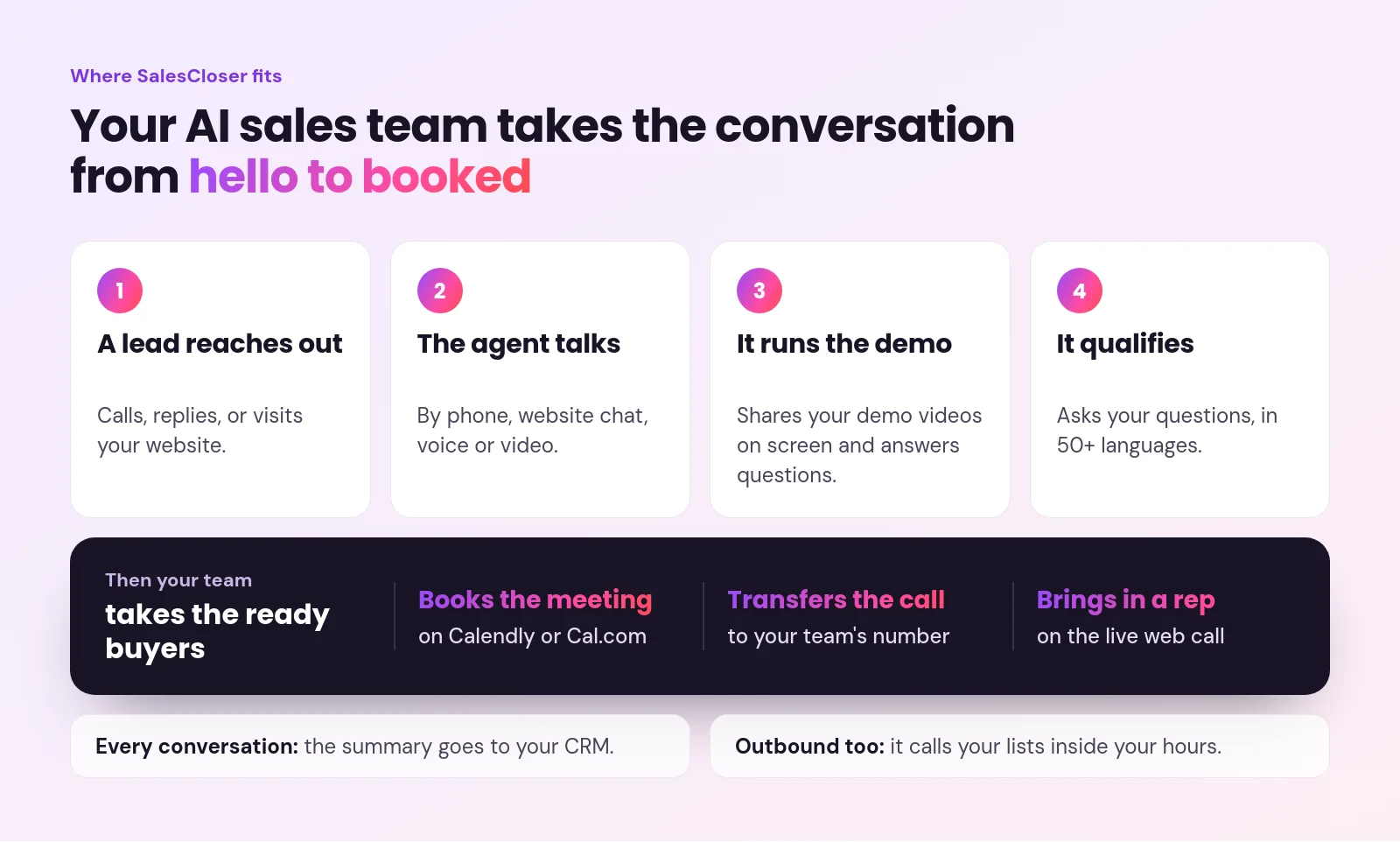
Outreach and Salesloft are built to make reps faster: they plan the touches, write the emails and analyse the calls reps make. SalesCloser is your AI sales team for the conversation itself.
- It talks to the buyer. When a lead replies, calls or visits your website, the agent talks with them by phone, website chat, browser voice or video, and WhatsApp.
- It runs the demo. On a browser video call, the agent shares your product demo videos on screen and answers questions as the buyer watches.
- It calls your lists. Outbound campaigns call leads inside your calling hours, retry, leave voicemails and book callbacks.
- A clean handoff. It books on Calendly or Cal.com, writes the summary to HubSpot, Pipedrive, Zoho CRM, Zendesk or GoHighLevel, and brings a rep into the live call when a buyer is ready.
- It works alongside a sales engagement tool. SalesCloser does not run email cadences or forecasts, so many teams keep one and let the agent handle the conversations.
What that looks like: a SaaS team keeps its email cadences in a sales engagement tool. Prospects who reply “tell me more” or book through the website get a SalesCloser agent on video, which shows a short demo, asks about team size and timeline, and books the qualified ones with an account executive.
How to choose
- Pick Outreach or Salesloft if you need a system for your reps’ cadences, call coaching and forecasts across a large team.
- Pick Apollo.io if you want contact data and sequences in one place at a smaller scale.
- Add SalesCloser when leads reply, call or visit and nobody talks to them fast enough, or when you want the demo to start in the first conversation.
What to check before you choose
- Ask how seats and AI credits are counted, and what happens when you run out.
- Check which channels each tool handles live, and which it only schedules for a rep.
- Email, calling and consent rules stay your responsibility with any vendor.
For a wider view, read our guides to AI sales engagement and the best AI sales agents in 2026. To see an agent talk to your leads, book a SalesCloser demo.
Frequently asked questions
What is Outreach?
Outreach describes itself as an agentic AI platform for revenue teams, combining sales engagement, conversation intelligence, deal management and forecasting, with AI agents across the revenue lifecycle.
How much does Outreach cost?
Outreach does not publish list prices. Its pricing combines seat-based access with consumption-based AI credits, and you request a quote.
What is the best Outreach alternative?
For rep workflows, Salesloft and Apollo.io are the closest alternatives. If you want an AI that holds the live conversation with leads by phone, chat, voice and video, demos the product and books meetings, SalesCloser covers that part.
Can SalesCloser replace a sales engagement platform?
Not on its own. SalesCloser handles conversations and outbound calling, but it does not run email cadences or forecasting. Many teams use both.
Does SalesCloser connect to my CRM?
Yes. HubSpot, Pipedrive, Zoho CRM, Zendesk and GoHighLevel connect from inside SalesCloser, and other tools connect through Zapier, webhooks or the API.
Building an Outreach Sequence That Works: Key Pointers
Creating a successful outreach sequence isn’t magic, but it does take some thought and effort. Here are some vital pointers to guide you:
- Know Who You’re Talking To: Research your ideal customer before writing your first email. What are their problems? What do they want to achieve? What kind of information resonates with them? The more you understand, the more targeted and effective your outreach will be. This understanding is the basis of personalized outreach.
- Outline Your Steps: Decide how many times you’ll reach out and through what channels. Will it be a series of emails? Will you include calls or LinkedIn messages? Think about how complex your product or service is and how your target customers usually make decisions.
- Make Each Touch Personal: Generic outreach rarely gets results. Take the time to personalize each message. Mention specific things about the prospect’s company, their role, or something they’ve recently done. This shows you’ve done your homework and are not just sending a mass email.
- Offer Something Useful at Every Point: Don’t just ask for a meeting in your first contact. Provide value, whether a helpful piece of content, a quick tip, or an invitation to a helpful webinar. This builds trust and positions you as someone who can help, which are cornerstones of good B2B outreach tips.
- Mix Up Your Messages: Don’t send the same email over and over with just a different subject line. Each step in your cold email sequence should offer a fresh angle, share a distinct benefit, or ask a slightly different question. This keeps your outreach interesting.
- Timing Matters: Think about the best time to reach out. When are your prospects most likely to be open to your messages? Try different days and times to see what gets the best response.
- Master the Follow-Up: Often, the sale happens in the follow-up. Many deals are closed after multiple interactions. Don’t give up after one or two emails. A well-timed follow-up email can re-engage someone who is busy or missed your first message. SalesCloser AI’s follow-up call functionalities let you easily move from email to a more personal phone call when it makes sense.
- Track and Analyze Your Results: Use analytics to see how your outreach sequence is performing. Look at open rates, click-through rates, and how many people convert. See what’s working well and what needs to be tweaked.
- Be Patient and Stick With It: Building relationships takes time. Don’t expect everyone to buy right away. Be patient, persistent, and focus on consistently providing value.
- Use Automation Wisely: Automation tools are powerful, but should help human connection, not replace it. Use tools like SalesCloser AI to handle repetitive tasks, personalize at scale, and ensure timely follow-ups, but always aim for a human touch in your interactions.
SalesCloser AI: Empowering Effective Outreach with AI Agents

In today’s rapid-fire sales environment, equipping your team with intelligent support can be a game-changer. SalesCloser AI provides sophisticated AI agents designed to supercharge your outreach sequences and drive better results. These agents work alongside your sales team, bringing intelligence and automation to every touchpoint.
AI Agents for Intelligent Email Automation:
Imagine having AI agents that craft and manage your personalized email sequences, adapting in real-time based on prospect behavior. SalesCloser AI makes this a reality. Our AI agents analyze how prospects interact with your emails, opens, clicks, replies, and dynamically adjust follow-up messages and timing to maximize engagement. This goes beyond basic email automation, ensuring your communication remains highly relevant and timely, as if a dedicated assistant were managing each interaction.
AI Agents for Seamless Follow-Up Calls:
SalesCloser AI’s AI agents also facilitate smoother transitions to phone conversations. They can analyze email engagement to identify the best moments for a call and even provide your sales team with context and talking points. The platform’s integrated calling features, guided by these AI agents, help schedule follow-ups and provide reminders, ensuring no opportunity is missed. This intelligent multi-channel approach significantly boosts your chances of connecting with prospects and building stronger relationships, a cornerstone of any successful prospecting sequence.
By leveraging the power of SalesCloser AI’s AI agents, you can create more effective and efficient email outreach strategies that feel genuinely personalized. These AI-powered assistants help you move beyond generic outreach, enabling deeper engagement with your prospects and ultimately leading to higher conversion rates and improved sales performance.
Comparing with How Others Do It
Many companies still rely on manual outreach or basic email blasts. While these might get some results, they often lack the personal touch and consistency needed for long-term success. However, industry best practices highlight the importance of structured, multi-step sequences tailored to each prospect.
Tools like Outreach.io and HubSpot offer sequence features that allow sales teams to automate and track their outreach. However, SalesCloser AI aims to go further by directly integrating AI-powered personalization and seamless follow-up call capabilities within the platform. This integrated approach can lead to smoother workflows and more impactful interactions than several separate tools.
For instance, while a standard automation tool might send a generic follow-up email after several days, SalesCloser AI could analyze how the prospect engaged with previous emails and adjust the follow-up message accordingly. Similarly, the integrated call feature removes the need to manually schedule and track phone calls, simplifying the entire lead generation process.
Building a Winning Outreach Sequence: A Step-by-Step Guide
Let’s break down how to build a high-performing outreach sequence:
Step 1: Know Your Target Audience (Again!)
This is so important, it’s worth repeating. The more specific you are about your ideal customer, the more exact your messaging will be more exact. Think about their industry, company size, job title, what problems they face, and what they want to achieve.
Step 2: Decide on Your Sequence Length and Channels
Figure out how many times you’ll reach out and how. A typical cold email sequence might involve 3-5 emails over a week or two, possibly followed by a phone call or LinkedIn connection. For warmer leads, the sequence might be shorter and more focused on setting up a meeting.
Step 3: Craft Your First Outreach Email
Your initial email should be short, personal, and focused on offering value. Avoid lengthy introductions and learn how to help the prospect solve a specific issue. Include a clear and compelling call to action (CTA), such as downloading a helpful resource or requesting a quick chat.
Example:
Subject: Addressing Your [Prospect’s Pain Point] at [Prospect’s Company]
Hi [Prospect Name],
I came across [Prospect’s Company] and noticed your work in [Prospect’s Industry/Area of Focus]. I was particularly interested in [Specific Observation about their company/work].
Many companies like yours struggle with [Prospect’s Pain Point]. We’ve helped businesses like [Similar Company] to [Quantifiable Benefit].
I’ve compiled a quick resource on [Relevant Topic] that you might find helpful: [Link to Resource].
Would a brief 15-minute chat to discuss your challenges and how we might be able to help be of interest?
Best regards,
[Your Name]
Step 4: Plan Your Follow-Up Emails
Your follow-up emails should build on your first message and offer more value. Don’t just ask for a meeting again. Share a success story, highlight a specific feature, or solve a different problem.
Example (Follow-up Email 1):
Subject: Ideas to Improve [Prospect’s Area of Focus]
Hi [Prospect Name],
Following up on my previous email, I wanted to share a specific example of how we helped [Another Similar Company] improve their [Area of Focus] by [Quantifiable Result].
They were facing a similar challenge with [Prospect’s Pain Point], and by implementing [Your Solution], they saw a significant increase in [Key Metric].
You can learn more about their success here: [Link to Case Study].
Would you be willing to have a quick call to discuss whether similar strategies could benefit [Prospect’s Company]?
Best,
[Your Name]
Example (Follow-up Email 2):
Subject: Quick Question about [Prospect’s Company]’s [Specific Initiative]
Hi [Prospect Name],
I noticed [Prospect’s Company]’s recent initiative on [Specific Initiative]. That’s a great move towards [Positive Outcome].
We help companies in the [Prospect’s Industry] achieve [Related Benefit] through [Your Solution].
I have a quick question about your approach to [Specific Aspect of the Initiative]. Would you be open to a brief exchange?
Thanks,
[Your Name]
Step 5: Add Other Channels (If It Makes Sense)
Consider adding a LinkedIn connection request or a short phone call to your sequence, especially for essential prospects. Personalize your LinkedIn message and have an apparent reason for calling. SalesCloser AI’s follow-up call functionalities can help you efficiently manage these phone outreach efforts.
Step 6: Watch and Learn
Continuously track how your outreach sequence is doing. Look at open rates, click-through rates, and replies. See which emails are working well and which ones need improvement. Use this data to improve your messaging and timing.
Avoiding Common Mistakes
Even with a good plan, there are common mistakes to watch out for:
- Being Too General: Not making it personal is a big turn-off. Always tailor your message to the specific prospect.
- Talking Only About Yourself: Your outreach should focus on the prospect’s needs and problems, not just your product or service.
- Not Offering Value: Every time you reach out, provide something valuable to the prospect.
- Being Too Pushy: Avoid aggressive sales tactics. Focus on building relationships and sharing helpful information.
- Not Following Up Consistently: Failing to follow up regularly can lead to missed opportunities.
- Ignoring the Numbers: Not tracking and analyzing your results means you can’t improve your sequences.
By being aware of these mistakes and focusing on creating personalized, valuable outreach, you can significantly improve your engagement and conversion rates.
The Future of Outreach: AI Making It Personal
The future of successful outreach involves using technology to create more personalized and efficient interactions. SalesCloser AI represents this shift by integrating AI directly into the outreach process. We can expect even more innovative tools to analyze prospects’ behavior, predict their needs, and tailor outreach in real time as AI develops.
This doesn’t mean that human connection will disappear. Instead, AI will help sales professionals focus on building stronger relationships by automating routine tasks and providing valuable insights that lead to more meaningful conversations. The key will be to find the right balance between automation and personalization, using AI to enhance, not replace, the human touch.
In short, your outreach sequence isn’t just a set of steps; it’s the core of your sales engagement strategy. By taking a structured, personalized, and value-driven approach and using powerful AI tools like SalesCloser AI, you can cut through the noise, connect with your ideal prospects, and drive significant growth for your business. So, carefully craft your sequences and watch your outreach efforts transform from a gamble to a strategic path to success.