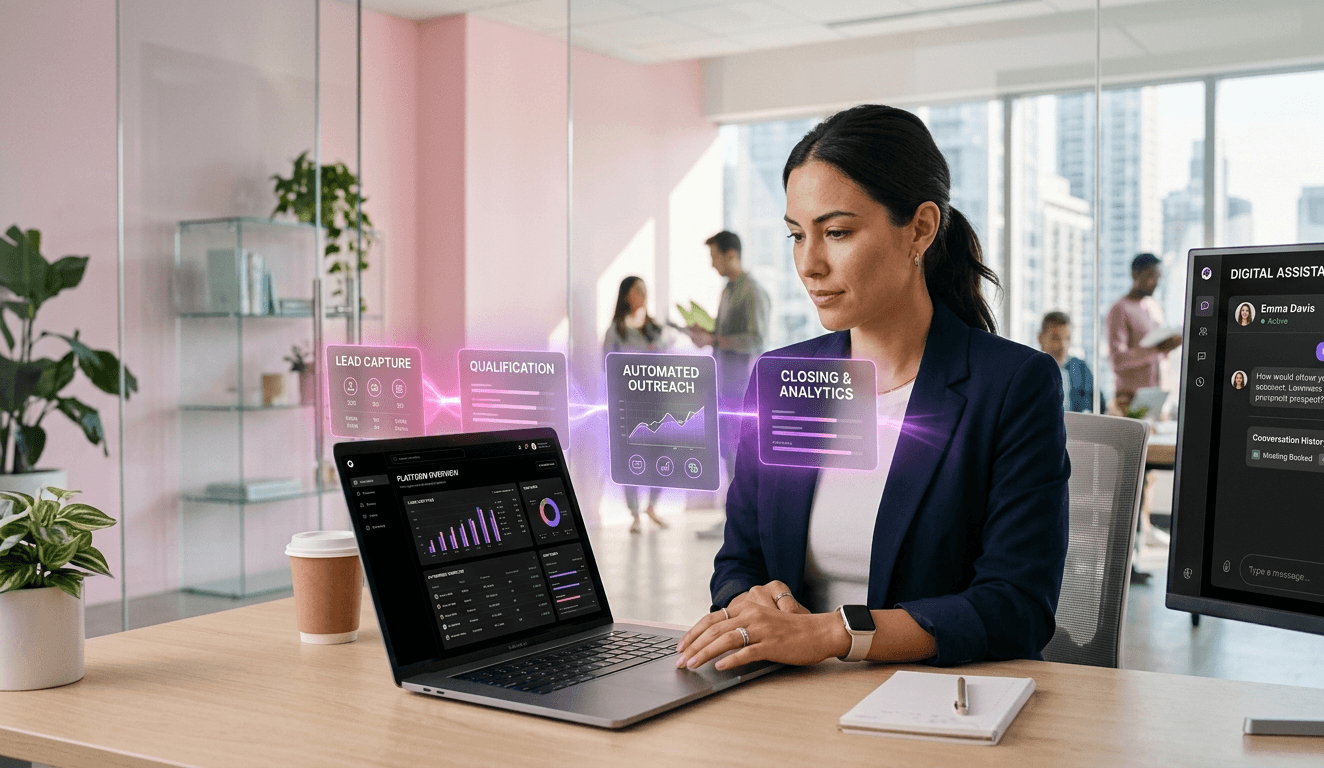
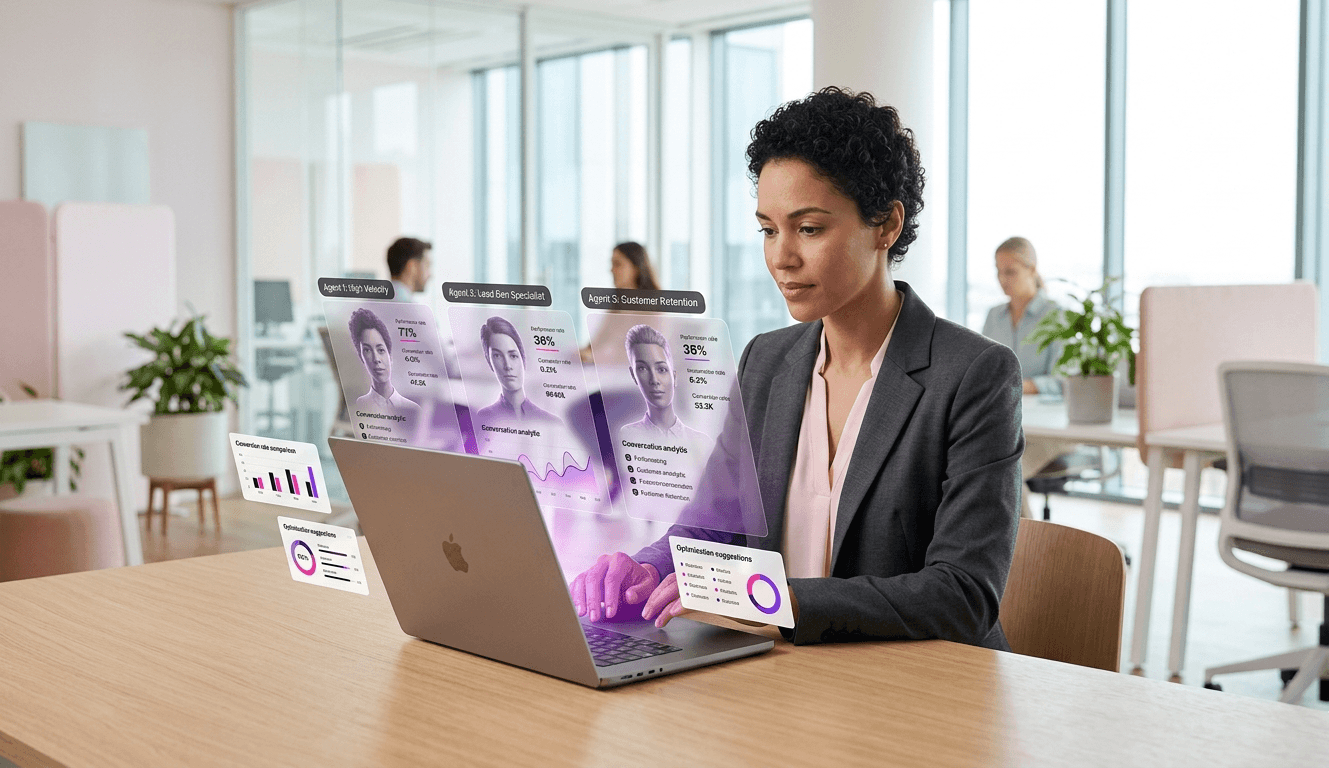
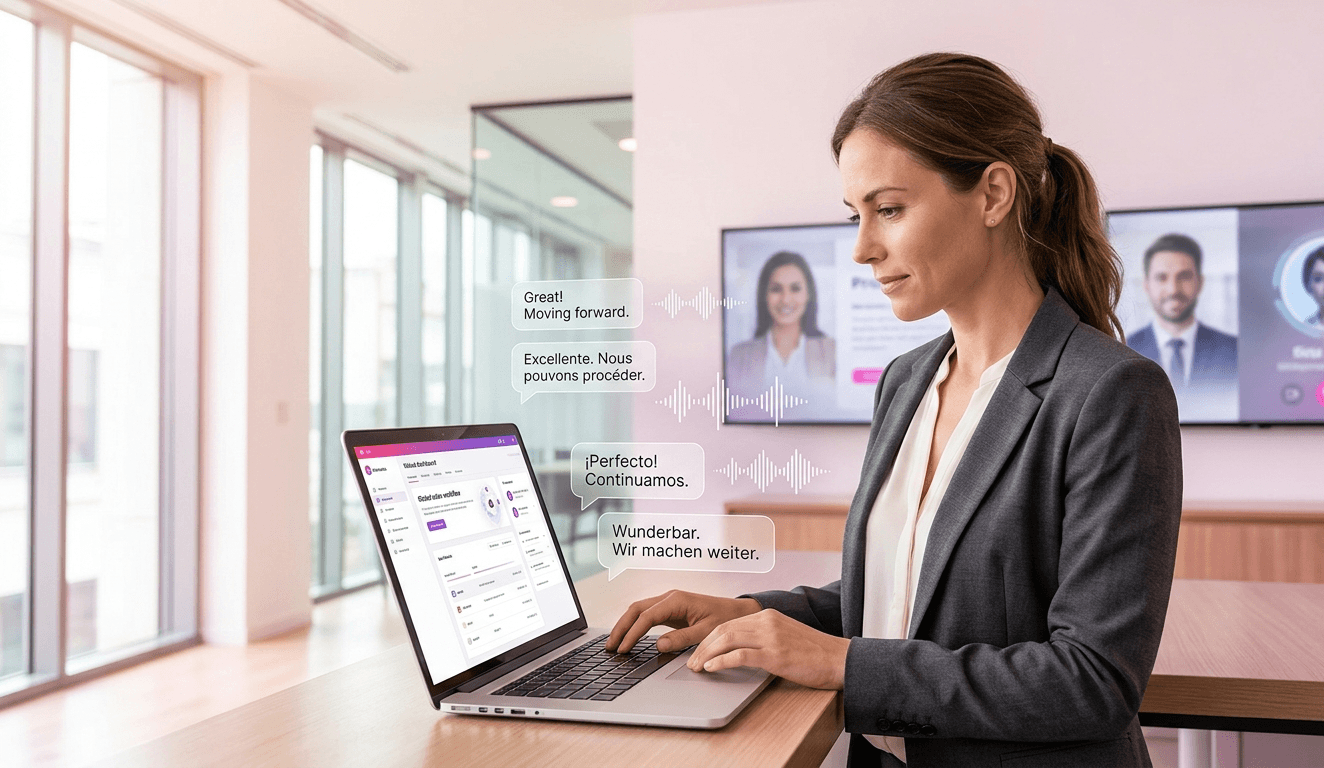
“Reclaim your time and grow faster with sales task automation for SMBs. Discover affordable AI tools that qualify leads and book meetings.”
Small business owners often feel like they are fighting a losing battle against time. You wear many hats. For one hour, you are the CEO. Next, you are the customer support rep. By the afternoon, you are trying to be the head of sales. This constant context switching kills productivity.
In the past, only giant corporations could afford high-end sales systems. They had the budget for massive sales teams and expensive software. Today, the playing field is changing. Sales task automation for SMBs is no longer a luxury. It is a survival requirement.
If you want to grow without burning out, you need to stop doing repetitive work manually. This guide will show you how to use affordable sales automation to reclaim your time and boost your revenue.
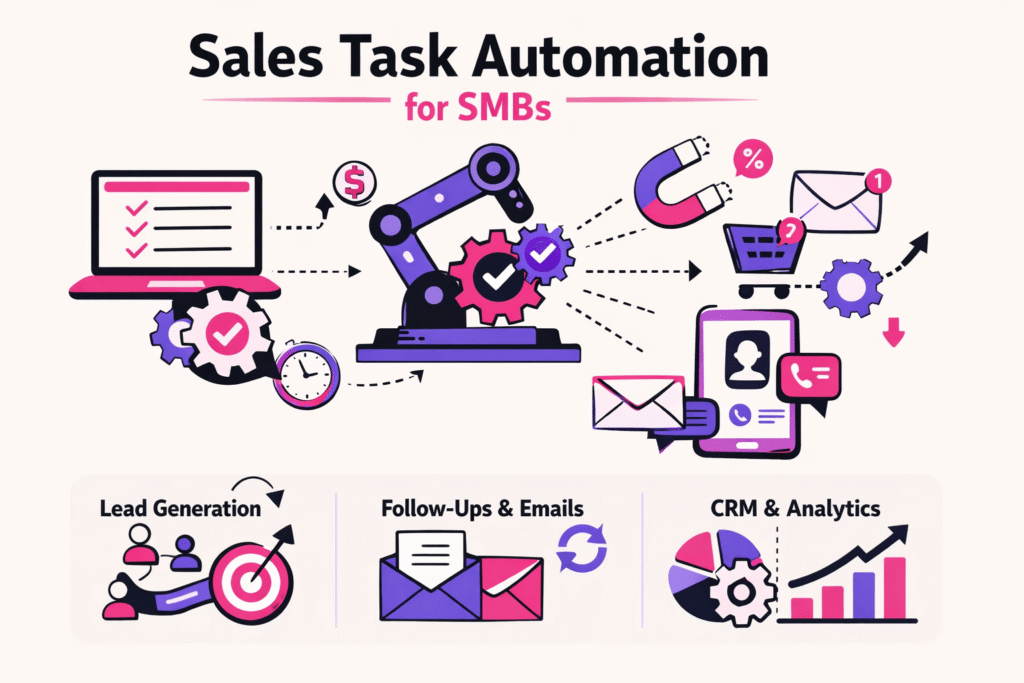
The Growth Trap for Small Businesses
Most small and medium-sized businesses (SMBs) hit a wall. You have a great product. You have a few happy customers. But to get more customers, you need to spend more time selling.
However, there are only 24 hours in a day. You cannot simply “work harder” to compete with a company that has 50 sales reps. If you try to do everything yourself, your lead response time slows down. You miss follow-ups. Prospects go cold.
This is the growth trap. You need sales to grow, but the process of getting sales takes you away from running the business. Affordable sales automation breaks this cycle. It allows you to scale your output without scaling your headcount.
Why Automation is the Great Equalizer
Automation handles the grunt work. It doesn’t get tired. It doesn’t take lunch breaks. Don’t forget to follow up on a Tuesday morning. When you use SMB sales tools, you give your small team the power of a large enterprise.
You can reach more people, respond faster, and close deals while you sleep. The goal isn’t to replace the human touch. The goal is to use technology so that your humans can focus on the conversations that actually require a brain.
Identifying High-Impact Sales Tasks
Not every task deserves automation. If you automate a bad process, you just fail faster. To get the best ROI, you must focus on the most time-consuming and repetitive parts of the sales cycle. These are often referred to as “top-of-funnel” activities.
1. Automate Prospecting for SMBs
Prospecting is the act of finding potential customers. It is often the most hated task in sales. It involves searching LinkedIn, scraping websites, and building lists.
If you spend four hours a day looking for email addresses, you are not selling. You are doing data entry. Sales software for small businesses can now handle this automatically. You define your target audience, and the tools find the contact info for you. This keeps your pipeline full without the manual labor.
2. Lead Qualification
Not every lead is a good lead. Some people are just browsing. Others don’t have the budget. If your sales team spends time talking to people who can’t buy, they are wasting money.
Automated qualification uses AI or logic-based forms to ask the right questions early. It filters out the “tire kickers.” By the time a lead reaches a human, it has already been vetted. This massively increases sales productivity for startups because every minute spent on the phone is spent with a high-probability buyer.
3. Scheduling and Appointments
The “email dance” is a productivity killer. You ask, “Are you free Tuesday?” They say, “No, how about Wednesday?” This can go on for days.
Automated scheduling tools sync with your calendar. You send a link, the prospect picks a time, and the meeting appears on your schedule. It sounds simple, but it saves hours of back-and-forth every single week.
The ROI of Sales Task Automation
Let’s look at the numbers. Consider the cost of a junior Sales Development Representative (SDR). Even a part-time employee will cost you thousands of dollars per month when you factor in salary, taxes, and benefits.
Now, look at the cost of cost-effective sales tools. Many automation platforms cost less than $300 per month.
Comparative Cost Analysis Table
| Feature | Human SDR (Part-Time) | AI/Automation Tools |
| Monthly Cost | $2,500 – $4,000 | $100 – $500 |
| Availability | 20 hours/week | 24/7/365 |
| Consistency | Varies with mood/energy | 100% Consistent |
| Scalability | Hard to scale quickly | Instant Scaling |
| Response Time | Minutes to Hours | Seconds |
As you can see, the math favors automation for the repetitive parts of the job. You save money on overhead and increase your capacity to handle leads. This is how you increase sales for SMBs without taking on massive financial risk.
Introducing SalesCloser.ai: Your AI Sales Force
If you are looking for the next level of sales task automation for SMBs, you need to look at AI agents. Traditional automation follows simple “if-this-then-that” rules. AI agents are different. They can think, adapt, and learn.
SalesCloser.ai is a leader in this space. It provides AI agents that act as full-time sales reps for your business.
How SalesCloser.ai Works
Imagine having a sales rep who knows your product inside and out. This rep can talk to prospects, answer their questions, and overcome objections. They do this over the phone or via video, in any language.
That is what SalesCloser.ai offers. It isn’t just a CRM or a mass emailer. It is an intelligent agent that handles the entire discovery and qualification process.
Features for SMBs and Solo Entrepreneurs
- 24/7 Prospecting: The AI never sleeps. It can reach out to leads the moment they show interest.
- Personalized Interaction: Unlike cold templates, the AI tailors its conversation to the specific needs of the prospect.
- Multi-Channel Reach: It can handle calls and presentations, making it one of the most versatile solo entrepreneur sales tools available.
- Real-Time Data: It syncs seamlessly with your existing systems, providing small-business automation that actually works.
“SalesCloser.ai allows a two-person team to perform like a twenty-person sales department. It’s about working smarter, not just faster.”
Why AI Agents Outperform Traditional Software
Standard sales software for small businesses usually requires a human to “drive” it. You still have to write the emails. You still have to set up the sequences. You still have to jump on the calls.
AI agents change the dynamic. They don’t just help you do the work; they do the work for you.
Autonomy and Decision Making
If a prospect asks a weird question, a traditional automated email sequence just keeps sending the next pre-written message. It looks robotic and annoying.
An AI agent from SalesCloser.ai understands the context. If the prospect says, “I’m interested, but I’m worried about the price,” the AI doesn’t just send a generic “Follow up” email. It addresses the price concern directly. It uses your pre-set logic to offer a discount or explain the value. This level of sophistication used to require a human. Now, it just requires a subscription.
Global Reach
For many SMBs, the biggest barrier to growth is geography. If you are based in New York, it is hard to sell to someone in Tokyo or Berlin because of time zones and language barriers.
AI agents solve this. They can speak multiple languages fluently. They can operate in any time zone. This opens up global markets for even the smallest startup. Lead generation for SMBs becomes a worldwide endeavor, not just a local one.
Step-by-Step Guide: Implementing Sales Automation
Moving from manual to automated can feel overwhelming. You don’t have to do everything at once. Follow this roadmap to get started.
Step 1: Audit Your Current Process
Track your time for one week. Every time you do a sales-related task, write it down.
- How long did you spend finding emails?
- How many times did you type the same “intro” message?
- How many hours were spent on “no-show” meetings?
Step 2: Choose Your Core Stack
You don’t need fifty tools. You need three or four that talk to each other.
- A CRM: To store your data (e.g., HubSpot, Pipedrive, or Zoho).
- A Prospecting Tool: To find leads (e.g., Apollo.io or LinkedIn Sales Navigator).
- An AI Sales Agent: To handle the outreach and qualification (SalesCloser.ai).
- A Scheduler: To finalize the bookings (e.g., Calendly).
Step 3: Set Up Small Business CRM Automation
Ensure your tools are connected. When a lead is found by your prospecting tool, it should automatically flow into your CRM. From there, your AI agent should be triggered to start the conversation. This “hands-off” flow is the secret to startup sales productivity.
Step 4: Refine Your Messaging
Automation only works if your message is good. Spend time crafting a compelling offer. What problem are you solving? Why should they care? Once you have a winning message, let the AI agent scale it.
Step 5: Monitor and Tweak
Automation isn’t “set it and forget it.” Check your stats once a week.
- Are people responding?
- Where are they dropping off?
- Is the AI agent answering questions correctly?
Small adjustments can lead to massive gains in conversion rates.
Common Myths About Sales Automation
Many SMB owners hesitate to use affordable sales automation because they believe certain myths. Let’s clear those up.
Myth 1: “It feels cold and robotic.”
This was true five years ago. Modern AI agents use Natural Language Processing (NLP). They sound like real people. They can use humor, acknowledge specific details from a prospect’s profile, and maintain a friendly tone. Most prospects won’t even know they are talking to an AI until you tell them.
Myth 2: “It’s too expensive for a small business.”
Actually, it is more expensive not to automate. If you spend $3,000 a month on a human rep who makes only 20 calls a day, your cost per lead is high. If you spend $200 a month on an AI that makes 200 calls a day, your cost per lead plummets. Automation is a cost-saving measure, not an expense.
Myth 3: “It’s too hard to set up.”
Platforms like SalesCloser.ai are designed for non-technical users. You don’t need to be a coder. If you can use an iPhone, you can set up an AI sales agent. Most of these tools offer “plug-and-play” templates that get you running in hours, not weeks.
Maximizing Lead Generation for SMBs
To truly increase sales for SMBs, you need a steady stream of leads. Automation helps you manage leads, but you still need to find them.
Inbound vs. Outbound Automation
- Inbound: This is when people come to you. You can automate your website chat so that when someone visits your site, an AI agent greets them. The agent can answer questions and book a demo immediately.
- Outbound: This is when you go to them. You can automate the process of finding contacts on LinkedIn and sending personalized voice or video messages.
Combining both creates a “surround sound” effect. Your brand stays top of mind, and you are always available when a prospect is ready to talk.
The Power of 24/7 Follow-Up
Statistics show that if you respond to a lead within five minutes, your chances of closing the deal are 100 times higher than if you wait 30 minutes.
Human beings can’t always respond in five minutes. We sleep. We drive. We eat. AI agents can. They ensure that no lead ever goes cold. This instant gratification for the customer leads to much higher conversion rates and better sales task automation for SMBs.
How Solo Entrepreneurs Can Compete with Giants
If you are a solo entrepreneur, your biggest challenge is “the plateau.” You reach a point where you literally cannot handle more work. You want to grow, but you can’t afford to hire a full-time assistant.
This is where solo entrepreneur sales tools like SalesCloser.ai become vital.
Case Study: The Freelance Consultant
Imagine a consultant who spends 10 hours a week on LinkedIn trying to find new clients. That is 10 hours they aren’t billing for.
By using an AI agent, the consultant can:
- Automate the search for high-value prospects.
- Have the AI send the initial “hook” message.
- Let the AI answer basic questions about its services.
- Only step in when the client says, “I’m ready to sign, let’s talk about the specific project.”
This person just bought back 10 hours of their life every week. That is an extra 40 hours a month for billable work or personal time.
The Future of SMB Sales Tools
We are entering an era of “Autonomous Sales.” In the near future, the businesses that thrive won’t be the ones with the biggest budgets. They will be the ones with the best-integrated AI systems.
Hyper-Personalization
Future tools will analyze a prospect’s entire digital footprint before making a call. They will know what the prospect posted on Twitter, what their company’s last quarterly report said, and even what their competitors are doing. The AI will use this data to have a conversation so relevant that it’s impossible to ignore.
Predictive Analytics
Sales software will soon tell you which leads are likely to buy before you even contact them. By looking at patterns in your data, the AI will say, “Focus on these 10 people today. They are 90% likely to close.” This focuses your energy where it matters most.
Overcoming the Technical Hurdle
If you feel tech-shy, don’t worry. The trend in cost-effective sales tools is “No-Code.” This means you don’t need to understand scripts or programming.
Most modern platforms use “Drag and Drop” interfaces. You simply:
- Upload your lead list.
- Tell the AI what your goal is (e.g., “Book a meeting”).
- Give it some basic info about your product.
- Hit “Start.”
The software handles the complex logic in the background. Your job is to show up to the meetings that appear on your calendar.
Crucial Tips for Success with Sales Automation
To get the most out of your sales software for a small business, keep these tips in mind:
- Keep it Human: Even if an AI is doing the work, the language should be conversational. Avoid corporate jargon. Speak like a friend trying to help.
- Test Everything: Run two different versions of your outreach script. See which one gets more bookings. This is called A/B testing.
- Don’t Spam: Automation makes it easy to send thousands of messages. Don’t do it—quality over quantity. Use the tool to find the right people, not every person.
- Integrate Your Data: Make sure your AI agent integrates with your CRM. If the two systems are separate, you will end up with messy data and missed opportunities.
- Focus on the Follow-up: Most deals are lost in the follow-up. Set your automation to reach out at least 5-7 times before giving up on a lead.
Cost-Effective Sales Tools to Consider
Beyond SalesCloser.ai, here are some other tools that fit well into an SMB budget:
| Tool Category | Recommended Tool | Why It’s Great for SMBs |
| CRM | Pipedrive | Very visual and easy to manage for small teams. |
| Email Discovery | Hunter.io | An affordable way to find professional email addresses. |
| Cold Outreach | Instantly.ai | Great for warming up email accounts so you don’t get flagged as spam. |
| AI Sales Agent | SalesCloser.ai | Handles the actual talking and closing, not just emails. |
| Meeting Prep | Otter.ai | Transcribes your meetings so you can focus on the talk. |
Conclusion: The Path to Scaling Your SMB
The era of manual sales is coming to an end. If you want to grow your business in today’s market, you have to embrace sales task automation for SMBs. You cannot compete with the big players by working more hours. You compete by using smarter tools.
By automating prospecting, qualifying, and scheduling, you remove friction from your sales process. Tools like SalesCloser.ai enable the deployment of an intelligent sales force at a fraction of the cost of traditional methods.
Stop doing the busy work. Stop wasting time on leads that won’t buy. Stop the endless back-and-forth of scheduling emails. Start using affordable sales automation to build the business you always imagined.
Your time is your most valuable asset. Don’t spend it doing things a machine can do better. Focus on your vision, focus on your customers, and let the AI handle the rest.
FAQs about Sales Task Automation for SMBs
1. Will automation replace my sales team?
No. It will make your sales team better. Automation handles the boring tasks that people hate. This allows your team to focus on high-level strategy and building deep relationships with big clients.
2. Is AI sales task automation for SMBs actually affordable?
Yes. Compared to the cost of a human salary, AI agents are incredibly cheap. Most SMBs find that the tool pays for itself after just one or two closed deals.
3. Do I need special training to use these tools?
Most are designed to be user-friendly. Most companies provide video tutorials and 24/7 support. You can get a system up and running in a single afternoon.
4. Is it ethical to use AI for sales calls?
Transparency is key. Many businesses find success by letting the AI introduce itself or by simply emphasizing that it provides faster, more efficient service to customers. As long as you are providing value, most customers don’t mind how the conversation started.
5. How does this improve lead generation for SMBs?
It increases your “surface area.” Because the AI can reach out to hundreds of people while you are doing other work, you have more opportunities coming into your funnel. It removes the bottleneck of human hours.
6. Can I use these tools if I’m a solo entrepreneur?
Absolutely. In fact, solo entrepreneurs have the most to gain. It acts as your first “hire” without the legal and financial headaches of a real employee.
7. What is the best tool for automating prospecting for SMBs?
While there are many options, tools like Apollo.io are great for finding data, and SalesCloser.ai is the best for turning that data into actual conversations and meetings.
8. Will my emails go to the spam folder?
Not if you use the right tools. Modern SMB sales tools include “email warming” features. They gradually send messages to build a good reputation with email providers like Gmail and Outlook.
9. How do I measure the ROI of my sales automation?
Look at your “Cost Per Meeting.” Before automation, calculate how much you spent (time + money) to get one meeting. After automation, do the same. Most businesses see their cost per meeting drop by 50% or more.
10. Can AI agents handle complex products?
Yes. You can upload your product manuals, pricing sheets, and FAQ documents to the AI. It uses this “knowledge base” to answer very specific and complex questions during the call.