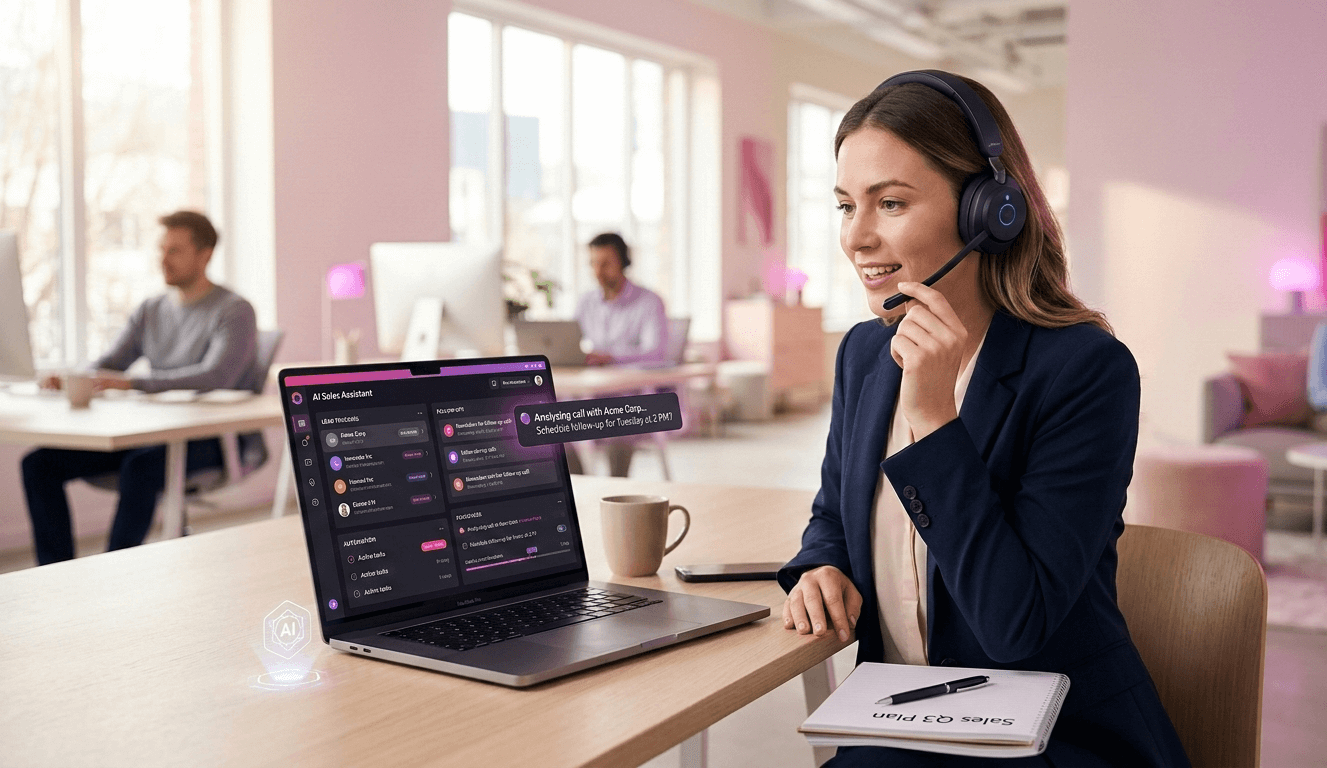
“Build custom AI agents with precision using the best platforms for 2026, from code-first orchestrators like LangGraph to specialized sales agents.”
The gap between a “chatbot” and an “agent” is not marketing—it is architecture.
A chatbot waits for input, retrieves a static answer, and outputs text. It is a linear, stateless transaction. An AI Agent has agency. It loops. It maintains state over time. It can decide to use a tool, query a database, fail, retry, and only then return an answer, or perform an action without ever speaking to the user.
For engineering teams and technical leaders, the challenge of 2026 is not “how to call an LLM.” The challenge is orchestration, state management, and observability. When you move from a prototype to production, you face the “Agentic Control Problem”: How do you ensure a nondeterministic model follows deterministic business logic?
This guide compares the best platforms for building custom AI agents today. We focus on the operational reality: how they handle state, how they integrate with your stack, and where they break down at scale.
We have categorized these platforms into three buckets:
- Code-First Orchestrators: For teams building proprietary engines.
- Cloud-Native Platforms: For teams engaging in heavy enterprise integration.
- Verticalized Solutions: For teams that need specific outcomes (like Sales) without the maintenance burden.
The Decision Matrix: Control vs. Velocity
Before evaluating tools, define your constraints. Building an agent involves three layers of complexity:
- The Cognitive Layer: The LLM (GPT-4, Claude, Llama).
- The Orchestration Layer: The logic that loops, manages memory, and handles tool execution.
- The Infrastructure Layer: Hosting, logging, and security.
Most platforms below address the Orchestration Layer. However, they trade flexibility for velocity.
| Feature | Code-First (LangGraph/CrewAI) | Cloud-Native (Bedrock/Azure) | Verticalized (SalesCloser) |
| State Control | 100% (You own the DB) | Partial (Managed Threads) | Abstracted (Outcome-focused) |
| Infrastructure | Self-Hosted / Vercel | Fully Managed (AWS/Azure) | SaaS |
| Time to Hello World | Hours | Days | Minutes |
| Time to Reliability | Weeks/Months | Weeks | Immediate |
| Maintenance | High (API breaking changes) | Medium (Platform updates) | Low (Vendor managed) |
Category 1: Code-First Orchestration Frameworks
These frameworks require you to write the loops and define the state machines in code (Python or TypeScript). They offer the highest control but require the most engineering effort.
1. LangGraph (by LangChain)
Best For: Engineering teams demanding granular control over cyclic workflows.
LangChain started as a linear chain builder. LangGraph is its evolution into a state machine library. Unlike simple chains, agents need loops (e.g., “Plan -> Execute -> Observe -> Refine Plan”). LangGraph models your agent as a graph of nodes (functions) and edges (conditions).
Architecture & Philosophy
LangGraph operates on a StateGraph. You define a State schema (usually a TypedDict or Pydantic model) that persists across steps. Every node receives the current state, modifies it, and passes it back.
This architecture solves the “infinite loop” problem common in early agent builds. You can define conditional edges that force the agent to stop after $N$ steps or route to a “Human” node for approval.
Technical Implementation
- State Management: You are responsible for persistence. LangGraph integrates with Postgres or Redis via “Checkpointers.” This allows “time travel”—you can pause an agent, inspect its state, edit the state, and resume execution.
- Cyclic Graphs: Unlike directed acyclic graphs (DAGs) in standard pipelines, LangGraph supports cycles natively. This is critical for “ReAct” patterns (Reason + Act) where the agent must try a tool, fail, and try again.
- Streaming: It supports token-level streaming, which is vital for UX latency.
Operational Trade-offs
- Complexity: The learning curve is steep. You are not just writing prompts; you are designing the logic of a distributed system.
- Debugging: When an agent gets stuck in a loop, you need deep observability (LangSmith is almost mandatory here).
2. CrewAI
Best For: Multi-agent systems simulating human teams.
CrewAI abstracts the complexity of loops into a “Role-Based” architecture. Instead of thinking in graphs and nodes, you believe in “Agents” (employees), “Tasks” (assignments), and “Processes” (workflows).
Architecture & Philosophy
CrewAI forces a structured mental model. You define an Agent with a Role, Goal, and Backstory. You then group agents into a Crew and assign them a Process (Sequential or Hierarchical).
- Sequential: Agent A does Task 1, passes output to Agent B for Task 2.
- Hierarchical: A “Manager” agent (usually GPT-4) plans the work and delegates tasks to worker agents, reviewing their output before finalizing.
Technical Implementation
- Inter-Agent Communication: CrewAI handles the prompt engineering required for agents to “talk” to each other. You do not write the hand-off logic; the framework handles the context window management.
- Tool Delegation: Agents can pass tools to each other. A “Researcher” agent can pass a scraped URL to a “Writer” agent.
- Memory: CrewAI has built-in short-term (RAM) and long-term (SQLite/RAG) memory, allowing agents to “remember” preferences across executions.
Operational Trade-offs
- Token Consumption: Hierarchical crews burn tokens rapidly. The “Manager” agent is constantly reading workers’ outputs and replanning. A simple task can generate 50+ API calls.
- Latency: Because it simulates a conversation between agents, it is slower than a single optimized LangGraph flow. It is better suited to background tasks (research, report generation) than to real-time user interaction.
Category 2: Cloud-Native & Enterprise Platforms
If you are already deep in AWS or Azure, using their native agent builders reduces the friction of security, IAM, and data privacy.
3. Amazon Bedrock Agents
Best For: Enterprises requiring strict IAM governance and AWS integration.
Amazon Bedrock Agents turns the agent building process into an infrastructure configuration. You do not manage the prompt loop; Amazon manages the orchestration runtime.
Architecture & Philosophy
You define an agent by selecting a Foundation Model (e.g., Claude 3.5 Sonnet) and associating it with:
- Action Groups: These map to AWS Lambda functions. The agent analyzes the OpenAPI schema of your Lambda and decides when to call it.
- Knowledge Bases: A managed RAG pipeline (Vector store + Embedding model) that the agent can query automatically.
Technical Implementation
- OpenAPI Schema First: You define your tools using standard OpenAPI (Swagger) JSON. Bedrock parses this to understand how to call your APIs.
- Traceability: Bedrock offers a “Trace” window that shows the Chain of Thought (CoT). You can see the exact rationale: “I need to call function X because the user asked for Y.”
- Security: This is the killer feature. The agent assumes an IAM role. You can lock down exactly which S3 buckets or DynamoDB tables the agent can touch.
Operational Trade-offs
- Latency: The managed runtime introduces overhead. Cold starts on Lambda functions can add to the delay.
- Black Box: You cannot tweak the system prompt that controls the orchestration loop as profoundly as you can in LangGraph. If the agent refuses to call a tool, debugging can be frustrating.
4. Microsoft Semantic Kernel
Best For: NET/C# shops and complex enterprise application integration.
Semantic Kernel (SK) is distinct because it is designed to be embedded into existing apps, not just to build standalone bots. Microsoft calls it “a lightweight SDK for integrating LLMs with existing code.”
Architecture & Philosophy
SK uses concepts like Plugins (tools), Planners (routers), and Memories.
- Dependency Injection: SK fits perfectly into the standard .NET dependency injection pattern. You inject the “Kernel” just like you inject a logger or database context.
- Planners: This is SK’s superpower. You give the Planner a goal (“Schedule a meeting”), and it looks at the available Plugins (Outlook, Calendar, Zoom) and generates a plan to execute it.
Technical Implementation
- Polyglot: While famous for C#, it has excellent Python and Java support.
- Connectors: It has native connectors for Azure AI Search, Pinecone, and standard vector DBs.
- Filters: You can write “Filters” (middleware) that run before or after every function call. This is crucial for enterprise compliance (e.g., stripping PII before sending text to OpenAI).
Operational Trade-offs
- Manual State: Unlike the OpenAI Assistant API, SK is stateless by default. You must manage the chat history and context window manually, which gives you control but adds work.
Category 3: Verticalized Specialized Platforms
Why Build When You Can Buy?
The “Variant C” operational reality is that building an agent is easy, but tuning it is hard.
If you build a Sales Agent from scratch using LangChain, you must solve:
- Voice Latency: Handling interruptions in real-time voice calls.
- RAG Hallucinations: Ensuring the bot doesn’t invent discounts.
- Calendar Conflicts: Managing race conditions in booking slots.
- CRM Sync: Mapping unstructured conversation data to structured HubSpot/Salesforce fields.
For specific verticals—especially Sales and Customer Success—using a specialized platform is often the superior operational choice.
5. SalesCloser.ai
Best For: Automated Sales, Discovery, and Demo bookings.
SalesCloser.ai is not a generic “agent builder.” It is a platform specifically architected for the sales vertical. It bypasses the need to engineer prompt loops for negotiation, objection handling, and closing.
Architecture & Philosophy
SalesCloser creates agents that act as “Digital Employees” with specialized roles. The architecture is pre-tuned for high-stakes conversations where hallucination is unacceptable.
- Role-Based Config: instead of writing Python code to define behavior, you select a mode: “Discovery Agent,” “Demo Agent,” or “Support Agent.”
- Video & Voice Native: Unlike text-first platforms (OpenAI Assistants), SalesCloser is built for calls. It handles the transcode/transcribe/respond loop with sub-second latency, which is nearly impossible to achieve with a home-brewed stack without a dedicated engineering team.
Integration Depth
- Calendar Bi-Directional Sync: The agent doesn’t just “ask” for a time; it reads availability from Google/Outlook calendars in real-time to prevent double bookings.
- Knowledge Base Injection: You upload PDFs, sales scripts, and recordings. The system chunks and indexes this data specifically for conversational retrieval (short, punchy answers) rather than document retrieval (long paragraphs).
- CRM Webhooks: Post call summaries, sentiment analysis, and action items directly to Salesforce, HubSpot, or Pipedrive immediately after the call.
Operational Upside
- Zero Maintenance: You do not have to worry about OpenAI API-breaking changes or Python library dependencies.
- Evaluation: The platform provides analytics on “Call Success Rate,” “Booking Conversion,” and “Objection Handling Success,” metrics that you would have to build manually in a custom observability stack.
Comparative Technical Matrix
| Capability | LangGraph | Amazon Bedrock | CrewAI | SalesCloser.ai |
| Primary Use Case | Complex, cyclic custom logic | Secure Enterprise automation | Multi-agent research/tasks | Sales & Revenue Automation |
| Hosting Model | Self-Hosted / Cloud Run | AWS Managed | Self-Hosted | SaaS |
| State Management | User-defined (Postgres/Redis) | Managed by AWS | In-memory / SQLite | Managed (Context retained) |
| Integrations | Python Code (Unlimited) | Lambda (OpenAPI) | Python Tools | Native CRM/Calendar |
| Voice/Video | External integration req. | External integration req. | No | Native / Real-time |
| Setup Effort | High (Code-heavy) | Medium (Config heavy) | Medium (Prompt heavy) | Low (Config only) |
Operational Realities: What They Don’t Tell You
When you move to production, these are the friction points that kill projects.
1. The “Infinite Loop” Bill
In code-first frameworks (LangGraph/CrewAI), an agent can get stuck in a “Task -> Fail -> Retry” loop. If you do not implement a “recursion limit” (e.g., max 10 steps), you can wake up to a $5,000 OpenAI bill.
- Solution: Always implement a “Time-to-Live” or “Step Count” hard stop in your orchestration logic.
2. Observability is not Optional
You cannot debug an agent by reading logs. You need Traces.
- In Bedrock, use CloudWatch Logs combined with the “Trace” feature.
- In LangGraph, use LangSmith.
- In SalesCloser, use the built-in Call Recording and Transcript audits.
Without traces, you cannot see why the agent decided to call a tool or why it hallucinated an answer.
3. Latency Stacking
Every “hop” in an agent’s thought process costs time.
- User Input (0s)
- LLM Thinks (1.5s)
- Agent Decides to use Tool (0.5s)
- Tool API Call (Wait for legacy system) (2.0s)
- Agent Reads Tool Output (1.0s)
- Final Response Generation (1.5s)
Total Latency: 6.5 seconds.
- Mitigation: Use “Optimistic UI” updates (show the user “I’m checking the database…”) or use faster, smaller models (like GPT-4o-mini or Claude Haiku) for the routing logic, reserving the big models for the final answer.
4. Governance & Guardrails
How do you stop the agent from promising a 90% discount?
- Prompt Engineering: “You are a helpful assistant” is not enough. You need “System Instructions” that explicitly list forbidden actions.
- Deterministic Filters: Platforms like Bedrock allow “Guardrails” that scan the output for PII or specific blocked topics before it reaches the user.
- Role Restrictions: In SalesCloser, the agent is constrained by the “Playbook” you define, preventing it from going rogue on pricing.
Conclusion: Which Platform Should You Choose?
The “best” platform depends entirely on your team’s DNA and the problem you are solving.
- Choose LangGraph if you are building a product where the AI is the core value proposition, and you need absolute control over the cognitive architecture.
- Choose Amazon Bedrock Agents if you are an enterprise IT team that needs to securely expose internal APIs to employees.
- Choose CrewAI if you are experimenting with multi-agent research or content generation pipelines.
- Choose SalesCloser.ai if your goal is to increase revenue through automated discovery and demos. Building a voice-capable sales agent from scratch is a massive engineering undertaking; buying a platform that has already solved the latency and integration challenges is the more brilliant operational move.
Next Step
If you are evaluating AI for sales enablement, do not start by writing Python code. Audit your current sales demo capacity. If your team is missing leads due to bandwidth, test a specialized agent platform first.
FAQs
Q: What is the difference between RAG and an Agent?
A: RAG (Retrieval-Augmented Generation) is a technique to give an LLM data. It reads a document and answers a question. An Agent uses RAG as a tool, but it also has the autonomy to execute tasks, loop, and change its behavior based on the results. RAG is “Read-Only.” Agents are “Read-Write.”
Q: Why shouldn’t I just use the OpenAI Assistants API for everything?
A: The Assistants API is powerful, but it is a “Black Box.” You cannot see the internal state machine. If the thread locks up or the tool calling fails, you have very few levers to fix it. Also, you are locked into OpenAI models. Frameworks like LangGraph or Semantic Kernel let you swap models (e.g., switch to Anthropic or Llama) without rewriting your code.
Q: How much does it cost to run a custom agent?
A: It is higher than a chatbot. A single user request might trigger 3 to 5 internal LLM calls (Thought -> Action -> Observation -> Response). If you have 1,000 users/day and each interaction burns 5,000 tokens, the cost scales linearly. Specialized platforms (like SalesCloser) often offer flat-rate or per-minute pricing, which can be more predictable for high-volume use cases like sales calls.
Q: Can I run these agents on-premise?
A: Yes.
- LangGraph and CrewAI can run on your own servers (using Docker).
- Semantic Kernel can run locally.
- Bedrock and OpenAI are cloud-only.
If you need air-gapped security, you must use open-source models (Llama 3, Mistral) with a self-hosted framework like LangGraph.