

“Scale your sales team in 2026 with Enterprise Voice Automation Platforms to ensure perfect messaging, 100% CRM data accuracy, and instant capacity.”
The enterprise sales landscape is shifting beneath our feet. If you run a large sales organization, you know the old playbook is losing its effectiveness. You hire an army of SDRs. You train them for months. You burn through cash on enablement. Yet, you still struggle with the same three problems: inconsistent messaging, spotty CRM data, and the inability to scale capacity instantly when the market demands it.
By 2026, the solution won’t be hiring more people. It will be adopting Enterprise Voice Automation Platforms.
We are moving past the era of “AI assistants” that simply transcribe calls. We are entering the age of autonomous voice agents that can handle end-to-end prospecting, qualification, and customer service calls with human-level fluency but machine-level precision. This isn’t science fiction. It is the immediate future of scalable sales technology.
This guide explores why this shift is inevitable. We will look at the crushing inefficiencies of the current human-centric model for high-volume tasks. We will examine the three main drivers pushing enterprises toward automation. Finally, we will show how SalesCloser.ai is positioning itself as the infrastructure layer for this new era of sales.
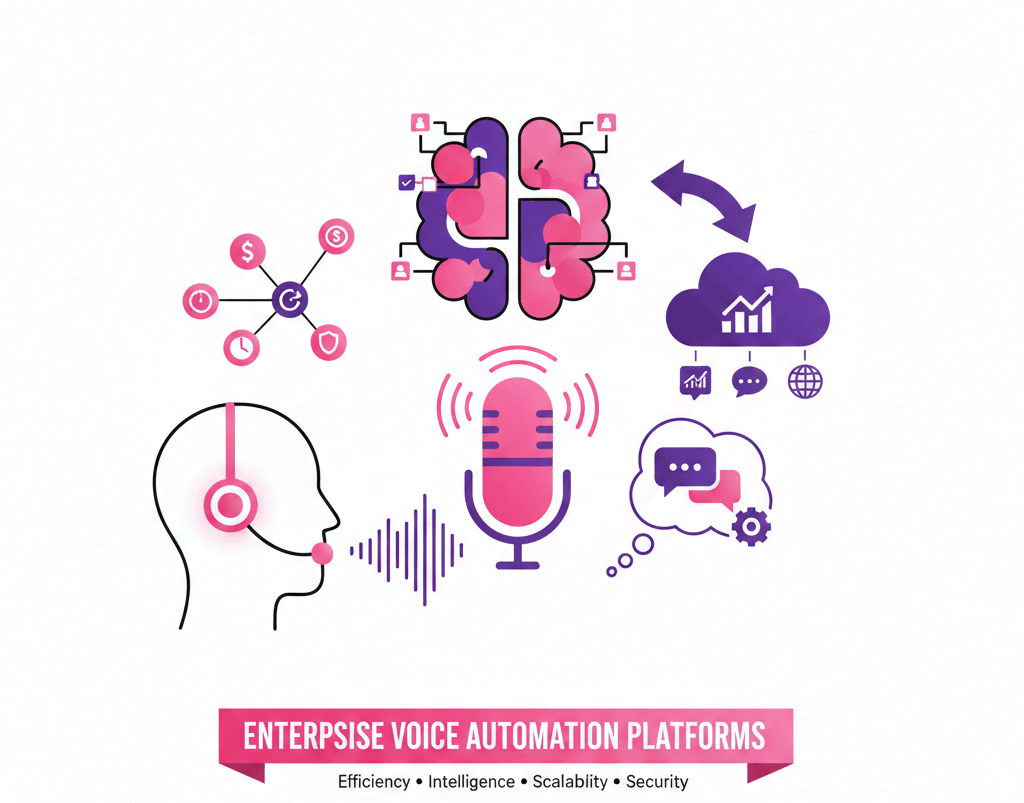
The Broken Economics of Human-Only Sales Scaling
Let’s look at the math. It rarely adds up.
Scaling a sales team is expensive. You have recruiting costs, base salaries, commissions, benefits, and software licenses. But the hidden costs are what kill your margins. The ramp time for a new enterprise BDR is typically 3 to 6 months. During that time, they burn leads. They make mistakes. They experiment with your brand messaging.
Even when fully ramped, human performance is variable. You have your top 10% who carry the team. You have the middle 60% who are steady but unspectacular. And you have the bottom 30% who are actively costing you money.
This variability is a nightmare for forecasting. You cannot predict revenue when your inputs (effort and execution) vary so widely from person to person.
Enterprise Voice Automation Platforms solve the variability problem. They don’t have bad days. They don’t get tired. They don’t deviate from the script because they “felt like it.” They offer a standardized unit of sales effort that is perfectly replicable.
In 2026, the competitive advantage will go to the companies that treat sales capacity like cloud computing: spin it up when you need it, spin it down when you don’t.
Driver 1: Achieving Perfect Message Consistency
Imagine you have 500 sales reps spread across three continents. You launch a new product on Monday. You hold an all-hands meeting. You send out the battle cards. You do role-playing exercises.
By Tuesday afternoon, how many of those 500 reps are delivering the pitch exactly as marketing designed it?
Maybe fifty.
The rest are improvising. Some are skipping the new value proposition entirely because they are comfortable with the old one. Others are misstating the pricing model. In a large organization, this “drift” in messaging dilutes your brand and confuses the market. It is the “Game of Telephone” played with millions of dollars in revenue at stake.
AI for enterprise sales changes this dynamic.
With an automation platform, you update the knowledge base once. Instantly, thousands of concurrent voice agents are updated. The next call they make—whether it is one minute later or one month later—will adhere strictly to the new parameters.
This is not about robotic repetition. Modern voice AI for B2B understands context. It can handle objections naturally. It can weave through a conversation fluidly. But it stays within the guardrails you define.
If you tell the system, “Do not mention price until the prospect confirms budget authority,” the system will never violate that rule. A human rep might forget or get pressured into revealing the price early. The AI will not.
For enterprise leaders, this control is addictive. It means you can A/B test your messaging with scientific rigor. You can run Script A on 5,000 calls and Script B on another 5,000 calls. The results you get back are pure data, unpolluted by human error or delivery variance. You know precisely which message works better.
This level of consistency allows you to refine your go-to-market strategy much faster than your competitors. While they are wondering if their pitch is bad or if their reps are just saying it wrong, you will already know the answer.
Driver 2: 100% CRM Data Compliance and Automated Call Logging
Data is the lifeblood of the modern enterprise. Yet, getting sales reps to enter data into Salesforce or HubSpot is a constant battle.
Salespeople want to sell. They do not want to be data entry clerks.
So what happens? They make 10 calls but log only 2. They forget to update the lead status. They don’t take detailed notes on why the prospect said no. They schedule a follow-up in their personal calendar but fail to put it in the CRM.
This creates a “dark data” problem. Your CRM becomes a graveyard of incomplete records. Marketing doesn’t know which leads are converting. The product doesn’t know what features customers are asking for. Leadership is flying blind.
Sales compliance automation is the killer feature of voice platforms.
When an AI agent handles the call, the data capture is automatic and absolute.
- Every call is recorded.
- Every call is transcribed.
- Automated call logging ensures the disposition (interested, not interested, callback, wrong number) is updated instantly.
- Key metadata—competitors mentioned, budget figures, timeline—is extracted and populated into the correct CRM fields.
There is no “I forgot.” There is no “I’ll do it on Friday.”
This leads to pristine data hygiene. When you run a report on Monday morning, you are looking at the absolute truth of what happened the previous week. You can see exactly how many calls were made, how many connected, and exactly where the conversations stalled.
This visibility transforms sales performance management. You stop managing based on gut feel and start working based on hard facts. You can identify market trends weeks before they show up in the revenue numbers.
For example, if prospects suddenly start mentioning a new competitor in 15% of calls, the AI will tag that data. You will see a spike in your analytics dashboard. You can react immediately. In a human-driven organization, that insight might take months to bubble up to the C-suite, if it ever does.
Driver 3: Instant Scalability and Capacity Management
The traditional BPO (Business Process Outsourcing) model is dying.
In the past, if an enterprise needed to make 100,000 extra calls for a Q4 push, it would hire an outsourced call center. This process is slow. You have to sign contracts, wait for the vendor to hire staff, wait for them to train the staff, and then manage the inevitable quality issues. By the time the team is ready, the market opportunity might be gone.
Large-scale prospecting requires agility.
Voice automation platforms decouple labor from capacity.
If you need to make 50,000 calls tomorrow between 9 AM and 11 AM, you can. The platform simply spins up more instances. If you need to make zero calls the next day, you spin them down. You pay for the usage, not the headcount.
This elasticity is crucial for modern businesses that deal with seasonality or rapid market shifts.
Consider these scenarios:
- Event Follow-up: You attend a massive trade show and collect 5,000 business cards. Speed to lead is everything. A human team might take two weeks to call everyone. An automated system can call everyone within one hour of the show closing.
- Inbound Surges: Marketing runs a Super Bowl ad. Your inbound lines are flooded. Instead of letting customers wait on hold (and hang up), voice agents answer instantly, qualify the lead, and book a meeting for a human account executive.
- Churn Prevention: A service outage impacts 10,000 customers. You need to call them proactively to apologize and offer a credit. Asking your high-value account executives to do this is a waste of their time. The AI can handle the outreach, ensuring every customer feels heard without paralyzing your sales team.
This is actual sales team productivity. It frees your human sellers to focus on what they do best: building complex relationships, negotiating high-value deals, and closing. The AI handles the volume; the humans handle the value.
The Tech Stack of 2026: Why Latency and Quality Matter
Why hasn’t this happened yet? Why is 2026 the tipping point?
Until recently, the technology wasn’t quite there. The latency (the delay between you speaking and the AI responding) was too high. A three-second pause breaks the illusion of conversation. The voices sounded synthetic. The understanding of nuance was poor.
That has changed.
We have reached a threshold where conversational intelligence platforms operate with near-zero latency. The voices are indistinguishable from human audio over a phone line (which already compresses audio). The Large Language Models (LLMs) powering these agents can understand idioms, interruptions, and complex questions.
By 2026, the infrastructure will be robust enough for enterprise-grade deployment. We aren’t talking about experimental beta tests anymore. We are talking about SOC2-compliant, globally distributed, highly redundant systems capable of handling millions of concurrent streams.
This maturity gives the C-Suite the confidence to migrate. It is no longer a risky bet; it is a standard infrastructure upgrade.
Introducing SalesCloser.ai: The Enterprise Standard
In a market flooding with startups, SalesCloser.ai stands out as the platform built specifically for the enterprise. While others focus on small businesses or single-user tools, SalesCloser.ai has architected its system for the demands of the Fortune 500.
Here is why SalesCloser.ai is becoming the default choice for large organizations.
1. Unmatched Scalability and Stability
SalesCloser.ai is built on a proprietary infrastructure designed for high concurrency. You can scale from 10 calls to 10,000 calls in seconds without degrading voice quality or latency. The platform handles the load balancing automatically. For an enterprise sales leader, this means you never have to worry if the system can handle your “power hour.” It just works.
2. Enterprise-Grade Security and Compliance
For large corporations, security is not a feature; it is a gatekeeper. If you cannot pass the security review, you cannot get deployed. SalesCloser.ai offers:
- SOC2 Type II Compliance: Verified security controls.
- Data Encryption: All data is encrypted at rest and in transit.
- GDPR and CCPA Readiness: Tools to manage data privacy and deletion requests automatically.
- Role-Based Access Control (RBAC): Granular control over who can see what data, ensuring that regional managers only see their region’s data.
3. Deep, Bi-Directional CRM Integrations
SalesCloser.ai doesn’t just “dump” data into your CRM. It intelligently syncs with it.
- Salesforce & HubSpot: Native integrations that allow for real-time record updates.
- Custom Object Support: If your enterprise uses custom objects to track specific metrics, SalesCloser.ai can map to them.
- Trigger-Based Workflows: You can set up complex logic. If the AI books a meeting, change the Lead Status to “Qualified,” create an Opportunity, and Slack the regional VP.
4. Advanced Analytics and “Voice of the Customer” Insights
The dashboard provided by SalesCloser.ai goes beyond simple call metrics. It offers advanced analytics on conversation quality.
- Sentiment Analysis: Track the emotional tone of your market. Are prospects frustrated? Happy? Confused?
- Objection Heatmaps: Visualize exactly where calls are falling off. Is it the pricing? The contract length? The feature set?
- A/B Testing Framework: Run controlled experiments on your scripts and view statistical significance in real-time.
5. The “Human-in-the-Loop” Hand-off
SalesCloser.ai understands its place in the ecosystem. It is not trying to replace your Enterprise Account Executives. It is trying to feed them. The platform features “Hot Transfer” capabilities. If an AI agent identifies a high-value prospect who is ready to buy now, it can instantly transfer the call to a human closer, passing along the full context and transcript of the conversation. Hence, the human picks up exactly where the AI left off. This hybrid approach maximizes revenue.
Implementation Strategy: How to Deploy Voice Automation
Adopting SalesCloser.ai requires a strategic approach. You cannot simply flip a switch and expect magic. Here is a roadmap for enterprise deployment.
Phase 1: The Pilot. Do not roll this out to the whole company at once. Pick a specific segment. Maybe it is “Lead Reactivation”—calling old leads that have gone cold. This is a low-risk, high-reward environment. Let the AI work on leads your humans are ignoring anyway.
Phase 2: The Benchmark Measure the results against your human benchmarks. Look at connection rates, conversion rates, and cost per meeting booked. You will likely find that while the AI might have a slightly lower conversion rate than your best rep, it has a much higher conversion rate than your average rep, and it does it at a fraction of the cost.
Phase 3: Integration and Training Connect SalesCloser.ai to your core CRM. Train the AI on your best objections. Feed it recordings of your top performers so it can learn the winning patterns. This is where you refine the script and the voice agent’s “personality” to match your brand.
Phase 4: Scale and Shift. Once the pilot proves successful, expand. Move the AI up the funnel to handle inbound qualification. As AI takes over grunt work, shift your human SDRs into AE or “Customer Success” roles that require empathy and complex problem-solving. This creates a career path for your staff and reduces burnout.
The Competitive Risk of Waiting
The question is not if you will adopt this technology. The question is when.
If you wait until 2027, you will be fighting competitors who have already automated their prospecting. They will have lower customer acquisition costs (CAC). They will have better data. They will have broader market coverage. They will be able to touch every single lead that enters their system within seconds, while your team is still working through yesterday’s list.
Enterprise Voice Automation Platforms are the lever that allows you to do more with less. In an economic environment that rewards efficiency, this is the ultimate weapon.
SalesCloser.ai provides the safe, scalable, and robust path forward. It allows you to maintain the high standards of an enterprise organization while leveraging the raw speed and infinite capacity of AI.
The future of sales is not about humans working harder. It is about humans building systems that work for them. 2026 is the year the systems take the phone.
Conclusion: The Strategic Imperative
The sales floor of 2026 will be quieter, but much more productive. You won’t hear the cacophony of hundreds of junior reps leaving voicemails. You will see a dashboard of green lights indicating thousands of simultaneous conversations happening in the cloud.
You will see your senior reps on Zoom calls, closing the meetings that the AI booked for them. You will see your CRM data at 100% completion. You will see your cost of acquisition drop and your revenue per employee skyrocket.
This is the promise of Enterprise Voice Automation Platforms. It is the shift from linear growth (hiring people) to exponential growth (deploying code).
SalesCloser.ai is ready to be your partner in this transition. The technology is proven. The economics are undeniable. The only variable left is your willingness to lead.
Frequently Asked Questions (FAQs)
Q: Will voice automation replace my entire sales team?
A: No. It replaces the tasks that humans hate and are bad at: high-volume dialing, repetitive qualification, and data entry. It frees your humans to focus on closing deals, building relationships, and handling complex consultations. It shifts your team from “lead generators” to “deal closers.”
Q: Is it legal to use AI voice agents for calling?
A: Yes, provided you adhere to regulations like the TCPA (in the US) and GDPR (in Europe). SalesCloser.ai includes compliance features to help you manage consent lists, Do-Not-Call registries, and calling windows. However, you should always consult with your legal team regarding your specific use case.
Q: Does the AI sound robotic?
A: Not anymore. Modern platforms like SalesCloser.ai use advanced neural voice models that include breath, pacing, and intonation. Most prospects do not realize they are speaking to an automation during the initial qualification phase.
Q: How long does it take to set up SalesCloser.ai?
A: Integration can happen in days, not months. Because it is a cloud-based platform, you don’t need to install hardware. Most of the time is spent refining your script and connecting your CRM. A pilot program can be live within one week.
Q: What happens if the AI doesn’t know the answer to a question?
A: You can program fallback logic. If the AI encounters a query it cannot handle with high confidence, it can politely admit it, take a note, and promise to follow up with a human specialist. Or, it can attempt to transfer the call to a live agent immediately.
Q: Can it handle multiple languages?
A: Yes. This is a massive advantage for global enterprises. SalesCloser.ai can speak dozens of languages fluently, allowing you to enter new international markets without hiring local language speakers immediately.