“Maximize performance with Real-Time Sales Coaching with Voice AI to transform data-driven insights into winning playbooks and smarter team training.”
The traditional sales floor is changing. If you walked into a high-performing sales hub five years ago, you would hear a cacophony of voices, the ringing of bells, and managers hovering over desks. Today, the noise has shifted. The energy is still there, but it is fueled by something invisible: data.
By 2026, Real-Time Sales Coaching with Voice AI has moved from a futuristic concept to a daily necessity. We are no longer in the era of “gut-feeling” leadership. Managers used to pick three random calls out of a hundred, listen to them, and offer feedback like “be more aggressive” or “build more rapport.” That method is dead. It was biased, slow, and statistically insignificant.
Now, we use large-scale conversational data to build playbooks that actually work. This post explores how Voice AI is revolutionizing sales performance management and why tools like SalesCloser.ai are the new “laboratories” for sales success.
The Death of the “Random Sample” Coaching Model
For decades, sales coaching relied on a tiny fraction of total activity. A manager might oversee ten reps. Each rep makes fifty calls a day. That is 500 calls a day across the team. Even the most dedicated manager can only listen to five or ten of those calls deeply.
Why the old way failed:
- Recency Bias: Managers coached based on the last call they heard, not the rep’s overall trend.
- Subjectivity: One manager likes a soft sell; another likes a hard close. The rep gets confused.
- Small Sample Size: You cannot make strategic pivots based on 2% of your data.
- Lack of Context: A “bad” call might have been a “bad” lead, but the manager blames the rep’s tone.
In 2026, conversational intelligence has solved this. Voice AI doesn’t just record calls; it understands them. It analyzes 100% of the conversations. It identifies patterns that a human ear would never catch. It sees the correlation between a specific phrase used in minute three and a closed deal twenty days later.
How Voice AI Builds a Data-Driven Sales Playbook
A “playbook” used to be a PDF that sat in a shared folder, gathering digital dust. It was a collection of best guesses. Today, a playbook is a living, breathing document powered by AI sales insights.
1. Identifying Winning Patterns
Voice AI looks at your top 10% of performers. It doesn’t just look at their “energy.” It looks at their talk-to-listen ratio. It tracks how often they mention a specific competitor. It notes the exact moment they bring up pricing.
When you analyze thousands of hours of audio, “magic moments” appear. You might find that when a rep mentions “integration ease” within the first five minutes, the deal’s closing probability increases by 22%. That isn’t a guess; it is a statistical fact.
2. Optimizing Sales Scripts
We used to write scripts based on what sounded good in a boardroom. Now, we optimize sales scripts through iteration. AI tracks which opening lines keep a prospect on the phone longer.
If “How are you today?” has a 30% hang-up rate, but “I’m calling because I saw your recent post about…” has a 10% hang-up rate, the AI flags it immediately. The script evolves in real time based on what the market says, not on what the manager thinks.
3. Sales Enablement Analytics
Sales enablement analytics now provide a “health score” for every conversation. Managers can see a heat map of their entire team’s performance. They can see which reps are struggling with the new product rollout and which ones have mastered the new value proposition.
The Sales Laboratory: A/B Testing Your Strategy
This is where the shift becomes truly transformative. In the past, if you wanted to test a new pitch, you had to train your human reps, wait a month, and look at the revenue. But humans are inconsistent. Some reps will use the new pitch; others will stick to what they know. This “noise” ruins your data.
Enter SalesCloser.ai.
By using AI-led sales agents, you can treat your sales process like a laboratory. You can run 1,000 calls using “Pitch A” and 1,000 calls using “Pitch B.”
The Power of A/B Testing Sales Calls
Because the AI follows the script perfectly every time, you get pure data. You eliminate human variables like “having a bad day” or “forgetting the talking points.”
- Test Value Propositions: Does the market care more about “cost savings” or “time efficiency”? Run the test and see the results by Monday.
- Handle Objections: Test three different ways to handle the “it’s too expensive” objection. The AI will tell you which one leads to the next meeting.
- Market Entry: Want to expand into a new industry? Use AI to test the waters before you hire a human team.
Once the AI finds the “winning” formula, you take that proven data and use it for improving sales conversations among your human staff. You aren’t asking them to try something new; you are giving them a weapon that has already been battle-tested.
Real-Time Coaching: The “Angels on the Shoulder”
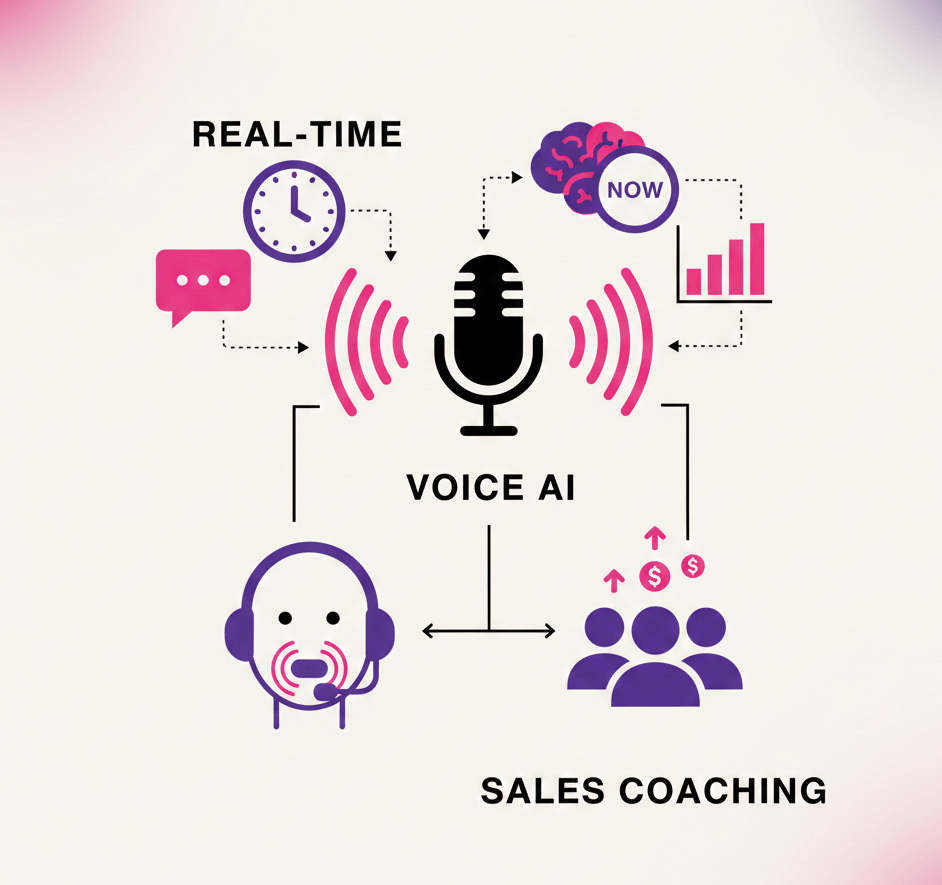
By 2026, coaching happens during the call, not just after it. Real-time sales coaching with Voice AI acts as a digital co-pilot.
Imagine a junior rep on a tough discovery call. The prospect brings up a technical integration that the rep isn’t familiar with. In the past, the rep would stumble, lose credibility, and promise to “follow up via email.”
With Voice AI, a prompt appears on the rep’s screen: “This prospect is asking about API latency. Mention our 99.9% uptime and the ‘Easy-Connect’ feature.” ### Key Features of Real-Time AI Coaching:
- Sentiment Alerts: The AI detects when a prospect’s tone turns defensive and suggests a de-escalation tactic.
- Monologue Detection: If a rep speaks for more than 2 minutes without pausing, the AI pings them with “Ask a discovery question.”
- Competitor Battlecards: When a competitor’s name is mentioned, the AI instantly pulls up the three key areas where your product wins.
This is AI for sales training at its most practical. It reduces the “ramp-up” time for new hires from months to weeks.
Moving Toward Data-Driven Sales Performance Management
Sales managers in 2026 spend less time “policing” and more time “strategizing.” With sales performance management tools, the data is already organized.
The Feedback Loop
The loop starts with the AI Laboratory (SalesCloser.ai). The lab identifies the best script. The humans are then coached on that script. The Voice AI monitors the humans to ensure they stay on track. The data from the human calls is fed back into the lab to further refine the script.
This creates a cycle of continuous improvement. Your sales process never becomes stagnant. It adapts to market shifts, competitor moves, and buyer psychology in real-time.
Why Human Connection Still Matters
With all this talk of AI, it is easy to think humans are becoming obsolete. That is a mistake. AI handles the “science” of the sale—the data, scripts, initial outreach, and testing. This frees up the human rep to focus on the “art” of the sale.
Human reps can now focus on:
- Complex Relationship Building: Navigating multi-stakeholder deals in large enterprises.
- Deep Empathy: Understanding the personal stakes for a buyer.
- Creative Problem Solving: Structuring deals that require “outside the box” thinking.
The AI doesn’t replace the rep; it makes the rep smarter. It ensures that when a human does speak, they are saying the things that are statistically most likely to lead to success.
The Future is Here
The companies that win in 2026 won’t be the ones with the loudest managers. They will be the ones with the best data. By using Real-Time Sales Coaching with Voice AI, you turn your sales department into a high-precision machine.
You stop guessing. You stop hoping. You start knowing.
Utilizing SalesCloser.ai as your “Sales Laboratory” gives you the freedom to fail fast and succeed faster. You can test a dozen different strategies in a week, find the one that sticks, and then coach your human team to execute it with perfection.
The era of “blind coaching” is over. The era of the data-proven salesperson has begun.
FAQs: Real-Time Sales Coaching and Voice AI
1. Is Voice AI going to replace my sales team?
No. It replaces the repetitive, data-heavy parts of the job. It handles the initial prospecting, the A/B testing, and data entry. This allows your human team to focus on high-value conversations. Think of it as an assistant that makes every rep your “best” rep.
2. How does A/B testing a sales call actually work?
You create two versions of a script. You assign them to your AI agents. They make hundreds of calls. The system tracks metrics like “time on call,” “positive sentiment,” and “meeting booked.” You then see a clear winner based on actual results, not opinions.
3. Isn’t real-time coaching distracting for reps?
It can be if not implemented correctly. The best systems use subtle, visual cues rather than intrusive pop-ups. Most reps find it helpful because it removes the “panic” of not knowing an answer. It acts as a safety net.
4. How long does it take to see results from conversational intelligence?
You start seeing patterns almost immediately. However, for statistically significant data, most teams see a major shift in their “proven playbook” within 30 to 60 days of consistent AI use.
5. Does this work for B2B and B2C?
Yes. While the scripts and strategies differ, the core principle remains: data-driven messaging wins. Whether you are selling software or insurance, knowing exactly which words resonate with your audience is an unfair advantage.