“Use an AI Sales Agent to guarantee a persistent, multi-channel Solution for Inconsistent Lead Follow-Up, turning neglected prospects into booked meetings.”
Picture this. Your marketing team just delivered a fresh batch of leads. They’re excited. You’re excited. These aren’t just names on a spreadsheet; they are potential customers, future partners, and the lifeblood of your next quarter’s revenue. Your sales reps dive in, making calls and sending emails. The energy is high.
Now, fast forward three weeks. A few of those leads have turned into meetings. A handful are in the proposal stage. But what about the rest? What happened to the 70, 80, or even 90 percent who didn’t answer on the first or second try? They’re sitting in the CRM, gathering digital dust. Your star rep got pulled into a significant negotiation. Another got swamped with demo preparations. The rest simply moved on to the newer, “fresher” leads that just came in.
This scenario is painfully familiar in almost every sales organization. It’s the silent killer of growth, the leaky bucket that drains your pipeline and wastes your marketing budget. It’s the massive, costly problem of inconsistent lead follow-up.
The truth is, most leads aren’t lost because they were bad leads. They’re lost because they were neglected. The failure to persistently and systematically follow up is arguably the single most significant point of failure in the modern sales process. But what if you could plug that leak forever? What if you could build a system that guarantees every single lead gets the attention it deserves, without burning out your human team?
This isn’t a fantasy. The solution for inconsistent lead follow-up is here, and it’s more powerful than you can imagine. It’s about combining a proven strategy with revolutionary technology. In this guide, we’ll outline the ideal follow-up blueprint and then introduce the ultimate executor of that plan: an AI Sales Agent.
The Leaky Bucket: Why Inconsistent Follow-Up is Costing You a Fortune
Before we can fix the leak, we need to understand exactly where the holes are and how much they’re costing you. The problem of inconsistent follow-up isn’t a small drip; it’s a torrent of lost opportunity that impacts every part of your business.
The Anatomy of a Lost Lead
Let’s trace the journey of a typical lead, we’ll call her “Prospect Patty.” Patty downloaded a whitepaper from your website. She’s a great fit—right industry, proper title, right company size. She’s a Marketing Qualified Lead (MQL) and gets routed to a sales rep, let’s call him “Sales Rep Sam.”
- Day 1: Sam is on his game. He calls Patty. She doesn’t answer, so he leaves a voicemail and sends a thoughtful email—a great start.
- Day 3: Sam tries calling again. This time, he gets her voicemail again. He’s busy with three demos today, so he skips leaving a message and tells himself he’ll send an email later. He forgets.
- Day 7: A new, “hotter” inbound lead comes in. Sam’s attention shifts. He glances at Patty’s record in the CRM. “She never called back,” he thinks. “Probably not interested.” He changes her status to “Cold” to clean up his pipeline.
What Sam doesn’t know is that on Day 1, Patty was in a board meeting. On Day 3, she was putting out a fire with her biggest client. She was interested, but she was also busy—just like every other decision-maker. By the time Day 7 rolled around, your company was not at the forefront of your top of mind. A competitor who called her on Day 4 and again on Day 6 landed the meeting.
Patty wasn’t a lost cause; she was a victim of a broken process. Multiply this story by hundreds or thousands of leads, and you begin to see the scale of the disaster.
Why Do Good Sales Reps Fail at Follow-Up?
It’s easy to blame the reps, but that’s not fair. The problem isn’t a lack of effort or skill; it’s that we’re asking humans to perform a task that is fundamentally machine-like in its demands for consistency and repetition. Here’s why even the best reps struggle:
1. Overwhelm and Cognitive Load
A typical B2B sales rep is juggling dozens, if not hundreds, of leads at any given time. Each lead is at a different stage and requires a different representative. The representative must also prepare for demos, answer questions from existing customers, update the CRM, and attend internal meetings. The sheer mental effort required to keep track of who needs to be called, when, and what to say is immense. Faced with this overload, the human brain does what it’s designed to do: it prioritizes. It focuses on the leads that seem easiest or most likely to close right now, and the longer-term nurturing tasks get pushed to the back burner.
2. The Lure of the “New”
There’s a powerful psychological pull toward novelty. A brand-new lead that just came in feels full of potential and excitement. A lead you’ve tried to reach four times already feels like a chore. This “recency bias” causes reps to constantly chase new opportunities while neglecting the goldmine of slightly older, yet still valuable, leads already in their pipeline. They abandon the methodical work of nurturing for the thrill of the chase.
3. Fear of Being a Pest
Let’s be honest, no one likes feeling like they’re annoying someone. After the third or fourth unanswered call, a little voice creeps into a salesperson’s head: “Am I being a pest? Am I hurting the brand by being too aggressive?” This hesitation is a uniquely human emotion. It causes reps to give up far too early, even when data proves that persistence is what wins. The fear of rejection or annoyance stops them from making that crucial 5th, 6th, or 7th touchpoint where the breakthrough often happens.
4. The Absence of a Standardized System
Many discuss the importance of follow-up, but few have a rigidly consistent and enforced process in place. When you create a consistent sales process, you remove the guesswork. Without one, every rep is left to their own devices. One rep might try twice and give up, while another tries seven times. This creates wild inconsistencies in performance and makes it impossible to measure what’s actually working. Standardizing sales outreach isn’t about turning reps into robots; it’s about giving them a proven playbook for success. Without that playbook, chaos reigns.
Quantifying the Damage: The True Cost of Doing Nothing
The financial impact of this problem is staggering. Let’s break it down into four key areas:
- Directly Lost Revenue: This is the most obvious cost. Studies have shown that it can take anywhere from 5 to 12 touchpoints to secure a meeting with a new prospect. However, other data shows that nearly half of all salespeople give up after a single attempt. Imagine your team is only converting 2% of leads due to poor follow-up. By implementing a system that ensures every lead is touched 8 times, you might increase that to 6%. If your average deal is worth $20,000, and you generate 500 leads a month, that’s the difference between $10,000,000 and $30,000,000 in pipeline value. The numbers add up frighteningly fast.
- Wasted Marketing Spend: Your company spends a fortune on content marketing, SEO, PPC ads, and trade shows to generate those leads. Every single lead that gets ignored is like taking a pile of cash and setting it on fire. If marketing spends $50 to acquire each lead, and 500 out of 1000 leads are neglected each month, that’s $25,000 in pure waste. This creates enormous friction between sales and marketing, as the marketing team feels their hard work is disregarded.
- Damaged Brand Reputation: Your interaction with a prospect is their primary experience with your brand. When a potential customer shows interest by downloading an asset or filling out a form, they expect a professional response. If they receive one half-hearted call and are then ignored, it sends a clear message: “We don’t really value your interest.” This can leave a lasting negative impression that not only loses the immediate deal but can also poison the well for future opportunities.
- Eroding Team Morale: Nothing kills a sales team’s spirit faster than feeling like they’re spinning their wheels. When reps are constantly battling an overwhelming and disorganized pipeline, they get burned out. They miss their quotas, their confidence drops, and they start looking for other jobs. The high turnover rate in sales is often a direct symptom of broken processes, not a lack of talent.
The conclusion is inescapable. Inconsistent follow-up isn’t just a minor inefficiency; it’s a systemic failure that bleeds revenue, wastes resources, and cripples your growth potential.
The Blueprint for Success: Building an Unbeatable Follow-Up Cadence
Okay, we’ve thoroughly diagnosed the problem. Now, let’s talk about the cure. You can’t just tell your team to “follow up more.” You need a plan. You need a system. You need a sales cadence.
A sales cadence is a predefined sequence of outreach activities designed to connect with a new lead. Think of it as a playbook for engagement. It dictates the what, when, and how of your follow-up, ensuring every prospect receives a consistent and persistent series of touchpoints over a specific period. This is the foundation for standardizing sales outreach and creating a predictable sales machine.
The Core Principles of a World-Class Cadence
Building a great cadence isn’t just about sending a bunch of emails and making calls; it’s about establishing a consistent and practical approach. It’s a strategic endeavor built on a few core principles.
Principle 1: Automated Persistence is Non-Negotiable
This is the most important rule. The vast majority of sales are made after the fifth contact, yet most salespeople give up before the third. Your cadence must be built on the principle of automated persistence. It must be designed to outlast the prospect’s initial silence and your rep’s initial reluctance.
Consider this famous data point:
- 2% of sales are made on the 1st contact
- 3% of sales are made on the 2nd contact
- 5% of sales are made on the 3rd contact
- 10% of sales are made on the 4th contact
- 80% of sales are made on the 5th to 12th contact
Your cadence must be designed to operate in that 5th-to-12th-contact zone. This is where deals are won. A typical lasts for 15-30 minutes and includes 10-15 touchpoints. It may feel like a lot, but it’s what it takes to break through the noise and connect with a busy decision-maker.
Principle 2: The Power of Multi-Channel Outreach
If you’re only using the phone or only using email, you’re fighting with one hand tied behind your back. A powerful cadence leverages multiple channels to create a surround-sound effect that keeps you top of mind. The most effective combination typically includes:
- Phone Calls: The most direct and personal way to connect. Even a voicemail is a valuable touchpoint, as it puts your voice and name in the prospect’s ear.
- Ideal for providing detailed information, sharing resources (such as case studies or blog posts), and confirming next steps. An email that references a voicemail you just left is exponentially more effective than a cold email alone.
- Social Media (especially LinkedIn): Excellent for B2B sales. A connection request, a thoughtful comment on a prospect’s post, or a brief InMail message can add another layer of professional engagement and help you stand out from the crowd.
- SMS (Optional): In some industries, a well-timed and professional text message can be a highly effective way to get a quick response, especially for tasks such as confirming a meeting time.
The key is to orchestrate these channels. For example, a phone call in the morning can be followed by an email in the afternoon and a LinkedIn connection request the next day. This variety prevents you from seeming like a one-trick pony and increases your chances of connecting on the prospect’s preferred platform.
Principle 3: Strategic Timing and Spacing
You can’t just bombard a prospect with 12 touchpoints in three days. That’s not persistence; that’s harassment. A well-designed cadence strategically spaces out the touchpoints to maintain presence without creating fatigue.
A sample cadence structure might look something like this:
- Day 1: Automated Email + Personal Phone Call (Voicemail)
- Day 3: LinkedIn Connection Request
- Day 5: Phone Call (No Voicemail) + Email with a Value-Add (e.g., link to a relevant article)
- Day 8: LinkedIn Message (commenting on a post or sharing an insight)
- Day 11: Phone Call (Voicemail)
- Day 14: “Breakup” Email (a final, friendly email to gauge interest before pausing contact)
The initial touches are closer together to build momentum. Then, they become more spaced out to serve as gentle, professional reminders. This rhythm respects the prospect’s time while ensuring you never fall off their radar.
Principle 4: Add Value with Every Touch
The deadliest sin in sales follow-up is the “just checking in” email. It offers zero value to the prospect and signals that you have nothing valuable to say. Every single touchpoint in your cadence should have a purpose beyond just making contact.
- Reference their initial action: “You recently downloaded our guide on X, and I thought you might find this related case study on Y interesting.”
- Share a relevant insight: “I saw your company announced Z on LinkedIn, which reminded me of how we helped a similar client overcome a related challenge.”
- Offer a tangible resource: “Here’s a short video that explains how our platform solves the exact problem you mentioned on your website.”
- Ask a thought-provoking question: “Many leaders in your industry are struggling with ABC. Is that a priority for you in Q4?”
When you create a consistent sales process built on value, you transform yourself from a persistent salesperson into a trusted advisor. You’re no longer just asking for their time; you’re earning it. This approach is fundamental to effective lead management best practices.
By building a cadence on these four principles, you create a powerful engine for predictable growth. You establish a reliable follow-up system that gives every lead a fair shot and provides your team with a clear path to success. The only question left is whether we will execute this perfect plan flawlessly every single time.
The Game-Changer: Let an AI Sales Agent Run the Playbook
We’ve established that inconsistent follow-up is a disaster. We’ve also designed the perfect solution: a persistent, multi-channel, value-driven sales cadence.
But this brings us back to our original problem. Even with the world’s greatest playbook, you still need a player who can execute it without getting tired, distracted, or discouraged. And as we’ve seen, that’s a massive challenge for human reps who are already juggling a dozen other priorities. The manual execution of a rigorous cadence is tedious, repetitive, and the first thing to be dropped when things get busy.
This is where the revolution begins. This is where you introduce an AI Sales Agent.
Your Newest and Most Reliable Team Member
First, let’s clarify what an AI Sales Agent is. It’s not a character from a sci-fi movie. It is a sophisticated piece of software, powered by artificial intelligence and machine learning, designed to autonomously execute the top-of-funnel sales outreach tasks that humans find so challenging to perform consistently.
Think of it as the ultimate Sales Development Representative (SDR). It doesn’t need coffee, it never has a bad day, and its sole purpose is to execute your sales cadence with machine-like perfection. It’s not here to replace your sales team; it’s here to supercharge them. It handles the grueling, repetitive work of initial outreach and follow-up, allowing highly paid human closers to focus on what they do best: building relationships and closing deals.
How an AI Agent Solves Follow-Up Problems for Good
An AI Sales Agent takes the perfect cadence blueprint and brings it to life with a level of precision and endurance that is simply not humanly possible. Here’s how it permanently solves the core challenges we identified.
1. Flawless, Unwavering Consistency
This is the AI’s superpower. You define the 12-step, multi-channel cadence once. The AI will then execute that exact sequence for every single lead you give it, without fail. It sends the email on the first day. It makes the call on Day 3. It sends the LinkedIn message on Day 5. It does this for one lead or for ten thousand leads. The consistency is absolute. This immediately establishes a reliable follow-up system that ensures adherence to the perfect sales process. There is no more variation between Rep A and Rep B. The process becomes the system, and the system is perfect.
2. Tireless, Automated Persistence
Remember the fear of being a pest? The AI doesn’t have it. It feels no rejection, no hesitation, and no emotional fatigue. It will make that 5th, 8th, or even 12th call with the same neutral, professional purpose as the first. This is automated persistence in its purest form. It will continue to follow the plan until one of two things happens: the prospect explicitly says “not interested,” or they show a sign of interest and are ready for a meeting. It never gives up early and never lets a lead go cold due to a lack of nerve. It is programmed to ensure no lead is forgotten.
3. 24/7 Scalability and Speed
Your sales reps work eight hours a day. Your AI Sales Agent can work 24/7. It can call leads in different time zones at the optimal local time. More importantly, it can scale instantly. Let’s say your marketing team has a blowout month and generates 3,000 new leads instead of the usual 500. For a human team, this is a crisis. People would be overwhelmed, and hundreds of leads would be neglected. For an AI Sales Agent, it’s just another Tuesday. It can handle a massive influx of volume with no drop in performance, ensuring every single one of those hard-won leads gets the immediate and persistent follow-up it deserves.
4. Perfect Data and Accountability
One of the biggest headaches for sales managers is obtaining accurate data from the CRM. Reps often forget to log calls or update lead statuses, making it impossible to know what’s really happening. An AI Sales Agent eliminates this problem. Every call, every email, every outcome is logged automatically, instantly, and with perfect accuracy.
This creates a pristine dataset you can use to analyze what’s working. Which email subject line gets the most opens? Which call script generates the most interest? The AI provides the clean data needed for constant improvement. Furthermore, it significantly enhances the accountability of the sales team. You know for a fact that the process was followed for every lead, so you can focus on coaching your reps on closing skills, not on whether they made their calls.
Liberating Your Human Talent
The most profound impact of implementing an AI Sales Agent is what it does for your human team. By automating the most monotonous and draining part of the sales process, you free up your reps to operate at the top of their game.
Instead of spending 80% of their day cold calling and chasing prospects who aren’t ready to talk, they can spend 100% of their time on highly qualified, sales-ready conversations. The AI acts as a perfect filter. It sifts through the entire pile of leads, nurtures them patiently, and hands over only the golden nuggets: the people who have raised their hand and said, “Yes, I’m interested. I want to schedule a meeting.”
This leads to:
- Higher Productivity: Reps spend their time on revenue-generating activities, not busywork.
- Increased Job Satisfaction: Salespeople love to sell, not dial for dollars. Taking away the grind reduces burnout and boosts morale.
- Better Closing Ratios: Reps are entering conversations with prospects who are already warmed up and have agreed to a meeting. These are far easier to close than cold leads.
The AI Sales Agent doesn’t just fix your follow-up problem; it redefines the role of your sales team, transforming them from prospectors into expert closers.
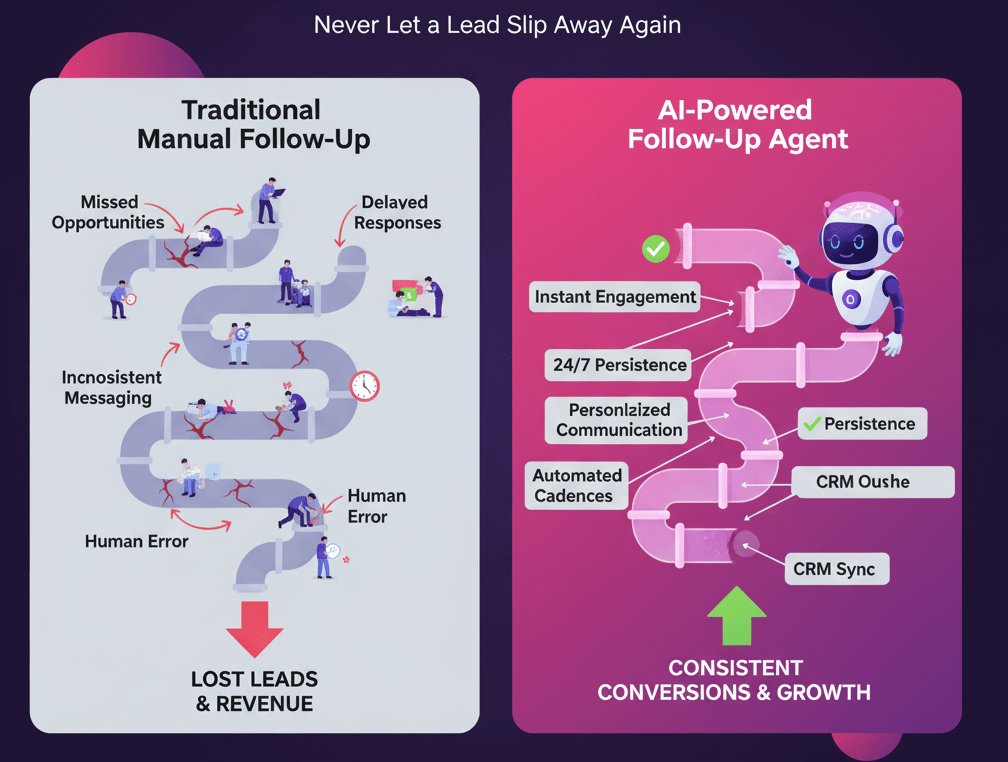
Putting It All Together: SalesCloser.ai in Action
The concept of an AI Sales Agent is powerful, but it’s not just a concept. It’s a reality, and platforms like SalesCloser.ai are leading the charge. SalesCloser.ai was built from the ground up to be the ultimate solution for inconsistent lead follow-up, turning the principles we’ve discussed into a seamless, automated reality.
Your AI Agent, Powered by SalesClHow
How does it actually work? SalesCloser.ai provides you with an AI agent that becomes an integrated part of your team. Here’s a look at how it executes the perfect follow-up cadence.
1. The AI Calling Agent: More Than a Robocall
The heart of the SalesCloser.ai platform is its conversational AI calling agent. This is not a pre-recorded, robotic message. The AI uses advanced natural language processing to have honest, two-way conversations over the phone. It can:
- Navigate Gatekeepers: It knows how to ask for the right person professionally.
- Understand Context: It can understand responses like “He’s in a meeting,” “Can you call back next Tuesday?” or “Just send me an email.”
- Handle Objections: Respond appropriately to the most common initial objections.
- Leave Natural-Sounding Voicemails: It can leave a perfect, personalized voicemail every time.
The experience for the prospect is surprisingly human. They are interacting with a professional and articulate representative of your company whose goal is to gauge their interest.
2. Intelligent, Goal-Oriented Engagement
The AI agent’s mission is clear: qualify initial interest and book a meeting. It’s not trying to close the deal. It’s programmed to listen for buying signals and interest indicators. When a prospect says something like, “That sounds interesting, tell me more,” or “Yes, I’d be open to a 15-minute demo,” the AI knows exactly what to do.
It can access your representative’s live calendar via API and book a call directly. It will then automatically send a calendar invitation to both the prospect and your rep, along with a confirmation email.
3. Seamless Handoff to Your Human Closer
This is the magic moment. Your sales rep receives a notification. A new meeting has been booked on their calendar. They open the record in your CRM and see the entire history of the AI’s interactions with the prospect. They can see every call attempt, every email sent, and even a transcript of the final conversation where the prospect agreed to the meeting. Your representative is walking into a warm, scheduled appointment with a qualified prospect, fully armed with the necessary context and background. All they have to do is what they do best: build a relationship and close the sale.
With SalesCloser.ai, you are not just automating tasks; you are automating outcomes. The system guarantees that your lead follow-up process is executed with 100% consistency and persistence, ensuring that no lead—and no opportunity for revenue—ever falls through the cracks again.
Conclusion: Stop Leaking Revenue and Start Closing More Deals
The problem of inconsistent lead follow-up has plagued sales teams for decades. It has wasted billions in marketing dollars, burned out countless talented salespeople, and left an immeasurable amount of revenue on the table. For years, we’ve tried to solve this human problem with human solutions: more training, more motivation, more nagging from managers. It has never worked.
The reason is simple: the task of consistently following up at high volume is not a human task. It is a machine task.
Today, the machine is here. An AI Sales Agent is the definitive solution for inconsistent lead follow-up. It takes the strategic blueprint of a perfect sales cadence and executes it with a level of precision, persistence, and scale that humans simply cannot match. It doesn’t replace your team; it unleashes them.
By using a platform like SalesCloser.ai, you can permanently plug the leaks in your sales funnel. You can create a consistent sales process that runs on autopilot, ensure no lead is forgotten, and empower your sales reps to focus on what they were hired to do: sell.
The era of letting valuable leads wither and die in your CRM is over. It’s established to build a reliable follow-up system that drives predictable growth, providing you with an unbeatable competitive advantage.
Frequently Asked Questions (FAQs)
Q1: Will an AI sales agent sound robotic and annoy my prospects?
This is a common concern, but the technology has advanced dramatically. Platforms like SalesCloser.ai use sophisticated conversational AI that sounds remarkably natural and human-like. The AI is trained to understand nuances in conversation, handle interruptions, and respond intelligently. Its goal is to deceive no one, but to be a professional and efficient first point of contact. The result is a positive and streamlined experience for the prospect, not an annoying robocall.
Q2: Does this replace my existing sales team or my SDRs?
Absolutely not. It augments them. The AI Sales Agent handles the most repetitive, time-consuming part of the job: top-of-funnel prospecting and follow-up. This frees up your human SDRs and Account Executives to focus on higher-value activities, such as running demos, conducting in-depth discovery calls, building relationships, and negotiating contracts. It turns your SDRs from “dialers” into strategic “meeting setters,” and your closers into pure revenue generators.
Q3: How does the AI know when a lead is qualified?
The AI is programmed with a clear, singular goal: book a meeting with anyone who expresses interest. Qualification at this stage is simple: is the prospect willing to learn more? The AI listens for key phrases and positive sentiment (“That sounds interesting,” “Yes, I’m available Tuesday,” “Can you send me more information?”). Once it identifies this interest, its objectives are scheduled to work with them on a representative calendar. The deeper qualification is then handled by your skilled sales reps during that planned meeting.
Q4: What kind of setup or integration is required?
Leading platforms like SalesCloser.ai are designed for easy integration. They typically connect directly with your existing CRM (like Salesforce, HubSpot, etc.) through APIs. The setup involves defining your sales cadence (the sequence of calls and emails), loading your call scripts and email templates, and syncing your reps’ calendars. An implementation specialist usually guides the process and can be up and running much faster than hiring and training a new human SDR.
Q5: How is this different from a simple auto-dialer or email automation tool?
An auto-dialer simply dials numbers from a list to connect a rep with a live person. Email automation tools just send pre-written emails on a schedule. An AI sales agent represents a significant leap forward. It combines these channels and adds intelligence. It doesn’t just dial; it has a conversation. It doesn’t just send emails; it orchestrates a multi-channel cadence of calls, voicemails, and emails, and it understands the prospect’s responses to make intelligent decisions in real time. It’s the difference between a simple tool and an autonomous team member.
Q6: Is this technology affordable for a small or medium-sized business?
Yes. In fact, it can be far more cost-effective than hiring human staff. Consifully loaded cost of a h, including man SDR: salary, benefits, training, software licenses, and overhead. An AI Sales Agent can perform the work of multiple SDRs for a fraction of the cost, and it works 24/7 without ever taking a vacation. Seeking to scale their sales effort, increasing their headcount provides an incredible return on investment.