“Drive growth with AI Revenue Acceleration Platforms: the 2026 solution for autonomous sales, predictive analytics, and full-funnel automation.”
The sales floor is quiet.
Walk into a modern tech company today, and you won’t hear the chaotic buzzing of phones or the ringing of bells that defined the sales bullpens of the 1990s or even the early 2010s. Instead, you hear the clicking of keyboards. You see focused faces illuminated by dual monitors. You see CRM dashboards, email sequences, and LinkedIn tabs open by the dozen.
But if you look closer, you see a problem.
You see highly paid account executives acting as data entry clerks. You see talented communicators pasting templates into emails. You see a “go-to-market” strategy that is stuck in the mud, bogged down by administrative friction.
We have spent the last decade buying tools to help salespeople work faster. We bought CRMs to store data. We bought Sales Engagement Platforms (SEPs) to blast emails. We bought conversational intelligence tools to record calls. Yet, despite billions of dollars invested in the modern sales stack, quota attainment is dropping. Sales cycles are getting longer. Customer acquisition costs are skyrocketing.
Why? Because we kept adding tools that required human input. We built a stack that demanded attention rather than one that created time.
This is about to change.
We are standing on the precipice of a massive shift. We are moving away from “sales enablement”—tools that help humans do tasks—and entering the era of AI Revenue Acceleration Platforms. By 2026, the sales landscape will look unrecognizable compared to today. The focus will no longer be on managing salespeople; it will be on orchestrating autonomous systems that drive revenue.
This article explores this future. We will examine how revenue intelligence and sales automation platforms are merging into a new super-category. We will look at how AI in sales in 2026 will function and discuss why tools like SalesCloser.ai are the first essential step toward this autonomous future.
Part 1: The Broken Promise of the Modern Stack
To understand where we are going, we have to look at where we went wrong.
For the last fifteen years, the philosophy of sales technology was simple: give the rep a better shovel.
If a rep couldn’t track their leads, we gave them Salesforce or HubSpot. If they couldn’t type emails fast enough, we gave them Outreach or Salesloft. If they couldn’t find phone numbers, we gave them ZoomInfo.
Each of these tools solved a specific, isolated problem. But together, they created a Frankenstein monster of disconnected workflows. A typical sales rep today logs into 6 to 10 applications just to do their job. They spend hours syncing data between systems. They waste valuable cognitive energy switching contexts.
The data backs this up. Most studies show that sales representatives spend less than 30% of their time actually selling. The other 70% goes to research, administration, data entry, and internal meetings.
We reached the limit of human efficiency. You cannot type faster. You cannot read faster. You cannot multitask more effectively.
The industry realized that “enablement” has a ceiling. You can only enable a human so much before they burn out. This realization gave rise to the concept of Revenue Intelligence. This was a step in the right direction. These tools captured data automatically. They recorded calls, analyzed emails, and gave leaders a “predictive” view of the pipeline.
But intelligence is passive. Knowing your deal is going to slip doesn’t fix the deal. Knowing your pipeline is light doesn’t generate new leads.
Intelligence without action is just anxiety.
This is the gap that AI Revenue Acceleration Platforms will fill. These platforms do not just show you the problem. They fix it. They do not just recommend an action. They take it.
Part 2: Defining the AI Revenue Acceleration Platform
So, what exactly is this new category?
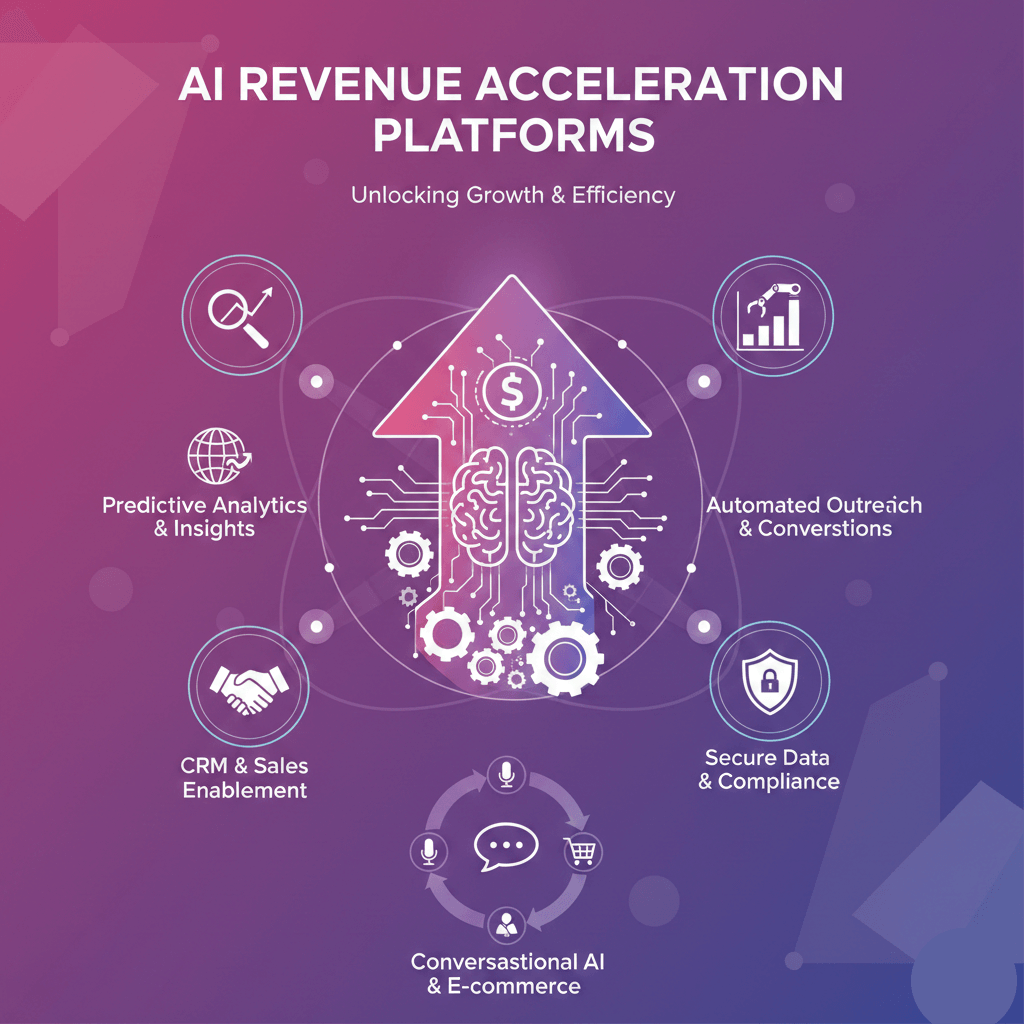
An AI Revenue Acceleration Platform is an end-to-end ecosystem that autonomously executes key parts of the sales cycle. It combines the data housing of a CRM, the activity of an engagement platform, and the brain of a revenue intelligence tool into a single, agentic system.
It is not a tool you use. It is a system you employ.
In 2026, you will not hire a fleet of Business Development Representatives (BDRs) to scour LinkedIn and send cold emails. You will plug your value proposition and your ideal customer profile (ICP) into a go-to-market automation engine.
Here is the core difference:
- Current Tech: You filter a list. You write a template. You click send. You wait for a reply. You book the meeting.
- Revenue Acceleration Platform: You define the outcome (e.g., “Book 50 meetings with VP of Sales in the Fintech sector”). The AI finds the leads. The AI personalizes the outreach based on news and social data. The AI engages in a two-way conversation. The AI handles the objection. The AI books the meeting on your calendar.
This is full-funnel automation. It is not about making humans faster. It is about removing the human from the parts of the process where they add the least value.
The Core Components of the Platform
For a platform to qualify as a true Revenue Accelerator, it must possess three distinct capabilities:
- Autonomous Ingestion & Synthesis: It must consume data from the world (news, LinkedIn, 10k reports, job postings) and synthesize it into actionable context without human help.
- Agentic Execution: It must be able to perform complex tasks. This means sending emails, making voice calls, scheduling calendar invites, and updating the CRM.
- Dynamic Optimization: It must learn. If a specific subject line works better for CFOs than CTOs, the system must recognize this pattern and adjust its strategy instantly across thousands of interactions.
This is the holy grail of sales velocity optimization. A human takes weeks to run an A/B test on a message. An AI does it in hours.
Part 3: The Vision of 2026
Let’s travel forward a few years. It is a Tuesday morning in 2026.
You are the Vice President of Sales. You open your laptop. You do not see a list of overdue tasks. You see a dashboard powered by predictive sales analytics that tells you exactly how much revenue will close this quarter with 95% accuracy.
But here is the magic.
Overnight, your AI Revenue Acceleration Platform engaged with 4,000 prospects. It held 300 text-based conversations via email and chat. It conducted 50 voice conversations.
It filtered out 3,980 of them.
Some weren’t ready to buy. Some didn’t have the budget. Some were just browsing. The AI nurtured them, putting them into long-term holding patterns with zero effort from your team.
But 20 of them were hot.
The AI qualified them. It checked their budget. It identified the decision-maker. It handled the initial “what do you do?” questions. And it booked 20 meetings directly on your Account Executives’ (AEs) calendars.
Your AEs wake up to full calendars. They did not prospect. They did not research. They simply reviewed the “pre-game” dossier the AI prepared for them. The dossier contains a summary of the AI’s conversation with the prospect, the prospect’s pain points, and a suggested closing strategy.
This is sales cycle compression in action.
In the old world (today), a lead might sit in an inbox for 4 hours. In 2026, the “speed to lead” is zero seconds. The moment interest is shown, the AI engages.
In the old world, a deal stalls because the rep forgets to follow up. In 2026, the platform detects a stall in momentum and automatically sends a value-add case study to the champion or flags the manager to intervene.
AI-driven sales growth in 2026 isn’t about hiring more heads. It is about increasing the revenue per head by a factor of ten. The role of the salesperson shifts from “hunter” to “closer” and “relationship manager.” The grunt work—the prospecting, the qualifying, the chasing—is gone.
Part 4: The Engine of Change – Predictive Sales Analytics
The fuel for these platforms is data. But not the static data we have today.
Today, predictive analytics usually means “lead scoring.” It’s a number from 1 to 100 that indicates how good a lead is. Often, it’s wrong.
By 2026, predictive sales analytics will be prescriptive.
The platform won’t just say, “This lead is a 90.” It will say: “This lead has a high probability of closing if you discuss ‘security compliance’ and reference their competitor’s recent breach. Schedule the call for Thursday afternoon, as their CTO is usually active on LinkedIn at that time.”
This level of insight requires access to massive datasets. AI Revenue Acceleration Platforms will integrate with:
- Intent Data: Who is searching for your solution right now?
- Technographic Data: What software are they currently using?
- Psychographic Data: How does this specific buyer like to be sold to? Do they want quick facts or a long relationship?
The platform processes this information in real-time. It adjusts the tone of the outreach emails. It changes the script used by the voice AI. It tailors the slide deck for the human AE.
This solves the biggest problem in sales: Relevance.
A human can’t be perfectly relevant to 50 prospects a day. We get tired. We copy-paste. We make mistakes. An AI never gets tired. It treats the 10,000th lead with the same level of personalization and care as the first one.
Part 5: The Go-To-Market Automation Revolution
This shift forces us to rethink the entire “Go-To-Market” (GTM) motion.
Currently, GTM is siloed. Marketing generates leads. SDRs qualify them. Sales close them. Customer Success keeps them. Hand-offs are messy. Data gets lost.
Go-to-market automation collapses these silos.
The AI platform sits across the entire lifecycle. It sees the ad the prospect clicked (Marketing). It has the initial conversation (SDR). It assists the closer (Sales). It monitors usage data to predict churn (Success).
Because one brain controls the data flow, nothing gets lost.
If a prospect tells the AI during the prospecting phase, “We are expanding to Europe next year,” that data point isn’t lost in a chat log. It is stored. Six months later, when the account is closed, the Customer Success AI reminds the human CSM: “Ask about the Europe expansion.”
This is the definition of a seamless customer journey. It builds trust. It proves competence. And it drives revenue.
Part 6: SalesCloser.ai – The First Pillar of the Future
We have examined the vision of 2026. We have looked at the data. Now, we must look at the “how.” You cannot simply flip a switch three years from now and hope your organization is ready. You need to start building the infrastructure today.
The journey to a complete AI Revenue Acceleration Platform begins by addressing the most friction-heavy part of your funnel: the top.
This is where SalesCloser.ai changes the game.
SalesCloser.ai is not just another piece of software you add to your stack. It is a workforce multiplier. It provides AI agents that improve sales performance by taking over the heavy lifting of the sales cycle. These are not simple chatbots or email scripts; they are autonomous agents capable of learning, adapting, and driving revenue.
Most companies struggle today because their top-of-funnel is broken. They rely on human Sales Development Representatives (SDRs) to grind through cold calls and emails. It is a grueling job with high turnover, burnout, and inconsistent results. Humans have bad days. Humans get tired. Humans miss details.
SalesCloser.ai solves this immediate pain. It allows you to deploy AI agents that work alongside your team, handling the prospecting and qualification so your human closers can focus on signing deals. This is the foundational pillar of the emerging revenue acceleration category.
How SalesCloser.ai’s Agents Drive Performance:
1. Autonomous Presentation & Discovery The agents deployed by SalesCloser.ai go far beyond simple text exchanges. They can hold voice conversations that sound natural and professional. They engage in deep discovery calls, asking the right qualifying questions to understand prospect needs. They present your product value clearly and consistently every single time. It acts like your best human employee, but one that is infinitely scalable and never forgets a talking point.
2. Scheduling & Logistics The back-and-forth friction of “finding a time to meet” kills more deals than we care to admit. SalesCloser.ai agents handle this logistics layer autonomously. They negotiate time slots, handle reschedules, and place the meeting directly on your calendar. This is immediate sales cycle compression. By removing the administrative lag, you keep the deal momentum high.
3. 24/7 Global Availability Modern buyers are global, and they do not always shop between 9 AM and 5 PM in your time zone. If a high-value lead from Singapore visits your site at 3 AM, a human team misses it. A SalesCloser.ai agent is there to greet them, qualify them, and move them to the next stage instantly. This “always-on” capability dramatically improves speed-to-lead, a key metric in conversion performance.
4. Consistent Qualification Standards Human reps often interpret qualification criteria differently. One rep might pass a weak lead; another might disqualify a good one. SalesCloser.ai agents apply your specific criteria with 100% consistency. They ensure that every meeting booked on your calendar is with a prospect who actually fits your Ideal Customer Profile (ICP), improving the efficiency of your senior sales team.
By implementing SalesCloser.ai today, you are effectively hiring the “AI BDR” of the future. You are freeing up your human sales team to focus on what they do best: building deep relationships, navigating complex organizational politics, and negotiating final terms.
The companies that win in 2026 will be the ones that adopt these agentic workflows now. They will have years of data to train their models. They will have workflows optimized for automation. They will have a culture that embraces AI rather than fears it.
SalesCloser.ai is not just a product; it is a glimpse into the mechanics of the future revenue engine. It proves that full-funnel automation is not a pipe dream—it is a technical reality that is scaling right now.
Part 7: Overcoming the Fear of ” The Robot Salesman”
Whenever we discuss AI-driven sales growth, we must address the elephant in the room: What happens to the humans?
There is a fear that automation will replace salespeople. This is a misunderstanding of the technology and the profession.
Sales is, at its core, a transfer of trust. For low-stakes, transactional purchases, a human is unnecessary. You don’t need a salesperson to help you buy a Netflix subscription. AI will completely take over transactional sales.
But for high-stakes, complex B2B sales, trust is paramount. A CEO will not sign a million-dollar contract purely because an AI told them to. They need to look a human in the eye (or a Zoom camera) and feel confident that they are making the right choice.
AI Revenue Acceleration Platforms do not replace the human element; they purify it.
They strip away the robotic parts of the human job. Entering data into Salesforce is robotic. Copying email templates is robotic. Dialing phone numbers is robotic. Humans should not do these things.
By offloading these tasks to platforms like SalesCloser.ai, sales professionals become more human. They have the time to be creative. They have the mental bandwidth to strategize. They become consultants rather than grinders.
The sales teams of 2026 will be smaller, yes. But they will be higher-paid, happier, and vastly more productive.
Part 8: The Financial Impact of Acceleration
Let’s talk about the bottom line. Why will CFOs push for this transition?
It comes down to Unit Economics.
Currently, the Customer Acquisition Cost (CAC) for B2B SaaS is dangerously high. It takes months to ramp up a new sales rep. You pay for their salaries, benefits, training, and tech stack. And if they leave after 11 months, you lose money.
Sales automation platforms break this cost curve.
An AI agent does not need health insurance. It does not require a ramp-up period. It does not quit going to a competitor.
When you use a platform to handle the top of the funnel, your CAC drops dramatically. You are generating leads at a fraction of the cost of human labor. This frees up budget to invest in product, customer success, and better commissions for your closers.
Furthermore, sales velocity optimization has a compounding effect on revenue.
If you can shorten your sales cycle from 4 months to 3 months, you don’t just get that revenue faster. You free up capacity to close more deals in the same fiscal year. A 25% reduction in sales cycle length can lead to a 30-40% increase in annual revenue, purely through improved throughput.
This is the math that will drive the adoption of AI Revenue Acceleration Platforms. It is not just about “cool tech.” It is about financial survival and dominance.
Part 9: Preparing for the Shift
If you are a sales leader or a founder, you cannot afford to wait until 2026. The transition is happening now.
Here is how you prepare your organization for the rise of Revenue Acceleration:
1. Audit Your Data Hygiene: AI is only as good as the data it eats. If your CRM is a mess of duplicate records and missing fields, an AI platform will fail. You must invest in data cleanliness now. Get your house in order.
2. Map Your Manual Processes. Look at your sales process. Identify every step where a human manually moves data or performs a repetitive task. These are the first areas to automate. Is it lead routing? Is it first-touch outreach? Is it meeting scheduling?
3. Experiment with Agentic AI. Do not just buy more tools for your reps. Start testing tools that replace tasks. Deploy SalesCloser.ai for a segment of your inbound leads or a specific outbound campaign. Measure the results. Compare the conversion rates to your human SDRs.
4. Retrain Your Team Start teaching your sales team to work with AI. They need to learn how to interpret the data the AI provides. They need to learn how to pick up a conversation that an AI started. The skill set is shifting from “prospecting” to “deal management.”
5. Shift Your Mindset to “Revenue Engineering.” Stop thinking about “managing a sales team.” Start thinking about “engineering a revenue system.” The Sales leader of the future is part psychologist, part data scientist, part systems architect.
Conclusion: The Future is Autonomous
The era of the “lone wolf” salesperson grinding out 100 cold calls a day is ending. The era of the AI Revenue Acceleration Platform is replacing it.
By 2026, the competitive advantage will not belong to the company with the hardest-working reps. It will belong to the company with the best automated architecture. It will belong to the organizations that utilize revenue intelligence, go-to-market automation, and predictive sales analytics to build a machine that never sleeps.
This future promises a sales world that is faster, more efficient, and surprisingly, more human. By removing the drudgery, we unlock the creativity.
The tools are already here. SalesCloser.ai is proving that autonomous prospecting and qualification are not just possible—they are superior. The engine is warming up. The only question remaining is:
Will you be the one driving the machine, or will you be the one replaced by it?
The choice is yours, and the time to decide is now.
FAQs: AI Revenue Acceleration Platforms
1. What is the difference between a CRM and an AI Revenue Acceleration Platform?
A CRM (Customer Relationship Management) is a database of records; it stores information. An AI Revenue Acceleration Platform is a system of action. It uses the data to autonomously execute tasks such as sending emails, qualifying leads, and scheduling meetings without human intervention.
2. Will AI replace sales jobs by 2026?
AI will likely replace entry-level roles that focus heavily on repetitive tasks, such as manual lead generation and cold outreach. However, it will transform senior sales roles. Account Executives will focus more on relationship building, strategy, and closing, while AI handles the administrative and top-of-funnel work.
3. What is “Sales Velocity Optimization”?
Sales velocity is a metric that measures how fast you generate revenue. It looks at the number of opportunities, average deal size, win rate, and sales cycle length. AI optimizes this by responding to leads instantly, qualifying them faster, and preventing deals from stalling, effectively speeding up the entire process.
4. Is “Full-Funnel Automation” really possible?
Yes, but it is a gradient. Today, we can fully automate the top of the funnel (lead finding and qualification) and parts of the bottom of the funnel (renewals, transaction processing). By 2026, as AI becomes more sophisticated at handling nuance and objections, automation will cover more complex aspects of the negotiation phase. However, human oversight will likely remain for high-value deals.
5. Why is predictive sales analytics important for 2026?
Predictive analytics moves sales from “reactive” to “proactive.” Instead of analyzing why you missed a target last quarter, predictive models will tell you exactly which actions to take today to hit your number next month. It allows leaders to steer the ship with forward-looking radar rather than a rearview mirror.
6. How do I start building a Revenue Acceleration stack today?
Start by identifying the bottlenecks in your current process. Usually, this is the time spent on prospecting and scheduling. Implement an autonomous agent solution, such as SalesCloser.ai, to handle these tasks. Ensure your CRM data is clean and integrated, so your AI tools have accurate information to work with.