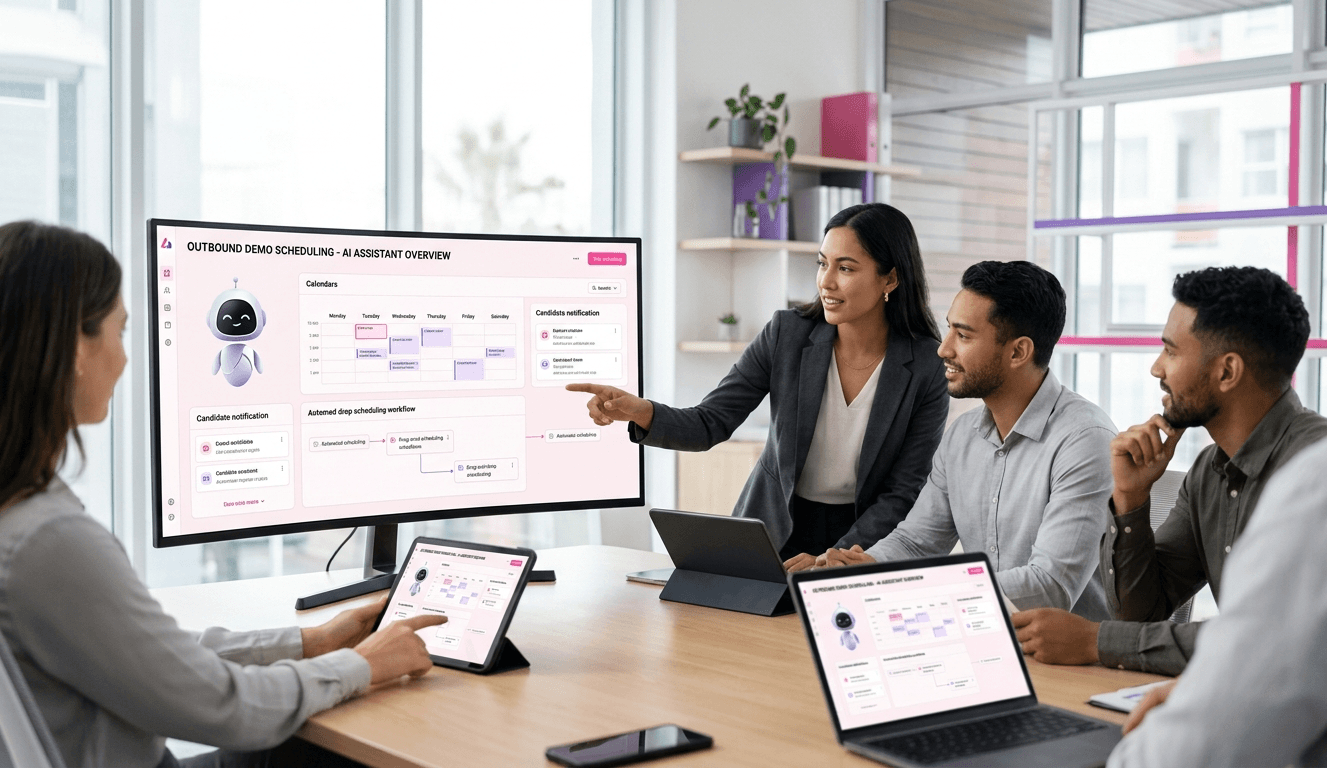
“Stop burning out your team with manual dials. Use an AI agent for outbound demo scheduling to book more qualified meetings automatically.”
Sales development representatives spend just 35% of their working hours actually selling. The rest of their time vanishes into administrative tasks, manual CRM data entry, and staring at a dialer waiting for someone to pick up the phone. If your primary goal is booking qualified meetings, this model is fundamentally broken.
Relying on humans to dial hundreds of numbers, navigate defensive gatekeepers, and push through endless voicemails drains your budget and burns out your team. The alternative is leveraging an AI agent for outbound demo scheduling. This technology changes the math of sales development entirely.
In this guide, we will break down the precise inefficiencies of manual outbound prospecting. We will provide a proven, structured framework for scripting highly effective cold calls. Finally, we will show you how SalesCloser AI deploys intelligent agents to execute these calls automatically, handle objections in real time, and integrate directly with your sales reps’ calendars to scale your pipeline.
The Hidden Inefficiencies of Traditional Outbound Prospecting
The standard outbound sales motion relies heavily on volume. Sales leaders know that a pipeline requires consistent activity to generate revenue. However, the manual execution of that activity comes with massive hidden costs.
Most sales teams measure activity by dials. A typical SDR might make 80 to 100 dials per day. Of those 100 dials, industry benchmarks suggest they will connect with 5 actual decision-makers.
The other 95 calls result in voicemails, disconnected numbers, or gatekeepers who aggressively block access. Consequently, your company pays a premium salary for an employee to listen to ringing phones for four hours a day.
Calculating the Cost of a Human-Booked Demo
Let us break down the mathematics of a manual outbound team. Assume you pay an SDR a base salary of $60,000, plus commission, bringing their on-target earnings (OTE) to $85,000. When you factor in software licenses, benefits, and management overhead, the fully loaded cost of that SDR is easily $120,000 annually.
If that SDR books 15 qualified meetings per month, they generate 180 meetings a year. By dividing the $120,000 cost by 180 meetings, you determine that every single meeting costs your company roughly $666.
This calculation does not even account for meetings that fail to show up or leads that are ultimately unqualified. When you rely exclusively on manual labor for automated appointment setting, your customer acquisition cost (CAC) remains dangerously high.
Caption: Analyzing the true cost of a manually booked sales meeting reveals significant financial inefficiencies.
The Pitch and Follow-Up Fatigue
Even when an SDR finally connects with a prospect, human error introduces further friction. Cold calling is psychologically taxing. After facing rejection 15 times in an hour, an SDR’s energy naturally drops.
They might rush the pitch, forget a critical value proposition, or fail to handle a standard objection effectively. Human beings struggle to maintain perfect consistency over thousands of repetitive interactions.
Furthermore, follow-up introduces another layer of failure. If a prospect asks an SDR to call back next Tuesday at 2:00 PM, the SDR must log the task in the CRM and remember to follow through. Often, these follow-ups slip through the cracks, leaving potential revenue on the table.
What is an AI agent for outbound demo scheduling?
What is an AI agent for outbound demo scheduling? An AI agent for outbound demo scheduling is specialized software that autonomously executes cold calls, engages prospects in natural two-way conversations, and books meetings directly onto a sales representative’s calendar without human intervention. These systems handle the entire top-of-funnel outbound motion at scale.
Unlike basic chatbots or simple auto-dialers, modern AI agents understand context. They listen to the prospect’s responses, interpret the underlying intent, and reply with appropriate, pre-programmed logic.
If a prospect asks a complex compliance question, the AI can reference its knowledge base to provide an accurate answer, then immediately pivot back to the goal of booking the demo. This represents a massive leap forward in outbound sales automation.
The Framework for a High-Converting Appointment-Setting Script
Whether a human or an AI executes the call, the underlying script dictates the success rate. Cold calling is an interruption. Therefore, your script must be direct, respectful of the prospect’s time, and relentlessly focused on the value you provide.
A highly effective appointment-setting conversation follows a strict, four-part framework. You must capture attention, state the problem, handle the inevitable brush-off, and secure the calendar slot.
Step 1: The Pattern Interrupt
The first five seconds of a cold call determine the outcome. Most sales reps open with standard pleasantries like, “How are you doing today?” Prospects instantly recognize this as a sales call and mentally check out.
Instead, use a pattern interrupt. This is a direct, slightly unconventional opening that forces the prospect actually to listen.
A strong pattern interrupt sounds like this: “Hi [Name], this is Marcus calling. I know I am catching you by surprise. Do you have 30 seconds for me to tell you why I called, and then you can hang up if it’s not relevant?” This approach is honest, disarming, and sets a clear time limit.
Step 2: The Hyper-Personalized Value Prop
Once you earn the 30 seconds, you must drop the value proposition immediately. Do not talk about your company’s history or a laundry list of features. Focus entirely on the specific problem your target persona faces.
For example: “The reason for my call is that we are helping VP’s of Sales eliminate the time their SDRs spend dialing. We use an automated system that books qualified demos directly onto your calendar, usually lowering acquisition costs by 40%.”
Step 3: Handling the “Send Me an Email” Objection
At this point, the prospect will almost certainly offer an objection. The most common brush-off in B2B sales is, “Just send me an email with some information.”
A poor response is simply agreeing and asking for their email address. A strong response acknowledges the request but pushes for the meeting.
You should reply: “I can absolutely send you an email. However, our platform is highly visual, and the math usually makes more sense when you see it in action. If I send the email now, can we put 10 minutes on the calendar for next Tuesday to review it together?”
Step 4: The Frictionless Close
The final step is securing the actual time. Do not ask open-ended questions like, “When are you free?” This forces the prospect to think, open their calendar, and do the work.
Instead, offer two specific options. “Does Tuesday at 10:00 AM or Wednesday at 2:00 PM work better for your schedule?”
If they agree, immediately confirm their email address and send the calendar invite while still on the phone. This precise framework is exactly what an AI meeting scheduler executes flawlessly on every single call.
Overcoming Gatekeepers and Objections Automatically
One of the largest hurdles in B2B outbound is the gatekeeper. Executive assistants and receptionists are trained to block unsolicited sales calls. Navigating them requires tact, confidence, and specific phrasing.
Human SDRs often falter here, sounding nervous or overly aggressive. An AI agent, however, never experiences call reluctance or anxiety. It maintains a perfectly calibrated, professional tone.
The AI Approach to Gatekeepers
When an AI agent reaches a gatekeeper, it relies on strict conversational logic. If the gatekeeper asks, “What is this regarding?”, the AI provides a brief, authoritative answer.
“I am calling regarding the quarterly outbound metrics review, with which Marcus and I previously corresponded about. Is he available?” This statement is technically true—the AI did send a cold email previously—but it sounds authoritative enough to secure the transfer.
Real-Time Objection Handling
Beyond gatekeepers, decision-makers will throw complex objections at you. “We already use a competitor,” or “We don’t have the budget right now.”
When an AI encounters these objections, it instantly queries its database for the optimal rebuttal. If the prospect mentions a competitor, the AI immediately deploys a battlecard response.
“I understand you use Competitor X. Many of our current clients actually switched from them because they found our calendar integration saved them an additional 10 hours a week. Would you be open to seeing a quick comparison next Thursday?” The AI delivers this rebuttal instantly, without pausing or stuttering.
“The ability to handle objections in real-time without human hesitation is the defining characteristic of elite outbound campaigns.” — B2B Sales Automation Institute.
Enter SalesCloser.ai: Your Automated Booking Engine
Building a highly efficient outbound motion from scratch takes years of hiring, training, and management. You can bypass this entire process by deploying SalesCloser AI. Our platform operates as your ultimate SDR automation tool, executing your outbound strategy autonomously.
SalesCloser AI is not a simple dialer. It is a comprehensive outbound machine that takes a list of target prospects, dials them sequentially, and engages them in human-like conversations using advanced generative audio models.
When a prospect answers the phone, SalesCloser AI immediately deploys your customized pattern interrupt. It speaks with natural cadence, pauses appropriately, and even uses conversational fillers like “hmm” to sound completely human.
Autonomous Execution of Thousands of Calls
A human SDR maxes out at roughly 100 dials per day. SalesCloser AI can execute thousands of simultaneous calls per minute.
You can upload a list of 10,000 cold leads on a Monday morning. By Monday afternoon, SalesCloser AI will have dialed every number, left custom voicemails for unanswered calls, and pitched every prospect who picked up.
This level of scale is mathematically impossible for a human team to replicate. Consequently, your pipeline volume increases exponentially almost overnight.
Perfect Script Adherence Every Time
Humans get tired. Humans deviate from the script. Humans forget to mention key product features. SalesCloser AI never forgets.
When you configure your AI agent, you lock in the exact phrasing, the specific value propositions, and the precise rebuttals to objections. The AI delivers this script with 100% fidelity on call number one, and with the same enthusiasm on call number ten thousand.
This ensures your brand messaging remains consistent across your entire market.
Caption: SalesCloser AI seamlessly integrates with your existing tech stack to drop booked meetings directly onto your calendar.
Seamless Calendar and CRM Integration
An AI calendar scheduling tool is useless if it creates administrative work for your human reps. SalesCloser AI integrates directly with your existing infrastructure, including Salesforce, HubSpot, and Google Calendar.
During a call, when a prospect agrees to a meeting, the AI checks the designated sales rep’s calendar in real time. It confirms an open slot, books the meeting, and immediately sends a calendar invitation to both parties.
Simultaneously, the AI updates your CRM. It logs the call duration, records the call outcome, transcribes the entire conversation, and updates the lead status to “Meeting Booked.” Your human sales reps simply wake up, check their calendars, and run the demos.
Comparing Traditional SDRs vs. Outbound Prospecting AI
To truly understand the value of an AI agent for outbound demo scheduling, you must compare it directly to the traditional human model. The differences in cost, scale, and consistency are striking.
| Feature | Human SDR Team | SalesCloser AI Agent |
| Daily Call Volume | 80–100 dials per rep | 10,000+ dials simultaneously |
| Cost to Scale | Requires hiring, training, benefits ($120k+) | Fixed software subscription |
| Script Consistency | Varies widely based on fatigue | 100% perfect adherence |
| CRM Data Entry | Often delayed or incomplete | Instant, automated logging |
| Objection Handling | Requires ongoing coaching | Programmed, instant retrieval |
| Working Hours | 8 hours, 5 days a week | 24/7 continuous operation |
This table clearly illustrates why fast-growing companies are aggressively adopting outbound prospecting AI. The traditional model simply cannot compete with the mathematics of automation.
How to Implement an AI Meeting Scheduler in Your Tech Stack
Deploying an automated cold calling system requires strategic planning. You cannot simply turn the machine on and expect revenue to flow. You must integrate it thoughtfully into your existing B2B appointment setting strategy.
Follow these exact steps to ensure a successful rollout of your AI sales agent.
- Define Your ICP and Target List: Ensure your data is pristine. The AI will call whoever you tell it to call. Source high-quality phone numbers and verify titles before uploading your list.
- Map Out Your Conversational Logic: Write a comprehensive script using the pattern interrupt framework. Map out every potential objection and write the corresponding rebuttal.
- Craft the AI Persona and Voice: Select a voice profile that matches your brand. A financial services firm might choose a mature, formal voice, while a tech startup might prefer a casual, energetic tone.
- Integrate Your CRM and Calendars: Connect SalesCloser AI to HubSpot or Salesforce. Map the data fields so call outcomes and transcripts sync perfectly to the correct contact records.
- Run a Controlled Pilot: Do not call 10,000 people on day one. Start with a batch of 100 calls. Listen to the recordings, analyze where prospects drop off, and refine the AI’s script accordingly.
- Scale and Monitor: Once the conversion rate stabilizes, increase the volume. Continuously monitor the dashboard to ensure calendar syncs are executing flawlessly.
By following this precise sequence, you eliminate launch risks and ensure your team actually adopts the technology rather than fighting against it.
Real-World Applications: Scaling Demo Booking Across Industries
Automated cold calling for demos is not limited to software sales. The ability to book appointments autonomously provides a massive competitive advantage across multiple high-value industries.
Different sectors require slightly different approaches, but the underlying technology remains equally powerful.
B2B SaaS Companies
Software companies live and die by pipeline velocity. A B2B SaaS company might use SalesCloser AI to call a list of users who recently downloaded a whitepaper.
Instead of waiting for an SDR to follow up three days later, the AI calls the prospect within five minutes of the download. “Hi Sarah, I saw you just grabbed our guide on server security. Are you currently evaluating new hosting solutions, or just doing some preliminary research?” This speed-to-lead dramatically increases conversion rates.
Financial Services and Wealth Management
Wealth managers spend an exorbitant amount of time prospecting high-net-worth individuals. They need to set up initial consultations to discuss portfolio management.
An AI agent can call a list of qualified leads purchased. The script can be highly professional: “Good afternoon. We are setting up brief 15-minute consultations to discuss tax-loss harvesting strategies ahead of Q4. Would Tuesday morning work for a preliminary discussion?” The AI handles the initial friction, allowing the wealth manager to focus entirely on the actual consultation.
Healthcare Technology and Medical Devices
Selling to hospital administrators or doctors is notoriously difficult because they are rarely at their desks. Human SDRs waste weeks leaving voicemails for medical directors.
SalesCloser AI can systematically call these directors every single week. When a doctor finally answers between surgeries, the AI is ready. “Dr. Smith, I know you are incredibly busy. I am calling regarding a new automated imaging software that reduces patient scan times by 15%. Can we schedule an online demo for next month when your schedule clears?”
Caption: Implementing an AI agent consistently drives an increase in sales meetings across SaaS, finance, and healthcare sectors.
The Financial Impact: Why SDR Automation Tools Win
Ultimately, business decisions come down to financial impact. You must evaluate SDR automation tools based on their impact on your bottom line.
Let us revisit the math from earlier. We established that a manual SDR might cost your company $666 per booked meeting.
When you implement an AI agent for outbound demo scheduling, your fixed costs drop dramatically. You pay a subscription fee for the software and a nominal per-minute charge for phone calls. You eliminate the base salary, benefits, desk space, and management overhead associated with that specific outbound task.
Slashing Customer Acquisition Cost (CAC)
If your automated system costs $3,000 a month to run and books 100 qualified meetings that month, your cost per meeting drops to just $30.
You have effectively reduced the cost of generating a top-of-funnel opportunity by over 90%. Furthermore, because the AI executes the script perfectly every time, the quality of those meetings often improves. Prospects arrive at the demo fully understanding the value proposition because the AI communicated it flawlessly.
This massive reduction in Customer Acquisition Cost (CAC) allows you to reinvest capital into product development, marketing, or hiring elite account executives who focus solely on closing deals rather than dialing phones.
Increasing sales meetings while simultaneously lowering costs is the holy grail of revenue operations. AI automation makes this a tangible reality.
The Future of Outbound Sales Automation
The role of the traditional SDR is fundamentally changing. The days of paying humans to act like human dialers are ending.
This does not mean humans will disappear from sales. Rather, humans will be elevated to do what humans do best: building complex relationships, navigating nuanced corporate politics, and negotiating enterprise contracts.
The repetitive, brutal, and mathematically inefficient task of cold dialing will be entirely automated. Companies that adopt this technology early will capture market share at a fraction of the cost of their competitors. Companies that refuse to adapt will find their customer acquisition costs unsustainable.
Sales leaders must evaluate their current tech stack and honestly assess their outbound efficiency. If your team is struggling to hit activity metrics, or if your pipeline is dry despite high dial counts, the solution is not to hire more SDRs. The solution is to automate the bottleneck.
Conclusion
Manual outbound prospecting is mathematically inefficient. Paying humans to dial phones, navigate gatekeepers, and face constant rejection drives up your customer acquisition costs and burns out your talent. An AI agent for outbound demo scheduling fundamentally solves this problem.
By automating the entire top-of-funnel motion, you ensure perfect script adherence, instant objection handling, and massive call volume at a fraction of the cost. Today, the technology exists to scale your pipeline autonomously.
Stop relying on manual labor for automated tasks. Book a demo with SalesCloser.ai today and start building your automated appointment-setting machine.
Frequently Asked Questions (FAQ)
Is automated cold calling legal?
Yes, provided you adhere to local regulations such as the TCPA in the United States and GDPR in Europe. You must ensure you are calling B2B numbers, screening against national Do Not Call registries, and providing clear opt-out mechanisms if requested. SalesCloser AI includes built-in compliance checks to help manage these requirements.
Will prospects know they are talking to an AI?
Generative audio technology has advanced to the point where the AI sounds remarkably human. It breathes, pauses, and uses natural inflections. However, if a prospect explicitly asks, “Are you a robot?”, ethical sales practices dictate that the AI should truthfully confirm its automated nature before returning to the script. Transparency builds trust.
How long does it take to train an AI sales agent?
Unlike a human who requires weeks of onboarding and role-playing, an AI agent can be configured in a matter of hours. Once you input your scripts, define your objections, and integrate your CRM, the system is fully operational. The “training” happens instantaneously.
Can the AI handle multiple languages?
Yes. Advanced AI agents can be programmed to speak multiple languages fluently. If you are targeting a global market, you can configure the AI to deliver outbound pitches in Spanish, French, or German with perfect native accents, instantly expanding your total addressable market.
What happens if the AI encounters an objection it doesn’t know?
You establish fallback logic during the setup phase. If a prospect asks a highly technical question that is not in the AI’s knowledge base, the AI is programmed to say, “That is a highly technical question, and I want to make sure you get the exact right specifications. Let’s get 15 minutes on the calendar with one of our senior engineers to walk through that.” It pivots the unknown back to the primary goal: booking the demo.
Does AI replace my sales team?
No. It replaces the most inefficient part of their job. AI agents are top-of-funnel engines. They handle the grueling work of B2B appointment setting. Your human Account Executives are still required to run the complex discovery calls, negotiate pricing, and close the actual revenue.
How does the calendar scheduling actually work?
The system uses direct API integrations with platforms like Google Workspace and Microsoft 365. It reads the Account Executive’s calendar in real time to find available slots. It ensures it never double-books a rep and accounts for different time zones automatically before proposing a time to the prospect.
Can I use this for inbound leads as well?
Absolutely. While this guide focuses on outbound prospecting, you can connect the AI agent to your inbound lead forms. When a prospect submits a contact form on your website, the AI can call them within 60 seconds to qualify the lead and book the demo while their intent is at its absolute peak.
What metrics should I track to measure the AI’s success?
You should track the same metrics you use for a human SDR team. Monitor the dial-to-connect rate, the connect-to-meeting booked rate, and the show rate of those booked meetings. You will also want to closely monitor the cost per meeting to demonstrate the software’s ROI.
Is it difficult to integrate with Salesforce?
No. Enterprise-grade AI tools provide native integrations. You simply map the fields. The AI will automatically pull lead data from Salesforce, make the calls, and push the call recordings, transcripts, and calendar events back into the Salesforce contact record, with no manual data entry required.