
AI telemarketing uses an AI voice agent to make outbound sales calls from your lead list. An AI telemarketer talks with each lead using the instructions you give it, tries again when no one answers, books a callback when asked, and logs the result. Your team keeps responsibility for consent, Do Not Call and calling hour rules.
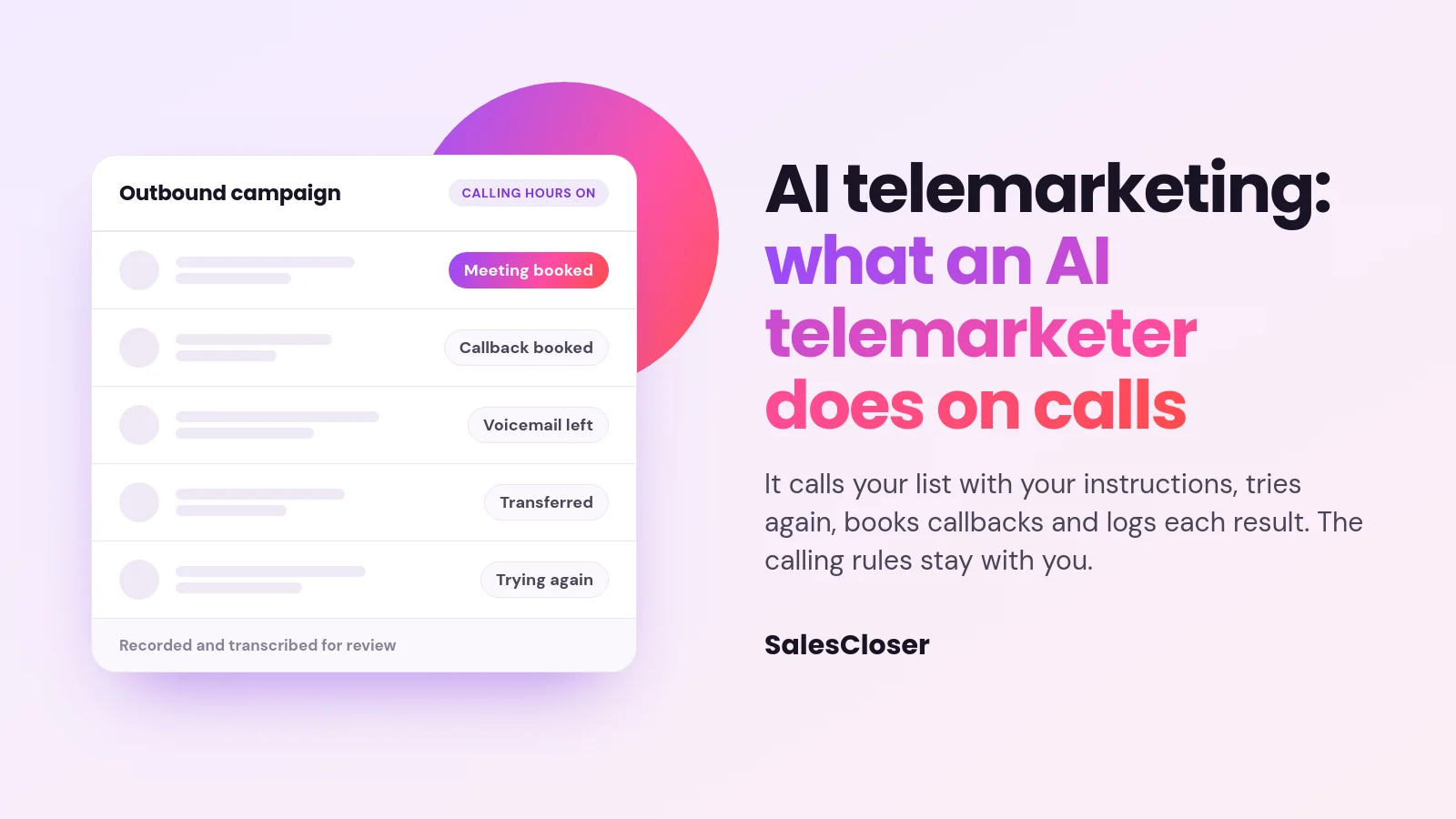
Telemarketing has always been a volume job: work the list, dial, wait, try again later. Most of the effort goes into reaching people, not talking to them. AI telemarketing changes who does that work. An AI voice agent places the outbound calls, has the conversation and hands the outcome to your team.
Here is how it compares with the two options you probably know, what real calls sound like, and how to start without creating a mess.
Human seat, dialer or AI telemarketer?
| Human seat | Dialer + human agents | AI telemarketer | |
|---|---|---|---|
| Who talks to the lead | A person | A person, once the dialer connects | The AI voice agent |
| What limits output | Hours and headcount | Seats you staff | List quality and your instructions |
| Message consistency | Varies by person | Varies by person | Same instructions on every call |
| Retries and callbacks | Often skipped on long lists | Retries yes, conversations no | Retries, voicemail and requested callbacks |
| Best at | Judgment, rapport, complex deals | Getting humans connected faster | First touches, old lists, follow-up |
| Hidden work | Hiring, training, turnover | Idle time, training, turnover | Writing, testing and reviewing instructions |
A dialer speeds up reaching people but still needs a person for every conversation. An AI telemarketer holds the conversation itself, so the bottleneck moves from staffing to the quality of your list and your script. Neither replaces judgment: the strongest setups let the AI work the list and route interested leads to people.

Two calls, start to finish
Call 1: reviving old quote requests for a solar installer. The installer has 600 homeowners who asked for a quote last spring and went quiet. The agent calls each one, says why it is calling, and asks whether they are still thinking about panels. One homeowner says yes but is driving. The agent offers to call back, she picks Thursday at 6 pm, and it calls her then. On that call she answers two qualifying questions about her roof and bill, and the agent books a site visit in the installer’s Calendly.
Call 2: a B2B event follow-up. A software company met 200 people at a trade show. The agent calls the list, references the event, and asks one question about their current process. A finance director says she wants to talk to someone now. The agent offers to connect her, she agrees, and the call transfers to the account executive on duty. If he does not pick up, the next number on the fallback list rings. He gets an email with her details and a call summary before he says hello.

Calls that reach voicemail get a message guided by a prompt you write, and the agent can press keys to get through a phone menu. Turn on Call Retry and the campaign redials unanswered leads up to five more times, with the delay you set. More on voicemail and phone menus and call transfer.
Everything lands where your team works. Conversations are recorded and transcribed so your team can review them, and call activity reaches HubSpot, Pipedrive, GoHighLevel and Zoho directly, plus Salesforce, Zapier and webhooks.
Where people still matter most
Keep a person on the call when the deal is complex or high value, when every word is reviewed in a regulated product, and whenever a lead asks for one. An AI telemarketer repeats a weak script as faithfully as a strong one, so someone on your team should own the instructions and read a sample of calls every week.
The practical split most teams land on: the AI makes first touches, works old lists and handles requested callbacks, and people take the leads who showed interest, through a booked meeting or a live transfer. Reps then spend their day in conversations that already have momentum, instead of on dial tone and voicemail.
Set up a first campaign
- Pick one goal, such as reviving quiet leads or booking meetings from an event list.
- Clean the list: confirm consent, scrub it against the registry and your own do-not-call list, and note each lead’s time zone.
- Write the instructions: how the agent introduces itself, why it is calling, what to ask and what a good outcome is.
- Connect your calendar and CRM and add transfer numbers for leads who want a person.
- Set calling hours and retries in the campaign’s calling controls, including whether to use each lead’s local time.
- Test on your own numbers, launch to a small batch, review the recordings, then widen the list.
What to check before you launch
- Consent, Do Not Call and calling-hour rules stay your responsibility. In the US, AI voices count as artificial under the TCPA, so these calls generally need prior express written consent; check with your counsel.
- SalesCloser does not scrub your list against the national Do Not Call registry, and opt-outs said on a call are blocked only when you turn on the Compliance setting.
- You decide how the agent introduces itself, including whether it says it is an AI, so put any disclosure your market requires in its opening.
For the bigger picture of AI in an outbound motion, read AI agents for outbound sales. To hear an AI telemarketer on your own list, book a demo and bring the campaign you want to run first.
Frequently asked questions
What is an AI telemarketer?
An AI voice agent that makes outbound sales or marketing calls for a business. It calls leads from your list, holds a two-way conversation based on your instructions, tries again when no one answers, books a callback when asked and leaves a record your team can review.
Is AI telemarketing legal?
It can be, if your calls follow the rules that apply to them. In the US that generally means prior express written consent, Do Not Call compliance and calling-hour limits. Those decisions stay with your business, so check with your counsel before you launch.
What happens when a lead does not answer?
With Call Retry on, the campaign tries again up to five more times with a delay you set. On voicemail, the agent can leave a message. If a lead answers but asks for a later time, the agent books a callback and calls then.
Can the AI hand a call to a person?
Yes. When a lead wants a person and agrees, the agent transfers the live call to your team, trying the next number on your fallback list if the first rep does not answer. The rep gets the lead’s details and a call summary by email.
Is an AI telemarketer better than a predictive dialer?
They solve different problems. A dialer reaches people faster but still needs a human for every conversation. An AI telemarketer holds the conversation itself. Many teams use the AI for first touches and callbacks and keep people for interested leads.