
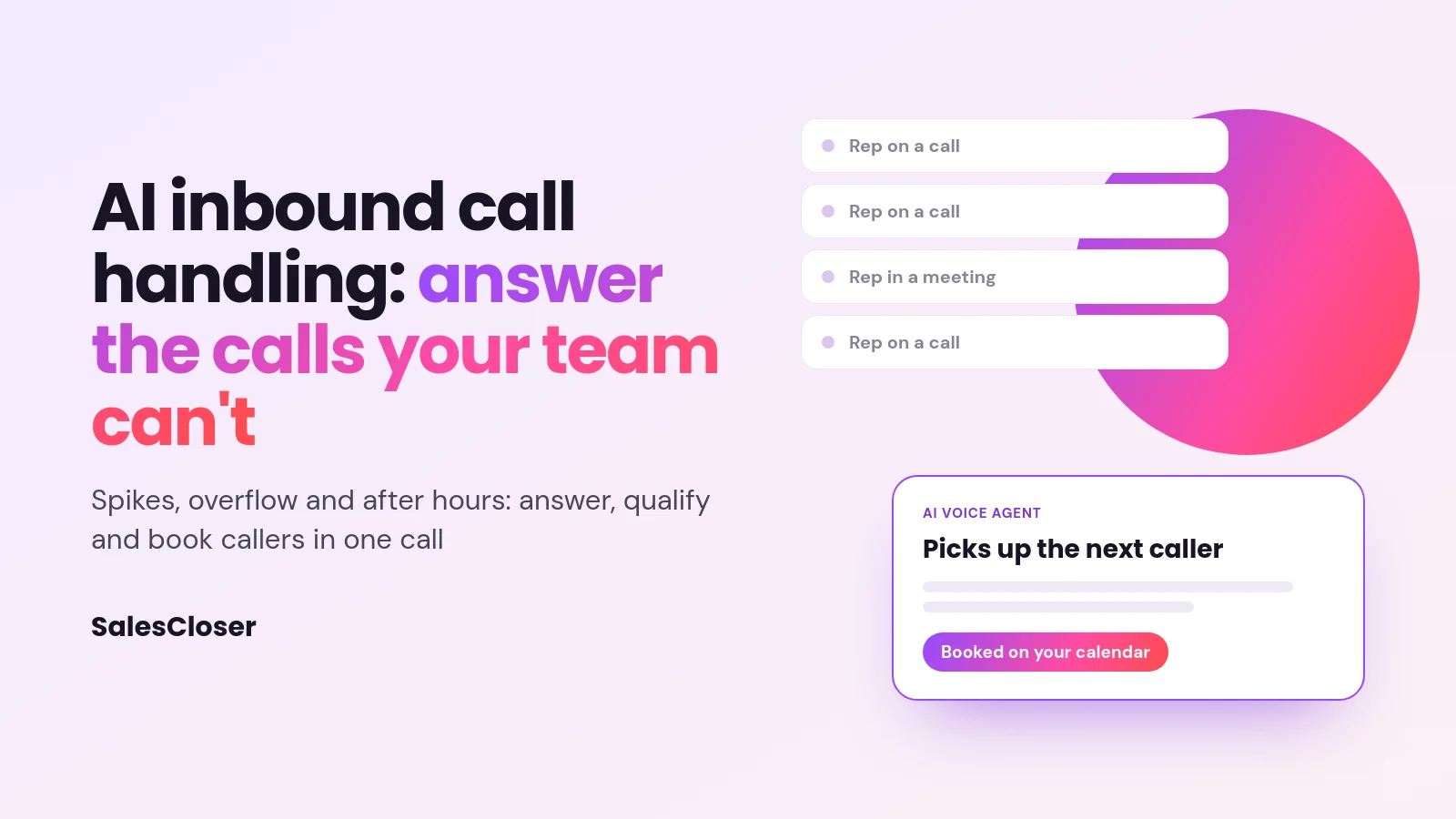
AI inbound call handling means an AI voice agent answers the calls your team cannot get to: during spikes, overflow and after hours. It answers common questions, asks your qualifying questions and books qualified callers onto your calendar in the same call. When a caller needs a person, it can transfer the call to your team or book a callback.
A hailstorm rolls through on Sunday night. By 7:30 on Monday morning, every roofing and restoration company in town has a full voicemail box and four people on the phones. The homeowner who gets through first usually books first.
That is the problem AI inbound call handling solves. An AI voice agent picks up the calls your team cannot get to, has a real conversation, and leaves your people with qualified, booked callers instead of a voicemail backlog. Here is what that looks like on an actual busy morning, then how to set it up.
A storm Monday, hour by hour
Take a roofing contractor with three people answering phones. Normally they handle the day without trouble. After a storm, the calls arrive faster than anyone can pick up.
- 7:30 am. Twelve calls in the first half hour. Your team answers three. Without an agent, nine go to voicemail and most never leave a message. With an agent, the calls nobody picks up roll to it instead.
- 8:15 am. A homeowner asks whether you work in her suburb and whether her insurance covers the inspection. The agent answers from the service area and FAQ you gave it, asks about the damage, and books an inspection slot on your calendar while she is still on the line.
- 10:00 am. A property manager with six buildings calls. That is a job for your estimator, not a script. The agent recognises it from your instructions, offers to connect him, and once he agrees, transfers the call to your estimator, with a summary sent ahead.
- 6:45 pm. Your office is closed. The calls keep coming. The agent answers, takes the address and a short description of the damage, and books first thing Tuesday. Anyone who asks for a person gets a callback at the time they choose.
- Tuesday, 8:00 am. Your team opens the CRM to booked inspections with notes and transcripts, instead of forty voicemails to return.

Which calls to hand to the agent
Spikes are the dramatic case, but most of the value comes from three everyday situations. Decide the outcome you want from each before you route a single call.
| Situation | Today | What the agent does | What your team gets |
|---|---|---|---|
| Campaign or seasonal spike | Long holds and hang-ups | Answers the offer questions, qualifies and books | Qualified callers on the calendar |
| Daytime overflow | Voicemail while reps are busy | Picks up unanswered calls, qualifies, books or schedules a callback | Context before the follow-up |
| After hours | Voicemail until morning | Answers, takes details, books the next open slot | A full calendar at opening time |
| Caller wants a person | Waits or gives up | Transfers live or books a callback at the caller’s chosen time | A warm call with the transcript |
After-hours and overflow calls are the easiest place to start, because every call the agent handles is one you would otherwise have missed. Spikes come next: put the campaign or seasonal details into the agent’s knowledge before the rush, and every caller gets the same accurate answer.
Qualify and book in the same call
Answering is only half the job. The agent asks the questions a rep would ask on a first call, such as what the caller needs, where they are, their timing and their budget range, and follows your rules to decide whether to book.
Example: a dental clinic at 8 pm. A caller asks whether the clinic does implants and takes new patients. The agent answers from the clinic’s service list, asks whether this is for a consultation or an urgent problem, and books a consultation into the clinic’s calendar for Thursday. The front desk sees the booking, the caller’s answers and the transcript the next morning.
Bookings go through Calendly or Cal.com, and callers can cancel or reschedule. Caller details flow to your CRM through direct integrations with HubSpot, Pipedrive, Zoho and GoHighLevel, plus Salesforce, Zapier and webhooks. Conversations are recorded and transcribed so your team can review them.
When a person should take over
Some calls should end with a person: a large quote, an unhappy customer, a sensitive question. List those in the agent’s instructions so it recognises the moment and stops trying to answer on its own.
Example: a software company’s sales line. A caller wants pricing for 400 seats and a security review. The agent asks two qualifying questions, then offers to connect them with an account executive. You set the numbers to try, and if the first rep does not answer, the agent dials the next one on your fallback list. The rep who picks up gets an email with the caller’s details, a call summary and next steps.
If the caller would rather talk later, the agent can book a callback at a time that suits them. Either way, nobody has to repeat themselves. More on how call transfer works.

Set it up in a week
- Pick one type of call. Overflow, after hours or a single campaign number.
- Write down the top questions and answers. Your team already knows them.
- Define a good fit. The qualifying questions, and what the agent should say to callers who are not a fit.
- Connect your calendar and CRM so bookings and caller details land where your team works.
- Set the handoff rules and your transfer and fallback numbers. Decide how the agent introduces itself, including whether it says it is an AI.
- Route the calls in your phone system, then read transcripts each week and widen the scope once the first type of call works well.
What to check before you choose
- Capacity at your peak depends on your plan, minutes and phone numbers, so bring your expected peak to the demo.
- Bookings use one calendar per agent, with no round-robin, so plan who takes which meetings.
- Callbacks are calls you place, so consent and calling-hour rules where you operate stay your responsibility.
SalesCloser agents answer your inbound phone calls in 50+ languages, qualify callers and book them onto your calendar. For the bigger picture, read the inbound AI voice agent guide. To hear an agent handle your busiest type of call, book a demo and bring your expected peak.
Frequently asked questions
What is an inbound AI agent?
An inbound AI agent is an AI voice agent that answers incoming calls, understands what the caller asks and replies in natural conversation. It answers from the knowledge you give it, asks the questions you set and takes the next step you choose, such as booking a meeting or a callback.
Can AI agents handle high-volume inbound calls?
Yes. An AI agent is not limited by how many people are on shift, so it suits spikes and overflow. Real capacity depends on your plan, minutes and phone numbers, so check it against your expected peak before a big campaign.
Will callers know they are talking to an AI?
That is your choice. You decide how the agent introduces itself, including whether it says it is an AI at the start of the call. Check any disclosure rules that apply where you and your callers are.
What happens if the AI does not know an answer?
Write its instructions so it says so rather than guessing, then offers the next step you set: a transfer, a callback or a booked meeting. Add the answer to its knowledge afterwards and the next caller gets it.
Do I still need people answering the phone?
Yes. The agent takes routine questions, overflow and after-hours calls, and books qualified callers. Your team handles the conversations that need judgment, with the details of each call already in front of them.