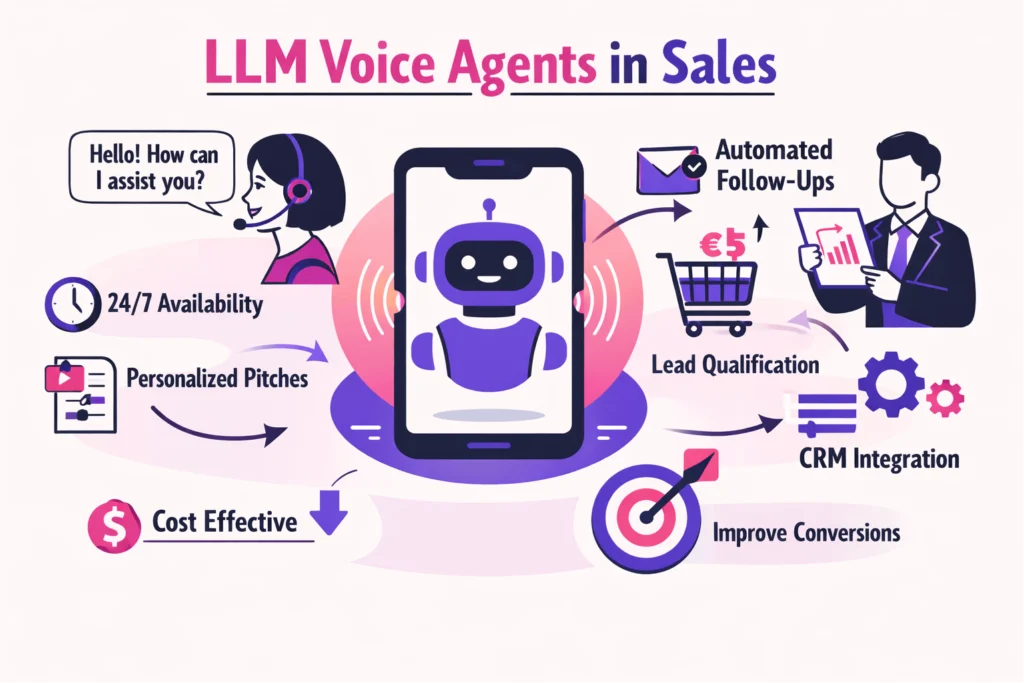
“Scale your outreach with LLM-based sales calling automation. Deliver human-level intelligence and dynamic objection handling at 24/7 scale.”
Sales reps spend only 28% of their week actually selling. The rest of their time vanishes into manual dialing, leaving voicemails, and drafting follow-up emails. Consequently, quotas drop, pipeline dries up, and customer acquisition costs spiral out of control. Scaling a human sales team requires massive capital, months of training, and constant management.
Traditional automation tools promised a fix but delivered robotic, script-bound chatbots that frustrated buyers. Now, a massive shift is happening. LLM-based sales calling automation changes the fundamental math of revenue generation.
This technology equips your team with artificial intelligence that speaks, listens, and reacts exactly like a seasoned sales professional. This guide breaks down the mechanics of a large language model for sales. We will explore how dynamic AI handles complex objections, qualifies leads instantly, and drives revenue. Most importantly, you will see how SalesCloser.ai provides human-level conversational intelligence at a scale human teams cannot match.

What is LLM-Based Sales Calling Automation?
Many leaders still confuse modern artificial intelligence with older, rigid systems. To grasp the value of this technology, we must define it clearly.
LLM-based sales calling automation is software that uses large language models to conduct autonomous voice conversations with prospects. Unlike older, rule-based dialers, this technology understands conversational nuance, handles unexpected objections in real-time, and generates human-like responses on the fly to qualify leads and book meetings without human intervention.
The Shift from Rules to Reasoning
Legacy software relies on decision trees. If a prospect says “A”, the bot responds with “B”. However, human conversations rarely follow a straight line. Prospects interrupt, change the subject, or ask complex technical questions.
A large language model for sales does not use a rigid path. Instead, it relies on advanced neural networks trained on vast amounts of conversational data. It analyzes the specific words the prospect uses, determines the intent behind those words, and generates a contextually accurate response within milliseconds.
This creates dynamic conversation AI. The agent can pivot from a pricing discussion to a feature explanation in an instant. It sounds natural because it generates language on the spot, rather than playing pre-recorded audio files.
Why Voice AI Matters Now
Voice remains the most powerful tool for closing deals. Emails get ignored. LinkedIn messages get lost in the noise. A live phone call forces immediate engagement.
Until recently, generating a realistic voice in real-time was too slow. Latency ruined the illusion. Today, advanced sales AI processes speech-to-text, analyzes the text via the LLM, and synthesizes a voice response in under a second. This speed makes conversational AI platforms viable for high-stakes enterprise sales.
The Death of the Rigid Script: Why Legacy AI Fails
Before generative AI in sales emerged, companies tried to automate calling with Interactive Voice Response (IVR) and basic voicebots. These systems actively damaged brand reputations.
The Problem with Decision Trees
Decision trees fail because they require developers to map out every possible human response. This is impossible. If a prospect says something slightly outside the programmed parameters, the bot fails.
Consider a standard discovery call. A prospect might say, “I am interested, but my budget does not refresh until Q3, and I need to consult my CTO.” A legacy bot cannot process multiple variables at once. It will likely trigger a generic error response like, “I did not catch that.” This immediately alienates the buyer.
The Limits of Human Scaling
Companies address this by hiring more Sales Development Representatives (SDRs). However, human teams face strict physical limits.
- Dial limits: A strong human SDR might make 80-100 dials per day.
- Fatigue: Call quality drops significantly after the 50th dial.
- Consistency: Humans forget to ask crucial qualification questions.
- Turnover: The average SDR tenure is roughly 14 months.
When you scale humans, you scale overhead. When an SDR leaves, you lose the investment you made in their training. An AI-powered sales agent never leaves, never gets tired, and executes your strategy perfectly on the thousandth call of the day.
Comparison: Legacy Systems vs. LLM Agents
| Feature | Legacy Voicebots | LLM-Based Sales Calling Automation |
| Architecture | Rigid decision trees | Neural networks and deep learning |
| Response Generation | Pre-written templates | Real-time generative responses |
| Handling Interruptions | Fails or restarts the script | Pauses, listens, and adapts dynamically |
| Context Memory | None (forgets previous turns) | Full context window throughout the call |
| Implementation Time | Months of mapping logic | Days of prompting and knowledge ingestion |
Inside a Large Language Model for Sales
To understand why this intelligent sales automation works, you need to understand the engine powering it. Large Language Models operate differently from traditional software.
What Makes an LLM Tick?
At its core, an LLM predicts the next best word in a sequence. However, calling it a “word predictor” drastically undersells its capability. These models contain billions of parameters. They understand syntax, tone, urgency, and context.
When you adapt a general LLM for sales, you constrain it. You provide a system prompt that gives the AI a persona, a goal, and specific guardrails.
Ingesting Your Unique Business Data
A generic LLM knows general facts, but it does not know your product. To make an AI sales agent effective, you must provide it with your specific business context.
You upload your knowledge base into the conversational AI platform. This includes:
- Product specification sheets
- Pricing matrices
- Past successful call transcripts
- Competitive battle cards
When the AI agent speaks to a prospect, it uses a technique called Retrieval-Augmented Generation (RAG). It searches your uploaded documents in milliseconds, pulls the exact fact needed, and weaves that fact into a natural spoken sentence.
Natural Language Processing (NLP) in Action
NLP allows the AI to understand sentiment. If a prospect sounds rushed or annoyed, the LLM detects the negative sentiment based on word choice and pacing.
A human SDR might push through their script regardless. The AI, properly prompted, will recognize the urgency. It might say, “I hear you are busy. I can give you the 30-second version, or we can reschedule. What works best?” This level of emotional intelligence builds immediate trust.
Mastering AI Objection Handling in Real-Time
Sales do not happen without objections. A system that cannot handle pushback is useless to a revenue team. AI objection handling represents the most significant breakthrough in advanced sales AI.
The Psychology of an Objection
Prospects throw up objections as a defense mechanism. They use standard lines like “Send me an email” or “We do not have the budget.” Human reps often freeze or argue when they hear this.
An LLM-based system processes these objections logically. It does not feel fear or rejection. It instantly categorizes the objection and retrieves the best rebuttal framework.
Frameworks Used by Advanced Sales AI
SalesCloser.ai programs its agents to use proven sales frameworks, such as the Feel-Felt-Found or LAER (Listen, Acknowledge, Explore, Respond) model.
Let’s look at three common scenarios and how dynamic conversation AI handles them.
Scenario 1: The “Send Me an Email” Brush-off
- Prospect: “Just send me an email with some info.”
- Human Rep (often): “Okay, what is your email address?” (Loses the lead).
- AI Agent: “I will absolutely send that over so you have it in writing. Just so I make sure I only send you what is relevant, are you currently struggling more with lead generation or closing deals?”
- Result: The AI acknowledges the request but uses a soft tie-down question to keep the prospect talking and uncover pain points.
Scenario 2: The Competitor Objection
- Prospect: “We already use [Competitor X], and we are happy.”
- AI Agent: “Competitor X makes a solid product, especially for basic outreach. Most of the clients who switch to us from them do so because they need deeper CRM integration without the extra fees. Are you currently paying extra for their advanced API access?”
- Result: The agent uses knowledge base ingestion to instantly reference a specific competitive advantage, shifting the conversation from a closed door to a discovery question.
Scenario 3: The Price Objection
- Prospect: “We do not have the budget for a new tool right now.”
- AI Agent: “I completely understand keeping a tight watch on the budget. Often, companies find that our platform actually replaces three existing tools, making it budget-neutral. If I could show you how to cut your software spend by 20%, would it be worth a brief look?”
- Result: The AI pivots from cost to value and return on investment (ROI).
Continuous Improvement
The best part about AI objection handling is the feedback loop. When an AI encounters a new, highly specific objection, you review the call transcript later. You add a new rule or fact to the knowledge base. The next day, the AI handles that exact objection perfectly across 10,000 calls.
The Economics of Scalable Sales Outreach
Traditionally, scaling a business means hiring more people. This linear growth model is expensive and risky. Scalable sales outreach via AI breaks this linear relationship.
Breaking Down Customer Acquisition Cost (CAC)
Customer Acquisition Cost includes marketing spend, sales salaries, software licenses, and commissions. Human SDRs represent a massive fixed cost. If an SDR team has a bad month, your CAC skyrockets.
Generative AI in sales shifts your model from high fixed costs to low variable costs. You pay for the minutes the AI actually speaks.
Consider this mathematical breakdown:
- A team of 5 human SDRs costs roughly $350,000 annually (base, commission, taxes, benefits).
- They collectively make 100,000 dials a year.
- An AI conversational platform can make 100,000 dials in a single week.
- The software cost is a fraction of the cost of the human team.
This drastic reduction in cost per dial allows you to attack smaller accounts or colder lists that would be unprofitable for a human team to call.
Volume Without Sacrificing Personalization
Historically, increasing volume meant decreasing quality. “Spray and pray” tactics yield terrible conversion rates.
LLM-based sales calling automation maintains extreme personalization at scale. Because the system integrates directly with your CRM, it knows exactly who it is calling.
Before the AI dials, it pulls the prospect’s name, company size, recent website visits, and past purchase history. The opening line is entirely custom.
“Hi John, I saw your team at Acme Corp has just opened a new office in Austin. I am calling because…”
This level of detail, delivered via natural voice at 10,000 calls an hour, represents a true paradigm shift in B2B sales.
SalesCloser.ai: Your Ultimate Conversational AI Platform
You understand the technology. Now you need the right tool. Building a custom LLM system from scratch takes millions of dollars and a team of machine learning engineers.
SalesCloser.ai eliminates the development time. It provides a ready-to-deploy, enterprise-grade conversational AI platform designed exclusively for revenue teams.
Why SalesCloser Wins
Not all voice bots are created equal. Many platforms use generic models that hallucinate or speak with high latency. SalesCloser relies on a proprietary architecture specifically tuned for sales negotiations, discovery calls, and appointment setting.
1. Ultra-Low Latency
In a sales call, a two-second pause feels like an eternity. It destroys trust. SalesCloser processes audio, generates the LLM response, and synthesizes speech in under 800 milliseconds. The prospect feels like they are talking to a sharp, attentive human.
2. Seamless CRM Integration
An AI is only as smart as its data. SalesCloser features native integrations with Salesforce, HubSpot, and GoHighLevel.
- It pulls lead lists automatically.
- It updates custom fields during the call based on the prospect’s answers.
- It logs the full call transcript and summary directly onto the contact record.
3. Hyper-Realistic Voice Cloning
Robotic voices instantly trigger hang-ups. SalesCloser utilizes cutting-edge voice synthesis. You can choose from dozens of pre-trained professional voices and adjust their tone, pacing, and accent. You can even clone your top-performing rep’s voice for ultimate brand consistency.
Real-World Workflows
How does a company actually use SalesCloser? Let’s look at three practical deployments.
The Inbound Lead Responder
Speed to lead is critical. If a prospect downloads a whitepaper, SalesCloser calls them within 60 seconds. The AI references the specific whitepaper, asks two qualifying questions, and immediately books a demo on your Account Executive’s calendar.
The Churn Prevention Agent
For SaaS companies, churn is the enemy. SalesCloser monitors product usage data in your CRM. If a user’s activity drops for 14 days, the AI triggers a check-in call. It asks whether they are stuck on a specific feature and offers to connect them with a live customer success manager.
The Cold Outbound Machine
You upload a list of 5,000 cold leads from an event. SalesCloser dials them sequentially. It navigates gatekeepers, leaves personalized voicemails, and engages decision-makers. It handles the initial heavy lifting, passing only qualified, warm leads to your human closers.
Step-by-Step: Deploying Your AI-Powered Sales Agent
Deploying an AI-powered sales agent requires strategy. You do not just press a button and walk away. You must train the AI just as you would train a new human hire.
Here is the exact framework we use to onboard enterprise clients onto SalesCloser.
Step 1: Define the Specific Objective
Do not ask the AI to do everything at once. Pick a narrow, high-value use case.
- Do you want to qualify inbound leads?
- Do you want to reactivate last year’s dead opportunities?
- Do you want to remind attendees about an upcoming webinar?
Define the success metric. For example: “Book a calendar appointment for the AE.”
Step 2: Craft the Core Prompt
The system prompt is the AI’s brain. You must explicitly define its persona and rules.
A strong prompt looks like this:
- “You are Alex, a senior SDR at CloudTech.”
- “Your goal is to book a 15-minute discovery call.”
- “You must ask about their current cloud storage provider.”
- “If they ask about pricing, do not give specific numbers. Say our pricing scales based on data volume, and the AE will provide a custom quote.”
- “Always be polite, concise, and professional.”
Step 3: Ingest the Knowledge Base
Upload your collateral. The AI needs ammo to handle objections. Upload FAQs, competitor comparison charts, and successful call transcripts. SalesCloser structures this data so the LLM can retrieve it instantly during live calls.
Step 4: Test in a Sandbox Environment
Never unleash an AI on live prospects without testing. Use the internal simulation tools. Have your toughest sales managers roleplay with the AI agent.
Throw difficult objections at it. Interrupt it. Speak quickly. See how the AI reacts. Refine the prompt based on these simulations.
Step 5: Launch and Monitor Call Intelligence
Start with a small batch of live leads. Monitor the first 100 calls closely. Use AI sales intelligence tools to review the transcripts.
Look for friction points. Did the AI stumble on a specific competitor mention? Update the knowledge base immediately. Once the AI performs flawlessly, scale to thousands of calls per day.
Advanced Sales AI: Extracting Actionable Intelligence
The value of LLM-based sales calling automation extends far beyond simply making dials. The true power lies in the data it generates.
Human reps are terrible at taking notes. They paraphrase, forget details, and leave CRM fields blank. This creates a massive blind spot for sales leadership.
100% Data Capture
An AI agent records and transcribes every single word of every single interaction. But raw transcripts are hard to read. Advanced sales AI uses a secondary LLM process to analyze the transcript immediately after the call ends.
It automatically extracts critical information.
- BANT Qualification: Did the prospect mention Budget, Authority, Need, or Timeline? The AI tags these variables.
- Action Items: Did the prospect ask for a specific case study? The AI triggers a workflow to send the exact document via email.
- Competitor Mentions: The AI aggregates how often specific competitors are mentioned across thousands of calls, giving your product team real-time market intelligence.
Sentiment Analysis and Intent Scoring
Not all booked meetings have the same value. Conversational AI platforms analyze the tone and vocabulary to determine buying intent.
If a prospect asks highly specific technical questions and uses words like “urgent” or “immediately,” the AI flags that account with a high intent score. Your human Account Executives can then prioritize their follow-ups, focusing their time on the deals most likely to close.
Identifying Market Shifts
Because the AI processes data at scale, it spots trends humans miss. If a new objection starts popping up—for example, prospects suddenly asking about compliance with a new data privacy law—the AI dashboard highlights this trend instantly. Leadership can adjust the company’s messaging across all channels before the problem impacts quarterly revenue.
Integrating Generative AI in Sales Workflows
Replacing your entire human SDR team with AI overnight is rarely the right move. The most successful revenue organizations use generative AI in sales to augment and supercharge their human talent.
The Hybrid Model
In a hybrid model, the AI handles the grueling, high-volume work. The human handles the high-value, high-empathy work.
Phase 1: The AI Icebreaker
The AI agent cold calls lists of thousands. It wades through voicemails, gatekeepers, and angry hang-ups. It identifies the 5% of prospects who are genuinely interested and available.
Phase 2: The Human Closer
The AI books the appointment directly onto the human rep’s calendar. The human rep wakes up to a full schedule of warm leads. Because the AI logged perfect notes in the CRM, the human rep knows exactly what pain points to focus on.
Real-Time Coaching for Humans
Generative AI also helps when the human is on the phone. While the human rep is conducting a complex closing call, the AI listens in the background.
It provides real-time battle cards on the rep’s screen. If the prospect mentions a competitor, the AI instantly displays the exact rebuttal strategy. If the rep talks for too long without asking a question, the AI flashes a warning to “Listen more.” This ensures your human reps perform as efficiently as your AI agents.
Technical Considerations: Security, Compliance, and Trust
When you deploy AI to speak on behalf of your brand, security and compliance become paramount. Enterprise buyers demand strict adherence to data privacy regulations.
Preventing AI Hallucinations
A “hallucination” occurs when an LLM confidently states something entirely false. In a sales context, an AI promising a feature you do not have, or quoting a discount you do not offer, creates legal liability.
SalesCloser prevents hallucinations through strict guardrails. The system prompt forces the AI only to answer questions based on the uploaded knowledge base. If a prospect asks a question the AI does not know the answer to, it is programmed to say, “That is a great technical question. I want to make sure I give you the exact specifications. I will have our solutions engineer follow up with you.”
Data Privacy and Security
Enterprise conversational AI platforms must comply with major data regulations.
- SOC 2 Type II: Ensures the platform securely handles customer data.
- GDPR and CCPA: Ensures prospect data is managed legally, allowing for the deletion of personal information upon request.
- Call Recording Laws: The AI can be programmed to automatically state, “This call is on a recorded line,” adjusting this behavior dynamically based on the prospect’s area code to comply with one-party or two-party consent laws.
SalesCloser encrypts all voice data and transcripts in transit and at rest. Your proprietary sales strategies and customer data are never used to train external public models.
Future Trends in Dynamic Conversation AI
The technology driving LLM-based sales calling automation evolves rapidly. According to Gartner, by 2026, B2B sales organizations that use AI to augment human agents will see a drastic increase in revenue. What is next for the industry?
Multilingual Autonomous Agents
Sales are global. Currently, expanding into a new region requires hiring native speakers. Soon, a single AI agent will seamlessly switch between English, Spanish, German, and Mandarin based on the prospect’s location, maintaining perfect syntax and cultural nuance.
Omni-Channel Context
Future AI agents will not just handle phone calls. They will own the entire prospect relationship across channels.
If an AI emails a prospect on Monday, connects with them on LinkedIn on Tuesday, and calls them on Wednesday, it will seamlessly reference those previous touchpoints during the call. “Hi Sarah, I saw you viewed the message I sent on LinkedIn yesterday regarding our new integration…”
Advanced Emotional Emulation
While today’s models understand sentiment, tomorrow’s models will dynamically adapt their own vocal tone to match the prospect. If the prospect speaks slowly and quietly, the AI will lower its volume and slow its cadence to build a better rapport. This subtle mimicking technique, used by top human salespeople, will become standard in advanced sales AI.
Building Your AI Strategy
You cannot ignore this technology. The efficiency gains are too massive. Companies that adopt LLM-based sales-calling automation will simply outpace competitors who rely on manual dials and legacy software.
To build your strategy, start by mapping your current funnel. Identify the exact points where human effort yields the lowest return. Usually, this is top-of-funnel outbound calling and initial inbound lead qualification.
Implement an AI agent specifically for these bottlenecks. Measure the decrease in Customer Acquisition Cost and the increase in booked meetings. Once you prove the ROI in one channel, expand the AI’s responsibilities across the revenue organization.
Conclusion
The era of rigid, frustrating voicebots is over. LLM-based sales calling automation introduces a level of reasoning, adaptability, and emotional intelligence previously reserved for human teams. By leveraging dynamic conversation AI, you eliminate the physical limits of traditional SDR outreach.
You handle objections smoothly, personalize pitches instantly, and scale your pipeline infinitely. Your human reps stop dialing and start closing.
Stop losing deals because your team cannot make enough calls. It is time to deploy human-level intelligence at scale. Book a demo with SalesCloser.ai today and build your first AI-powered sales agent in minutes.
FAQ
Q: What is LLM-based sales calling automation?
A: It is software that uses large language models to conduct autonomous voice conversations, handle objections, and qualify leads without human intervention.
Q: Does the AI sound like a robot?
A: No. Modern conversational AI platforms use low-latency, hyper-realistic voice cloning to sound exactly like a professional human sales rep.
Q: How does the AI handle objections?
A: It uses dynamic conversation AI to analyze the prospect’s intent instantly, pulling proven rebuttals from your custom knowledge base to pivot the conversation effectively.
Q: Can AI replace my entire sales team?
A: AI is best used to augment teams. It handles the high-volume, repetitive tasks (cold calling, initial qualification), allowing human closers to focus entirely on complex negotiations.