“Scale your outreach with LLM Voice Agents in Sales. Learn how conversational AI handles tangents and objections to book more meetings.”
Buyers hang up on robotic, pre-recorded voices within 5 seconds. If your outreach relies on rigid scripts or dial-by-number menus, you actively burn your pipeline. Modern buyers demand fluid, intelligent conversations.
Therefore, sales teams face a critical problem: scaling outreach without sounding like a machine. Traditional chatbots and Interactive Voice Response (IVR) systems fail because they rely on exact keywords. They break down the moment a prospect goes off-script.
This post explains the technology that fixes this gap. We will demystify how LLM voice agents work in sales. You will learn how these systems understand context, handle complex tangents, and respond with natural language. Furthermore, we will show you how deploying conversational AI technology transforms cold leads into qualified meetings.
What Are LLM Voice Agents?
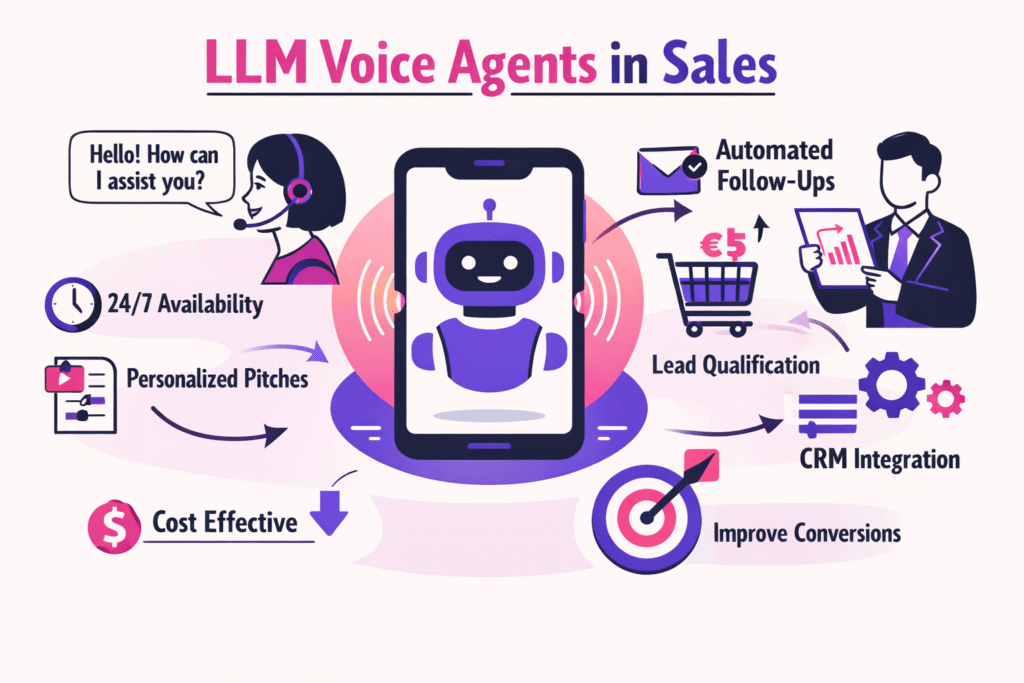
What are LLM voice agents in sales? LLM voice agents in sales are AI systems that conduct natural, dynamic phone conversations with buyers. They use large language models to understand context, handle objections, and book meetings autonomously, completely replacing rigid scripts and decision-tree chatbots with human-like interactions.
This technology represents a massive shift in how companies handle outreach. Previous generations of AI call center technology simply transcribed speech to text, searched for a pre-programmed keyword, and read a canned response. Consequently, the conversations felt stiff and unnatural.
A large language model for sales operates differently. It predicts the most logical, natural next word in a sequence based on vast amounts of training data. Instead of pulling from a limited menu of answers, it generates responses in real-time. This capability creates a human-like AI voice that adapts to the specific flow of your buyer’s conversation.
The Mechanics Behind the Voice
Large Language Models do not “think” like humans. Instead, they recognize patterns. When a prospect speaks, natural language processing sales algorithms convert the audio into text. The LLM then analyzes this text, taking into account the entire history of the conversation.
It evaluates intent, tone, and context. After determining the optimal reply, a text-to-speech engine delivers the response with natural inflection and pacing. The entire process takes milliseconds. This speed ensures the AI sales conversation feels completely seamless.
How Large Language Models Understand Context
Traditional voicebots fail the context test. If a prospect says, “I am interested, but my budget is locked until Q3,” an old bot might just hear “interested” and immediately push for a sale. This approach frustrates buyers and ruins deals.
According to Harvard Business Review research, AI tools that adapt to buyer context increase conversion rates significantly by aligning with the customer’s actual purchasing timeline. LLMs excel precisely where old bots fail. They process the entire sentence.
Specifically, the model understands that “interested” is conditional upon “budget locked until Q3.” The intelligent voice agent then adjusts its strategy. It might reply, “That makes complete sense. Would it be helpful if we just did a quick introductory demo now, so you have all the information ready when Q3 rolls around?”
Managing Conversational Tangents
Human conversations rarely follow a straight line. Prospects ask questions, interrupt, or bring up competitors out of nowhere. LLM voice agents handle these tangents gracefully.
For instance, if you are pitching a software solution and the prospect suddenly asks about your security compliance, the AI smoothly pivots. It answers the security question accurately. Then it uses conversational AI to guide the prospect back to the main value proposition gently.
Old IVR vs. Advanced Voice AI
Sales leaders must understand the stark difference between legacy systems and next-gen voicebots. The table below outlines why advanced voice AI effectively replaces older technologies.
| Feature | Legacy IVR & Chatbots | LLM Voice Agents |
| Logic Engine | Rigid decision trees and rules | Dynamic, predictive language models |
| Input Recognition | Exact keyword matching only | Contextual intent and sentiment analysis |
| Conversational Flow | Scripted, robotic, easily broken | Fluid, handles interruptions and tangents |
| Voice Quality | Synthetic, monotone delivery | Human-like AI voice with natural inflection |
| Sales Capability | Basic routing and data collection | Advanced AI objection handling and meeting booking |
Legacy systems force the buyer to adapt to the machine. They require the user to speak clearly and use specific phrases. Conversely, LLM voice agents adapt to the buyer.
They understand slang, industry jargon, and complex sentence structures. This flexibility is crucial for building rapport. When an AI sounds and acts like a knowledgeable human, buyers lower their guard and engage more deeply with the pitch.
Mastering AI Objection Handling
Objections kill deals if handled poorly. Human sales development reps (SDRs) spend months practicing role-play scenarios to master objection handling. Now you can deploy AI sales agents pre-trained with top-tier objection frameworks.
When a prospect says, “Send me an email,” a poor system agrees and hangs up. An LLM-powered agent recognizes this as a brush-off. It uses proven sales psychology to keep the conversation alive.
It might respond with, “I can certainly send you an email. Just so I make sure I only send you relevant information, are you currently struggling more with lead generation or closing deals?” This tactic validates the prospect’s request while seamlessly asking a discovery question.
Customizing the AI’s Knowledge Base
You maintain complete control over how the AI responds to specific objections. By feeding the large language model your company’s sales playbooks, battle cards, and product FAQs, you create a highly specialized expert.
The agent learns your competitive advantages. If a prospect mentions a specific competitor, the AI instantly recalls your predefined differentiation points. It delivers this information smoothly, without sounding like it is reading from a script. This level of AI objection handling builds immediate credibility with the buyer.
The Impact on AI Call Center Technology
Scaling a human sales team requires massive capital. You face recruiting costs, training time, base salaries, and inevitable turnover. AI call center technology fundamentally changes this economic equation.
Gartner predicts that by 2025, 75% of B2B sales organizations will augment traditional playbooks with AI-guided selling solutions. Adopting an intelligent voice agent allows you to multiply your outreach efforts instantly without adding headcount.
Scaling Outreach Without Losing Quality
One LLM voice agent handles thousands of calls simultaneously. It never takes a sick day. It never sounds tired on the last call of the shift. Most importantly, it delivers your best possible pitch on every single connection.
This consistency guarantees that your pipeline remains full of high-quality leads. Human reps then focus their time on what they do best: closing complex deals and building deep relationships with qualified buyers. The AI handles the grueling, high-volume work of initial contact and qualification.
Why SalesCloser.ai Leads Next-Gen Voicebots
Not all AI solutions deliver the same results. Many platforms still rely on outdated models or lack the deep integrations required for serious B2B sales. SalesCloser.ai stands out by leveraging cutting-edge LLMs to power its infrastructure.
Our platform trains its AI agents specifically for complex sales environments. When you deploy a SalesCloser AI voice agent, you get a system that understands the nuances of B2B discovery calls.
Real-Time CRM Integration
SalesCloser.ai does more than just talk. It acts. During a conversation, the AI instantly updates your CRM. It logs notes, qualifies the lead based on your specific criteria, and categorizes the prospect’s intent.
If the prospect agrees to a meeting, the AI checks your calendar. It negotiates a time directly over the phone and sends the calendar invite before the call even ends. This seamless workflow eliminates manual data entry and ensures no lead falls through the cracks.
Our AI SDR guide details exactly how SalesCloser.ai reduces customer acquisition costs (CAC) while doubling meeting booking rates. The technology empowers your existing team to hit revenue targets faster and with less manual effort.
Conclusion
LLM voice agents in sales fundamentally change how companies connect with buyers. By leveraging advanced conversational AI, these systems move beyond the robotic limitations of legacy chatbots. They understand deep context, manage unpredictable conversational tangents, and handle complex AI objections.
Most importantly, they deliver a human-like AI voice that builds rapport and successfully books qualified meetings. Stop burning your valuable pipeline on rigid scripts and outdated automated systems.
Ready to scale your outreach with intelligent voice agents that actually perform?
Book a demo with SalesCloser.ai today and hear the difference for yourself.