
AI in sales and marketing means using software that writes, predicts, analyzes and holds conversations to take on repetitive funnel work. Marketing uses it for content, segmentation, ad targeting and lead scoring. Sales uses it for research, first response, qualification, call notes and forecasting. Start with one leak, set a baseline and measure qualified meetings and pipeline.
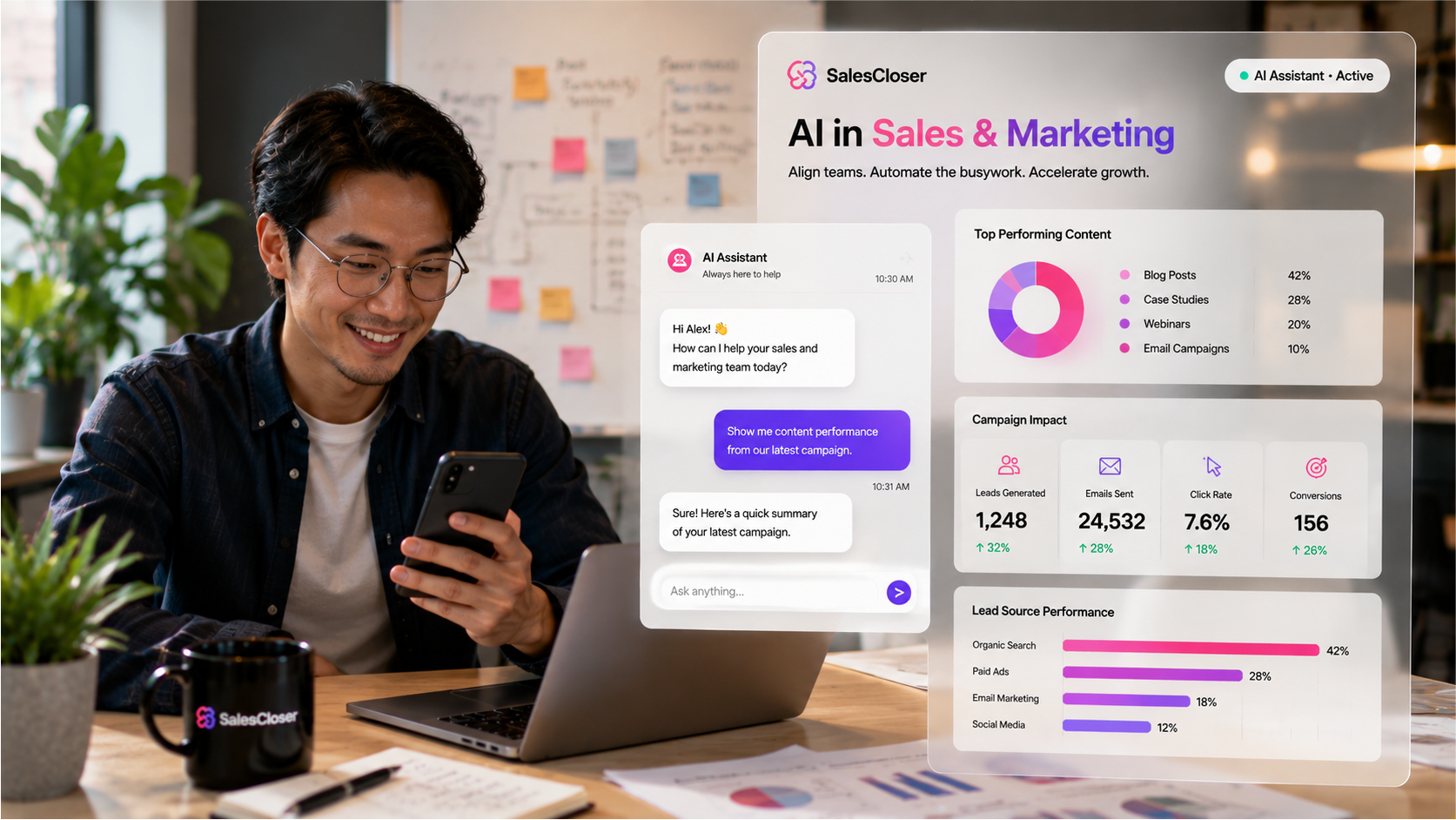
Most teams already use some AI in sales and marketing. Someone drafts emails with a chatbot, the ad platform bids on its own, and the CRM suggests a lead score nobody trusts. That is not a strategy. It is a pile of features.
This guide is the broad view. It covers concrete AI use cases in marketing, in sales, and at the point where the two teams meet, then shows how to pick a starting point, roll it out, and measure whether it worked.
What AI in sales and marketing actually means
Artificial intelligence in sales and marketing is software that learns from data or language to do work that used to need a person: writing, sorting, predicting, or holding a conversation. In practice it falls into four groups.
- Generative AI drafts copy, summaries, replies and research notes.
- Predictive AI scores leads, forecasts pipeline and flags accounts likely to buy or churn.
- Conversational AI talks to buyers by chat, phone or video, answers questions and books meetings.
- Analytical AI finds patterns in campaign, call and CRM data that a person would miss or never have time to look for.
The useful question is not “should we use AI?” It is “which slow, repetitive or inconsistent step in our funnel should AI take on first?”
How AI helps in marketing
Marketing has the most mature AI tooling, because so much of the work is content and data. These are the use cases that tend to pay off.
Content drafts and variations
AI writes first drafts of emails, landing page copy, ad variations and social posts. A marketer still sets the angle, checks facts and edits for voice. The gain is more versions to test, not fewer people thinking.
Segmentation and personalization
Models group contacts by behavior instead of only by job title or industry. That lets you send a different nurture track to someone reading pricing pages than to someone reading beginner guides.
Ad targeting and bidding
The major ad platforms already use machine learning to decide who sees an ad and what to bid. Your job is to feed them clean conversion data, ideally qualified meetings rather than raw form fills, so they optimize for the right outcome.
Lead scoring
Predictive scoring looks at which past leads became customers and ranks new ones on the same signals. It only works if your CRM records outcomes honestly, including lost deals.
Campaign analysis
AI can summarize what changed in a campaign week over week and suggest why. Treat its answers as a starting point for a question, not as the conclusion.
How AI helps in sales
AI for sales is about time. Reps lose hours to research, data entry, chasing unqualified leads and writing follow-ups. For a stage-by-stage look at the sales side alone, see our guide to AI for sales by funnel stage. Here are the main uses.
Prospect and account research
AI pulls together what a company does, recent news and likely priorities before a call, so the rep opens with something relevant.
First response and qualification
When a lead comes in, an AI agent can reply, ask your qualifying questions and book the right people onto a rep’s calendar at any hour. Reps spend their time on buyers who fit.
Discovery and demos
Some AI agents can run a first discovery call or walk a prospect through a product demo, then pass the conversation to a person when the buyer is ready for more.
Call notes and coaching
Recording and transcribing calls, then summarizing them, removes manual note taking. Managers can review real conversations and coach on specific moments instead of guessing.
Follow-ups and CRM updates
AI drafts the follow-up email from the call summary and logs key fields in the CRM, so records stay current without a Friday afternoon cleanup.
Forecasting
Predictive models compare open opportunities with past patterns and flag deals that look stalled. They are only as good as the stage data reps enter.
Where sales and marketing AI connect
The biggest gains often sit between the two teams, not inside either one. Marketing pays to create a lead, then the lead waits for a reply, gets a generic email, or is judged “not ready” with no feedback. AI helps in four places.
- One definition of a qualified lead. Write the qualifying questions down once and let both marketing scoring and sales conversations use them.
- Fast first conversation. An AI agent can respond to a new lead right away, in the channel the buyer chose, instead of leaving it in a queue.
- Shared context. When the CRM holds the lead, a call summary and the qualification answers, the rep who takes over does not start from zero.
- Feedback to marketing. Conversation summaries show which questions and objections come up most. Marketing can turn those into content, ads and better targeting.
If the handoff is your main problem, our article on AI agents for sales and marketing goes deeper on fixing it.
AI use cases in sales and marketing at a glance
Use this table to match a problem to a use case and to the number that tells you if it is working.
| Use case | Team | What AI does | What to measure |
|---|---|---|---|
| Content drafts | Marketing | Writes first versions of emails, ads and pages for a person to edit | Time to publish, test volume, conversion by variant |
| Segmentation | Marketing | Groups contacts by behavior and intent | Engagement and conversion by segment |
| Ad optimization | Marketing | Targets and bids based on your conversion data | Cost per qualified meeting, not cost per lead |
| Lead scoring | Both | Ranks leads on signals from past wins | Win rate by score band |
| First response | Both | Replies to new leads and asks qualifying questions | Time to first reply, share of leads reached |
| Meeting booking | Both | Books qualified buyers onto the right calendar | Meetings booked, show rate |
| Conversation insights | Both | Summarizes calls and surfaces common objections | Content and script changes made from insights |
| Research | Sales | Builds account briefs before calls | Prep time per call |
| Follow-ups and CRM notes | Sales | Drafts follow-ups and logs call details | CRM field completeness |
| Forecasting | Sales | Flags stalled or at-risk deals | Forecast accuracy over time |
AI strategy for sales and marketing: how to pick and roll out
An AI strategy for sales and marketing does not need to be a long document. It needs a clear problem, an owner and a way to measure. This sequence works for most teams.
- Map the funnel and find the leak. Walk a lead from first touch to signed contract. Note where it waits, where data gets retyped and where quality drops.
- Pick one use case. Choose the leak that is most painful and easiest to measure. For many teams that is slow first response or inconsistent qualification.
- Write the rules first. Define your ideal customer, qualifying questions, handoff criteria and brand voice before you configure anything. AI follows rules; it does not invent good ones.
- Check your data. Clean the CRM fields the tool will read and write. Bad data in means confident bad answers out.
- Choose tools that fit your stack. Confirm the tool connects to your CRM and calendar, and ask exactly what data it writes back.
- Run a contained pilot. Start with one lead source, region or product line for a few weeks. Keep a comparison group handled the old way.
- Review real output. Read transcripts, drafts and scores every week. Fix the instructions, not just the symptoms.
- Expand and train the team. Roll out to more sources only when the pilot numbers hold, and show reps how to work with the tool.
How to measure AI in sales and marketing
Measure the business outcome, not the activity. An AI tool that sends more emails is not a win if meetings stay flat.
- Set a baseline first. Record the numbers for at least a few weeks before the pilot starts.
- Track a leading metric. Examples: time to first reply, share of leads reached, CRM completeness, time to publish.
- Track a lagging metric. Examples: qualified meetings booked, show rate, pipeline created, win rate, cost per qualified meeting.
- Compare against a control. Use the group still handled the old way so seasonality does not fool you.
- Score quality, not just volume. Have a manager or marketer rate a sample of conversations or drafts each week.
- Ask the people downstream. If reps say the meetings are poor fits, the qualification rules need work, whatever the dashboard says.
Risks and guardrails
AI makes mistakes with confidence. A few guardrails keep it useful.
- Keep a human in the loop for anything published or sent to a key account.
- Ground it in your own content. Tools that answer from your website, documents and FAQs stay closer to the truth than tools that answer from general knowledge.
- Be open about AI. Decide how your agents introduce themselves and make sure they answer honestly when a buyer asks if they are talking to an AI.
- Check your obligations. Review privacy, consent and call recording rules in each market you sell into, and confirm how each vendor handles your data.
- Watch for drift. Products, prices and messaging change. Update the knowledge the AI uses whenever they do.
Where SalesCloser fits
SalesCloser covers the conversation part of this picture: first response, qualification, discovery and demos. Its AI sales agents hold real conversations by voice, video or chat, on the phone, on Zoom or in the browser. They answer inbound leads, ask your qualifying questions, give product demos by live screen share or by presenting your product video, and book qualified prospects onto your team’s calendar through Calendly or Cal.com.
Setup is no-code. You give the agent your website, documents, FAQs and rules, and choose a demo, discovery, onboarding or support agent. It works around the clock in 50+ languages.
SalesCloser connects to HubSpot, Pipedrive, Zoho, GoHighLevel, Zendesk and Intercom, saving the lead, a call summary and the qualification answers. Conversations are recorded and transcribed so your team can review them. You control how the agent introduces itself, including whether it says it is an AI up front, and you can tell it to always answer truthfully when asked. See how it handles lead qualification or how it links to your CRM and calendar.
Conclusion
AI in sales and marketing works best when it fixes one real problem at a time. Find the slowest or leakiest step between first touch and signed contract, give AI clear rules and clean data, measure the outcome against a baseline, and expand only what proves itself. The teams that get value are not the ones with the most tools. They are the ones that know exactly what each tool is for. If you want to see an AI agent qualify and book a lead, you can book a demo.