“Scale revenue with Voice Commerce Automation for B2B Sales to handle discovery calls, qualify leads, and close deals 24/7 with autonomous AI.”
The sales landscape in 2026 looks nothing like it did five years ago. If you still think of “voice commerce” as someone asking a smart speaker to order laundry detergent, you are missing a massive shift in the industrial and corporate sectors. Today, Voice Commerce Automation for B2B Sales is the silent engine driving record-breaking quarters for manufacturers, wholesalers, and software providers alike.
We have moved past the era of “press 1 for sales.” We are now in the age of the intelligent, conversational AI agent that doesn’t just route calls—it closes deals. For B2B sales teams, this isn’t just a new gadget. It is an essential survival tool. By the end of this year, a B2B company without an automated voice channel will be as obsolete as a company without a website was in 2005.
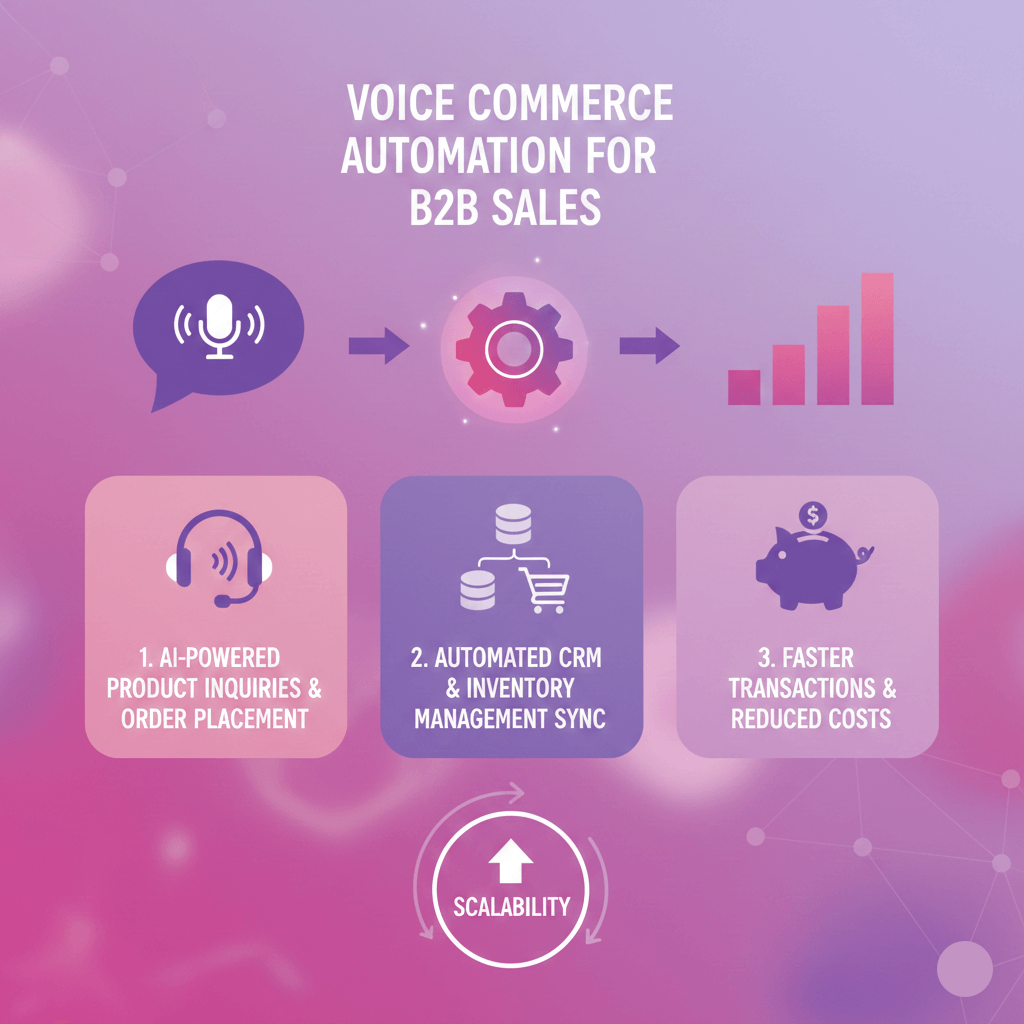
The Death of the Traditional Cold Call and the Rise of Conversational AI
For decades, the B2B sales cycle relied on manual labor. Sales Development Representatives (SDRs) spent their days dialing numbers, leaving voicemails, and filtering through low-quality leads. It was a numbers game that burned through talent and frustrated prospects.
Then came the shift. Buyers started demanding immediate gratification. In 2026, a B2B buyer doesn’t want to wait 24 hours for a “discovery call.” They want answers at 9:00 PM on a Sunday or 6:00 AM on a Tuesday. Conversational commerce AI filled this gap. These systems allow businesses to handle inquiries instantly, regardless of the time zone or office hours.
Voice commerce in B2B is the use of sophisticated AI to manage complex verbal interactions. It goes far beyond simple commands. These systems understand industry jargon, detect intent, and navigate the nuances of a corporate procurement process.
Why 2026 is the Tipping Point for Voice-Activated Sales
Several factors converged to make 2026 the year of the voice revolution. First, the underlying technology reached a level of “human parity” in terms of latency and natural language understanding. When a prospect speaks to a modern AI sales assistant, there is no delay. The conversation flows.
Second, the cost of human labor for repetitive tasks has skyrocketed. Companies can no longer afford to have a $60k-a-year employee spend four hours a day qualifying leads that will never buy. Automated B2B purchasing and inquiry handling allow companies to reallocate their human talent to high-stakes negotiations and relationship building.
Finally, the data proves it works. Statistics from early 2026 show that companies using voice commerce automation for B2B sales see a 40% increase in lead conversion rates. Why? Because the AI never forgets to follow up, never has a “bad day,” and never misses a detail in the CRM.
Redefining the B2B Sales Funnel with Voice AI
To understand the impact, we need to look at how voice AI interacts with the traditional sales funnel.
1. Instant Lead Qualification
When a prospect calls your dedicated sales line, they usually have a specific problem. In the old world, they might hit a voicemail. In 2026, they meet your AI agent. This agent doesn’t just take a message. It asks the tough questions:
- “What is your current monthly volume?”
- “Are you looking for integration with SAP or Oracle?”
- “What is your timeline for implementation?”
By the time a human salesperson sees the lead, it is already “Sales Qualified.” The AI has done the heavy lifting of vetting the prospect.
2. 24/7 Availability: The Always-On Revenue Channel
B2B cycles are global. Your best prospect might be in Singapore while your team in Chicago is asleep. A 24/7 sales channel powered by voice AI ensures you never miss an opportunity. This isn’t a passive contact form; it is an active, engaging participant that can guide a user through your product catalog or service tiers in real-time.
3. Handling Service Requests and Re-Orders
A considerable portion of B2B “sales” is actually recurring business. B2B voice ordering allows long-term clients to call in and say, “I need the same shipment of industrial-grade steel we ordered last month, but double the quantity.” The AI verifies the account, checks the inventory, and processes the order. No human intervention is required, yet the client feels they received personal service.
SalesCloser.ai: The Premier Engine for B2B Voice Commerce
As the market floods with AI tools, one platform has emerged as the clear leader for the B2B sector: SalesCloser.ai.
While many tools focus on simple chatbots, SalesCloser.ai focuses on the “Voice” in Voice Commerce. It is built specifically for the complexities of B2B. It doesn’t just talk; it thinks. SalesCloser.ai offers AI agents that improve sales performance by acting as a full-cycle sales representative.
The Sophisticated AI Agent
SalesCloser.ai provides an AI agent that acts as your most reliable employee. It understands the “why” behind a customer’s question. This agent is capable of conducting deep discovery calls and even performing live screen-share demonstrations. If a prospect asks about pricing, the AI doesn’t just bark a number. It explains the value, mentions the current promotions, and asks if they want to see a live demo.
Turning Voice into a Scalable Revenue Channel
The beauty of SalesCloser.ai lies in its scalability. A human team can only handle as many calls as they have phones and ears. SalesCloser.ai can handle 1,000 calls simultaneously. This allows a small B2B firm to compete with a global conglomerate. You can scale your “sales floor” up or down instantly without hiring a single person or renting more office space.
Seamless Demo Scheduling
One of the most friction-filled parts of B2B sales is the “scheduling dance.” Emails go back and forth for days as we try to find a time. SalesCloser.ai solves this by integrating directly with your team’s calendars. During a voice call, the AI can say, “I see our specialist is free on Thursday at 2:00 PM. Should I lock that in for you?”
Once the prospect agrees, the calendar invite is sent, the CRM is updated, and the human closer is briefed with a full transcript of the conversation.
The Strategic Advantage of AI-Powered Phone Sales
Integrating AI-powered phone sales into your organization provides more than just efficiency. It provides data that was previously impossible to capture.
Deep Analytics
Every conversation is transcribed and analyzed. You can see exactly which objections are most common. Do prospects mention a specific competitor often? Are they confused about your shipping terms? This feedback loop allows marketing and product teams to pivot faster than ever before.
Consistency of Message
Humans have off days. They might forget to mention a new feature or misquote a warranty period. An AI agent is always “on-brand.” It delivers your value proposition perfectly every single time. This consistency builds trust with high-value B2B clients who expect professionalism.
Reduced Overhead
Think about the cost of a traditional call center: the real estate, the hardware, the management, and the high turnover rates. Sales process automation through voice removes these headaches. You pay for performance and technology, not for empty desks or training periods.
Overcoming the “Robot” Stigma: The Human Element of 2026
A common concern in 2024 and 2025 was that B2B buyers would hate talking to “robots.” However, by 2026, the technology will have advanced to the point where the distinction blurs. More importantly, the value provided by the AI outweighs the desire for a human voice.
B2B buyers are busy. They value their time above all else. If an AI can answer their technical questions and book a demo in three minutes, while a human would take twenty minutes of small talk to get to the point, the buyer chooses the AI every time.
The goal of conversational AI in B2B is not to replace humans entirely. It is to remove the “robotic” tasks from humans. This leaves the creative, emotional, and strategic work to your best people.
Implementing Voice Commerce: A Step-by-Step Guide for B2B Leaders
If you are ready to turn your phone line into a revenue-generating machine, follow these steps.
Step 1: Identify Your High-Volume Inquiries
Look at your current call logs. What are people asking? If 60% of your calls are people checking order status or asking for basic spec sheets, those are your first candidates for automation.
Step 2: Define Your Qualification Logic
What makes a “good” lead for your business? Map out the questions your AI needs to ask. You can build complex logic trees. For example, if a caller says their budget is under $5,000, the AI can direct them to your self-service portal. If it’s over $50,000, the AI prioritizes a demo.
Step 3: Integrate with Your Tech Stack
Your voice AI should not live in a vacuum. It must talk to your CRM (like Salesforce or HubSpot), your ERP, and your calendar apps. This ensures that every piece of data captured during a call is immediately actionable.
Step 4: Test and Refine
Start with a small segment of your traffic. Listen to the recordings. Fine-tune the AI’s responses based on how real customers interact with it. The “machine learning” aspect means the system gets smarter with every call.
The Future is Vocal
We are entering an era where the voice is the primary interface for business. Typing into search bars and filling out forms feels “old-school.” In the fast-paced B2B world of 2026, the company that answers the phone first wins.
By using Voice Commerce Automation for B2B Sales, you aren’t just following a trend. You are building a scalable, resilient, and highly profitable sales organization. You are giving your prospects exactly what they want: speed, accuracy, and 24/7 availability.
Platforms like SalesCloser.ai are no longer optional “add-ons.” They are the core infrastructure of modern commerce. Whether you are selling industrial machinery, SaaS platforms, or consulting services, your voice channel is your new front door. Make sure there is someone—or something—intelligent waiting on the other side.
Frequently Asked Questions (FAQs)
What is the difference between a standard IVR and B2B voice commerce automation?
A standard IVR (Interactive Voice Response) uses “press 1 for this” menus and simple keyword recognition. It is often frustrating for users. B2B voice commerce automation uses Natural Language Processing (NLP). It understands complete sentences, context, and intent. It can engage in back-and-forth conversations, answer specific questions, and perform tasks such as scheduling or order processing.
Can AI really handle complex B2B technical questions?
Yes. Modern AI agents can be trained on your specific product manuals, white papers, and technical specifications. They can provide accurate data on tolerances, materials, and compatibility much faster than a human could look it up in a database.
Is it expensive to implement voice commerce for a mid-sized B2B company?
It is often more cost-effective than hiring a single full-time SDR. Because these systems are cloud-based, you don’t need to invest in hardware. You pay for the service, and the ROI is usually realized quickly through increased lead capture and reduced labor costs.
Will our customers be offended that they aren’t talking to a human?
Market research in 2026 shows that B2B buyers prioritize efficiency. As long as the AI is helpful, transparent, and can seamlessly hand off to a human when necessary, buyers appreciate the instant response. Most people prefer a smart AI over a long hold time for a human.
Can the AI handle different accents or languages?
Absolutely. One of the greatest strengths of conversational commerce AI is its ability to support multiple languages and understand various accents perfectly. This is a game-changer for companies with international client bases.