
SaaS companies lose up to 30% of their recurring revenue to preventable churn every single year. You work hard to acquire users, but poor retention strategies drain your pipeline from the bottom. Traditional dunning emails land in spam. Account managers lack the bandwidth to chase down every expiring credit card or minor tier upgrade.
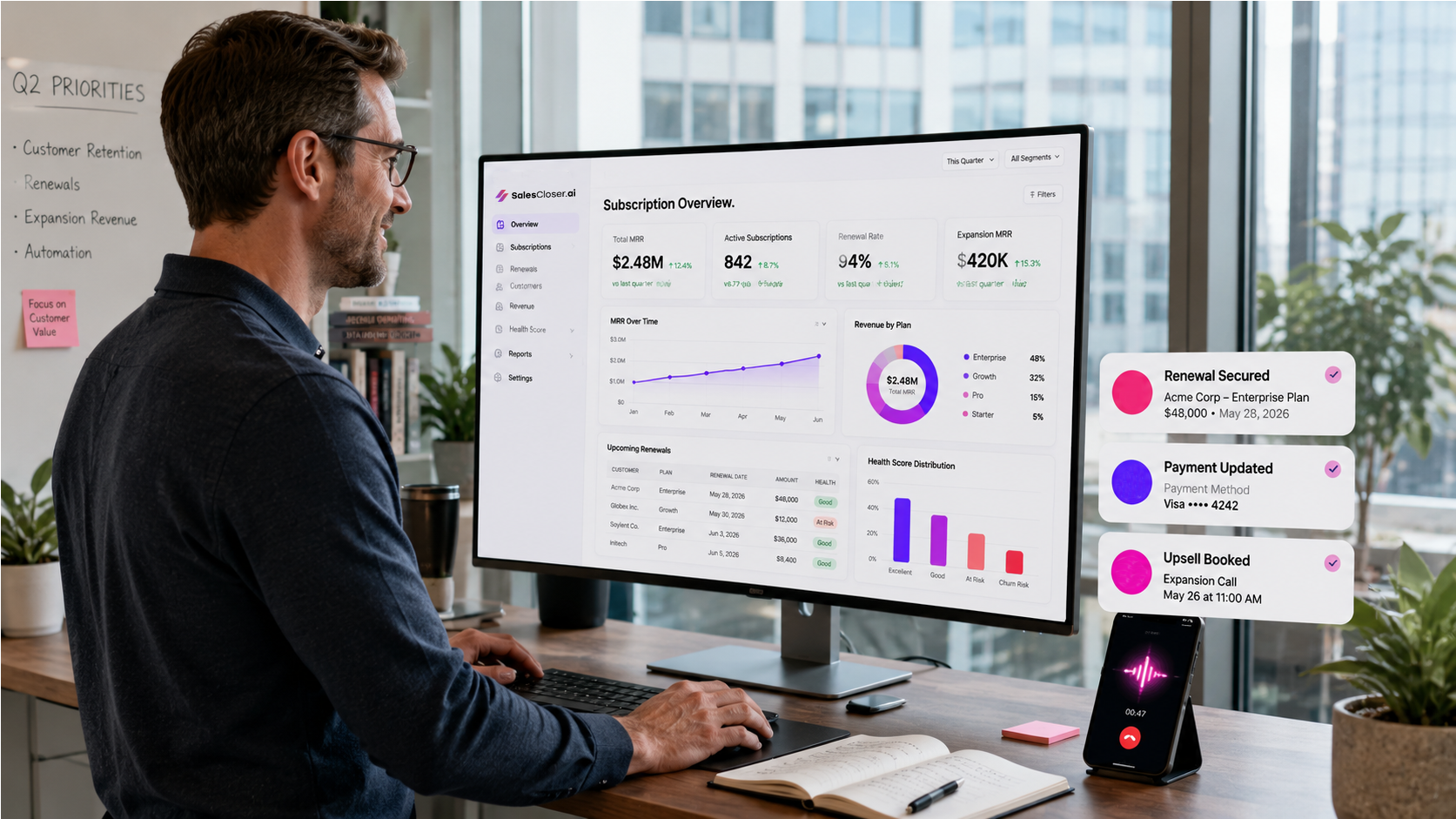
This creates a massive gap in your revenue cycle. You need a system that actively fights churn and secures expansion revenue without requiring a massive human headcount.
This guide details exactly how to fix this revenue leak. We will explain how deploying an AI closing agent for subscription sales transforms your retention strategy. You will learn how to automate renewals, contact customers before their payments fail, and run targeted outbound campaigns to automatically secure high-value upsells.
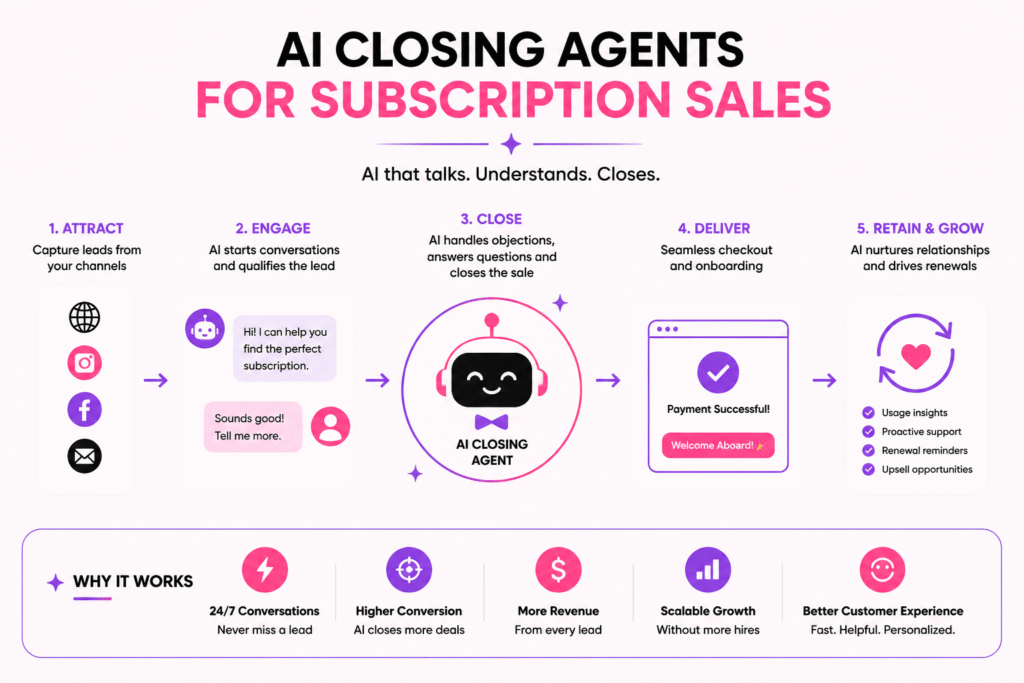
What Is an AI Closing Agent for Subscription Sales?
An AI closing agent for subscription sales is voice-enabled software that autonomously handles customer renewals, payment updates, and upsell conversations. Unlike basic chatbots, an AI closing agent makes outbound phone calls, negotiates terms, processes credit card updates, and books upgrade meetings directly with human account executives.
The subscription model relies heavily on the concept of Net Revenue Retention (NRR). NRR measures the percentage of recurring revenue retained from existing customers over a specific period. It includes upgrades, downgrades, and cancellations. World-class SaaS companies maintain an NRR above 120%.
Achieving this requires aggressive, proactive account management. You cannot rely on passive portals. An AI closing agent acts as a relentless, perfectly consistent digital employee. It monitors your billing system for specific triggers. When a trigger fires, the agent executes a targeted outreach campaign.
This technology handles the conversational heavy lifting. It speaks with a natural, human-like voice. It recognizes intent, handles basic objections, and executes specific software tasks through API integrations. You immediately reduce customer churn because the agent intercepts problems before the customer actually cancels.
Consider the traditional workflow. A customer’s card expires in 15 days. Your billing system sends a generic email. The customer ignores it. The card declines. The account locks. The customer gets frustrated and moves to a competitor.
With an AI agent, the workflow changes completely. Five days before expiration, the AI calls the customer. It politely informs them of the upcoming expiration. It offers to send a secure payment update link directly to their phone via SMS while they are on the call. The payment updates, the account remains active, and the revenue stays secure.
The High Cost of Passive Retention Strategies
Most subscription businesses treat renewals as an afterthought. They focus their entire sales budget on acquiring new logos. This creates a fatal imbalance. Customer Acquisition Cost (CAC) continues to rise across the software industry. If you lose customers quickly, your Lifetime Value (LTV) never surpasses your CAC. You burn cash and fail to scale.
Passive retention relies almost entirely on automated email sequences. The industry calls this the “dunning” process. Dunning attempts to recover revenue after a payment fails. According to data from ProfitWell, involuntary churn makes up 20% to 40% of all SaaS churn.
Involuntary churn happens when a customer intends to pay, but the payment mechanism fails. This occurs due to expired cards, network errors, or bank holds. Passive retention strategies wait for the failure to happen before taking action.
Emails simply do not command attention. Average open rates for billing emails hover around 20%. Click-through rates drop below 3%. Your customers have full inboxes. They route automated billing emails straight to promotional folders or trash bins.
Furthermore, passive strategies fail at expanding revenue. To increase LTV, you must upsell your current base. An automated email offering a 10% discount on an annual plan rarely converts. Upselling requires a conversation. You need to remind the customer of the value they receive, explain the benefits of the higher tier, and close the transaction.
Human account managers perform this well, but they cost money. A human rep cannot profitably call 500 accounts that pay $50 a month just to check in. The unit economics do not support it. Therefore, low-tier customers receive zero personalized attention. They churn quietly.
This is why you need subscription retention automation. You need the personalization and persistence of a phone call combined with the scale and cost-efficiency of software. AI bridges this gap. It allows you to run high-touch retention campaigns on low-dollar accounts profitably.
Conquering Involuntary Churn and Failed Payments
You must stop treating failed payments as an administrative error. A failed payment is a critical revenue risk. Every time a transaction declines, the customer faces a decision. They must actively choose to find their wallet, type in new numbers, and recommit to your product. Many simply decide the hassle outweighs the benefit.
To prevent failed payments, you must shift from reactive dunning to proactive intervention. The most predictable cause of a failed payment is an expired credit card. Your payment gateway knows exactly when every card on file will expire. You possess the data needed to stop this churn before it happens.
An automated renewal process powered by AI changes the game entirely. You connect your AI agent to your billing platform, such as Stripe or Chargebee. You configure a webhook that fires seven days before a card expires.
This trigger prompts the AI agent to initiate an outbound call. The agent uses a custom script tailored to the specific account. It greets the customer by name, references their current plan, and clearly states the purpose of the call.
“Hi Sarah, this is Alex calling from SalesCloser. I’m reaching out because the Visa ending in 4112 on your pro subscription is set to expire next week. I want to make sure your service isn’t interrupted. I can text you a secure link right now to update it. Does that sound good?”
This approach works for three reasons. First, a phone call commands immediate attention. Second, the AI provides a frictionless solution by texting a secure payment link directly to the user’s mobile device. Third, it removes the mental burden from the customer. They do not have to log into a portal, remember a password, or navigate billing menus.
Furthermore, AI handles the nuances of payment failures gracefully. If a card declines due to insufficient funds, the AI can call and gently offer a temporary downgrade or a payment extension. This preserves the customer relationship and keeps the account active while they resolve their financial issue.
You protect your baseline revenue. You stop the bleeding. By automating this specific outreach, companies routinely recover 40% to 60% of revenue that would otherwise vanish into the involuntary churn bucket.
Driving Expansion with Automated Upselling
Securing the renewal only maintains the status quo. To achieve hyper-growth, you must drive expansion revenue. You must sell more to the people who already buy from you. This is the core principle of recurring revenue growth.
Upselling requires perfect timing. You cannot simply blast your entire user base with upgrade offers on the last day of the month. You must identify the users who extract the most value from your platform. We call these “happy customers.”
How do you identify a happy customer? You look at product usage data. You track active logins, feature utilization, and approaching account limits. If a customer pays for a 10-seat license and currently has 9 active users, they are a prime candidate for an upgrade.
Traditional teams struggle here. Tracking these micro-metrics across thousands of accounts requires intense manual effort. Reps miss the window of opportunity. The customer hits the limit, gets frustrated by a paywall, and looks for alternatives.
Automated upselling solves this timing issue. You pipe your product analytics data into your CRM. When a customer hits an 80% utilization threshold, the CRM triggers your AI closing agent.
The AI agent initiates an outbound campaign. It does not aggressively push a sale. Instead, it positions the call as a proactive account review.
The AI introduces the higher-tier plan, explains the specific features that map to the user’s current behavior, and gauges their interest. If the customer expresses a desire to learn more, the AI executes its primary function: it books a meeting.
The AI agent checks your human Account Manager’s calendar in real-time. It proposes a slot, confirms the time with the customer, and sends the calendar invite automatically. Your human rep wakes up to a calendar full of highly qualified, data-backed upsell meetings. They spend their day closing, not prospecting.
This is true customer success automation. You deliver value by anticipating the customer’s needs before they hit friction points within your software.
Deploying SalesCloser.ai as Your AI Account Manager
To execute these strategies, you need purpose-built technology. SalesCloser.ai serves as the ultimate AI account manager. It provides the voice capabilities, the reasoning engine, and the integration architecture required to handle complex subscription sales.
SalesCloser.ai does not just read a script. It listens, understands intent, and formulates intelligent responses in milliseconds. This creates a natural, free-flowing conversation that builds trust. Customers often do not realize they are speaking with an AI.
When you deploy SalesCloser.ai, you gain a massive competitive advantage. You can run targeted outbound campaigns to existing users effortlessly. You load a list of 1,000 mid-tier subscribers into the platform. You define the campaign goal: introduce the new Enterprise feature set and book a demo.
SalesCloser.ai dials the list systematically. It handles voicemail drops, gatekeepers, and wrong numbers automatically. When it connects with the decision-maker, it delivers a flawless pitch.
Here is how SalesCloser.ai specifically handles an upgrade objection:
- Customer: “We like the product, but we don’t have the budget for the Enterprise tier right now.”
- SalesCloser.ai: “I completely understand keeping an eye on the budget. Many of our clients felt the same way initially. However, the Enterprise tier actually consolidates your reporting tools, which often saves money overall. Would you be open to a brief 10-minute walkthrough with our team on Tuesday to see the exact ROI breakdown?”
It handles the objection, pivots back to value, and asks for the micro-commitment (the meeting).
Furthermore, SalesCloser.ai excels at AI for SaaS renewals. For high-ticket annual contracts, the renewal conversation should start 60 days before the contract’s end date. SalesCloser.ai initiates these discovery calls.
It asks the customer about their satisfaction, gathers product feedback, and identifies any churn risks early. If the customer reports an issue, the AI immediately flags the account in your CRM and routes a transcript to a human Customer Success Manager. This hybrid approach ensures you never lose a major account due to a lack of communication.
The platform integrates directly with HubSpot, Salesforce, and major billing providers. It writes detailed call notes into the contact record. It logs the call disposition. It changes deal stages automatically. You maintain perfect data hygiene without requiring your reps to do manual data entry.
Building a Subscription Retention Automation Strategy
Implementing an AI closing agent requires strategic planning. You cannot just flip a switch. You must map your customer journey, define your data triggers, and script your AI accurately.
This section provides a concrete roadmap for deploying AI in your retention workflows. Follow these steps to ensure a high return on investment and a smooth customer experience.
Step 1: Map Your Data Triggers
First, audit your existing billing and CRM platforms. Identify the exact moments a customer becomes a churn risk or an expansion opportunity. Create a formal list of triggers.
Common triggers include:
- Credit card expiration date equals 14 days out.
- Payment gateway returns a “declined” status code.
- Account usage drops by 50% week-over-week (churn risk).
- Account usage hits 90% of the current plan limit (upsell opportunity).
- Annual contract end date equals 60 days out.
Connect these triggers to your marketing automation platform or CRM. Ensure that when a trigger fires, it sends a standardized webhook payload to your AI system.
Step 2: Script the AI Workflows
Next, build the conversational pathways for your AI agent. Do not write stiff, robotic scripts. Write exactly how your best human account manager speaks.
Keep your sentences short. Ask direct questions. Build in pauses so the customer can interrupt. SalesCloser.ai handles interruptions gracefully, stopping its speech when the user talks.
Create specific knowledge bases for the AI. Upload your pricing sheets, feature comparison matrices, and common FAQs. This allows the AI to answer complex product questions dynamically during the call without breaking character.
Step 3: Define the Handoff Protocol
Determine exactly when the AI should transfer control to a human. For low-dollar renewals, the AI should handle the entire transaction end-to-end via SMS links.
For complex Enterprise upsells, the AI should purely function as an SDR. Its only goal is to qualify the interest and book the meeting. Configure the AI to check the specific calendar of the account owner assigned to that record in the CRM.
Step 4: Compare Traditional vs. AI-Driven Retention
To understand the impact, review this comparison of retention strategies.
| Feature | Traditional Account Management | AI Closing Agent (SalesCloser.ai) |
| Outreach Capacity | 40-60 calls per day | Thousands of simultaneous calls |
| Cost to Serve | High (Salary, benefits, commissions) | Low (Software subscription per minute) |
| Response Time | Hours to Days | Milliseconds after the trigger event |
| Dunning Method | Ignored automated emails | Proactive, personalized phone calls |
| Data Accuracy | Relies on manual CRM entry | 100% automated call logging and transcription |
This table clearly shows why relying solely on human reps for volume-based retention fails. The math simply requires automation.
Step 5: Follow Best Practices to Reduce Customer Churn
When building out your automated retention campaigns, adhere to these proven guidelines.
- Call before the card expires: Never wait for the decline.
- Send secure payment links via SMS: Do not read credit card numbers over the phone.
- Track usage, not just time: Base upsells on feature adoption.
- Keep the AI transparent: State clearly that the user is speaking with an AI.
- Always offer a human escalation path: Let angry customers speak to a manager.
- A/B test your opening lines: Measure which greeting yields the lowest hang-up rate.
- Review call transcripts weekly: Use AI insights to improve your product.
By following these rules, you build a system that respects the customer’s time while aggressively protecting your recurring revenue. You turn customer success into a profit center rather than a cost center.
Conclusion
Securing your recurring revenue requires proactive, relentless outreach. Passive email dunning campaigns simply cost you money and mask the true extent of your churn problem. You must engage your customers directly when their cards expire or when their usage dictates an upgrade.
An AI closing agent for subscription sales provides the perfect solution. It delivers the personalization of a human phone call with the scale and speed of enterprise software. You fix failed payments, run continuous upsell campaigns, and drive massive LTV growth without hiring dozens of junior reps.
Stop letting your hard-earned recurring revenue slip away. Take control of your retention metrics today. Book a demo with SalesCloser.ai to build your automated revenue engine.