
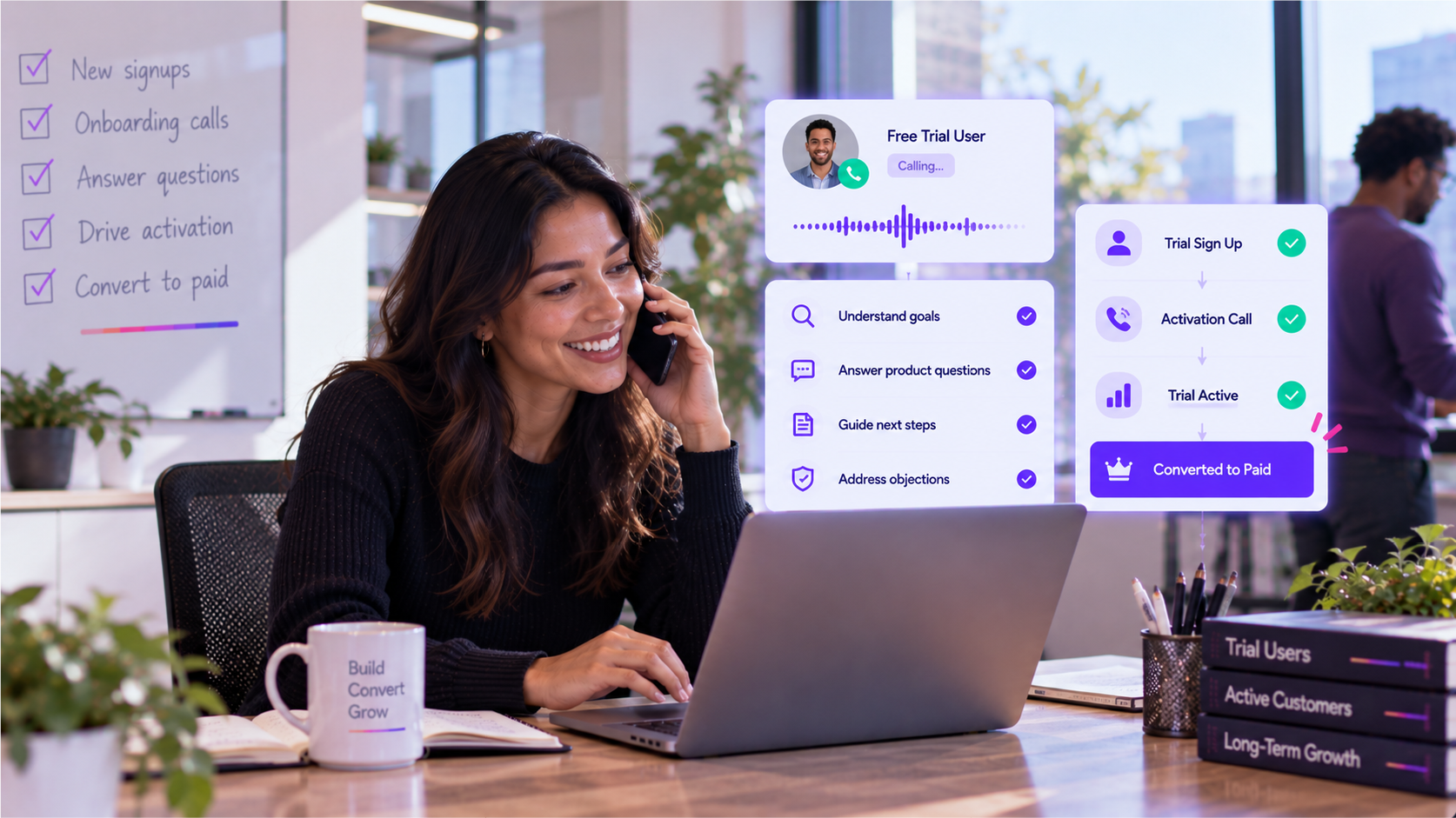
AI conversion calls use voice agents to phone SaaS users while they evaluate your product. Triggered by in-app behavior, such as stalled setup or high-intent page visits, the agent asks qualifying questions, helps users past roadblocks, highlights key features and schedules meetings with human reps for high-intent buyers.
Imagine pouring your entire marketing budget into a leaky bucket. Every day, hundreds of high-intent users sign up for your free trial, only to go dark within the first twenty minutes. They aren’t leaving because your software is broken; they are leaving because they reached a friction point and nobody was there to help them cross it. While you wait for them to open a generic “Day 3” onboarding email, they have already moved on to a competitor.
The “set it and forget it” model of trial management is officially dead. To capture revenue today, you need a proactive product activation strategy that meets users where they are, on the phone and ready to engage. This is where AI for free trial conversion calls changes the game. By automating personalized voice outreach, you can guide users through complex setups in real-time. In this post, we explore how automated engagement turns silent trialers into loyal, paying customers.
The Silent Problem Sinking Your SaaS Product Activation Strategy
Software companies rely heavily on passive communication. You build a great interface, set up an automated welcome email, and hope the user figures it out. This approach fails at scale.
Users sign up for free trials with high intent but low patience. If they cannot achieve their desired outcome within the first session, they close the tab. B2B buyers struggle deeply with information overload and complex purchasing decisions. They need active buyer enablement, not just another generic tutorial video.
Why Email Fails the Activation Test
Email open rates for SaaS onboarding sequences are often low. Click-through rates are even worse. When a user gets stuck configuring an integration or uploading data, an email sitting in their promotions tab offers zero immediate help.
Furthermore, emails lack urgency. A user sees a “Tips for your first day” subject line and archives it instantly. They intend to read it later, but “later” never comes. This lack of urgency destroys your SaaS trial conversion automation efforts before they even begin.
The Power of Proactive Voice
Voice outreach disrupts this passive cycle. A well-timed phone call interrupts the user’s pattern of ignoring software. It forces a moment of engagement.
When a human sales rep calls a trial user 48 hours after signup, conversion rates spike. The rep can ask targeted questions, uncover the user’s specific roadblock, and guide them to the “Aha!” moment. However, paying human Account Executives to call every free-trial signup destroys your Customer Acquisition Cost (CAC) margins.
This creates a massive gap. You need the effectiveness of a voice conversation with the scalability of an email campaign. AI fills this gap perfectly.
What is AI for Free Trial Conversion Calls?
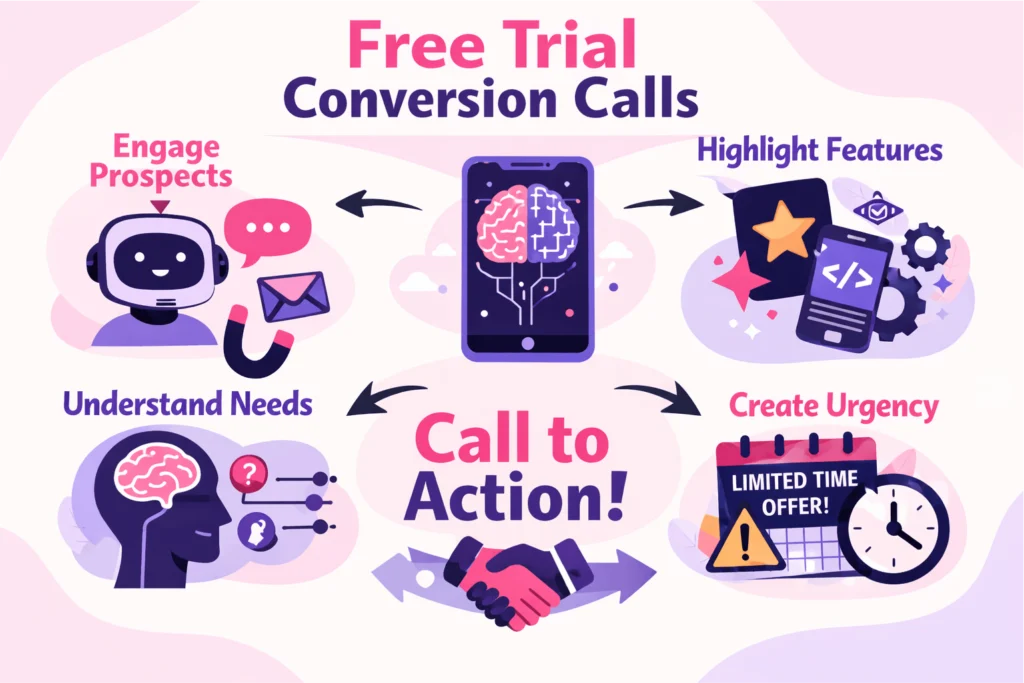
AI for free trial conversion calls involves using autonomous voice agents to contact users during their software trial period. These AI agents ask qualifying questions, help users navigate product roadblocks, highlight key features, and instantly schedule meetings with human sales reps for high-intent buyers.
This technology replaces passive follow-ups with active, two-way conversations. Unlike traditional chatbots that wait for the user to initiate contact, these voice agents engage proactively with the user. They call the user directly based on specific behavioral triggers inside your application.
Human Reps vs. AI Conversion Agents
Understanding the shift requires looking at the limitations of traditional models. Human Sales Development Representatives (SDRs) simply cannot reach every user at the exact right moment.
| Feature | Human SDR | AI Sales Agent |
| Response Time | Hours to Days | Immediate |
| Call Capacity | Limited daily dials | Many calls at the same time |
| Trigger Timing | Relies on manual CRM checks | Instant API webhook triggers |
| Cost per Lead | High (Base salary + commission) | Low (Fractional software cost) |
| Consistency | Varies by rep and mood | Consistent adherence to script guidelines |
Google often pulls tables like the one above for featured snippets because buyers want quick comparisons. The takeaway is clear: automated trial follow-up via voice delivers the scale SaaS companies desperately need without sacrificing the personal touch of a phone call.
5 Key Triggers for Automated Trial Follow-Up
You cannot call a user unthinkingly. Effective user onboarding calls require context. The AI needs to know exactly why it is calling and what the user has (or has not) done inside the product.
Setting up the right triggers ensures your AI for customer success operates with surgical precision. Here are the five most profitable triggers to integrate into your workflow.
1. The 48-Hour Activation Check-In
The first two days of a trial dictate a user’s long-term retention if a user logs in on day one and does not return by day three, their likelihood of converting plummets.
Trigger an automated call exactly 48 hours after signup if the user has not completed your defined “activation event.” In CRM software, this event might be the import of a contact list. For a video editing tool, it might be rendering the first clip.
The AI agent opens with context: “Hi [Name], I noticed you set up an account on Tuesday but haven’t had a chance to import your data yet. I’m calling to see if you hit a technical snag I can help resolve?”
2. The High-Intent “Power User.”
Not all trial users need help; some need to be closed. When a user logs in multiple times a day, invites team members, and maxes out the free-tier limits, they demonstrate strong buying intent.
Waiting for their 14-day trial to expire leaves money on the table. Trigger a call when usage metrics cross a specific threshold.
The AI agent pivots from support to sales: “Hi [Name], I see you and three team members are actively using the project dashboard. Since you’re getting close to the free tier limits, I wanted to see if you’d like to schedule a quick custom demo with an account executive to discuss an enterprise plan?”
3. The “Stuck” User Friction Point
Modern SaaS platforms track click paths and session times. If a user spends ten minutes on your billing integration page without saving their settings, they are stuck. Frustration is building.
Trigger a call immediately after they log out, following a session with high friction indicators. Fast intervention saves the user from churning to a competitor.
The AI acknowledges the specific issue: “Hi [Name], I saw you were reviewing the Stripe integration options a few minutes ago. Setting that up can be tricky the first time. Would you like me to email you our quick-start video, or can I book five minutes with our onboarding specialist for you?”
4. The Pricing Page Prowler
A trial user visiting your pricing page is the digital equivalent of a retail shopper looking at price tags. They are evaluating the cost against the value they have experienced.
Set a webhook to fire when a free-trial user spends more than 30 seconds on the pricing page.
The AI agent strikes while the iron is hot: “Hi [Name], I’m reaching out because I noticed you’re exploring our paid plans. I want to make sure you have all the information you need to calculate ROI. Do you have any specific questions about the features included in the Pro tier?”
5. The 48-Hour Expiration Warning
The final days of a trial require aggressive, proactive user engagement. Emails warning of trial expiration are often overlooked until the user’s account is already locked.
Trigger a final conversion call two days before the trial ends. This call creates urgency and offers a clear path forward.
The AI agent drives action: “Hi [Name], your free access expires in two days. You’ve built two campaigns so far, and I want to make sure you don’t lose that work. Can I help you process an upgrade, or would you like to schedule a call with our team to discuss an extension?”
Structuring User Engagement Automation Workflows
Knowing when to call is only half the battle. You must design the conversation logic. An AI agent cannot sound like a robotic answering machine; it must adapt to the user’s responses in real-time.
Building effective SaaS trial conversion automation requires a deep understanding of multi-turn dialogue. The AI must handle objections, pivot the conversation, and guide the user toward a specific call to action (CTA).
Designing the Call Logic
Every user onboarding call needs a primary objective and a fallback objective.
- Primary Objective: Book a demo with a human Account Executive.
- Fallback Objective: Send a targeted resource link to the user’s email.
You structure the prompt logic by giving the AI specific boundaries and knowledge bases. If the user asks a complex technical question, the AI must know it cannot answer perfectly and immediately pivot to the primary objective.
User: “Does your API support bi-directional syncing with custom Salesforce objects?”
AI Agent: “That’s a great technical question. While we do have a robust Salesforce integration, bi-directional syncing for custom objects requires a quick look at your specific data structure. Let me schedule a brief 10-minute call with our lead sales engineer to confirm that for you. Does tomorrow at 2 PM work?”
Integrating with Your Existing Stack
Your AI for customer success does not operate in a vacuum. It must connect seamlessly to your existing go-to-market tools.
- Product Analytics: Tools like Mixpanel or Amplitude track user behavior and fire the initial webhook.
- CRM: Hubspot or Salesforce receives the webhook and updates the user’s lead status to “Call Triggered.”
- AI Voice Engine: The AI receives the signal, dials the number, and executes the conversation.
- Calendar: If the user agrees to a meeting, the AI checks real-time availability and books the slot.
- Data Write-back: The AI logs the call recording, transcript, and outcome back into the CRM.
This closed-loop system ensures your human sales team never steps on the AI’s toes, and all data remains centralized. You can read more about setting up these exact workflows in our AI SDR Guide.
How SalesCloser AI Acts as Your Trial Conversion Specialist
Implementing this strategy requires purpose-built technology. Generic voice bots fail because they lack sales-specific training. They cannot handle the nuance of a B2B SaaS buyer journey.
This is where SalesCloser AI changes the game. We designed SalesCloser AI specifically as an AI Trial Conversion Specialist. It does not just speak; it sells.
Seamless Human Handoffs
The goal of user engagement automation is not to eliminate human salespeople. The goal is to protect their time. Human reps should speak only to users with high buying intent and a clear understanding of the product’s value.
SalesCloser AI qualifies the user during the automated call. It asks BANT (Budget, Authority, Need, Timing) style questions naturally within the conversation. If the user meets the qualification criteria, the AI agent instantly pulls up your team’s calendar and books the meeting.
Your Account Executives wake up to a calendar full of qualified product demos, rather than a list of 100 cold trial users they need to chase.
Dynamic Context Switching
SaaS buyers are unpredictable. They will interrupt the AI. They will change the subject. They will ask unrelated questions.
SalesCloser AI utilizes advanced natural language processing to handle dynamic context switching. If the AI calls to ask about the Stripe integration, but the user interrupts to complain about pricing, the AI instantly drops the onboarding script and switches to pricing objection handling.
This fluid conversation style makes the user feel heard and respected, drastically reducing the friction typically associated with automated calls.
Measuring the ROI of AI for SaaS Sales
You cannot manage what you do not measure. Implementing AI for free trial conversion calls requires strict adherence to data tracking. If you configure the system correctly, the return on investment (ROI) becomes easy to measure early on.
Do not focus solely on the final revenue number immediately. Focus on the leading indicators that prove the AI is successfully engaging users.
Core Metrics to Track
To truly evaluate your AI for customer success, monitor these specific data points:
- Call Answer Rate: Are users actually picking up the phone? If this is below 15%, you need to adjust the caller ID settings or the time of day the triggers fire.
- Average Conversation Length: A call lasting longer than 45 seconds indicates the AI successfully hooked the user and bypassed the initial hang-up reflex.
- Activation Event Completion: Track the percentage of users who complete their core setup task within 24 hours after speaking to the AI agent. This proves the call drove product adoption.
- Demo Booked Rate: Out of all connected calls, how many resulted in a scheduled meeting with a human rep?
- Trial-to-Paid Conversion Rate: The ultimate metric. Compare the conversion rate of the cohort that received AI calls with that of the cohort that received only traditional emails.
Reducing Customer Acquisition Cost (CAC)
The most significant financial impact of using AI for SaaS sales lies in CAC reduction.
When you convert trial users to paid customers faster, you shorten the sales cycle. When you use AI to handle the initial discovery and qualification, you reduce the headcount required on your SDR team. You extract more revenue from your existing marketing spend because fewer leads leak out of the bottom of the funnel.
By automating the most repetitive, low-converting stage of the pipeline, you improve your unit economics.
Conclusion
Relying on passive emails to convert SaaS trials guarantees high churn. Modern B2B buyers require active guidance, prompt answers, and proactive engagement to reach their “Aha!” moment.
Deploying AI for free-trial conversion calls lets you scale personalized voice outreach to every single signup. By targeting specific behavioral triggers, such as the 48-hour mark or a visit to a pricing page, you interrupt the churn cycle and drive product activation. AI handles the heavy lifting of initial qualification, ensuring your human sales team spends time only on closing high-intent buyers.
Stop watching your marketing dollars vanish into silent trial accounts. Book a demo with SalesCloser AI today and let our AI agents turn your free users into paying customers.