
AI lead follow up means using an AI sales agent to contact leads again after their first touch, by phone, SMS, WhatsApp or chat. The agent answers questions, asks qualifying questions and books interested leads onto your team’s calendar, then saves the lead, a call summary and the answers to your CRM. Your reps take it from there.
Most leads do not say no. They just stop hearing from you. A form comes in on a Friday evening, a rep is on another call, the follow up slips to Monday, and by then the lead has talked to someone else or forgotten why they asked.
AI lead follow up is a way to make sure that gap does not happen. This guide covers what it is, which leads and channels it works for, what the AI agent does, what still needs a person, how to set it up, what to measure and the compliance basics.
What is AI lead follow up?
AI lead follow up means using an AI sales agent to contact a lead again after the first touch, and to keep doing it on a schedule you set until the lead responds, books or asks you to stop.
The difference from older tools is the conversation. An email drip sends the same message to everyone. A dialer connects calls to a rep.
An AI sales agent calls, texts or chats with the lead itself, listens to what they say, answers questions from your own content, asks qualifying questions and takes a next step, such as booking a meeting with your team.
The AI does the repeatable part: reaching out and sorting interested leads from the rest. Your reps spend their time with leads who are ready to talk.
Why do follow-up speed and persistence matter?
Two things decide whether a lead turns into a conversation: how fast you reach them and whether you keep trying.
Speed. A lead is most interested right after they reach out. They remember what they asked about, they still have the problem in mind and they have not yet booked a call with someone else. Every hour of delay gives that attention time to move elsewhere. Our guide to speed to lead goes deeper on why the first response matters.
Persistence. Many leads do not answer the first call or text. That rarely means they are not interested. They were driving, in a meeting or busy with something else. Teams often stop after one or two attempts because reps have newer leads to call, and the older ones quietly go cold.
A rep who is fast on new leads has less time for repeat attempts on older ones. An AI agent can do both within the limits you set.
Can AI agents handle sales follow-ups?
Yes, for the repeatable follow-up conversations that make up most of the work. An AI agent can follow up with:
- New inbound leads. Someone fills in a form or requests a demo. The agent calls or messages them soon after, answers their questions and qualifies them.
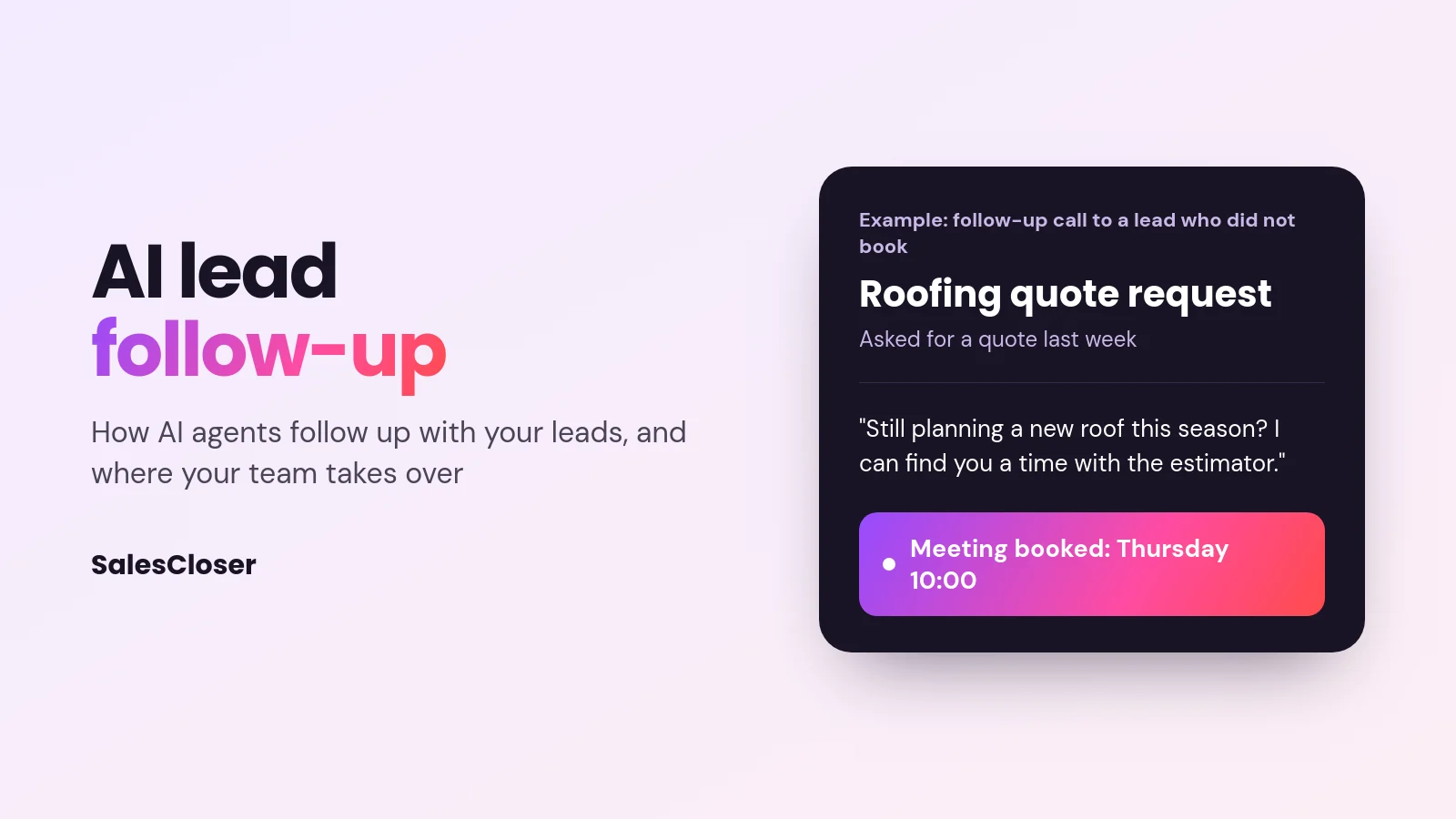
- Leads who did not book. They showed interest but never picked a time. An ongoing campaign can target leads by filters such as appointment scheduled, lead status or call status, so the agent follows up only with the ones who still have no meeting.
- Old and cold leads. Leads in your CRM who went quiet months ago. You can import or upload the list, preview it and have the agent work through it. Our guide to AI agents for outbound sales covers this in more detail.
- Post-demo next steps. After a demo, the agent can check in, answer remaining questions from your knowledge base and book the next meeting with the rep.
On the channel side, follow up can happen by phone call, SMS or WhatsApp, and inbound conversations can also happen by chat in the browser or by video. Each outbound campaign uses one channel, so you pick the one that fits the lead and the situation.
What can an AI agent do on a follow-up call or chat?
A good follow-up conversation has a goal. Here is what the AI agent can do once the lead picks up or replies:
- Answer questions about your product, process and policies, using the knowledge base you give it, such as your website, documents and FAQs.
- Qualify the lead by asking the same questions every time, such as use case, timeline, company size and who else is involved. See AI for instant lead qualification for how to design those questions.
- Book a meeting on your team’s calendar through Calendly or Cal.com while the lead is still on the call or in the chat.
- Retry when nobody answers. You set the number of attempts and the delay between them, choose what happens with voicemail and stop the follow up if the lead replies.
- Log the result to your CRM. The lead, a summary of the conversation and the qualification answers are saved, so the rep starts the next call with context.
The agent works from your rules. If a lead asks something outside the knowledge base or asks for a person, the right move is to hand off, not to guess.
Which follow-up situations should the AI handle, and which need your team?
Most teams split the work by situation. This table shows a typical split:

| Follow-up situation | What the AI does | What your team does |
|---|---|---|
| New inbound lead | Responds soon after the lead arrives, answers questions, qualifies and books a meeting | Takes the booked meeting and runs the sales conversation |
| Lead who did not book | Follows up through an ongoing campaign filtered on appointment status, offers times | Reviews leads who decline or ask for a person |
| Old or cold leads | Works through an uploaded or imported list within your calling hours and retry limits | Decides which segments to contact and what offer to make |
| Post-demo next steps | Checks in, answers common questions, books the next meeting | Handles pricing discussions, proposals and stakeholders |
| Missed appointment | Calls to rebook when your calendar or CRM sends the event through Zapier or the API | Follows up personally on high-value accounts |
| Lead asks for a call later | Books a time on the calendar during the conversation | Owns the relationship from the booked meeting on |
| Complex or sensitive questions | Hands off instead of guessing | Answers, negotiates and makes judgment calls |
For more on cutting missed meetings, see our guide to reducing appointment no-show rates.
What still needs a person?
AI follow up covers the first conversations and the repeat attempts. Some parts of the sale still belong to your people:
- Negotiation and pricing exceptions. Discounts, contract terms and custom deals need someone who can make the call.
- Complex, multi-stakeholder deals. Large accounts with several decision makers need a rep who builds relationships over time.
- Unhappy or sensitive situations. A lead who is upset, confused or raising a complaint should reach a person.
- Deciding the strategy. Your team decides who gets contacted, on which channel, how often and with what message. The agent follows those rules.
The best setups make the handoff clear: the agent books qualified leads onto a rep’s calendar and passes everything else to the team with notes in the CRM.
How do you set up AI lead follow up step by step?

- Pick one follow-up situation. Start with the one that loses the most leads today, such as new demo requests that wait too long or leads who never booked.
- Define the goal and what qualified means. Decide what the conversation should end with, usually a booked meeting, and which answers make a lead qualified.
- Give the agent your knowledge. Add your website, documents and FAQs, plus rules for what it should and should not say. Setup is no-code.
- Connect your calendar and CRM. Link Calendly or Cal.com for booking, and your CRM so the lead, summary and answers are saved.
- Set up the phone number and channel. Outbound calls need a phone number on the agent, either through your own Twilio account or a SalesCloser-managed account. Some countries need regulatory paperwork before a number can be used.
- Set the guardrails. Choose calling hours in the lead’s timezone, the number of retries and the delay between them, rate limits, voicemail behavior and blocked numbers.
- Choose how leads get in. Send leads one at a time through Zapier or the API, upload a list, or run a campaign as a single scheduled batch or as an ongoing campaign with filters.
- Test, then review real conversations. Run test calls, then read the first live conversations and tune the knowledge base and rules before you add volume.
For a wider look at where AI fits in your process, see AI for sales.
What should you measure?
Measure against your own baseline from before the AI started, and look at the same numbers each week:
- Time to first response for new leads.
- Share of leads reached in each campaign, and how many attempts it took.
- Meetings booked from follow-up conversations.
- Meeting quality, judged by your reps: were the booked leads actually qualified?
- Show rate for meetings the agent booked.
- Pipeline created from those meetings, tracked in your CRM.
- Opt-outs and complaints, which tell you if you are contacting too often or the wrong people.
Read conversations as well as numbers. If reps reject meetings, tighten qualification. If answers are off, fix the knowledge base. Our guide to AI-driven CRM integration strategies covers how to keep that data clean.
What compliance basics should you check?
Calling and texting leads comes with rules, and they differ by country and sometimes by state. This is not legal advice, so check your own obligations with someone qualified. The basics most teams look at:
- Consent. Many places require consent before you call or text someone with automated or AI voice technology, especially for marketing. Know how each lead gave you their number and what they agreed to.
- Calling rules. Respect do-not-call lists, permitted calling hours and opt-out requests. In the US, the TCPA and the National Do Not Call Registry are the usual starting points.
- Data protection. If you store recordings and personal data, check rules such as GDPR in Europe on how you collect, keep and use it.
- AI disclosure. Some places require you to say the caller is an AI. Decide your approach before launch.
SalesCloser gives you controls that help: calling hours in the lead’s timezone, blocked numbers that are never called, retry limits and stopping when a lead replies. You remain responsible for consent and for following the rules where you sell.
How SalesCloser fits
SalesCloser’s AI sales agents hold real conversations by voice, video or chat: on the phone, on Zoom or in the browser. For follow up, agents can place outbound calls to any lead with a phone number, whether the lead came from a form, a CRM import, a file upload, Zapier or the API.
Campaigns run on phone, SMS or WhatsApp, with calling hours, retries, voicemail settings and stop-on-reply controls.
On the call, the agent answers from your knowledge base, asks qualifying questions and books qualified prospects onto your calendar through Calendly or Cal.com. SalesCloser connects to HubSpot, Pipedrive, Zoho, GoHighLevel, Zendesk and Intercom, saving the lead, a call summary and the qualification answers. Agents work around the clock in 50+ languages.
Conversations are recorded and transcribed so your team can review them. You control how the agent introduces itself, including whether it says it’s an AI up front, and you can tell it to always answer truthfully when asked. You can book a demo to talk to an agent yourself.
Conclusion
AI lead follow up is about not letting interested leads go quiet. Let an AI agent respond fast, keep trying within the limits you set, qualify and book the leads who are ready, and log everything for your reps.
Keep people on negotiation, complex deals and strategy. Start with one follow-up situation, check your compliance obligations, and measure the results against your own baseline before you expand.