
An AI lead response platform contacts new leads automatically as soon as they submit a form, at any hour. It can reach them by phone, SMS or email, ask qualifying questions, answer common questions and book meetings, then log every interaction in the CRM so the sales team stays informed.
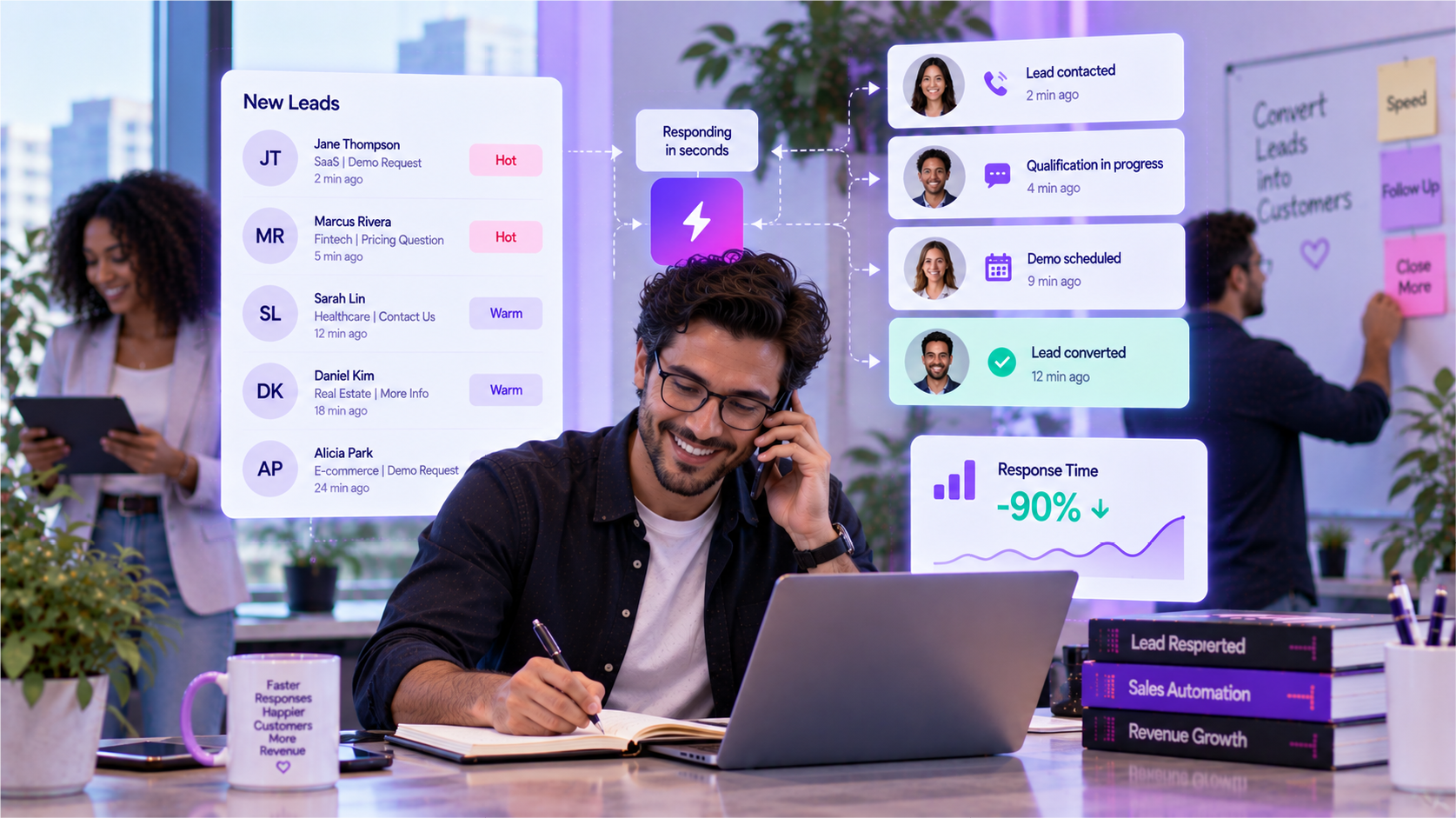
The digital marketplace never sleeps. Right now, a potential customer is browsing your website. They are looking for a solution to a problem that bothers them. They find your “Contact Us” or “Get a Quote” form. They fill it out, hit submit, and wait.
What happens in the next sixty seconds determines whether you win a new client or lose them to a competitor.
In the modern sales landscape, AI-powered lead response platforms have shifted from a “nice-to-have” luxury to a fundamental necessity. If you rely on manual human outreach, you are already behind. This guide explores the science of speed-to-lead and how you can dominate your industry by automating your first impression.
The Brutal Reality of Speed to Lead
We live in an era of instant gratification. When someone submits a lead form, they are in “solution mode.” Their pain point is front and center in their mind. They are ready to talk.
However, that window of interest closes faster than most sales managers realize. Research consistently shows a direct correlation between response time and conversion rates.
The Five-Minute Rule
Studies from Harvard Business Review and other sales researchers have highlighted a hard truth: your chances of qualifying a lead fall quickly with every minute you wait to respond.
After 30 minutes? The lead is effectively cold. They may have moved on to a competitor’s site, gone to a meeting, or simply lost interest in the topic.
Why Every Minute Costs You Money
- The “First Responder” Advantage: Up to 50% of sales go to the vendor that responds first. It is rarely about who has the best product; it is often about who showed up when the buyer was ready.
- The Decay of Intent: High intent is a fleeting emotion. The moment a user leaves your website, their focus shifts to the next task on their to-do list.
- Ad Spend Waste: You spend thousands of dollars on SEO, PPC, and social media ads to get people to your site. If you let those leads sit in an inbox for three hours, you are throwing your marketing ROI into the trash.
What are AI-Powered Lead Response Platforms?
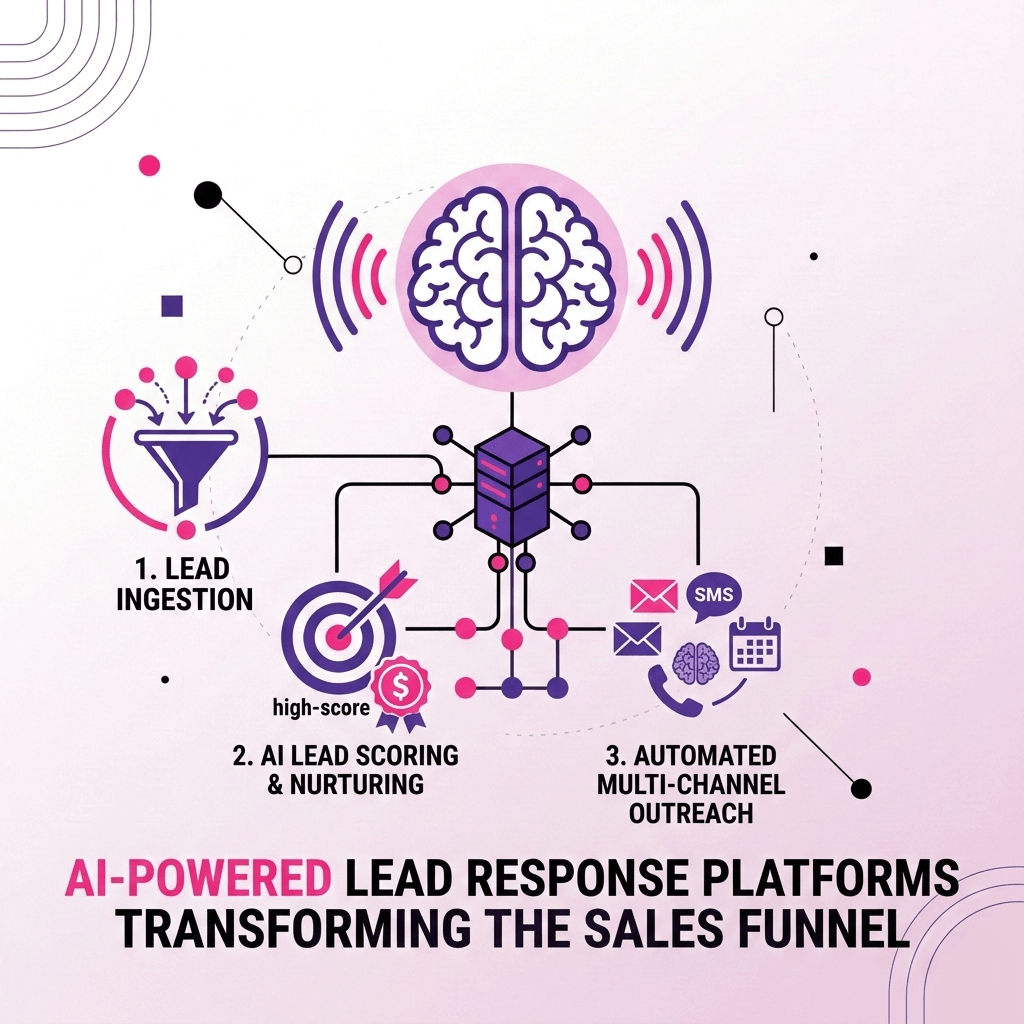
An AI-powered lead response platform is a software solution that uses artificial intelligence to engage with new inbound leads the moment they enter your system. Unlike traditional CRM alerts that simply tell a human to “call this person later,” these platforms take action autonomously.
Core Capabilities
- Instant Multi-Channel Outreach: These tools can trigger SMS, email, and phone calls simultaneously.
- 24/7 Availability: AI doesn’t take lunch breaks, sleep, or take weekends off. It qualifies leads at 2:00 AM on a Sunday just as effectively as at 10:00 AM on a Tuesday.
- Natural Language Processing (NLP): Modern AI can understand the context of a lead’s inquiry and provide relevant, human-like responses.
- Lead Qualification: The AI asks the “discovery” questions, budget, timeline, authority, before passing the lead to your human closers.
What is an automated lead response system?
An automated lead response system is software that contacts every new lead as soon as they come in, without waiting for a rep to be free. AI lead response software goes a step further: it holds a real conversation by phone, chat, SMS or email, asks your qualifying questions, and books a meeting on your calendar when the lead is a fit.
The result is that no inquiry waits in an inbox overnight, and your team only spends time on leads who are ready to talk. See how this works on our inbound lead response page.
Why Manual Follow-Up is Failing Your Business
Many companies still rely on a “Lead Routing” system. A lead comes in, the CRM assigns it to a sales rep, and the rep gets an email notification.
Here is why that system is broken:
- The “Busy Rep” Syndrome: Your best reps are usually on the phone or in meetings. They cannot drop everything to call a new lead immediately.
- Manual Entry Errors: Humans forget to log calls or miss notifications.
- The Weekend Gap: If a lead comes in on Friday evening, a human won’t see it until Monday morning. By then, the lead has already spoken to three other companies.
- Inconsistency: Some reps are fast; others are slow. This creates an unpredictable sales pipeline.
Speed-to-lead automation removes the human element from the initial touchpoint. It ensures every single lead gets the “VIP treatment” instantly.
The Multi-Channel Strategy: Why Email Isn’t Enough
Many businesses think they have “automated lead follow-up” because they send an automated “Thank you for contacting us” email.
An automated email is not a response; it’s a receipt.
Inboxes are cluttered. Most people ignore automated marketing emails. To truly capture a lead’s attention, you need a multi-channel approach:
1. Instant SMS
Text messaging has an open rate of nearly 98%. A quick “Hey [Name], I saw you just requested info. Do you have a second to chat?” feels personal and urgent.
2. Immediate Email
The email should contain the specific information they requested (a PDF, a link, or an answer to a question) to build immediate authority.
3. The Power of the Phone Call
Despite the rise of digital messaging, the phone remains the most effective tool for closing deals. A conversation builds trust faster than a hundred emails. However, humans are often afraid to call. AI isn’t.
SalesCloser AI: The World’s First AI Sales Agent for Peak Performance
While many tools rely on simple chatbots or slow email sequences, SalesCloser AI transforms how businesses handle inbound interest. It focuses on the most direct and effective channel available: the instant, AI-driven phone call.
SalesCloser AI is not just another automated follow-up tool. It is a sophisticated AI Sales Agent that acts as your most reliable, high-performing SDR. By handling initial outreach with human-like precision, you ensure your sales performance never dips due to human delays or missed opportunities.
How SalesCloser AI Transforms Your Sales Pipeline
To understand the power of an AI agent, imagine this workflow in action:
- The Submission: A high-value lead fills out a form on your website.
- The Trigger: They click “Submit,” and the data is sent to SalesCloser AI instantly.
- The Interaction: Within 60 seconds, the lead’s phone rings.
- The Engagement: On the other end is a professional SalesCloser AI agent. It greets them by name, mentions the specific service they just viewed, and begins a natural conversation.
- The Qualification: The AI asks your specific discovery questions to ensure the lead is a fit.
- The Close: If the lead qualifies, the AI checks your team’s live calendar and books a meeting on the spot.
This is the “Golden Minute” of modern sales. While your competitors are still waiting for their email notifications to sync, SalesCloser AI has already finished the discovery call, qualified the prospect, and put a firm meeting on your calendar.
Key Features That Drive Sales Performance
SalesCloser AI outpaces traditional methods by combining speed with high-level intelligence. Here is what makes these AI agents a game-changer for your bottom line:
- Sub-60 Second Response: It engages the lead at the absolute peak of their interest. This immediate contact prevents them from browsing your competitors’ websites.
- Human-Like Interaction: This is not a “press 1 for sales” recording. It is a conversational AI that listens, understands context, and responds naturally. It handles objections and answers questions just like a top-tier sales rep.
- 24/7/365 Coverage: Your sales performance remains high even on holidays, weekends, and at midnight. The AI agent never gets tired and never misses a lead.
- Precision Qualification: It effectively filters out “tire kickers.” This means your human closers only spend time on high-value opportunities that are ready to buy.
- Infinite Scalability: Whether you receive one lead or 10,000 leads simultaneously, the AI handles them all at once. You can scale your marketing campaigns aggressively without ever worrying about lead “overflow” or staff burnout.
- Multi-Language Support: SalesCloser AI can communicate with your leads in their native language, enabling you to expand into global markets without hiring localized teams.
Maximizing Marketing ROI with Automated Lead Follow-Up
Marketing is expensive. Whether you are running Google Ads or LinkedIn campaigns, you are paying a premium for every click.
If your inbound lead conversion rate is low, your Cost Per Acquisition (CPA) skyrockets. You might think your ads aren’t working, but often, the ads are fine, the follow-up is the problem.
Reducing “Lead Leakage”
Lead leakage happens when leads fall through the cracks of your sales process.
- Leads that are never called.
- Leads called once, no answer, and never followed up again.
- Leads that wait too long and lose interest.
An AI-powered lead response platform plugs these holes. It ensures a 100% contact rate. Every lead is engaged. Every lead is tracked. Every lead is allowed to convert.
Improving Lead Quality
Not all leads are created equal. Your human sales reps shouldn’t spend their day calling people who don’t have the budget or the proper use case. SalesCloser AI acts as a filter. It asks the hard questions up front.
When your reps see a meeting on their calendar, they know it’s someone worth talking to. This boosts morale and keeps your top closers focused on closing, not cold calling.
How to Implement an AI Lead Engagement Platform
Transitioning to an AI-driven model is simpler than most businesses realize. You don’t need to scrap your existing CRM or retrain your entire staff.
Step 1: Integration
Connect your lead sources (website forms, Facebook Lead Ads, etc.) to your AI platform. SalesCloser AI integrates seamlessly with most modern tech stacks.
Step 2: Define Your Script and Persona
What do you want the AI to say? How should it sound? You can tailor your AI agent’s “voice” to match your brand. Professional, friendly, aggressive, or consultative, the choice is yours.
Step 3: Set Qualification Criteria
Define what a “good lead” looks like for your business. The AI will use these parameters to decide whether to book a meeting or simply provide information.
Step 4: Let the AI Take the Lead
Once active, the AI takes over the “front end” of your sales funnel. Your human team now focuses solely on the “bottom of the funnel” activities, product demos, negotiations, and closing deals.
The Psychology of the Instant Response
Why does an instant call work so much better than an email? It’s about psychological momentum.
When a person fills out a form, they have just acknowledged a problem. They are actively seeking a solution. This is a moment of high cognitive engagement.
If you call them while they are still on your website, you are part of their current thought process. If you call them two hours later, you are an interruption. You are “the salesperson calling about that thing I did earlier.”
By using sales lead management software like SalesCloser AI, you capitalize on momentum. You aren’t “selling” yet; you are “assisting” at the moment of need.
Comparing Lead Response Strategies
| Strategy | Speed | Effectiveness | Cost-to-Scale |
| Manual Rep Follow-up | Slow (Average 12-24 hours) | Moderate | High (Requires hiring) |
| Basic Email Automation | Instant | Low (Easy to ignore) | Low |
| Standard Chatbots | Instant | Moderate (Text-only) | Low |
| SalesCloser AI (AI Voice) | Instant (< 60s) | Very High (Direct Conversation) | Low (Scale without hiring) |
Future-Proofing Your Sales Process
The technology behind 24/7 lead qualification is only getting better. We are entering a phase in which the distinction between “AI” and “Human” in initial sales interactions is becoming irrelevant to consumers. What consumers care about is getting their questions answered quickly.
Businesses that cling to old-fashioned manual processes will find it increasingly difficult to compete. Their customer acquisition costs will rise as their conversion rates fall.
Conversely, companies that embrace AI-powered lead response platforms will enjoy:
- Lower CPA.
- Higher sales team productivity.
- Better customer experiences.
- Dominant market share.
The Verdict: Convert Leads Faster
If you want to convert leads faster, you must shorten the distance between “Inquiry” and “Interaction.”
Waiting for a human to find the time to make a phone call is a recipe for missed targets. You need a system that is proactive, relentless, and lightning-fast.
SalesCloser AI provides that system. By automating the first 60 seconds of the sales cycle with an AI voice agent, you ensure that no lead ever goes cold. You maximize your marketing spend, empower your sales team, and, most importantly, you close more deals.
Your Next Step to Sales Dominance
Don’t let another high-value lead sit in your inbox until it’s too late. The difference between a “closed-won” and a “lost” deal is often just a matter of seconds.