
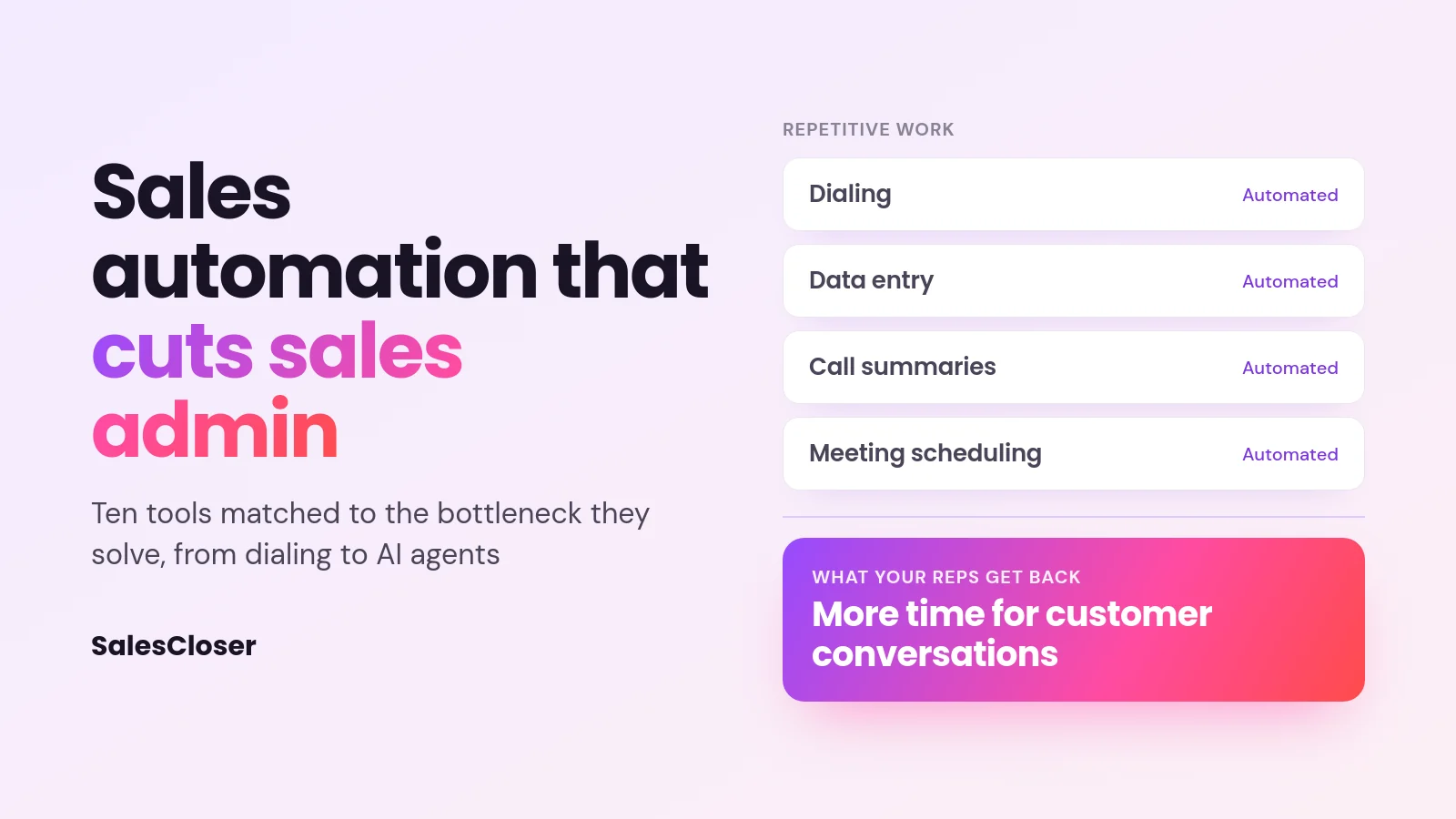
AI sales automation uses software to handle repetitive sales work such as dialing, follow-up sequences, call summaries, CRM updates, meeting scheduling and lead qualification. No single tool covers everything, so teams usually pair a CRM with tools matched to their main bottleneck, giving reps more time for customer conversations.
Finding the right sales automation tools often feels like trying to assemble a 5,000-piece puzzle where the pieces keep changing shape. You aren’t just looking for “the best” software; you are looking for the right gears to fit into a concrete machine: your revenue workflow.
The reality of modern sales is that no single tool does everything. If you try to force a CRM to act like a high-velocity dialer, or an email sequencer to manage complex post-call follow-ups, your team will end up with “tool fatigue.” Instead of helping them sell, the technology becomes a chore they have to manage.
This guide focuses on a use-case-first approach. We won’t give you a list of winners and losers. Instead, we will map out the most common bottlenecks in a sales process and identify which tools excel at solving those specific problems.
1. High-Velocity Outbound Dialing
The Problem: Your SDRs spend 70% of their day listening to ringing tones, navigating phone trees, or hitting voicemails instead of actually talking to prospects.
If your primary bottleneck is the sheer volume of calls required to hit your meeting targets, you need a specialized dialer. These tools aren’t just “phones”, they are execution engines designed to keep reps in a flow state.
Nooks: The Unified Outbound Workspace
Nooks is built for teams that treat calling as a team sport. It is more than a dialer; it is a virtual sales floor.
- Best Use Case: Teams that run concentrated “call blocks” and want real-time coaching alongside their dialing.
- How it helps: It uses AI to filter out dead air, voicemails, and phone trees, only connecting the rep when a human actually picks up. It also includes a “Virtual Salesfloor” where reps can see each other, creating a high-energy environment even for remote teams.
- Complementary Fit: Nooks doesn’t replace your CRM. It sits on top of it, pulling lists from Salesforce or HubSpot and pushing call data back instantly.
Orum: The Parallel Dialing Powerhouse
Orum is famous for its “parallel dialing” feature, which allows a single rep to dial multiple lines simultaneously.
- Best Use Case: High-volume outbound teams where the number of live conversations is the only metric that matters.
- How it helps: It automates the “tedious” parts of the call, the dialing and waiting, and only bridges the rep into the call the moment a prospect says “Hello.”
- Complementary Fit: Works best for teams already using a Sales Engagement Platform (SEP) like Salesloft or Outreach, acting as the “turbocharger” for their existing call tasks.
2. Multi-Channel Prospecting and Sequence Management
The Problem: Your team is excellent at sending emails, but they forget to follow up on LinkedIn or skip their manual call tasks. The “human” element of the outreach is getting lost in a mess of browser tabs.
When the goal is to orchestrate a symphony of touchpoints, email, LinkedIn, and phone, across a specific timeline, you need an engagement platform.
Apollo.io: The All-in-One Data and Outreach Hub
Apollo.io has gained massive traction by combining a gigantic B2B database with an outreach sequencer.
- Best Use Case: Lean sales teams or startups that don’t want to pay for three different subscriptions (a data provider, an email tool, and a LinkedIn automator).
- How it helps: You can find a prospect, verify their email, and add them to a 12-step sequence without ever leaving the platform. The AI assistant can even help draft the messages based on the prospect’s recent news or job changes.
- Complementary Fit: For small teams, Apollo can act as a lightweight CRM. For larger teams, it replaces the need for separate tools like ZoomInfo and Hunter.io.
Salesloft: The Enterprise Revenue Orchestrator
Salesloft focuses on the “Revenue Team”, not just SDRs, but also AEs and Account Managers.
- Best Use Case: Large organizations with complex sales cycles where multiple stakeholders are involved in every deal.
- How it helps: It provides a “Rhythm” workflow that uses AI to tell reps exactly which action to take next based on buyer signals. It prioritizes the hottest leads so reps don’t waste time on cold accounts.
- Complementary Fit: It is designed to live inside Salesforce. It doesn’t replace your CRM; it makes it “actionable” for the people on the front lines.
3. Post-Call Summaries and CRM Hygiene
The Problem: Your reps have great conversations, but the details never make it into the CRM. Follow-up emails take 20 minutes to write, and essential “next steps” are forgotten.
Admin work is the silent killer of sales productivity. These tools focus on capturing the “gold” from a conversation and making sure it is documented and acted upon.
Sybill: The Context-Aware AI Assistant
Sybill doesn’t just transcribe calls; it understands them. It looks at body language on Zoom and hears the tone of voice.
- Best Use Case: AEs who run discovery calls and demos and need highly personalized follow-up emails and perfectly updated CRM fields.
- How it helps: After a call, Sybill automatically generates a summary that includes the “emotional” pulse of the meeting, who was interested, who was skeptical, and what the real pain points were. It then drafts a follow-up email that sounds like the rep actually wrote it.
- Complementary Fit: It plugs into your calendar and meeting platform (Zoom/Teams/Meet). It serves as the bridge between the live conversation and the CRM record.
Gong: The Revenue Intelligence Giant
Gong is the industry standard for recording and analyzing sales conversations at scale.
- Best Use Case: Sales leaders who need to know why deals are winning or losing across the entire organization.
- How it helps: It tracks “trackers”, specific keywords like pricing, competitors, or objections, and shows you how the best reps handle them. It also identifies “deal risks,” such as if a prospect hasn’t replied to an email in over a week.
- Complementary Fit: Gong is a must-have for coaching. While Sybill is excellent for individual reps’ daily follow-up, Gong is for managers who need to see the big picture.
4. Scheduling and Lead Handoff
The Problem: A prospect expresses interest, but by the time a rep tries to schedule a meeting, the lead has gone cold. Or, an SDR books a meeting, but the AE doesn’t show up because the calendar sync failed.
Speed-to-lead is a competitive advantage. If your scheduling process is manual, you are losing money.
Chili Piper: The Inbound Conversion Specialist
Chili Piper is the “concierge” of your website.
- Best Use Case: Marketing-heavy teams that get a lot of “Request a Demo” submissions and need to route them to the correct AE instantly.
- How it helps: Instead of a “Thank you, we’ll call you” page, Chili Piper qualifies the lead in real time and shows them available calendar slots for the right rep, based on territory or account size.
- Complementary Fit: It replaces the back-and-forth of “Are you free at 2 PM?” and ensures a seamless handoff from marketing (the lead form) to sales (the meeting).
Calendly: The Universal Scheduling Tool
Calendly is the simplest way to let people book time with you.
- Best Use Case: Individual reps or small teams who need a reliable, low-cost way to manage their own calendars.
- How it helps: You send a link, they pick a time. It handles the time zones and the calendar invites automatically.
- Complementary Fit: It is a horizontal tool. It works for sales, recruiting, support, and internal meetings. It is less “sales-specific” than Chili Piper but much easier to set up.
5. CRM Data Enrichment and Hygiene
The Problem: Your CRM is full of “ghost” contacts, people who left their companies three years ago. Your reps are wasting time searching for phone numbers instead of actually using them.
Data decays at about 30% per year. Without automation, your CRM becomes a graveyard of useless information.
Clay: The Programmable Prospecting Engine
Clay is for the “power user” who wants to build highly targeted lists that go beyond simple filters.
- Best Use Case: Teams running Account-Based Marketing (ABM) who need to find particular data points (e.g., “Find companies using AWS that just hired a new VP of Engineering”).
- How it helps: It’s a spreadsheet on steroids. It can pull data from 50+ sources (LinkedIn, Google Maps, BuiltWith, etc.) and use AI to scrape websites for specific context. It then pushes this “enriched” data directly into your CRM or outbound tool.
- Complementary Fit: Clay is the “brain” that feeds your “muscles” (like Salesloft or Outreach). It ensures that the inputs are high quality, so the outputs (the emails) are relevant.
LeadIQ: The Frictionless Data Capture
LeadIQ is built for the rep who spends their day on LinkedIn.
- Best Use Case: SDRs who prospect one by one and want to “capture” a person’s contact info with a single click.
- How it helps: It has a browser extension that finds the work email and mobile number of someone’s LinkedIn profile and sends it straight to a sequence or the CRM.
- Complementary Fit: It eliminates the need for CSV exports and manual data entry. It is a “point-and-click” solution for data hygiene.
6. Autonomous AI Agents: The New Frontier
The Problem: Your human team is at capacity. You have more leads than your SDRs can call, or your market is global, and you can’t staff 24/7 coverage in every language.
Traditional automation follows rules; autonomous agents follow goals. This is where the industry is moving in 2026.
SalesCloser AI: The Performance-Driven AI Workforce
SalesCloser AI represents a massive shift from “tools that help reps” to “agents that perform work.” It offers intelligent AI agents explicitly designed to improve sales performance by handling the entire front end of the sales funnel.
- Best Use Case: Companies that need to scale their pipeline coverage without a massive increase in headcount, especially those operating across multiple time zones or languages.
- How it helps:Autonomous Discovery & Demos: Unlike a simple chatbot, SalesCloser AI agents can conduct full, natural-sounding discovery calls and even deliver screen-share presentations in the browser.
- 24/7 Multilingual Support: These agents speak 50+ languages and work around the clock. They ensure that a lead from Tokyo gets the same high-quality discovery experience at 3:00 AM as a lead from New York gets at 10:00 AM.
- Real-Time Performance Improvement: Because the AI learns from every interaction, it continuously refines its pitch. It identifies pain points and adapts its conversation flow to maximize the chance of a conversion.
- No-Code Knowledge Base: You can train your agent on your specific product docs, PDFs, and scripts in minutes, ensuring it stays perfectly “on-brand.”
- Complementary Fit: SalesCloser AI sits at the top of the funnel. It qualifies the lead, handles the initial demo, and then hands off a “warm” prospect to your human AEs. It integrates with your CRM to ensure every detail of the AI-led conversation is logged for the human closer.
Comparison Summary: Which Tool for Which Bottleneck?

| If your bottleneck is… | You should look at… | Because… |
| Low call volume | Nooks, Orum | They automate the dialing process and maximize live talk time. |
| Scale & Coverage | SalesCloser AI | It uses autonomous agents to conduct calls/demos 24/7 in 50+ languages. |
| Messy outreach | Apollo, Salesloft | They centralize multi-channel steps into a single, repeatable workflow. |
| Bad CRM data | Clay, LeadIQ | They automate the research and data entry that reps hate. |
| Slow lead response | Chili Piper | It routes and schedules leads the moment they show interest. |
| Post-call admin | Sybill, Gong | They capture meeting insights and automatically update your CRM. |
The Hidden Costs of Automation: What to Watch For
While automation can be a superpower, it comes with risks. If you automate “bad” processes, you just get bad results faster. Here are three things to keep in mind:

1. The “Spam” Trap
Automating email sequences makes it easy to send 1,000 emails a day. But if those emails are irrelevant, you will destroy your domain reputation. Use tools like Clay or Regie.ai to ensure your automation still feels human and personalized.
2. The Integration Tax
Every tool you add creates a potential data silo. If your dialer doesn’t talk to your CRM, your reps will have to log calls manually, which defeats the purpose of the dialer. Prioritize tools with “native” integrations.
3. The Training Gap
Software doesn’t sell; people do. If you buy a complex tool like Salesforce or Outreach but don’t train your team on how to use it, they will revert to their old habits. Plan for at least 30 days of “enablement” for any new piece of technology.
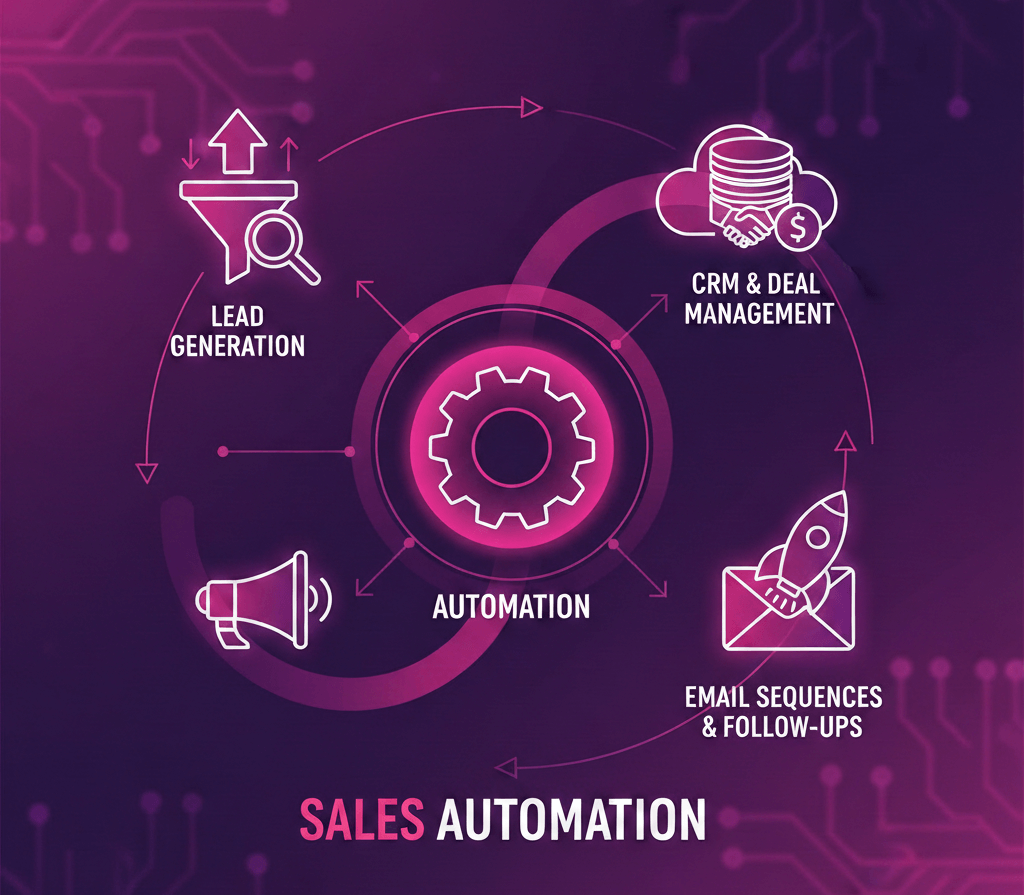
Deep Dive: How to Build Your “Sales Stack”
Building a sales stack is like building a house. You need a foundation (CRM), walls (Engagement), and a roof (Intelligence). Let’s look at how these categories interact.

The Foundation: The CRM
The CRM is your source of truth. Whether it is Salesforce, HubSpot, or Pipedrive, this is where the permanent record lives.
- Salesforce is for the “Power Builder.” If you have complex routing rules and a dedicated RevOps team, Salesforce is the standard.
- HubSpot is for the “Integrated Team.” If you want your marketing and sales data in the same place without a headache, HubSpot is the choice.
- Pipedrive is for the “Visual Seller.” It is simple, effective, and focuses on moving deals through a pipeline.
The Walls: Sales Engagement
Once you have a CRM, you need a way to reach out. This is where Salesloft, Outreach, or Apollo come in. These tools “pull” data from the CRM and generate a daily to-do list for reps.
- Workflow tip: Never let a rep “live” in the CRM. They should live in their Engagement tool. The CRM is the database; the Engagement tool is the cockpit.
The Roof: Intelligence and Analytics
The “roof” protects your deals and helps you see the weather coming. Tools like Gong or Sybill analyze what is happening inside the walls.
- They tell you if a deal is stalling.
- They tell you if a competitor is being mentioned more often.
- They tell you if your reps need more training on specific topics.
The Future of Sales Automation: Agentic Workflows
As we move further into 2026, we are seeing the rise of “Agentic” sales tools. These are tools that don’t just follow “if-this-then-that” rules, but actually “reason” through a task.
For example, an AI agent might:
- See that a prospect has changed jobs.
- Research their new company’s recent quarterly report.
- Draft a personalized email mentioning a specific challenge mentioned in that report.
- Find the best time to send it based on when that prospect usually opens emails.
Tools like Lindy and Artisan (with their AI BDR, Ava) are leading this charge. They move the needle from “automation” (doing the work for you) to “autonomy” (the tool doing the work with you).
How to Choose the Right Tool for Your Team
Before you sign a contract, do these three things:
- Identify the Single Biggest Bottleneck: Don’t try to fix everything at once. Is it a lack of leads? A lack of conversations? Or a lack of follow-up? Pick the tool that solves the one problem that is currently holding back your revenue.
- Audit Your Current Data: No tool can fix insufficient data. If your CRM is a mess, spend a month cleaning it (perhaps using a tool like Clay) before you hook up an expensive outreach sequencer.
- Run a Pilot with Your Best Rep: Don’t roll a tool out to the whole team immediately. Give it to your “tech-savviest” rep for two weeks. If they love it and see results, the rest of the team will follow. If they struggle with it, the rest of the team will hate it.
Sales automation is not about removing the human from the process. It is about removing the “robot” from the human. By automating the repetitive manual tasks that drain your team’s energy, you let them do what they do best: solve problems for your customers and close deals.
Conclusion: The Goal is Human Connection
Sales automation is not about removing the human from the process. It is about removing the “robot” from the human. By automating the repetitive, manual tasks that drain your team’s energy, like dialing, data entry, and initial discovery, you allow them to do what they do best: solve problems and close deals.
Whether you need the high-velocity power of Orum, the deep intelligence of Gong, or the autonomous performance of SalesCloser AI, the key is to choose the tool that fits your current bottleneck.