
AI lead qualification uses an AI agent to hold the first sales conversation with a new lead by chat, phone or video. It asks your qualifying questions, answers follow-ups, and then books a meeting, books a callback or marks the lead for later. Conversations are recorded and transcribed so your team can review them.
Most inbound leads are not ready to buy. Some are researching, some are the wrong size, and some want something you do not sell. When reps screen every lead by hand, the good ones wait in the same queue as the rest.
AI lead qualification moves that first conversation to an AI agent. This guide covers how agents qualify leads by chat, phone and video, the questions they ask, how you set the criteria, and what happens next. It ends with a short sample conversation and the checks to make before you go live.
What is AI lead qualification?
AI lead qualification is the use of an AI agent to hold the screening conversation with a new lead. The agent asks the questions a good rep would ask, listens to the answers, follows up when an answer is vague, and decides the next step from rules you give it.
It is different from lead scoring software, which ranks leads from data such as page visits or company size. A qualifying agent talks to the lead. It can learn things no form captures, like why they are looking now, what they use today, and who else needs to be in the room.
It is also different from the first generation of chatbots. Those bots offered fixed buttons and broke when a buyer typed something unexpected. A conversational agent reads the whole answer. If a lead says “we are a 40-person agency and need something this quarter”, it does not ask for team size again.
How do AI agents qualify leads by chat, phone and video?
The job is the same on every channel: ask, listen, decide, and set up the next step. What changes is how the lead shows up and how much time they have. The table below compares the three channels.
| Channel | How the lead reaches the agent | Where it fits best | What to plan for |
|---|---|---|---|
| Website chat | Types into a chat on your site while browsing | Visitors comparing options on your product pages | Short questions, since people type slower than they talk |
| Phone | Calls your number, or gets a call back after asking for one | Service businesses and leads who prefer to talk | Clear, spoken questions and a plan for when no one answers |
| Video | Joins a web video room or Zoom meeting | Buyers who want to see the product before they book | Have the product video ready for the agent to present |
On the phone, a SalesCloser agent answers your calls, asks your questions and can book the meeting during the same call. If a lead asks to be called later, it books a callback. If no one answers, it tries again, with up to five attempts and a delay you set. See AI phone calls for how calls are set up.
On video, the SalesCloser demo agent works in web video rooms and Zoom. It presents your product video and answers questions live, and the visitor can share their screen. A real-time avatar is available. The demo agent is for video only, not for phone or chat conversations.
What questions does an AI qualifier ask?
It asks the questions you give it. Most teams start from a framework they already use, such as BANT: budget, authority, need and timeline. The skill is in how the questions are asked. “Do you have authority to buy?” sounds blunt. “Who else usually weighs in on a decision like this?” gets the same answer politely.
Good qualifying questions usually cover these areas:
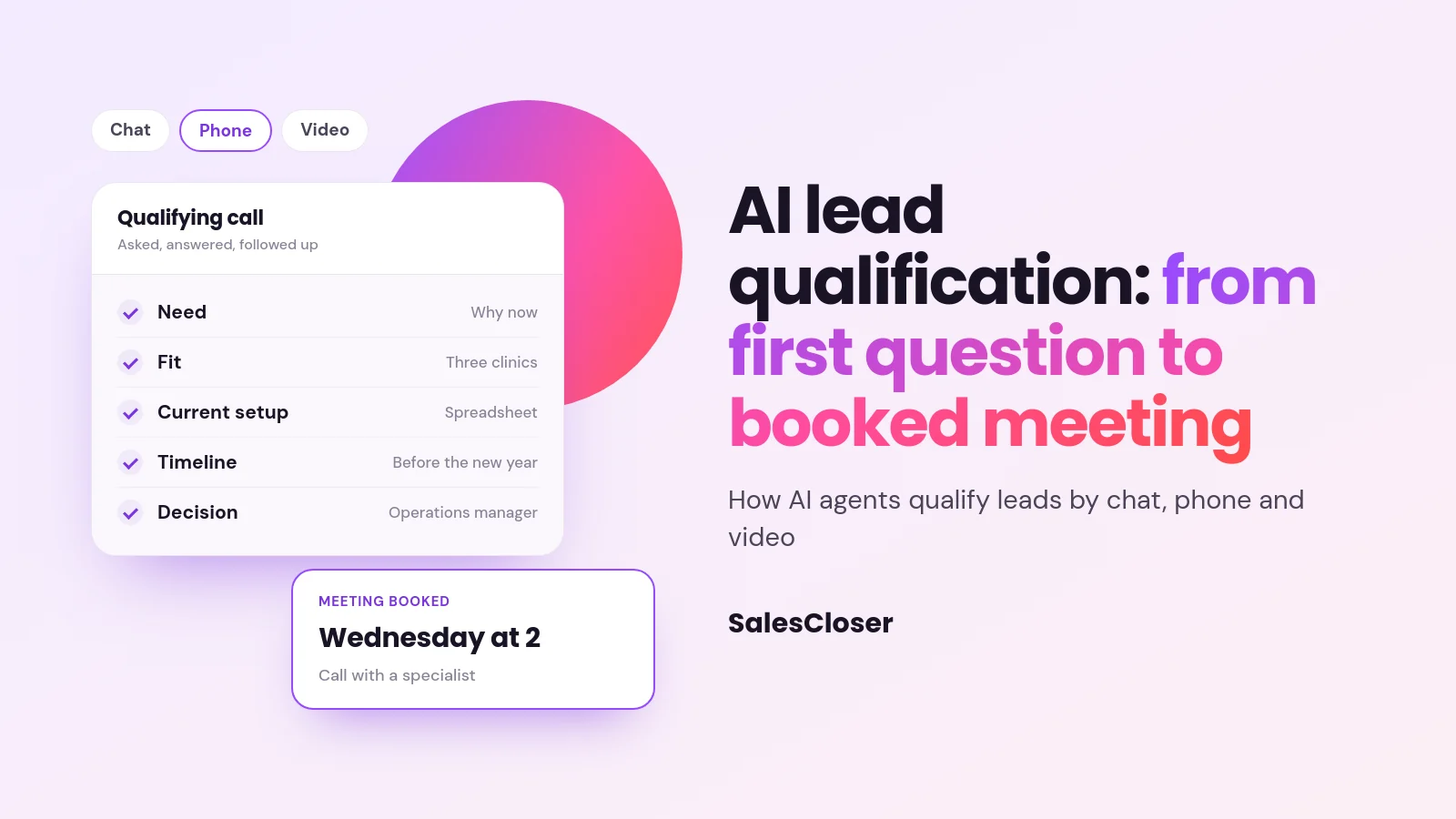
- Need: what prompted them to look now, and what problem they want solved.
- Fit: company size, industry, location or the service they need, whichever decides whether you can help.
- Current setup: what they use today and what is not working.
- Timeline: when they want something in place.
- Decision: who else is involved and how they usually decide.
- Budget: a range, or whether budget is set aside yet, asked once the lead is engaged.
The agent should follow up on answers, not just collect them. If a lead says their problem is “communication”, a good follow-up asks whether they mean inside the team or with clients. That follow-up is often where a weak lead and a strong one separate.
Order matters too. Put the question that rules leads in or out first, so a lead who is clearly not a fit is not asked six more questions. For more on running these screening calls by voice, see our guide to pre-qualifying discovery calls with AI voice agents.
How do you set the qualification criteria?
Criteria are the rules that turn answers into a decision. Write them down before you build anything, in plain words your sales team would agree with. If your reps disagree on what a qualified lead is, the agent will not settle it for you. It will just apply whichever version you wrote down.

A simple way to set them up:
- Pull your last 20 to 30 won deals and list what those buyers had in common, such as size, need and timeline.
- Turn each trait into one question and one rule, for example “fewer than 10 seats: not a fit for sales, point to the self-serve page”.
- Mark which rules are must-haves and which are nice-to-haves, so one missing answer does not disqualify a strong lead.
- Decide the outcome for each case: book a meeting, book a callback, or mark for later.
- Write how the agent should say no politely and where it should send leads who do not fit.
- Test with real past leads, read the transcripts, and adjust the rules where the agent made a call your team would not.
Keep the first version short. Three or four questions that really decide fit work better than a long list that tires the lead. Our AI qualification page shows how questions and rules are set up in SalesCloser.
What happens after a lead is qualified?
Every conversation should end with a clear next step. There are three common outcomes, and you decide which one applies to which lead.

Book. When a lead fits, the agent offers times and books the meeting while the lead is still on the call or in the conversation. SalesCloser books through Calendly or Cal.com, and bookings can be cancelled or rescheduled. Bookings do not rotate between reps automatically, so plan which calendar each agent books into. See calendar booking.
Hand off. The meeting is the handoff. Your rep starts with context instead of a cold call. Conversations are recorded and transcribed so your team can review them before the meeting. SalesCloser connects with HubSpot, Pipedrive, Zoho, GoHighLevel and Salesforce, plus Zapier and webhooks, so leads can reach the tools your team already uses.
Nurture. Some leads fit but are not ready. If they ask to talk later, the agent books a callback and calls back at that time. Leads that do not fit can be pointed to the right resource and left for your marketing team to follow up through your own tools.
One thing to know: SalesCloser does not run multi-step follow-up sequences across calls, texts and emails. It calls back, tries again if no one answers, and books callbacks. Longer nurture belongs in your CRM or marketing platform.
What does an AI qualification conversation sound like?
Here is a short example of an inbound phone call. The company, names and details are made up. The agent’s introduction is whatever you configure, since you decide how it introduces itself.

Agent: Thanks for calling Brightdesk, this is Alex. What made you reach out today?
Lead: We are looking at scheduling software. Our front desk spends half the day on the phone.
Agent: That sounds like a lot of calls. How many locations and front desk staff do you have?
Lead: Three clinics, about eight people on the desk.
Agent: Thanks. What are you using to book appointments today?
Lead: A shared spreadsheet, honestly.
Agent: Got it. When would you like something in place?
Lead: Before the new year if we can.
Agent: And will anyone else be part of the decision?
Lead: Our operations manager, Priya.
Agent: That all fits well with what our team helps with. I can book a call with a specialist so you and Priya can see it. Does Tuesday at 10 or Wednesday at 2 work better?
Lead: Wednesday at 2, but Priya might need to move it.
Agent: You are booked for Wednesday at 2, and it can be moved if her plans change. Anything else I can help with today?
If the lead had said “call me next week instead”, the agent would book a callback for the time they chose. Either way, the call is recorded and transcribed, so the specialist can read it before Wednesday.
What is the best way to move manual SDR qualification to AI?
Start with the part of the SDR job that repeats: the first screening conversation with inbound leads. Your reps keep the work that needs judgement, such as complex deals, negotiation and relationships. The aim is that reps spend their time on leads that already fit, not on finding out which ones do.
A rollout that tends to work:
- Pick one entry point first, such as your main phone line or one high-traffic page, rather than every channel at once.
- Copy your best rep. Use the questions and phrasing your strongest SDR already uses, then turn them into rules.
- Run it alongside your team for a few weeks. Compare the agent’s decisions with what your reps would have decided, using the transcripts.
- Agree the handoff. Decide which calendar each type of lead books into and what reps should read before the meeting.
- Review weekly. Read a sample of conversations, especially ones that ended with “not a fit”, and tune the rules.
The lead qualification use case shows how teams set this up in SalesCloser, from writing the questions to booking the leads that fit.
Can an AI chat qualify leads and book sales meetings on its own?
Yes, if it has two things: clear criteria and access to a calendar. With both, a lead can go from first message to booked meeting in one conversation without a rep stepping in. Without a calendar connection, the agent can only collect details and promise that someone will be in touch.
On its own does not mean unsupervised. Someone on your team should own the rules, read transcripts, and check that the leads being booked are the ones reps want. Treat the agent like a new hire: brief it well, check its work early, and widen what it handles as it proves itself.
What should you check before you go live?
A few decisions are yours to make before any lead talks to the agent:
- How the agent introduces itself. You decide how it introduces itself, including whether it says it is an AI. Choose what fits your brand and the rules where you sell.
- Calling rules. Consent, calling hours and do-not-call rules in your market stay your responsibility. Check them before the agent calls anyone back.
- Calendar routing. Bookings go to the calendar you connect. If several reps share inbound meetings, plan how they split them.
- Where answers go. Connect your CRM or tools first, so qualified leads do not sit in a separate system.
- What “no” sounds like. Write the polite exit and the resource the agent should offer leads who do not fit.
To see an agent qualify a lead and book a meeting on your own use case, book a SalesCloser demo. Bring your qualifying questions and we will walk through how an agent would handle your leads.
Frequently asked questions
What is AI lead qualification?
AI lead qualification uses an AI agent to hold the first screening conversation with a lead. It asks your qualifying questions, follows up on vague answers, and decides the next step from your rules: book a meeting, book a callback, or mark the lead for later.
Can AI voice calls qualify leads?
Yes. On a call, an AI agent can ask your questions, listen to the answers and book the meeting before hanging up. SalesCloser agents answer phone calls, book callbacks when a lead asks, and try again if no one answers.
How does an AI agent know if a lead is qualified?
It follows the criteria you write, such as company size, need, timeline and budget. Clear rules give consistent decisions. Test the rules on past leads and read transcripts early, so you can fix any rule that sends the wrong leads through.
Does AI lead qualification work with my CRM?
SalesCloser connects natively with HubSpot, Pipedrive, Zoho and GoHighLevel, and with Salesforce. Zapier and webhooks cover other tools. Conversations are recorded and transcribed so your team can review them.
Will reps still be needed?
Yes. The agent handles the repeatable first conversation, and your reps run the meetings it books, handle complex questions and build relationships. The goal is that reps spend more of their week with leads who already fit.